Where to Buy Real Green Calcite and Avoid Dyed Fakes
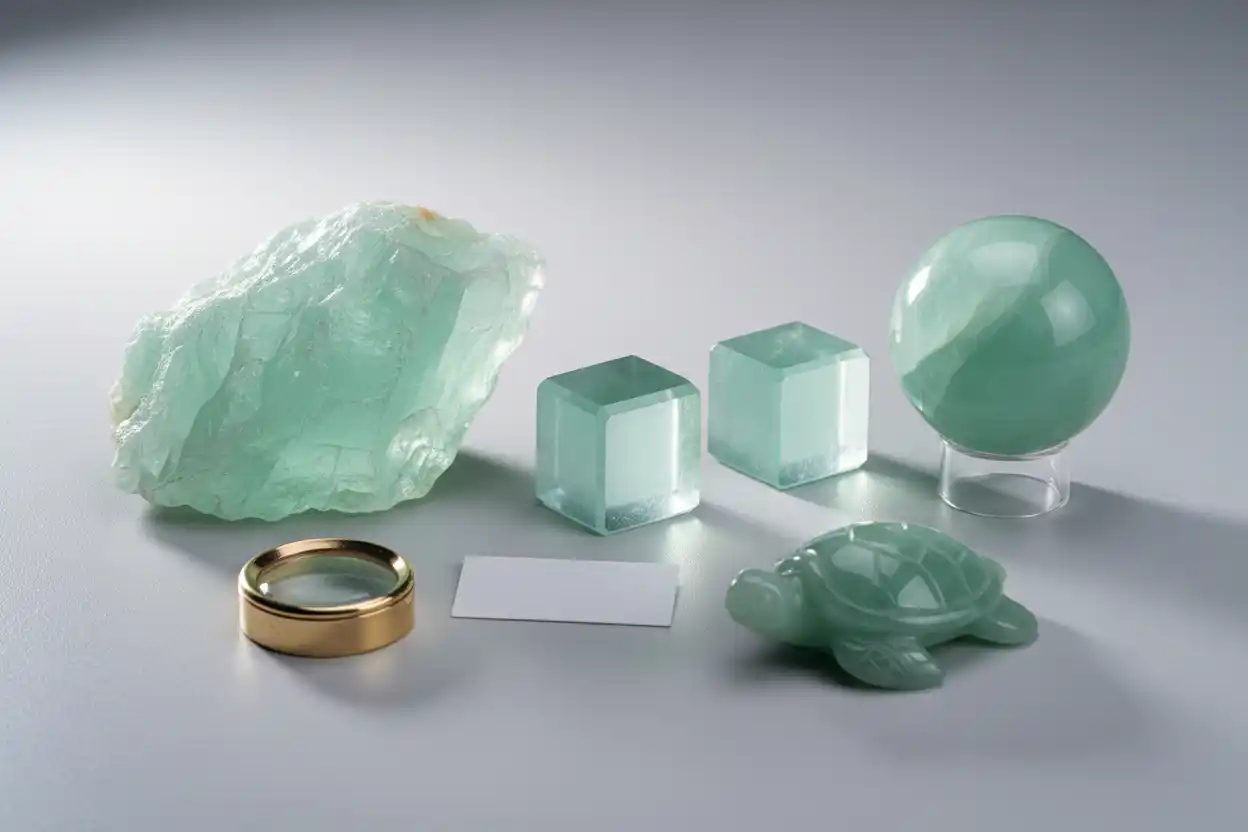
Real Green Calcite is a naturally colored calcium-carbonate mineral that commonly appears mint green, pale yellow-green, gray-green or soft apple green. It may occur as individual crystals, cleavage pieces, massive rough, banded decorative material, spheres, towers and carvings.
The green color can relate to trace impurities or microscopic mineral inclusions, and its exact cause can vary between deposits. Consequently, a seller should avoid presenting one universal coloring element as the explanation for every Green Calcite product.
Calcite is soft, strongly cleavable and sensitive to acids. Those properties make treatment, shipping and care just as important as color. Dyed white Calcite, coated material, green banded carbonate, Fluorite, Serpentine, Prehnite, resin and glass may all enter the market under confusing descriptions.
The Green Calcite meaning and properties guide covers the color variety’s identity and traditional symbolism. This buying guide focuses on sellers, natural color, lookalikes, treatment, product quality and safe ownership.
Understand Green Calcite Before Shopping
Calcite is calcium carbonate, CaCO3, and crystallizes in the trigonal system. It has Mohs hardness 3, perfect rhombohedral cleavage and strong birefringence.
The Calcite family guide covers the mineral’s broader properties. The types of Calcite guide separates color varieties, crystal habits and commercial products.
Green is one of many possible Calcite colors. The Calcite color guide keeps symbolic color associations separate from the practical question of whether a stone is naturally colored.
Clear areas may show double refraction, causing one line or object viewed through the crystal to appear doubled. Massive carvings are usually too cloudy for that effect to be obvious.
Calcite commonly breaks along smooth rhombohedral planes. A carved tower or sphere may therefore contain hidden cleavage cracks even when its polished surface looks sound.
Choose the Product Form First
| Product form | Best source | Main buying concern |
|---|---|---|
| Natural crystal specimen | Specialist mineral dealer | Cleavage, repairs, locality and natural color |
| Cleavage piece | Educational or mineral supplier | Accurate labeling and damage |
| Massive rough | Lapidary supplier | Dye, mixed carbonate composition and fractures |
| Banded decorative material | Stone dealer | Calcite versus aragonite, “onyx” naming and resin |
| Sphere or tower | Experienced carving retailer | Filled cleavage, repaired tips and coating |
| Carving | Skilled stone seller | Soft details, dye, resin and structural cracks |
| Cabochon | Independent lapidary | Backing, filler and limited durability |
| Bead strand | Established supplier | Dyed white stone, glass and drill-hole damage |
| Jewelry | Jeweler familiar with soft carbonates | Protective setting and realistic wear advice |
| Copper-associated specimen | Mineral dealer with provenance | Malachite, Duftite or other green inclusions rather than pure green Calcite |
The completed general Calcite buying guide owns family-wide crystal habits, optical Calcite and all-color identification. This page remains specific to natural green color and green lookalikes.
Where to Buy Genuine Green Calcite
Specialist mineral dealers
Mineral dealers are the best source for naturally crystallized specimens and documented localities.
The listing should include dimensions, weight, crystal habit, locality, condition and associated minerals. Request photographs of terminations, cleavage damage, matrix contacts and the base.
A green Calcite crystal may owe its appearance partly to inclusions or a coating of another natural mineral. A knowledgeable dealer should identify that possibility instead of calling the entire green area pure Calcite without testing.
Lapidary suppliers
Lapidary suppliers are appropriate for massive rough, slabs and carving material.
Request dry photographs. Water and oil deepen green color, temporarily hide scratches and make cleavage seams less obvious.
Ask whether the rough is single-mineral Calcite, Calcite-rich marble, banded Calcite-Aragonite or another mixed carbonate. Those materials can all be natural but cut and polish differently.
Gem and mineral shows
Shows let you compare Green Calcite with Fluorite, Prehnite, Serpentine, Aventurine and jade-like materials.
Examine the piece under neutral light and with a loupe. Look for rhombohedral cleavage, soft bruised edges, dye concentrations and resin-filled cracks.
Do not use vinegar, lemon juice or another acid. The reaction would damage the surface even if it supported a carbonate identification.
Established online sellers
The online gemstone buying guide explains seller identity, protected payment methods and return policies.
For Green Calcite, request photographs against white and neutral gray backgrounds. Warm lighting can make mint material appear yellow, while cool editing can shift it toward blue-green.
Exact-item photography is essential for spheres, towers and specimens because cleavage and color vary substantially.
Independent carvers and jewelry makers
A maker who cut the rough may know whether resin was necessary to hold cleavage fractures together.
Ask to see the loose stone before setting. A white backing can brighten pale green Calcite, while dark adhesive can deepen color.
What Genuine Green Calcite Looks Like
Natural Green Calcite commonly ranges from nearly colorless mint through pale apple green, yellow-green and gray-green. Stronger color may occur in crystals associated with copper-bearing minerals.
The body can be transparent, translucent or opaque. Many commercial carvings are cloudy or banded.
Fresh crystal faces have vitreous luster. Cleavage surfaces can appear pearly or especially reflective.
Natural color may be uneven, with pale zones, white Calcite, brown matrix or included green minerals. Completely uniform color is possible but should be evaluated alongside crystal structure.
Small scratches and bruised edges are common because Calcite is soft. A flawless high-gloss carving may have been coated or extensively polished, although good untreated workmanship is also possible.
Green Calcite Versus Green Fluorite
Green Fluorite is calcium fluoride with Mohs hardness 4 and perfect octahedral cleavage.
Green Calcite has hardness 3 and rhombohedral cleavage. Clear Calcite is strongly birefringent, while Fluorite is singly refractive.
Fluorite commonly forms cubes or octahedral cleavage pieces. Calcite can form rhombohedra, scalenohedra and many other trigonal habits.
The next dedicated guide to buying genuine Green Fluorite will own green Fluorite’s dye, irradiation, coating and glass risks.
Do not scratch either stone. Refractive index, Raman spectroscopy or X-ray diffraction provides safer separation.
Green Calcite Versus Green Aventurine
Green Aventurine is quartz-rich and commonly displays reflective Fuchsite mica plates.
The Green Aventurine guide explains that aventurescent texture. The completed guide to buying real Green Aventurine covers polymer, jade confusion and aventurine glass.
Calcite generally lacks mica sparkle and is far softer. Its cleavage can produce flat internal reflections rather than glitter.
A photograph taken under diffuse light can hide Aventurine sparkle, so request a moving-light video when uncertain.
Green Calcite Versus Prehnite
Prehnite commonly appears pale yellow-green, mint or apple green and may show attractive translucency.
It generally has greater hardness and a different refractive profile. Prehnite may occur in botryoidal aggregates or cabochons containing dark Epidote inclusions.
Green Calcite is more likely to show cleavage, strong birefringence and easy surface scratching.
The planned guide to buying genuine Prehnite will address Epidote inclusions, glass and green-color enhancement separately.
Green Calcite Versus Serpentine
Serpentine can be mint, apple green, yellow-green, olive or dark green.
It commonly has a waxy appearance and can be carved into large decorative objects. Some Serpentine products are sold under jade-related names.
Green Calcite may be similarly soft, so hardness alone is not a good home distinction. Cleavage, optical properties and Raman testing provide stronger evidence.
Green Calcite Versus Jade
Jade refers to Jadeite or Nephrite, both much tougher and more suitable for durable carvings and jewelry than Calcite.
Green banded Calcite is sometimes marketed as “Afghan Jade,” “Pakistan Jade” or another geographic jade name. Those labels do not make it true jade.
Calcite’s visible cleavage, low hardness and acid sensitivity distinguish it from legitimate Jadeite and Nephrite.
A seller should state “green banded Calcite” or “Calcite onyx” rather than relying only on a jade-related trade name.
Green Calcite Versus Banded Onyx
Onyx properly refers to banded chalcedony with relatively straight layers.
Much decorative “green onyx” is actually banded Calcite or Aragonite. The trade usage is established in the architectural-stone market, but mineral and gem sellers should disclose the carbonate composition.
Banded Calcite can be beautiful, translucent and suitable for carvings. It simply requires different care and value expectations from chalcedony Onyx.
Green Calcite Versus Aragonite
Aragonite has the same CaCO3 formula as Calcite but a different crystal structure.
Massive green or banded products may contain Calcite, Aragonite or both. Visual inspection can be insufficient after polishing.
The completed guide to buying genuine Aragonite covers reconstructed clusters, dye and Calcite substitution.
Both minerals react with acids, so an acid test cannot separate them safely. Raman spectroscopy or X-ray diffraction is more appropriate.
Green Calcite Versus Dolomite
Dolomite is a calcium-magnesium carbonate that can resemble pale green or white Calcite.
Dolomite generally has greater hardness and a weaker reaction to cold dilute acid unless powdered. Those field tests are not appropriate for a finished carving.
Mixed Calcite-Dolomite marble can also be dyed green. A seller should identify whether the product is a mineral crystal, marble or mixed carbonate rock.
Green Calcite Versus Malachite
Malachite is a green copper carbonate commonly recognized by rich green color and banding.
Calcite associated with copper deposits may contain green inclusions or coatings, but it does not become Malachite merely because both occur in one specimen.
The completed Malachite buying guide covers band quality and polished material.
A mixed specimen should identify which green mineral is present and whether Calcite forms the host, coating or crystal overgrowth.
Natural Green Color
Green Calcite may owe its color to trace impurities or microscopic included minerals. Copper can contribute green coloration in some material, while other deposits may involve different inclusions or compositional factors.
Therefore, color origin should be investigated specimen by specimen. A generic claim that all Green Calcite is colored by one element is unreliable.
Natural color commonly appears softly distributed or tied to zones, inclusions and growth features. However, some untreated material can be fairly even.
A seller charging a premium for rare natural color should provide locality context or laboratory evidence.
Dyed Calcite
White, colorless or pale Calcite can be dyed green. Dye may concentrate within cleavage cracks, fractures, pores and grain boundaries.
Inspect the back and edges. Chipped areas may expose a lighter underlying material.
A dyed stone remains Calcite, but it should not receive an untreated-color premium. Dye stability may also be limited by light, heat or cleaning chemicals.
GIA has documented dyed Calcite in the gem trade, confirming that artificial color is a realistic concern rather than a theoretical possibility.
Coated and Resin-Filled Material
A clear or colored coating can improve gloss and saturation. Wear around edges may reveal the underlying surface.
Resin can fill cleavage fractures in spheres, towers and carvings. Color-matched resin can make a crack look like a darker green band.
Bubbles, a resinous luster and a different ultraviolet response may support treatment.
The gemstone treatments guide explains coating, filling, impregnation and composite terminology.
Reconstituted Calcite and Marble
Calcite powder or fragments can be combined with resin and molded into decorative objects.
The product may contain genuine calcium carbonate while lacking the structure of a solid natural stone. Bubbles, polymer-rich seams and repeated patterns can reveal composite manufacture.
Green-dyed marble is another possibility. Marble consists largely of recrystallized Calcite or Dolomite, but it is a rock rather than one individual Calcite crystal.
The fake-crystal buyer’s guide provides broader checks for resin, glass and reconstructed products.
Glass Imitations
Green glass can imitate transparent crystals, spheres and carvings. Round bubbles, flow lines, mold seams and conchoidal chips support manufacture.
Glass lacks Calcite’s characteristic rhombohedral cleavage and strong birefringence.
A perfectly clear green object with no cleavage deserves testing, although good natural Calcite can also be highly transparent.
How to Evaluate a Natural Crystal Specimen
Crystal habit
Look for rhombohedral, scalenohedral, tabular or other plausible Calcite forms.
Color distribution
Examine whether green color follows growth zones, inclusions or coatings. Request neutral-light photographs.
Cleavage and condition
Inspect corners and internal planes for fresh breaks. Minor cleavage is common, but extensive damage reduces value.
Luster
Natural faces may be bright and vitreous. Etched, coated or polished surfaces should be identified.
Matrix and inclusions
Associated copper minerals, iron oxides and host rock can add interest. Their identity should not be guessed solely from color.
Repairs
Ask whether a crystal was reattached or a matrix crack was filled. Adhesive can be difficult to see in pale material.
How to Evaluate Rough and Slabs
Request dry photographs of natural and sawn surfaces.
Look for cleavage planes crossing the intended cutting area. A large block can split unexpectedly and produce little usable material.
Determine whether green color continues through the interior. Surface dye or a thin colored layer may disappear during cutting.
Ask whether the rough is Calcite, banded carbonate, marble or a mixed Calcite-Aragonite product.
How to Judge Spheres, Towers and Carvings
A sphere should be shown in complete rotation. Inspect for flat spots, resin-filled cracks and pale reverse areas.
Towers need stable bases and sound tips. A point crossing a cleavage plane may break during shipping.
Carved edges should be rounded rather than extremely thin. Fine details wear quickly in a Mohs 3 mineral.
A thick glossy coating should be disclosed because it affects scratches and cleaning.
Buying Beads and Jewelry
Calcite beads are vulnerable around drill holes. Inspect for radial fractures, dye and resin.
Natural strands should show plausible variation. Identical mint-green color across every bead can indicate dye, glass or heavy sorting.
Pendants and earrings are more realistic than exposed rings or bracelets.
The gemstone hardness chart explains Calcite’s low scratch resistance. The gemstone toughness-versus-hardness guide explains why cleavage adds a separate breakage risk.
A protective bezel can support a cabochon, but household chemicals and impacts remain important concerns.
Locality and Provenance
Calcite occurs worldwide, and green specimens can develop in several geological environments.
Copper-bearing districts can produce green Calcite or Calcite with green mineral inclusions. However, a green appearance cannot establish Tsumeb or another famous locality.
Country- and mine-level claims require labels, invoices or a trustworthy dealer chain.
The ethical crystal sourcing guide provides questions about legal extraction, labor and provenance.
Price and Value
Common massive Green Calcite is generally affordable. Fine crystals, strong natural color, large transparent pieces and documented localities can command more.
Value factors include color, translucency, crystal form, size, condition, cleavage, polish, treatment and provenance.
A large carving with several filled cracks should not automatically cost more than a smaller untreated crystal specimen.
Banded decorative material may be priced primarily for cutting labor and pattern rather than mineral rarity.
Avoid arbitrary “AAA” grades unless the seller defines color, transparency, condition and treatment criteria.
Questions to Ask the Seller
Ask whether the product is a natural Calcite crystal, massive Calcite, marble, banded Calcite-Aragonite or reconstructed carbonate.
Request the seller’s basis for the green-color claim. Then ask about dye, coating, resin, wax, oil, backing and repair.
For crystals, request every termination and the base. For spheres and carvings, obtain a complete rotation. For beads, request drill-hole close-ups.
Ask for locality documentation when origin affects price. Finally, obtain a return policy that does not require destructive testing.
Professional Identification
Raman spectroscopy and X-ray diffraction can confirm Calcite and separate it from Aragonite, Dolomite, Fluorite, Prehnite, Serpentine and glass.
Refractive testing and microscopy can reveal Calcite’s birefringence, cleavage, dye concentration and filler.
Chemical analysis may identify elements or included minerals associated with green color.
Testing a pale area can confirm Calcite without proving that a green surface layer is natural. Color and treatment investigation must target the relevant area.
Cleaning and Storage
The completed Calcite cleansing and charging guide offers non-destructive options for traditional practices.
For physical care, avoid vinegar, lemon juice, acidic cleaners, descalers and abrasive powders. Even weak acids can etch Calcite.
Do not soak fractured, dyed, filled or glued pieces. The planned crystal water-safety guide provides broader exposure guidance.
Steam and ultrasonic cleaning are unsuitable. The planned ultrasonic-cleaner guide explains why vibration and heat can extend cleavage or affect repairs.
Store Green Calcite separately from quartz and harder gems. Support specimens from the base rather than lifting them by exposed crystals.
Frequently Asked Questions
1. Is Green Calcite naturally occurring?
Yes. Calcite can occur naturally in green shades because of trace impurities or included minerals.
2. What causes Calcite to become green?
The cause varies. Copper or microscopic mineral inclusions can contribute, but one explanation does not apply to every deposit.
3. Can Green Calcite be dyed?
Yes. Pale Calcite can be dyed green, with color often concentrating in cleavage cracks and grain boundaries.
4. How is Green Calcite different from Green Fluorite?
Calcite has Mohs hardness 3, rhombohedral cleavage and strong birefringence. Fluorite has hardness 4 and octahedral cleavage.
5. Is Green Calcite the same as Green Aventurine?
No. Green Aventurine is quartz-rich and commonly sparkles because of Fuchsite mica.
6. Is Green Calcite true jade?
No. Jade consists of Jadeite or Nephrite. Jade-related names applied to banded Calcite are trade terms.
7. Is green onyx really Calcite?
Much decorative green onyx is banded Calcite or Aragonite rather than chalcedony Onyx.
8. Can Green Calcite contain resin?
Yes. Cleavage fractures in carvings, spheres and towers may be filled or stabilized.
9. Is Green Calcite suitable for daily-wear rings?
Generally, no. Its low hardness, cleavage and acid sensitivity make exposed daily rings impractical.
10. Should I test Green Calcite with vinegar?
No. Vinegar etches Calcite and permanently damages the surface.
11. Do ordinary Green Calcite pieces need certificates?
Usually not. Testing is more useful for valuable crystals, disputed natural color or uncertain polished products.
12. What is the biggest warning sign in a listing?
Be cautious when a flawless neon-green carving has no cleavage, treatment, composition or back-view information.
Buy the Carbonate the Seller Can Identify Precisely
Green Calcite should be described as more than a color. Its crystal structure, carbonate composition, treatment and physical limitations determine whether the object is a natural specimen, a dyed carving or a mixed decorative stone.
The G crystal directory, G gemstone directory and visual gemstone guide provide broader comparisons. Choose a seller who recognizes Calcite’s softness and cleavage rather than marketing it as jade-like indestructible stone.
Safety note: Calcite dust can irritate the eyes and respiratory system, while acids permanently etch the mineral. Avoid dry cutting or grinding and never use acid as a home identification test. Lapidary work requires wet methods, effective extraction and suitable eye and respiratory protection.