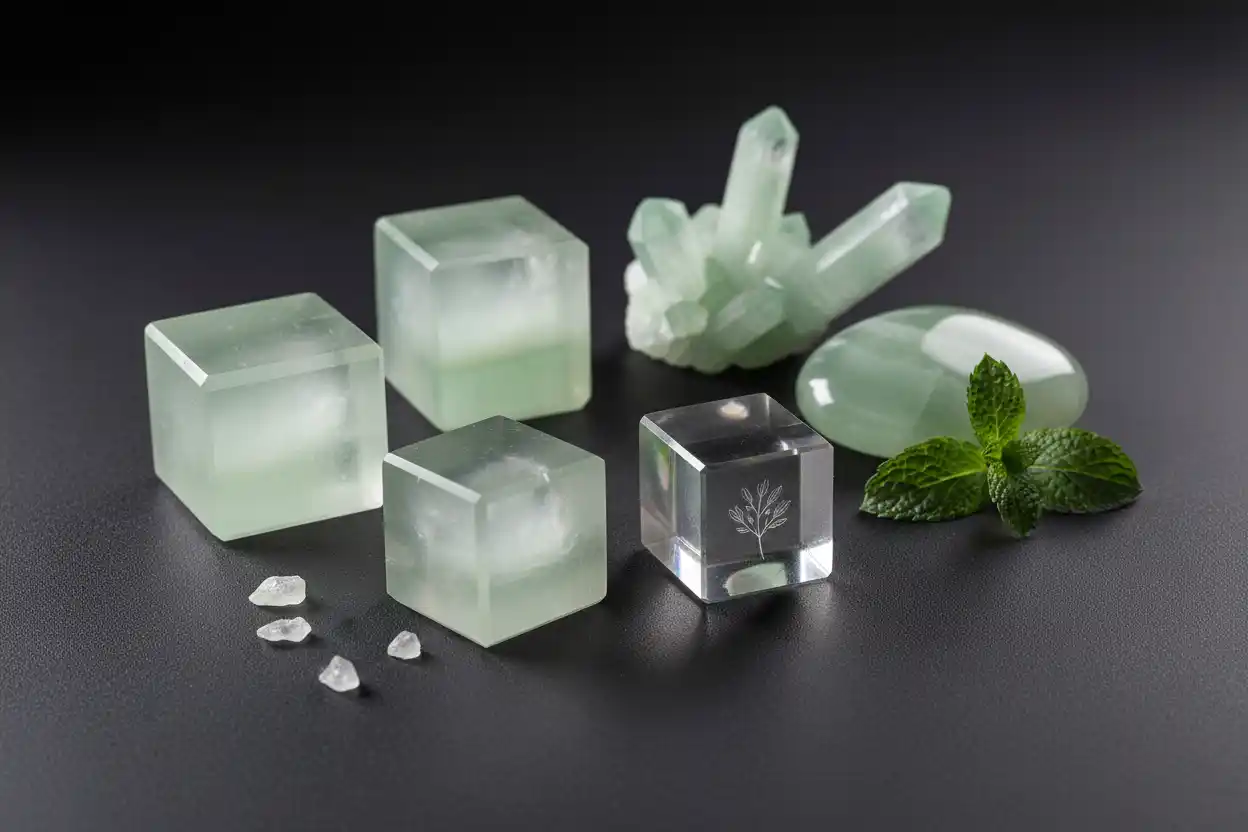
Green Calcite Meaning: Properties, Uses & Symbolism
Green calcite meaning begins with calcite, one of the most widespread carbonate minerals, rather than with a separate mineral species called “green calcite.” Calcite has the chemical formula CaCO₃, belongs to the trigonal crystal system, has a Mohs hardness of 3, a measured density close to 2.71 g/cm³, perfect rhombohedral cleavage, and a white streak. Mineralogical references record calcite in many colors, including green, because impurities, substitutions, inclusions, defects, coatings, and associated minerals can alter the appearance of otherwise colorless calcium carbonate.
The green color is therefore a descriptive feature rather than proof of one fixed chemical variety. Different green calcites can owe their coloration to different causes. An analyzed green calcite from Morocco, for example, was reported with measurable copper, demonstrating that copper can contribute to green coloration in at least some material. Other specimens can acquire green appearances from finely distributed associated minerals or inclusions, so it is unsafe to assign every pale-green specimen to copper, chlorite, nickel, chromium, or another single cause from appearance alone.
That distinction is central to green calcite meaning. Its calcium-carbonate chemistry, softness, cleavage, birefringence, formation environments, and color-causing impurities are mineralogical facts. Its long history as part of limestone, marble, mineral collections, and optical studies belongs to documented human use. Modern associations with renewal, patience, emotional reflection, relationships, or “heart” symbolism are contemporary interpretations rather than laboratory properties.
Readers exploring other material-first references can use the Gemstone Guides. This page defines green calcite, explains its physical identity and naming limits, and separates those facts from modern symbolism without duplicating the specialized buying, microscopy, optical, geological, lapidary, wear, and conservation pages mapped to the Green Calcite cluster.
Green Calcite Meaning at a Glance
| Property or question | Evidence-aware summary |
|---|---|
| Mineral identity | Green-colored calcite |
| Chemical formula | CaCO₃ |
| Mineral status | Calcite is a formal mineral species; “green calcite” is a color description |
| Crystal system | Trigonal |
| Typical green shades | Pale mint, yellow-green, gray-green, medium green, occasionally deeper green |
| Mohs hardness | 3 |
| Specific gravity | About 2.71 |
| Cleavage | Perfect rhombohedral cleavage |
| Tenacity | Brittle |
| Streak | White |
| Transparency | Transparent to translucent, depending on material |
| Optical character | Uniaxial with exceptionally strong birefringence |
| Green color cause | Variable; may involve trace elements or included/associated green minerals |
| Acid response | Calcite reacts readily with dilute acids, but testing damages the surface |
| Common forms | Crystals, cleavage fragments, massive material, polished stones, carvings |
| Modern symbolism | Commonly renewal, patience, emotional reflection, growth, or relationship themes |
| Scientific status of symbolism | Symbolic rather than demonstrated medical or physiological effects |
| Main ownership risk | Softness and perfect cleavage make calcite easy to scratch, chip, or split |
| Safe-use principle | Intact handling differs from grinding, drilling, crushing, acid testing, or other destructive procedures |
Calcite is actually one of the reference minerals defining Mohs hardness 3. Its cleavage and optical properties are far more useful for understanding practical ownership than generic statements that it is a “gentle green crystal.”
What Is Green Calcite?
Green calcite is simply calcite whose visible body color falls somewhere in the green range. The calcite itself remains calcium carbonate. Unlike emerald, green fluorite, or certain formally defined mineral varieties, the phrase green calcite does not require one universally agreed chromophore or composition beyond the underlying calcite identity.
That matters because the retail crystal market often creates the impression that every color prefix represents a separate mineral with distinct chemistry. Green calcite, blue calcite, orange calcite, honey calcite, and pink calcite can all be calcite whose appearances differ because of impurities, inclusions, defects, associated minerals, or geological history. The color adjective is useful for describing what a specimen looks like; it should not be mistaken for a separate species classification.
This page therefore treats green calcite meaning in two layers. First comes what can be measured: CaCO₃ chemistry, hardness 3, rhombohedral cleavage, strong birefringence, density near 2.71, and specimen-specific coloration. Symbolism comes only after that identity is established.
Green Calcite Identity Table
| Characteristic | Green calcite |
|---|---|
| Mineral species | Calcite |
| Formula | CaCO₃ |
| Crystal system | Trigonal |
| Typical color | Pale to medium green, often with gray, yellow, white, or cloudy components |
| Luster | Vitreous, pearly on some cleavage surfaces, sometimes waxy or dull in massive material |
| Transparency | Transparent to translucent |
| Hardness | Mohs 3 |
| Density | Approximately 2.71 g/cm³ |
| Cleavage | Perfect rhombohedral |
| Fracture | Conchoidal can occur, though cleavage commonly dominates breakage |
| Tenacity | Brittle |
| Streak | White |
| Optical behavior | Very strong birefringence / double refraction in sufficiently clear material |
| Common material form | Crystals, cleavage pieces, veins, massive carbonate material, polished objects |
| Color certainty | Green appearance alone does not identify the chromophore |
| Main look-alikes | Fluorite, aventurine, dyed calcite or marble, prehnite, serpentine, glass, other pale-green carbonates |
| Best identity approach | Combine cleavage, optical behavior, density, microscopy, spectroscopy, and other appropriate tests |
The identity table helps establish what observations are meaningful. Color is noticeable, but hardness, cleavage, double refraction, and carbonate chemistry are more characteristic of calcite.
Why Is Green Calcite Green?
There is no one universal answer. Calcite is capable of incorporating trace elements and of enclosing microscopic or macroscopic minerals during growth. Green color can therefore arise through more than one mechanism depending on the deposit and specimen.
A published USGS mineralogical summary records a Moroccan green calcite containing approximately 0.48% copper, providing direct evidence that copper can be associated with green color in some calcite. Other green calcite occurrences can contain fine green mineral inclusions, coatings, or associated phases that influence what the eye sees. Mineral collectors have documented cases where green coloration is clearly inclusion-related rather than produced by a dissolved trace element alone.
The correct wording for an untested specimen is therefore cautious: “green calcite,” followed by a more specific color-cause attribution only when chemistry, microscopy, spectroscopy, diffraction, geological context, or another suitable method supports it.
A seller photograph is not enough to declare that a particular piece is “copper calcite,” “chlorite calcite,” “nickel calcite,” or “chromium calcite.”
Green Calcite Is Not One Uniform Variety
Two pieces can both be legitimately described as green calcite while having different shades, transparency, textures, and geological causes of color. One may be pale mint and translucent; another may be dark gray-green with obvious mineral inclusions. A third may be a massive carbonate rock in which calcite occurs alongside other minerals that modify its overall appearance.
This variability is not a defect in the name. “Green calcite” simply answers the descriptive question: what mineral is dominant, and what color does it appear?
Problems arise only when the descriptive phrase is given more scientific precision than it possesses.
How Green Calcite Forms
Calcite forms in an exceptionally broad range of geological environments. It is a major component of limestone and marble, can precipitate from groundwater and hydrothermal fluids, occurs in veins and cavities, develops in sedimentary systems, and recrystallizes during metamorphism. It also appears in caves as stalactites, stalagmites, flowstone, and other carbonate deposits.
Green calcite requires an additional ingredient: some process must introduce the trace chemistry, inclusions, or associated minerals responsible for the green appearance. That may happen during the original calcite growth, during later fluid movement, or through alteration and mineral replacement.
Because geological pathways differ between deposits, a general green calcite meaning page should not pretend that every commercial piece formed through one identical mechanism.
The mapped Green Calcite Formation and Deposit Geology guide owns the detailed treatment of carbonate environments, host rocks, fluid chemistry, metamorphism, vein formation, and locality-specific paragenesis.
Calcite’s Extraordinary Double Refraction
Calcite has one of the most visually dramatic birefringence effects among common transparent minerals. Light entering clear calcite can split into ordinary and extraordinary rays, producing two visible images when a transparent cleavage rhomb is placed over printed text or another high-contrast object.
GIA has described unusually large faceted calcite in which calcite’s high birefringence creates multiple displaced images of pavilion facets. The optical effect is real physics arising from anisotropic crystal structure, not a metaphysical “energy doubling” property.
Clear green calcite may exhibit the same fundamental calcite behavior if transparency is sufficient, although cloudy massive material can obscure it.
The deeper discussion of refractive indices, birefringence, transmitted color, fluorescence, and light behavior belongs in the Green Calcite Optical Properties and Color Behavior guide.
Why Double Refraction Is Not Spiritual Evidence
The dramatic doubling produced by calcite can understandably attract symbolic interpretation. Someone might associate it with seeing two perspectives, reconsidering assumptions, or recognizing that one situation can have more than one interpretation.
That is a metaphor inspired by a real optical property.
It does not mean calcite doubles “life force,” duplicates intentions, amplifies healing energy, or changes brain function. The physical explanation is birefringence: different polarized components of light travel differently through the anisotropic crystal.
Material facts can inspire symbolism without becoming evidence for it.
Calcite’s Perfect Cleavage
Calcite has perfect rhombohedral cleavage. When mechanical stress follows its preferred structural planes, the mineral can split along smooth inclined surfaces instead of breaking randomly.
This is one of the most important practical properties of green calcite because it explains why an apparently substantial polished piece can chip or separate after an impact. Mohs hardness 3 already makes its surface vulnerable to scratches, but cleavage creates an additional structural weakness.
A polished green calcite sphere should therefore not be treated like quartz merely because both are sold as decorative stones. Quartz is harder and lacks calcite’s perfect rhombohedral cleavage.
The deeper implications for mounting and real-world wear belong in the Green Calcite Setting and Wear Engineering guide.
Calcite Reacts With Acid
Calcite is famous for reacting readily with dilute acid because calcium carbonate releases carbon dioxide during the reaction. That behavior is useful in geological identification but should not be turned into a casual home authenticity test on a finished gemstone or collector specimen.
Acid testing physically alters the calcite surface. On a polished stone it can leave dull, etched, or damaged areas. Even weak household acids may affect finish over time.
If a specimen is valuable, polished, historic, or aesthetically important, identification should prioritize non-destructive observation and appropriate professional testing.
Microscopic Features
Green calcite can contain fluid inclusions, solid mineral inclusions, fractures, cleavage-related features, growth zones, coatings, and associated minerals. Those internal structures may help reveal how the crystal formed and why it appears green.
The exact inclusion population varies by locality. A needle-like green inclusion in one specimen cannot be assumed to be the same mineral as a green inclusion in another specimen from a completely different geological environment.
The mapped Green Calcite Microscope Inclusion Notebook owns the detailed microscopy, inclusion documentation, and specimen-scale analysis.
On this page, the important boundary is straightforward: visible inclusions can support an interpretation, but they need identification before their mineral species is stated confidently.
Diagnostic Traits of Green Calcite
Color alone is weak evidence. More useful calcite clues include very low hardness, perfect rhombohedral cleavage, relatively high birefringence, carbonate reaction with acids, white streak, density near 2.71, and compatible crystal morphology.
Mindat lists calcite at hardness 3 with perfect cleavage and measured density near 2.71 g/cm³. Clear material can display pronounced double refraction, making optical examination particularly informative.
A reliable identification does not require intentionally damaging the specimen. Hardness and acid reaction are useful mineralogical properties, but scratching and acid etching are poor choices for finished collectible material when non-destructive alternatives exist.
Green Calcite Versus Green Fluorite
Green Fluorite Meaning concerns calcium fluoride, CaF₂, rather than calcium carbonate. Fluorite is typically Mohs 4, belongs to the cubic crystal system, and has perfect octahedral cleavage. Calcite is Mohs 3, trigonal, and has rhombohedral cleavage.
The two materials can both be pale green and translucent, making polished pieces superficially similar in photographs.
Their structures and diagnostic properties are nevertheless fundamentally different. A green color plus translucency does not establish identity.
Green Calcite Versus Grape Agate
Grape Agate Meaning covers grape-like aggregates of quartz, typically with amethystine or other silica coloration. Quartz is approximately Mohs 7 and far more scratch resistant than calcite.
A pale green grape-agate specimen can therefore occupy a similar color family while behaving very differently under physical testing.
Grape-like quartz morphology is also unlike the rhombohedral cleavage and carbonate behavior characteristic of calcite.
Green Calcite Versus Green Onyx
Green Onyx Meaning involves a trade-name problem of its own. Depending on commercial usage, “green onyx” may refer to chalcedony, dyed material, banded calcite sometimes called onyx marble, or another green ornamental stone.
That ambiguity makes mineral identification more important than the retail label. A seller calling something “green onyx calcite” may be describing banded ornamental calcite rather than silica onyx.
Green calcite itself should therefore be described by its actual carbonate identity rather than by whatever decorative comparison accompanies the sales name.
Green Calcite Versus Grandidierite
Grandidierite Meaning covers an orthorhombic magnesium-aluminum borosilicate with hardness around 7.5 and characteristic blue-green pleochroism.
Grandidierite is dramatically harder than calcite and belongs to a completely different mineral family.
A polished pale green stone shown in a poorly lit online photograph could create superficial color overlap, but density, hardness, optical behavior, cleavage, chemistry, and value context readily separate the two when properly examined.
Original Information Gain: Green Calcite Claim Audit
The green calcite market often mixes a basic mineral name with locality assumptions, health claims, and color-based symbolism. This audit separates them.
| Claim or label | Evidence-aware interpretation | What should not automatically be assumed | Stronger evidence when needed |
|---|---|---|---|
| Green calcite | Green-colored calcite | Separate mineral species | Confirm calcite identity |
| Mint calcite | Descriptive trade wording | Standardized variety with fixed chemistry | Material and color examination |
| Emerald calcite | Marketing comparison | Relation to emerald or beryl | Mineralogical identification |
| Copper-bearing green calcite | Can occur | All green calcite contains copper | Chemical analysis |
| Chlorite-included calcite | Plausible in specific specimens | Every green specimen contains chlorite | Microscopy/Raman/XRD |
| Nickel-bearing calcite | Possible in appropriate geological systems | Green color proves nickel | Chemical analysis |
| Natural green | May be correct | No dye, coating, impregnation, or associated material | Treatment examination |
| Mexican green calcite | Geographic claim | Appearance proves Mexico | Provenance documentation |
| “Heart stone” | Modern symbolic language | Cardiovascular effect | Remains spiritual interpretation |
| “Emotional healer” | Contemporary metaphysical wording | Treatment for anxiety, depression, grief, or trauma | Clinical evidence would be required |
| “Detox calcite” | Unsupported health claim | Removal of toxins | Medical evidence would be required |
| “Calcium healing crystal” | Chemistry-to-health inference | Wearing calcite provides dietary calcium | Mineral composition does not establish nutrition |
| “Growth stone” | Symbolic metaphor | Automatic personal transformation | Personal interpretation |
| “Ancient green calcite tradition” | Historical claim | Present-day color symbolism existed historically | Primary historical evidence |
| “Rare” | May describe a particular specimen or locality | Green calcite as a whole is scarce | Define quality, locality, size, and supply |
The purpose of this table is not to eliminate symbolism. It is to prevent a factual statement such as “calcite contains calcium” from being used as evidence that wearing it strengthens bones, improves calcium levels, or treats disease.
Original Specimen and Photo Checklist
A photo can document many green calcite features if its limitations are respected.
| Observation | Photograph may support | Photograph usually cannot prove |
|---|---|---|
| Green color | Hue, tone, zoning | Chemical cause of color |
| Translucency | Relative light transmission | Refractive indices |
| Cleavage surfaces | Flat rhombohedral-looking breakage | Complete identity by itself |
| Internal fractures | Large cracks and reflective planes | Full structural stability |
| Visible inclusions | Presence and morphology | Exact mineral species |
| Cloudy zones | Distribution of internal scattering | Cause of cloudiness |
| Surface polish | Quality and wear | Hardness |
| Dye concentration | Suspicious pooling may be visible | Complete treatment status |
| Locality label | Claimed source | Geographic origin |
| “Healing energy” | Nothing objectively measurable | Medical or supernatural effect |
For good documentation, photograph the specimen under neutral diffuse light and include at least one close-up of a natural or broken surface showing cleavage. If the material is sufficiently transparent, a second photograph over printed text can document visible double refraction without damaging the stone.
Original Source-Comparison Framework
| Source type | Best used for | Main limitation |
|---|---|---|
| Mineralogical database | Formula, hardness, cleavage, density, crystal system | Does not determine an individual specimen’s color cause |
| Gemological publication | Optical behavior, identification, unusual specimens | Usually specimen- or phenomenon-specific |
| Geological study | Deposit chemistry, associated minerals, formation | Does not establish metaphysical meaning |
| Chemical analysis | Trace-element or inclusion identification | Does not explain cultural symbolism |
| Provenance record | Mine, dealer, or collection history | Reliability depends on chain of custody |
| Retail listing | Current names and market terminology | Marketing claims need verification |
| Metaphysical source | Documents modern symbolism | Does not establish physical or medical mechanisms |
| Personal testimony | Describes subjective experience | Cannot demonstrate universal causation |
A trace-element study is appropriate evidence for color chemistry. A metaphysical source is appropriate evidence that a symbolic belief exists. Neither source type should be used to answer the other question.
Documented History: Calcite Before “Green Calcite”
Calcite has a much deeper scientific and human history than the modern green crystal-market category. Calcium carbonate has been used through limestone and marble in architecture, sculpture, lime production, pigments, and numerous practical materials. Transparent calcite varieties also became important in optics because of their unusually strong birefringence.
Calcite’s double-refraction behavior became one of the classic demonstrations of anisotropic light propagation. Modern optical research still uses calcite as an archetypal birefringent crystal.
That history belongs to calcite broadly. It should not be rewritten as proof that ancient people separated pale green calcite into the same metaphysical category now sold under the phrase green calcite meaning.
Modern Green Calcite Meaning
Modern green calcite meaning frequently centers on renewal, personal growth, patience, emotional reflection, relationships, compassion, and gentle change. These interpretations are easy to understand culturally because green commonly evokes vegetation, spring growth, renewal, and living landscapes.
A person might keep a polished green calcite on a desk as a reminder to respond more deliberately during a stressful conversation. Someone else might associate it with beginning a new routine or rebuilding a relationship through clearer communication.
The symbolism can be personally meaningful without requiring the mineral to alter hormones, neurotransmitters, probability, or another person’s behavior.
Green Calcite and Renewal
Renewal is one of the most natural symbolic themes within green calcite meaning. The color green commonly evokes new vegetation and growth, while calcite itself forms and recrystallizes through geological processes that can alter earlier material.
A grounded use might connect the stone with a specific reset: reorganize a workspace, restart an abandoned project, update a habit, or identify one realistic change.
Calcite does not biologically regenerate tissue or guarantee emotional transformation because it is green.
Green Calcite and Emotional Reflection
Some contemporary crystal traditions call green calcite an emotional-healing stone. That wording should be interpreted symbolically unless clinical evidence is provided.
A smooth object can be useful as a tactile focus while journaling, breathing slowly, or reviewing a difficult event. Someone may genuinely find its pale color pleasant or calming.
That subjective experience does not establish treatment of anxiety, depression, trauma, panic disorders, grief conditions, insomnia, or other mental-health concerns.
Green Calcite and Relationships
Green calcite meaning is sometimes connected to compassion, forgiveness, and relationship repair. The responsible way to use that symbolism is to focus on behaviors within the owner’s control: listen accurately, set boundaries, apologize where appropriate, communicate clearly, and avoid making assumptions about another person.
A gemstone cannot force reconciliation, make someone return, create loyalty, guarantee honesty, or override consent.
Symbolic relationship practices become safer when they emphasize personal conduct rather than control over someone else.
Green Calcite and “Heart” Symbolism
Modern chakra-based systems frequently place green stones in a heart-centered category because green is commonly associated with the heart chakra in contemporary practice.
That is spiritual symbolism rather than cardiovascular science.
Green calcite is not demonstrated to treat heart disease, blood pressure, circulation, arrhythmias, cholesterol disorders, blood clots, or other cardiovascular conditions. The fact that it contains calcium does not create a medical connection to the heart.
The spiritual association can remain meaningful without being presented as anatomy.
Green Calcite and Calcium Claims
Calcite is calcium carbonate, but that does not make a mineral specimen a nutritional calcium source. Calcium bound in geological material is not automatically an appropriate dietary supplement merely because calcium is nutritionally important.
Wearing, holding, or placing green calcite near the body is not scientifically demonstrated to increase blood calcium, strengthen bones, heal fractures, improve teeth, or treat osteoporosis.
Green calcite should not be ground into powder for supplementation.
Mineral chemistry describes the specimen. It does not prescribe ingestion.
Green Calcite and “Detox” Claims
There is no mineralogical basis for claiming that green calcite removes toxins from the liver, kidneys, blood, lymphatic system, or other organs.
Detoxification is a biological and medical concept involving actual physiological processes. A polished calcium-carbonate object does not become a detoxification treatment through symbolic association.
The site-wide boundary between gemstone symbolism and medical claims is explained in the Gems Lore Disclaimer.
Safe Ownership: Softness Matters
Green calcite is substantially softer than quartz, aventurine, garnet, corundum, and many familiar jewelry materials. At Mohs 3, it can be scratched by many common objects and abrasive particles.
Its perfect cleavage adds another vulnerability. An impact can produce a chip or split along a crystallographic plane even when the surface did not experience severe abrasion.
This makes calcite better suited to careful display, protected decorative objects, and low-impact uses than to unrestricted everyday jewelry.
Cutting and Polishing
Calcite can be cut and polished, but its low hardness and perfect cleavage make it demanding compared with tougher lapidary materials. Pressure applied in an unfavorable direction can open a cleavage plane, while excessive abrasion can round or scratch a surface quickly.
The detailed decisions around orientation, polishing compounds, cleavage management, and workmanship belong in the Green Calcite Cutting, Orientation and Polish guide.
For the owner of an intact specimen, the practical lesson is simply to avoid treating it like quartz.
Jewelry Wear
Green calcite jewelry is possible, but the object should be designed around the mineral rather than assuming every polished stone has equivalent durability. Pendants and earrings generally expose a stone to fewer impacts than rings or bracelets.
Protective settings can reduce edge damage, while exposed points or corners increase risk.
The Green Calcite Setting and Wear Engineering guide owns those mechanical decisions.
Water, Acids, and Cleaning
Calcite’s carbonate chemistry makes it sensitive to acids. Vinegar, acidic cleaning solutions, lemon juice, and stronger acids can etch or dull the surface.
Prolonged exposure to unsuitable cleaners should therefore be avoided. Abrasive powders are also unnecessary because the mineral is soft.
A conservative approach for an uncomplicated polished piece is minimal handling and gentle surface cleaning rather than repeated chemical treatment.
Do Not Put Green Calcite in Drinking Water
Green calcite should not be powdered, swallowed, added to supplements, or deliberately used to prepare mineral drinking-water elixirs.
Beyond the lack of demonstrated health benefit, an individual specimen may contain trace metals, associated minerals, dyes, surface residues, polishing compounds, matrix material, or treatments not evident from its name.
A symbolic practice does not require creating an ingestion pathway.
Specimen Conservation
Green calcite specimens benefit from individual support because cleavage surfaces and corners can chip in contact with harder minerals. Delicate crystals should not be stacked under heavier specimens.
Preserve original labels, acquisition records, dimensions, photographs, locality claims, old collection numbers, and any laboratory documentation. If an inclusion or green coating contributes to the specimen’s geological interest, aggressive cleaning can erase useful evidence.
The Green Calcite Specimen Conservation Record provides the mapped framework for tracking condition and documentation.
Buying Is a Separate Decision
Understanding green calcite meaning does not answer whether a particular listing is authentic, fairly priced, dyed, stabilized, correctly labeled, or appropriate for a specific collection.
Those are purchasing questions and should be evaluated separately through Where to Buy Green Calcite, where seller disclosure, photography, treatment information, return terms, provenance, and product condition can be considered without turning this reference page into a buying checklist.
Evidence and Technical Limits
This article does not claim first-hand mine visits, private purchases, unpublished chemical analysis, laboratory testing of a reader’s specimen, or personal authentication of commercial green calcite. The broader material-first approach used by Gems Lore is described on About Gems Lore.
Some technical questions cannot be answered from appearance. Establishing the exact cause of a green color, identifying tiny inclusions, confirming dye or impregnation, or proving geographic origin may require microscopy, spectroscopy, diffraction, chemical analysis, or specialist mineralogical review.
Readers with documented corrections, analytical data, locality records, or stronger technical evidence can submit them through Contact Gems Lore.
Frequently Asked Questions About Green Calcite Meaning
What is green calcite meaning?
Green calcite meaning commonly combines the factual identity of green-colored calcium carbonate with modern symbolic themes such as renewal, growth, compassion, reflection, and patient change. Those symbolic themes are interpretations rather than scientifically measured effects.
What is green calcite made of?
Green calcite is calcite, CaCO₃. Its green appearance can result from trace chemistry, mineral inclusions, or other specimen-specific causes rather than from one universal green-calcite formula.
Is green calcite a separate mineral?
No. Calcite is the mineral species. Green calcite is a descriptive color designation for calcite.
Why is green calcite green?
The cause can vary. Copper has been measured in at least some analyzed green calcite, while other specimens can be colored by included or associated minerals. Exact attribution should be based on evidence from the actual material rather than color alone.
How hard is green calcite?
Calcite is Mohs 3, making green calcite relatively easy to scratch compared with quartz and many common gemstones.
Does green calcite have cleavage?
Yes. Calcite has perfect rhombohedral cleavage. This makes it vulnerable to splitting or chipping along structural planes.
Does green calcite show double refraction?
Clear calcite can show very strong double refraction because of its high birefringence. Cloudy or massive green material may not display the visual effect as clearly.
Does green calcite react with acid?
Yes. Calcite reacts readily with acids. Acid testing can damage polished or valuable specimens and should not be used casually as a home authenticity test.
Is green calcite the same as green fluorite?
No. Green fluorite is CaF₂ and belongs to the cubic crystal system, while calcite is CaCO₃ and trigonal. Their hardness, cleavage, optics, and chemistry differ.
Is green calcite the same as jade?
No. Jadeite and nephrite are different minerals or mineral aggregates with substantially different chemistry and toughness.
Is green calcite safe to wear?
It can be worn in protected jewelry, but its Mohs hardness of 3 and perfect cleavage make it unsuitable for careless high-impact wear. Rings and bracelets require more caution than pendants or earrings.
Does green calcite have healing properties?
There is no established scientific evidence that green calcite treats disease or causes specific physiological healing effects. Healing language belongs to modern metaphysical interpretation.
Does green calcite heal the heart?
No evidence shows that green calcite treats cardiovascular disease, blood pressure, circulation, arrhythmias, or other heart conditions. Heart associations belong to modern spiritual symbolism.
Can green calcite give the body calcium?
Holding or wearing calcite is not a nutritional method for obtaining calcium. A mineral specimen should not be powdered or consumed as a supplement.
Can green calcite go in drinking water?
It should not be deliberately used to make drinking-water elixirs or ingested. Individual specimens may contain associated minerals, trace elements, treatments, or surface residues in addition to calcite.
Can I identify green calcite from a photo?
Only provisionally. Photographs can show color, translucency, cleavage-like surfaces, fractures, and visible inclusions, but they cannot reliably establish exact chemistry, color cause, treatment status, or provenance.
Final Perspective
Green calcite meaning becomes clearer when the color adjective is separated from the mineral identity. Green calcite is CaCO₃ with the same basic structural properties as calcite generally: Mohs hardness 3, perfect rhombohedral cleavage, density around 2.71, and exceptionally strong birefringence in sufficiently transparent material. The green appearance can have more than one cause, so responsible descriptions avoid assigning copper, chlorite, nickel, chromium, or another color agent without evidence from the actual specimen.
Calcite also has a substantial geological and scientific story before modern crystal symbolism is considered. It is a fundamental carbonate mineral, forms across sedimentary, hydrothermal, cave, and metamorphic environments, and its double refraction has long made transparent calcite important in the study of optics. These facts provide genuine information gain without inventing an ancient tradition specifically centered on green calcite.
Modern themes of renewal, growth, compassion, reflection, and patient change can still form a meaningful green calcite meaning when they remain clearly labeled as symbolism. The evidence-aware approach is material-first: identify calcite, treat the color cause cautiously, respect its softness and cleavage, avoid destructive acid or scratch testing on finished specimens, keep medical and nutritional claims separate from calcium-carbonate chemistry, and allow personal symbolism to remain personal rather than turning a pale-green carbonate mineral into unsupported medicine.