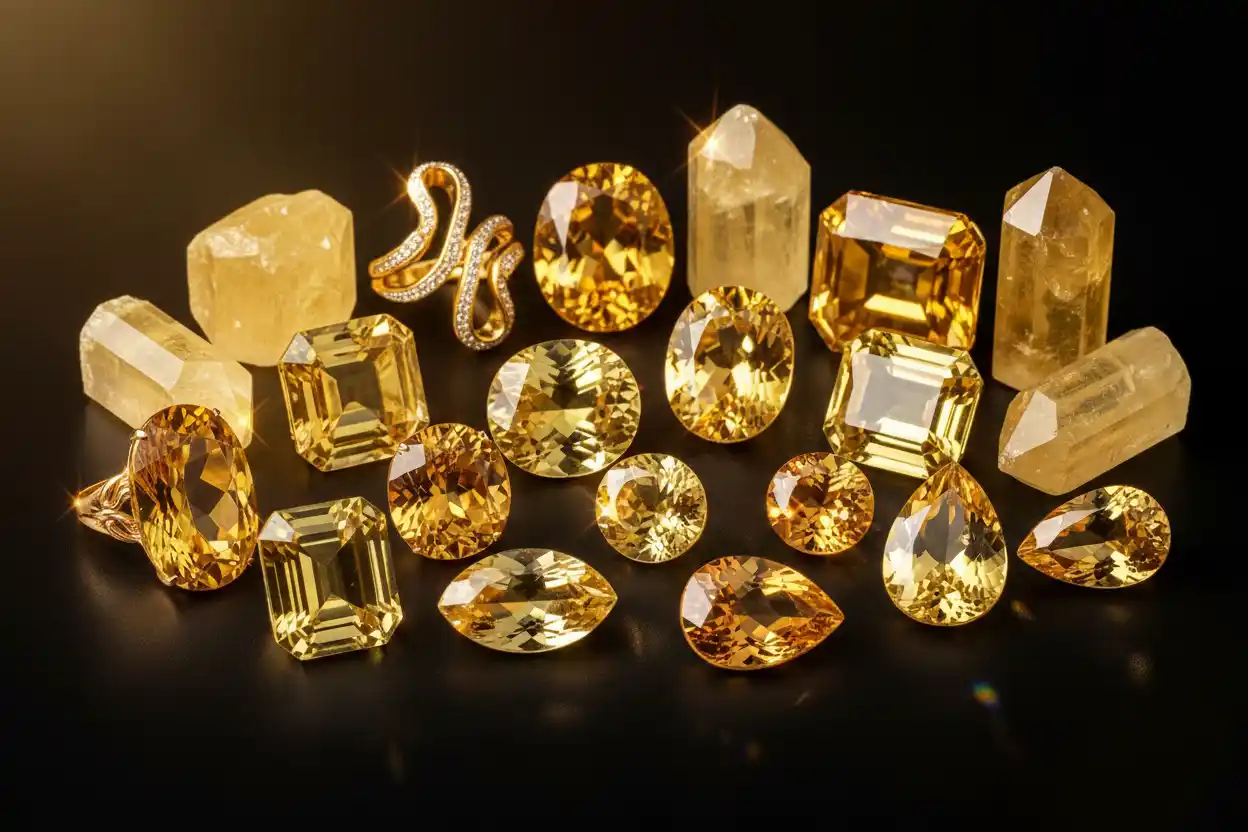
Heliodor Meaning: Properties, Uses & Symbolism
Heliodor meaning begins with beryl, not with a separate mineral species. Heliodor is yellow to golden or greenish-yellow gem-quality beryl, whose ideal formula is Be₃Al₂Si₆O₁₈. Beryl crystallizes in the hexagonal system, has a Mohs hardness of approximately 7.5–8, imperfect basal cleavage, brittle tenacity, and a specific-gravity range that varies with composition but commonly lies within roughly 2.6–2.9. GIA identifies heliodor as yellow beryl and attributes the yellow color principally to iron-related absorption, while chemically pure beryl itself is colorless.
That mineral identity immediately establishes an important boundary. Heliodor belongs to the same beryl family as aquamarine, emerald, morganite, goshenite, and red beryl, but those names describe different color varieties and, in some cases, different chromophore systems. A yellow beryl does not become chemically related to citrine simply because both can be yellow, and it is not a variety of topaz, quartz, garnet, or feldspar. Readers exploring the broader material-first reference collection can use Gemstone Guides, while this page remains focused specifically on heliodor identity, yellow-color mechanisms, naming history, formation, symbolism, and safe ownership.
The symbolic side of heliodor meaning is newer than the mineralogical story. Modern crystal traditions often associate the stone with confidence, clarity, optimism, disciplined action, personal direction, or solar imagery because of its yellow-to-golden appearance and its name, which evokes the sun. Those ideas may serve as personal metaphors or ritual themes, but they are not established consequences of beryllium-aluminum silicate chemistry, iron-related absorption, or hexagonal crystal structure. This article therefore keeps measurable gemology, documented naming history, and modern symbolism clearly separated.
Heliodor Meaning at a Glance
| Property or question | Evidence-aware summary |
|---|---|
| Material identity | Yellow to golden or greenish-yellow beryl |
| Mineral species | Beryl |
| Ideal formula | Be₃Al₂Si₆O₁₈ |
| Crystal system | Hexagonal |
| Mohs hardness | Approximately 7.5–8 |
| Typical color | Lemon yellow, golden yellow, yellow-green, greenish yellow |
| Main color relationship | Iron-related absorption in beryl |
| Typical optical character | Uniaxial negative |
| Common heliodor RI range | Roughly mid-1.56 to upper-1.58 range, depending on composition |
| Birefringence | Low, commonly around several thousandths |
| Cleavage | Imperfect/fair basal cleavage |
| Fracture | Commonly conchoidal |
| Transparency | Transparent to translucent |
| Pleochroism | Usually weak in yellow to greenish-yellow directions |
| Typical geological setting | Granitic pegmatites and related evolved felsic systems |
| Important variety-name issue | Heliodor and golden beryl are used partly as synonyms and partly as hue distinctions |
| Treatment issue | Heating can shift some yellow/greenish beryl toward blue; irradiation can also affect beryl color |
| Modern symbolism | Confidence, clarity, optimism, direction, disciplined action |
| Scientific status of symbolism | Personal or cultural interpretation, not demonstrated physiological effect |
| Main ownership consideration | Durable enough for many jewelry uses, but fractures and inclusions still matter |
GIA’s analytical study of blue-to-yellow beryl found heliodor samples with refractive indices broadly consistent with beryl and weak dichroism, while the yellowish color was tied to iron-related absorption in the violet-blue portion of the spectrum.
What Is Heliodor?
Heliodor is a color variety of beryl. The host mineral consists of rings of silicate tetrahedra arranged around channels parallel to the crystallographic c-axis. Those channels can contain alkali ions, water, and other components, while iron can occupy several structural or channel-related environments that influence color.
The basic beryl formula is often written Be₃Al₂Si₆O₁₈. Natural crystals commonly contain substitutions and channel constituents, so real gem beryl is more chemically complicated than the ideal formula suggests. Mindat records iron, manganese, magnesium, calcium, chromium, sodium, lithium, cesium, water-related species, potassium, and rubidium among common impurities or additional constituents in natural beryl.
Heliodor therefore should not be described as “yellow quartz” or “gold crystal.” It is a distinct beryllium-bearing silicate whose properties are inherited from beryl.
Heliodor Identity Table
| Characteristic | Heliodor |
|---|---|
| Mineral species | Beryl |
| Ideal chemistry | Be₃Al₂Si₆O₁₈ |
| Crystal system | Hexagonal |
| Typical habit | Hexagonal prisms, commonly vertically striated |
| Typical color | Greenish yellow to golden or lemon yellow |
| Hardness | Approximately 7.5–8 |
| Specific gravity | Often around the upper 2.6 to upper 2.8 range depending on composition |
| Optical character | Uniaxial negative |
| Typical RI | Approximately 1.566–1.586 for many yellow beryls, with natural variation |
| Birefringence | Usually low |
| Pleochroism | Weak yellow to greenish-yellow variations can occur |
| Luster | Vitreous |
| Transparency | Transparent to translucent |
| Cleavage | Imperfect basal |
| Fracture | Conchoidal to uneven |
| Common inclusions | Two-phase inclusions, healed fissures, growth tubes, mineral crystals |
| Major identification issue | Distinguish yellow beryl from yellow quartz, topaz, chrysoberyl, glass and other yellow gems |
| Main naming issue | Whether “heliodor” and “golden beryl” are synonyms or separate hue categories |
A yellow transparent gem should never be identified as heliodor from color alone. Standard gemological data, including refractive index, optic character, density, pleochroism, inclusions, and spectroscopy where appropriate, provide a much stronger identification framework.
Why Is Heliodor Yellow?
The yellow color of heliodor is fundamentally connected with iron. GIA’s broad study of blue-to-yellow beryl found that yellowish coloration develops when an iron-related absorption edge shifts from the ultraviolet into the violet-blue and blue portions of the visible spectrum. Removing more blue and violet light causes the transmitted light to appear yellow.
The same research recorded Fe³⁺-related absorption features in the studied beryls and emphasized that total iron concentration alone does not determine the final color. Two stones with different iron contents can display unexpected differences in saturation because oxidation state, structural position, channel chemistry, charge compensation, and absorption-band strength all matter.
Detailed work on heliodor from the Volyn pegmatite field provides an even more specific example. In that material, the yellow component has been associated with an O²⁻→Fe³⁺ charge-transfer absorption extending into the blue portion of the spectrum, while Fe²⁺ was not considered responsible for the characteristic yellow color of the studied heliodor.
The appropriate general statement is therefore that heliodor’s yellow color is iron-related, not that every specimen owes its appearance to one identical microscopic arrangement of iron.
The deeper relationship between Fe³⁺, Fe²⁺, charge transfer, pleochroism, absorption edges, channel constituents, and visible color belongs in the Heliodor Optical Properties and Color Behavior guide.
Is Heliodor the Same as Golden Beryl?
This is one of the most useful naming questions to address because authoritative sources do not all apply the terms in exactly the same way.
Mindat currently treats golden beryl as a synonym of heliodor and describes heliodor as gem-quality golden-yellow beryl. It also records the heliodor name as originally applied commercially to golden beryl from Namibia.
Other gemological discussions have proposed a narrower hue distinction: “golden beryl” for more purely yellow-to-golden material and “heliodor” for greener yellow beryl. A GIA conference report summarizing one proposed classification explicitly separated golden beryl as yellow from heliodor as greenish yellow.
Modern GIA research, however, uses heliodor across a greenish-yellow-to-yellow range, including lemon and golden samples.
The most defensible conclusion is that the trade boundary is not perfectly standardized. A transparent yellow beryl can reasonably be called heliodor in broad modern usage, while some gemologists and sellers use golden beryl for the purer yellow end of the range.
Original Information Gain: Heliodor Naming Decision Table
| Label | Defensible use | What should not automatically be assumed |
|---|---|---|
| Heliodor | Yellow to greenish-yellow gem beryl | One universally standardized hue boundary |
| Golden beryl | Yellow/golden gem beryl | Separate mineral species |
| Yellow beryl | Broad material-first description | Exact trade variety |
| Greenish-yellow beryl | Objective color description | Automatically heliodor under every naming system |
| Golden-yellow beryl | Objective color description | Automatically untreated |
| “Precious beryl” | Older/general trade wording | Exact modern variety |
| “Sun beryl” | Marketing or symbolic wording | Formal mineral name |
| “Yellow emerald” | Misleading marketing comparison | Emerald identity |
| “Citrine beryl” | Incorrect/confusing terminology | Relationship to quartz citrine |
| “Natural heliodor” | May be accurate | Untreated color without supporting evidence |
| “Irradiated heliodor” | Treatment description requiring evidence | Natural yellow origin |
| “Tajik heliodor” | Provenance claim requiring caution | Geographic origin from appearance alone |
The strongest approach is to state both mineral species and visible color when ambiguity matters: “yellow beryl sold as heliodor,” for example, communicates more than a trade name alone.
How Heliodor Forms
Heliodor commonly forms in evolved granitic pegmatites and related felsic systems capable of concentrating beryllium. Pegmatites are exceptionally coarse-grained igneous bodies that can concentrate incompatible elements during the late stages of magma evolution, creating environments where beryl, tourmaline, feldspar, mica, topaz, quartz, and other minerals may crystallize together.
GIA’s work on heliodor from the Volyn pegmatites describes high-quality yellow beryl from a well-known pegmatitic field where beryl occurs alongside other characteristic pegmatite minerals. GIA’s review of Namibian beryl likewise records yellow heliodor associated with fluorite, mica, and orthoclase in pegmatitic environments.
Formation is locality-specific. A Namibian heliodor crystal and a Ukrainian specimen need not share an identical fluid history, trace-element distribution, inclusion population, or alteration sequence simply because both are beryl.
The detailed pegmatite evolution, host-rock context, fluid stages, associated minerals, and deposit comparisons belong in the Heliodor Formation and Deposit Geology guide.
What Inclusions Occur in Heliodor?
Heliodor can contain two-phase fluid inclusions, healed fissures, growth tubes, mineral crystals, and various pegmatite-related inclusions. GIA’s comparative blue-to-yellow beryl study found two-phase inclusions to be common, including elongated rod-like two-phase inclusions parallel to the c-axis in heliodor.
GIA has also documented a striking schorl tourmaline inclusion inside an examined heliodor, complete with visible tourmaline morphology and its own associated fluid-inclusion band. Other beryl studies have identified minerals such as tourmaline, albite, muscovite, garnet, zircon, and tantalite-columbite within blue-to-yellow beryl samples.
These examples demonstrate diversity rather than a universal inclusion fingerprint. A single tourmaline, tube, fingerprint, or fluid inclusion does not prove heliodor identity or geographic origin.
The detailed specimen-scale inclusion work belongs in the Heliodor Microscope Inclusion Notebook.
Can Heliodor Be Heat Treated?
Yes, color modification through heat is relevant to yellow and greenish beryl. Heating can reduce or change iron-related absorption in some beryl and move the apparent color toward blue aquamarine. GIA research notes that yellowish and greenish beryl are commonly capable of becoming bluer after heating, although exact response depends on the material.
Older GIA gemological reporting likewise documents golden and yellow beryl changing toward aquamarine colors under heat treatment, while not every specimen responds identically.
This treatment relationship is important for understanding the broader beryl color system, but detailed treatment detection belongs outside this meaning page. A yellow stone’s present appearance alone does not reconstruct its complete treatment history.
Can Beryl Be Irradiated?
Beryl can also respond to irradiation. GIA’s treatment reference notes that certain beryl varieties may be irradiated to deepen or alter color and that some irradiated beryl colors can fade with strong light exposure.
This means a seller’s statement that a yellow stone is “completely natural color” is a disclosure claim rather than something that can always be verified from a photograph.
It also reinforces the separation between identity and treatment. Irradiated yellow beryl remains beryl; treatment concerns how the color developed or was altered.
Readers making an actual purchase can use Buy Heliodor for seller-disclosure and buying questions rather than treating this meaning reference as a purchase checklist.
Treatment and Provenance Are Separate Questions
A specimen may be genuine beryl but have modified color. It may also be natural-color beryl but carry an unsupported locality claim. Those questions require separate evidence.
Mindat cautions that some yellow beryl attributed to parts of Central and South Asia may warrant treatment and provenance scrutiny, while GIA has published examples where reported Tajik origin was questioned.
That does not justify declaring every yellow beryl from the region treated or falsely labeled. It means locality and treatment should not be inferred solely from color.
Diagnostic Characteristics of Heliodor
Once the stone is suspected to be beryl, several standard observations can support identification. Beryl is uniaxial negative, relatively hard at approximately 7.5–8, and commonly exhibits hexagonal crystal morphology. Its refractive indices are substantially higher than quartz but lower than many high-RI gems.
GIA’s blue-to-yellow beryl study reported typical heliodor-compatible RI values in the upper 1.56 through 1.58 range, low birefringence, and weak dichroism. Natural beryl’s density varies with alkali and channel content, so SG should be interpreted as part of a combined dataset rather than one fixed number.
A yellow gem should not be identified as heliodor through hardness alone. Topaz, chrysoberyl, yellow sapphire, citrine, scapolite, glass, and other materials can overlap visually while having different optical and physical properties.
Heliodor Versus Citrine
Heliodor and citrine can both appear lemon yellow, golden, or brownish yellow, which makes the comparison especially common in photographs and jewelry listings.
Their mineral identities are unrelated. Heliodor is beryl, Be₃Al₂Si₆O₁₈, with hardness approximately 7.5–8 and RI commonly around the upper 1.56 to 1.58 range. Citrine is quartz, SiO₂, hardness 7, with RI around 1.544–1.553.
The planned side-by-side identification questions belong in the dedicated Heliodor vs Citrine comparison rather than being duplicated here.
Heliodor Versus Herkimer Diamond
Herkimer Diamond Meaning concerns exceptionally clear double-terminated quartz associated with a particular New York geological setting. Despite its trade name, it is quartz rather than diamond.
Heliodor is beryl. It commonly forms hexagonal prisms and can show yellow to golden color, whereas Herkimer material is typically valued for clear quartz morphology.
The comparison illustrates why memorable trade names should never replace mineral identity.
Heliodor Versus Harlequin Quartz
Harlequin Quartz Meaning covers included quartz sold under a non-standard trade name, often containing red or dark iron-mineral inclusions.
Heliodor’s color primarily comes from iron-related absorption within the beryl system rather than from visible red hematite plates dispersed through a quartz host.
Both may contain iron, but “contains iron” does not describe the same mineralogical mechanism.
Original Specimen and Photo Checklist
Heliodor can be evaluated more responsibly when observations are separated from claims that need testing.
| Observation | Photograph can often support | Photograph cannot reliably prove |
|---|---|---|
| Yellow hue | Lemon, golden, greenish-yellow appearance | Exact Fe oxidation-state distribution |
| Hexagonal prism | Beryl-compatible morphology | Species identity by itself |
| Vertical striations | Natural-looking prism texture | Geographic origin |
| Transparency | Relative clarity | RI or SG |
| Two-phase inclusions | Visible gas/fluid structures under magnification | Treatment status alone |
| Mineral inclusions | Shape and distribution | Exact species without analysis |
| Color zoning | Visible variation | Cause of each zone |
| Etch pits | Surface morphology | Unique locality in every case |
| “Golden beryl” label | Trade terminology | Standardized distinction from heliodor |
| “Natural color” label | Seller claim | Untreated status |
| “African heliodor” | Provenance claim | Mine or country |
| “Healing energy” | Nothing objectively measurable | Medical or supernatural effect |
A useful photo set should include neutral daylight or standardized white illumination, at least two orientations, one transmitted-light view for transparent material, and close-ups of inclusions or crystal surfaces. Highly warm lighting can make pale yellow beryl appear artificially golden, while aggressive saturation can erase the subtle green component characteristic of some heliodor.
Original Heliodor Claim-Audit Framework
| Claim | Evidence-aware interpretation | Stronger evidence when important |
|---|---|---|
| “This is heliodor” | Plausible if gemological properties support yellow beryl | Standard gem testing |
| “This is golden beryl, not heliodor” | Depends on naming convention | State hue definition explicitly |
| “Iron makes it yellow” | Broadly supported | Spectroscopy for specimen-specific mechanism |
| “Fe³⁺ causes the yellow” | Supported broadly, but structural mechanism can be nuanced | UV-Vis and compositional analysis |
| “This stone is untreated” | Possible | Gemological/laboratory evidence |
| “This locality always produces natural yellow” | Too broad | Documented provenance and treatment evidence |
| “Heliodor is ancient sun stone” | Historical/metaphysical claim | Primary historical evidence |
| “Heliodor increases confidence” | Modern symbolic interpretation | Remains personal/reflective |
| “Heliodor provides solar energy” | Metaphorical language | No established physiological mechanism |
| “Heliodor treats digestion or hormones” | Medical claim | Appropriate clinical evidence would be required |
| “Beryllium in heliodor is beneficial to the body” | Unsupported chemistry-to-health inference | Mineral composition is not nutrition |
The audit prevents real gemological facts—such as Fe³⁺-related yellow absorption—from being extended into unrelated claims about confidence, digestion, endocrine function, or human “solar energy.”
Documented History of the Heliodor Name
The heliodor name was originally applied commercially to golden-yellow beryl from the Rössing area of Namibia. Mindat records the name as having been applied to golden beryl from that locality and notes that it later entered broader use for gem-quality golden-yellow beryl. GIA’s historical review of Namibian beryls likewise identifies the nearby Rössing pegmatite as the locality from which heliodor was originally described.
The name derives from Greek elements associated with the sun and gift, producing the familiar interpretation “gift of the sun.” That naming imagery naturally encourages modern solar symbolism.
However, the existence of a solar name does not establish an ancient religious tradition centered on heliodor. The mineral beryl has a much older history, but heliodor as a specific yellow-beryl trade/mineralogical name belongs to modern gem nomenclature.
The Sun Association: History Versus Symbolism
The sun association is embedded in the name, not in a measurable form of solar radiation stored inside the crystal.
Yellow and gold are culturally associated with daylight, warmth, visibility, wealth, harvest, optimism, and authority in many contexts. Heliodor’s color therefore lends itself naturally to symbolism involving clarity or confidence.
A person can use the stone to represent those ideas without claiming that beryl absorbs sunlight and later transfers “solar vitality” into the body.
Modern Heliodor Meaning
Modern heliodor meaning commonly centers on clarity, confidence, optimism, direction, discipline, personal responsibility, purposeful action, and visibility.
These themes fit both the stone’s bright color and its sun-related name. A transparent yellow crystal can symbolize seeing a situation clearly; a durable beryl can symbolize persistence; golden color can represent confidence or value.
The symbolism becomes useful when attached to observable behavior.
A heliodor on a desk might remind someone to finish one difficult task rather than avoiding it. A ring could represent a commitment to speak clearly. Neither use requires a supernatural mechanism.
Heliodor and Confidence
Confidence is one of the most common modern heliodor meaning themes.
A grounded interpretation does not say the stone chemically increases courage. Instead, the object can function as a cue: prepare thoroughly, speak clearly, make the decision, or take the next reasonable action despite uncertainty.
Confidence that develops from preparation and repeated action has an identifiable behavioral pathway.
The crystal serves as a symbol, not the physiological cause.
Heliodor and Clarity
Transparent yellow beryl naturally lends itself to clarity symbolism. A useful practice can be built around separating evidence into three categories: facts, interpretations, and unanswered questions.
Someone facing a difficult decision might use the stone as a reminder to write those categories down before acting.
That method may improve reasoning because it changes the decision process.
Heliodor itself does not reveal hidden truths, detect lies, read intentions, or provide supernatural certainty.
Heliodor and Optimism
Yellow is widely associated with light and positive affect in modern visual culture, making optimism another intuitive symbolic theme.
Optimism can be framed responsibly as the willingness to recognize uncertainty while still identifying constructive options. It should not require denial of risk or difficult circumstances.
A heliodor object can represent that attitude.
It cannot guarantee favorable outcomes.
Heliodor and Personal Direction
The sun provides an obvious metaphor for orientation and direction, which modern heliodor symbolism often borrows.
A grounded practice might identify one major priority, one unnecessary distraction, and one next action. The stone can mark the intention visually.
It does not choose a career, relationship, investment, or life path on behalf of the owner.
Heliodor and Prosperity
Golden color often brings financial or abundance symbolism into heliodor descriptions. That symbolism should stay clearly metaphorical.
Heliodor cannot guarantee wealth, improve trading outcomes, attract customers, alter lottery odds, secure employment, or increase investment returns.
A practical prosperity ritual can instead connect the stone with budgeting, skill development, sending invoices, saving consistently, or completing revenue-producing work.
The result depends on real decisions and external circumstances.
Heliodor and “Healing” Claims
There is no established scientific evidence that heliodor treats digestive disorders, liver disease, endocrine problems, hormonal imbalance, cardiovascular disease, anxiety, depression, neurological conditions, fertility issues, immune problems, pain, or other medical conditions.
Beryl contains beryllium, aluminum, silicon, and oxygen, while iron contributes to heliodor’s color. Those elements inside a stable mineral lattice should not be treated as nutrients or medicine.
Wearing yellow beryl does not provide a medically meaningful dose of iron or beryllium through the skin.
The site-wide distinction between symbolic gemstone use and medical claims is stated in the Gems Lore Disclaimer.
Safe Ownership
Heliodor’s beryl hardness of approximately 7.5–8 provides good scratch resistance for many jewelry applications, but hardness is not the same as toughness. Beryl is brittle, and large inclusions or surface-reaching fractures can create vulnerable areas.
A clean faceted stone in a protective setting may perform well under ordinary wear. A heavily fractured crystal or sharply pointed specimen needs more caution.
Individual condition therefore matters more than a generic statement that “heliodor is durable.”
The mechanical details belong in the Heliodor Setting and Wear Engineering guide.
Cutting and Orientation
Heliodor can be faceted into bright transparent gemstones. Orientation may influence face-up color because beryl can show weak pleochroism, while rough shape, color zoning, inclusions, fractures, and yield also affect the cutter’s decisions.
Some natural crystals have attractive etching that collectors or cutters may deliberately preserve. GIA has documented Ukrainian heliodor cuts designed to retain characteristic rough etch textures within finished stones.
The detailed lapidary considerations belong in the Heliodor Cutting, Orientation and Polish guide.
Intact Heliodor Versus Cutting Dust
Ordinary handling of intact beryl is different from sawing, grinding, sanding, drilling, or crushing it.
Mechanical processing produces fine mineral dust. Professional lapidary work should therefore use suitable wet methods and engineering controls where appropriate, eye protection, equipment safeguards, controlled cleanup, and properly selected respiratory protection when required.
The presence of beryllium in the mineral formula is another reason not to turn decorative beryl into powders for ritual or ingestion.
Do Not Ingest Heliodor
Heliodor should not be powdered, swallowed, added to supplements, or deliberately placed in drinking water to extract supposed mineral benefits.
The ideal formula does not describe all natural inclusions, associated minerals, residues, surface contamination, treatments, or compounds that may be present in an individual specimen.
A mineral being natural does not make it food.
Specimen Conservation
Natural heliodor crystals can preserve important geological information through crystal habit, etching, inclusion relationships, color zoning, matrix associations, and locality documentation. A fine natural crystal may therefore have scientific and collector significance that exceeds its value as cutting rough.
Record dimensions, photographs, weight where useful, natural faces, damaged areas, inclusions, color zoning, seller information, old labels, locality claims, and analytical documentation before altering an important specimen.
The Heliodor Specimen Conservation Record provides the mapped structure for preserving those details without turning this meaning page into a conservation manual.
Price and Value Are Separate From Meaning
Heliodor meaning does not determine market price. Value can depend on color, saturation, tone, transparency, cut quality, size, treatment disclosure, provenance, inclusions, market context, and whether the object is valued as a gem or mineral specimen.
Those questions belong in the dedicated Heliodor Price reference, where pricing methodology can be handled without turning symbolism into a value claim.
A seller describing heliodor as a “prosperity stone” does not make the gemstone financially appreciating or investment-grade.
Evidence and Technical Limits
This article does not claim first-hand mine visits, private purchases, unpublished spectroscopy, laboratory testing of reader stones, or personal authentication of commercial heliodor. The broader evidence approach used by Gems Lore is described on About Gems Lore.
Exact treatment history, iron valence distribution, geographic origin, unusual inclusion identity, or disputed golden-beryl/heliodor classification may require professional gemological or mineralogical examination. GIA’s research itself shows that yellow beryl color depends on more than total iron concentration and that natural material spans a green-to-yellow continuum within the broader beryl color system.
Readers with documented corrections, analytical results, locality records, or stronger technical evidence can submit them through Contact Gems Lore. Information submitted through site channels is handled according to the Privacy Policy.
Frequently Asked Questions About Heliodor Meaning
What is heliodor meaning?
Heliodor meaning commonly combines yellow beryl’s mineral identity with modern symbolic themes such as confidence, clarity, optimism, discipline, direction, and purposeful action. The symbolism is interpretive rather than a scientifically demonstrated therapeutic effect.
What is heliodor?
Heliodor is yellow to golden or greenish-yellow gem-quality beryl, Be₃Al₂Si₆O₁₈. GIA identifies yellow heliodor as an iron-colored member of the beryl family.
Is heliodor a separate mineral?
No. The mineral species is beryl. Heliodor is a color-variety name.
What causes heliodor’s yellow color?
Iron-related absorption causes the yellow appearance. GIA research connects yellow coloration with Fe³⁺-related absorption extending from the ultraviolet into the violet-blue/blue portion of the spectrum.
Is heliodor the same as golden beryl?
The terms overlap substantially. Some sources treat golden beryl as synonymous with heliodor, while some gemologists reserve heliodor for greener yellow material and golden beryl for more purely yellow stones. There is no universally applied trade boundary.
Is heliodor the same as emerald?
No. Both are beryl varieties, but emerald is green beryl whose recognized gemological color is associated principally with chromium and/or vanadium, while heliodor is yellow beryl whose color is iron-related.
Is heliodor the same as aquamarine?
They are both beryl. Aquamarine is blue to greenish-blue beryl, while heliodor is yellow to greenish-yellow beryl. Different iron-related absorption components influence their colors.
Is heliodor the same as citrine?
No. Citrine is quartz, SiO₂. Heliodor is beryl, Be₃Al₂Si₆O₁₈. Their hardness, RI, density, crystal symmetry, and chemistry differ.
How hard is heliodor?
As beryl, heliodor is approximately Mohs 7.5–8.
What is heliodor’s refractive index?
GIA’s studied yellow beryls generally fall around the upper 1.56 through 1.58 range, with natural variation depending on composition.
Does heliodor show pleochroism?
It can show weak dichroism or pleochroism, commonly involving yellow and greenish-yellow variations. GIA’s studied heliodor showed weak dichroism.
Where does heliodor form?
Heliodor is strongly associated with evolved granitic pegmatites capable of concentrating beryllium and other uncommon elements. Well-documented deposits occur in multiple countries, and each locality can have distinctive inclusions and color behavior.
Can heliodor be heat treated?
Yes. Some yellow or greenish beryl can be heated to reduce the yellow component and produce a bluer aquamarine-like color. Response varies with material.
Can heliodor be irradiated?
Beryl can be irradiated to alter or deepen color, and some irradiation-induced beryl colors may fade under strong light. Treatment status therefore should not be determined from color alone.
Does heliodor have healing properties?
There is no established scientific evidence that heliodor treats disease or creates specific physiological healing effects.
Does heliodor increase confidence?
A person may use it as a symbolic reminder to prepare, communicate clearly, or take purposeful action. It has not been demonstrated to biologically create confidence.
Does heliodor attract wealth?
There is no scientific evidence that heliodor alters financial probability, guarantees income, or improves investments. Golden color can support prosperity symbolism without guaranteeing financial results.
Is heliodor safe to wear?
Generally, beryl’s hardness makes heliodor suitable for many jewelry forms. Fractures, inclusions, cut shape, setting design, and impact exposure still affect the durability of an individual stone.
Is heliodor safe to touch?
Ordinary handling of intact heliodor differs from cutting or grinding beryl. Dust-generating processing should use appropriate professional controls.
Can heliodor go in drinking water?
Heliodor should not be powdered, ingested, or deliberately used to prepare gemstone drinking-water elixirs. Its mineral composition is not nutritional guidance.
Can a photograph identify heliodor?
A photograph can support observations about yellow hue, transparency, crystal form, zoning, and inclusions, but it cannot reliably establish refractive index, treatment status, exact iron mechanism, or geographic origin.
Final Perspective
Heliodor meaning becomes more informative when the sun-related name is placed on top of a solid beryl identity rather than substituted for it. Heliodor is yellow to greenish-yellow beryl, Be₃Al₂Si₆O₁₈, with the characteristic hardness, hexagonal structure, optical behavior, and pegmatite associations of the beryl family. GIA research demonstrates that its yellow appearance is fundamentally iron-related and that the visible color depends on absorption behavior and iron configuration rather than merely the total quantity of iron present.
The name itself also deserves nuance. Heliodor originated as a name applied to golden beryl from Namibia and is now widely used for yellow gem beryl, yet some gemological conventions attempt to distinguish greenish-yellow heliodor from purer golden-yellow beryl. Treating that boundary as a naming convention rather than a new mineral species avoids false precision.
Modern associations with confidence, clarity, optimism, direction, and disciplined action can still form a responsible heliodor meaning when clearly identified as symbolism. The evidence-aware approach is straightforward: establish beryl identity first, describe yellow color as iron-related without oversimplifying its mechanism, treat heliodor versus golden beryl as a terminology issue, keep treatment and provenance claims separate, preserve important specimens, distinguish intact ownership from dust-generating processing, and keep medical, financial, and supernatural promises distinct from what yellow beryl actually demonstrates.