11 Real Herkimer Diamond Benefits: Helpful Uses, Evidence, Safe Use & Clear Limits
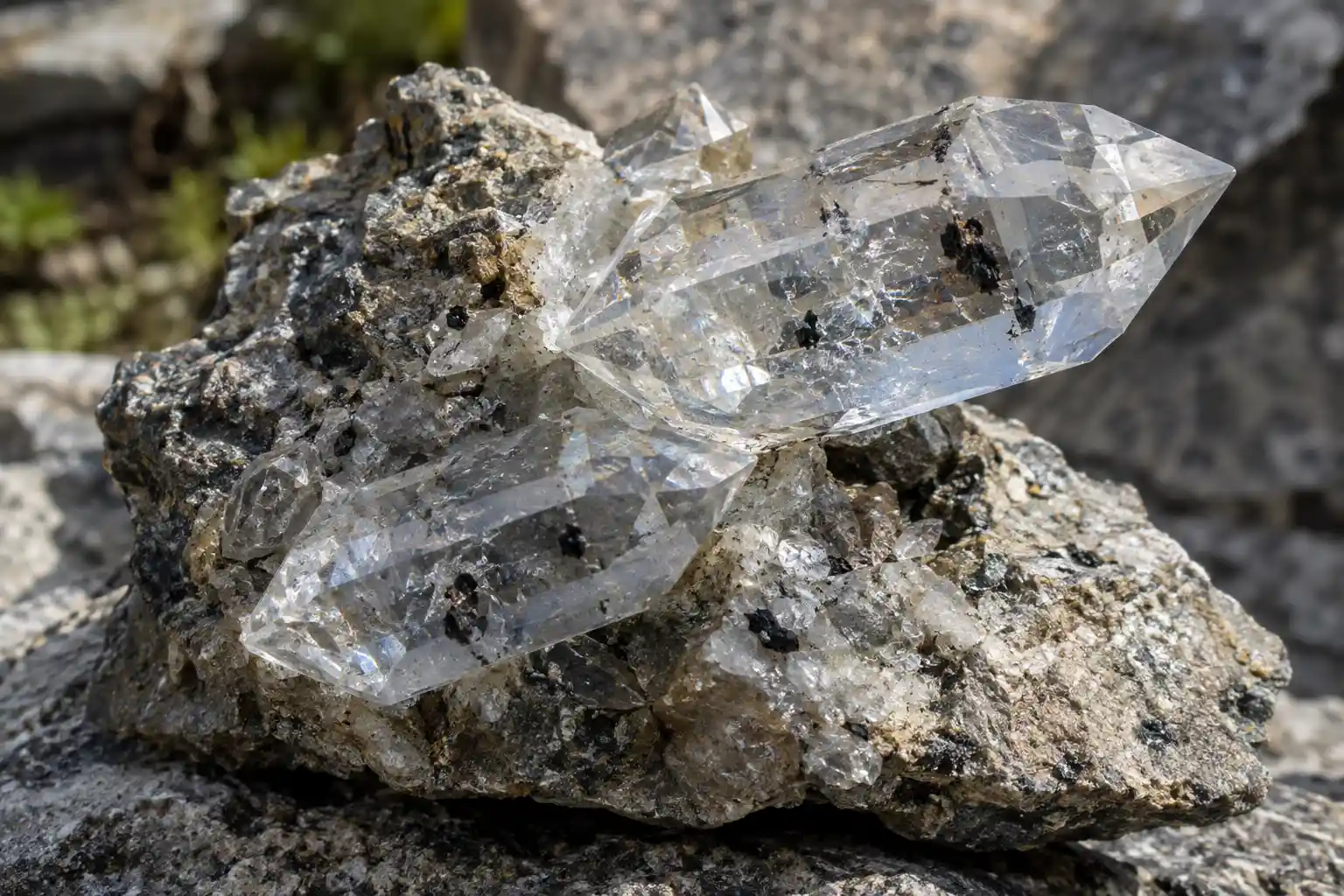
Herkimer Diamond benefits begin with a point that prevents one of the most common gemstone misunderstandings: a Herkimer Diamond is quartz, not diamond. The traditional name refers to exceptionally clear, lustrous, commonly doubly terminated quartz crystals associated with Herkimer County and nearby parts of New York State. Their bright surfaces, sharp natural terminations, high transparency, and jewel-like appearance explain how the diamond nickname developed, but their chemistry remains silicon dioxide, SiO₂, and their physical properties belong to quartz.
What makes these crystals especially interesting is the way they formed. Classic Herkimer quartz occurs in cavities within dolostone, particularly rocks of the Little Falls Formation in the Mohawk Valley region. Because crystals can grow freely into open cavities rather than remaining attached to a single broad base, many develop terminations at both ends. Some specimens contain fluid-filled negative crystals, dark hydrocarbon inclusions such as anthraxolite or pyrobitumen, mineral inclusions, internal veils, phantoms, or combinations that preserve evidence about the environment in which the quartz developed.
These features create genuine Herkimer Diamond benefits for mineral collecting, geological education, jewelry, crystal-growth study, inclusion examination, photography, and gem identification. Modern spiritual traditions also describe amplification, clarity, meditation, dream work, energetic cleansing, or emotional healing, but those interpretations remain personal or spiritual. Herkimer quartz does not medically increase energy, improve sleep disorders, treat neurological conditions, or amplify other gemstones through an established physical mechanism.
11 Herkimer Diamond Benefits at a Glance
- Natural double terminations create one of the most recognizable quartz habits associated with the Herkimer region.
- Mohs hardness 7 provides useful scratch resistance for jewelry, collecting, and handling.
- Exceptional transparency and bright luster give fine crystals strong display appeal without requiring cutting.
- Fluid, hydrocarbon, mineral, and negative-crystal inclusions provide substantial geological and microscopic interest.
- Dolostone cavity formation offers a clear example of free-growing quartz crystallization in open spaces.
- Natural crystal faces allow collectors to appreciate a gem-like appearance without faceting the quartz.
- Jewelry designers can use intact crystals while preserving their original terminations and growth surfaces.
- Locality collecting connects specimens directly with New York mineral history and the Mohawk Valley.
- Identification helps distinguish genuine Herkimer-region quartz from ordinary quartz, glass, diamond, and similar doubly terminated crystals from other localities.
- Photography and magnification reveal internal structures that can be as interesting as the external crystal form.
- Modern symbolism can represent clarity, perspective, or intentional focus when kept separate from medical and energetic claims.
Double Termination Is the Signature Feature Behind Herkimer Diamond Appeal
One of the most recognizable Herkimer Diamond benefits is the naturally doubly terminated crystal habit found in many classic specimens. A doubly terminated crystal has a complete termination at both ends rather than one end being attached broadly to the surrounding rock. This happens when quartz grows freely enough inside a cavity for crystal faces to develop around much of the crystal instead of being restricted by a matrix surface.
The result can look remarkably finished despite requiring no cutting. Fine Herkimer quartz may display six-sided prism faces, sharply formed pyramidal terminations, exceptional surface luster, and enough transparency to resemble a deliberately faceted gemstone from a distance. That natural geometry gives intact specimens a quality that conventional quartz points often lack, particularly when both ends remain undamaged and the crystal shows minimal contact with the cavity walls.
Double termination should not be treated as proof of geographic origin, however. Similar quartz habits occur in other parts of the world. The Herkimer name carries locality meaning, so crystals from Pakistan, China, Europe, Canada, or elsewhere may resemble Herkimer quartz while having different provenance. Someone considering where to buy Herkimer Diamond should therefore distinguish appearance from documented locality rather than assuming that every doubly terminated quartz crystal qualifies automatically.
Quartz Hardness Gives Herkimer Crystals Useful Practical Durability
Herkimer Diamond benefits also come from quartz’s Mohs hardness of 7, which provides considerably better resistance to scratching than softer collector minerals such as calcite, fluorite, or gypsum. This makes intact crystals practical for pendants, wire-wrapped jewelry, earrings, protected rings, display collections, and regular handling when sharp terminations are respected.
Hardness still does not make every specimen equally tough. Quartz can chip, fracture, or lose a termination after a strong impact, while crystals containing large internal fractures, cavities, or heavily included zones may be more vulnerable than clean compact pieces. Natural points also concentrate force at small areas, so a beautifully sharp termination can be damaged even though the quartz itself is relatively hard.
These Herkimer Diamond benefits are strongest when durability is understood realistically. A quartz crystal can retain polish and resist many everyday scratches, yet a natural specimen should not be carried loosely with harder gemstones, dropped onto stone floors, or worn during work likely to strike the points against metal or concrete. Protected settings allow the crystal’s natural form to remain visible without pretending it is indestructible.
Exceptional Transparency Allows Natural Crystals to Compete Visually with Cut Gems
Many fine Herkimer crystals are striking because transparency and natural luster work together without faceting. Clear specimens can transmit light through several crystal faces while internal reflections create flashes that resemble the brightness associated with polished gemstones. This natural brilliance explains why early observers compared these quartz crystals with diamonds even though the two minerals differ substantially in hardness, refractive index, dispersion, density, chemistry, and value.
Transparency therefore becomes one of the most aesthetically important Herkimer Diamond benefits. A crystal may be nearly water-clear, lightly smoky, partially cloudy, or filled with inclusions that add character without destroying the overall gem-like appearance. Collectors may prefer exceptional clarity, while others deliberately seek crystals with phantoms, fluid inclusions, carbonaceous material, or unusual internal architecture.
Because the crystal already possesses natural faces, cutting is often unnecessary. Removing a complete doubly terminated crystal merely to produce a small faceted quartz stone can destroy the very feature that makes Herkimer material distinctive. For many specimens, preservation rather than modification is the better way to retain both locality character and mineralogical information.
Inclusions Turn Herkimer Quartz into a Record of Geological Conditions
Some of the most scientifically interesting Herkimer Diamond benefits come from inclusions. Classic specimens may contain fluid inclusions, negative crystals, black hydrocarbon material often described as anthraxolite or pyrobitumen, tiny mineral crystals, internal veils, healed fractures, or phantom-like growth features. These structures can preserve evidence about changing conditions during quartz crystallization and the fluids moving through the host rock.
Negative crystals are especially fascinating because they are cavities whose internal walls reflect the shape of the surrounding quartz structure. Some contain liquid, gas bubbles, hydrocarbons, or multiple phases that can be studied under magnification. Dark carbonaceous inclusions create another distinctive appearance, sometimes forming spots, wisps, or larger black masses enclosed inside otherwise transparent quartz.
These inclusions should not automatically be viewed as defects. For a specimen collector, a perfectly positioned hydrocarbon inclusion or well-developed negative crystal can make one piece considerably more interesting than a completely clean crystal. The judgment depends on whether the goal is optical clarity, geological information, rarity, aesthetics, or a combination of several qualities.
Dolostone Cavities Explain How Herkimer Crystals Form So Completely
Classic Herkimer quartz occurs in cavities within dolostone of the Mohawk Valley region. These open spaces allowed silica-bearing fluids to circulate and quartz to crystallize with enough room for well-developed faces and double terminations. Associated cavity contents can include dolomite, calcite, anthraxolite or other hydrocarbon-rich substances, and smaller quartz crystals.
This geological setting gives Herkimer Diamond benefits substantial educational value because a specimen can demonstrate how crystal shape depends on available space. A quartz crystal growing tightly against surrounding rock may develop only partial faces, while one suspended or only lightly attached inside an open cavity can become much more complete.
The host rock therefore matters. A crystal still attached naturally within its dolostone cavity can preserve geological information that a loose polished stone cannot show. Matrix specimens reveal where the quartz grew, how crystals were distributed inside the opening, and what minerals or carbonaceous substances occurred alongside them.
Collectors who value geology may therefore prefer an intact cavity specimen even when individual crystals could be removed and sold separately.
Natural Crystal Faces Make Herkimer Quartz Valuable Without Lapidary Alteration
Most gemstones gain their final form through cutting, but one of the unusual Herkimer Diamond benefits is that natural crystals may already look finished. Sharp prism faces and terminations can create enough symmetry and brightness that polishing would add little while removing natural growth surfaces.
This makes specimen preservation particularly important. Growth marks, tiny surface features, contact points, etched areas, and natural terminations all provide clues about crystal development. Once the crystal is reshaped, much of that information disappears permanently.
Jewelry designers often work around this issue by mounting intact crystals rather than cutting them. Wire wrapping, drilled caps, custom prongs, cages, and carefully designed pendants can retain the natural point while making the piece wearable. The challenge is to secure the crystal without damaging a termination or creating excessive pressure across an internal fracture.
The result can preserve the exact form that developed underground rather than replacing it with a standardized jewelry shape.
New York Locality Gives Genuine Herkimer Quartz Strong Collecting Identity
Locality is central to the traditional Herkimer Diamond name. New York State is famous for these exceptionally clear doubly terminated quartz crystals, particularly from Herkimer County and surrounding Mohawk Valley localities. The region’s mineral heritage has made Herkimer quartz one of the most recognizable North American collector stones.
This geographic connection creates Herkimer Diamond benefits that cannot be reproduced simply by finding a visually similar crystal elsewhere. A well-documented specimen links the collector with a specific geological formation, mining area, and regional history. Mine or collecting-site provenance can therefore add meaning beyond size and transparency.
The name has increasingly been used commercially for similar quartz crystals from other countries, which can cause confusion. A doubly terminated quartz crystal from another locality may be beautiful and scientifically legitimate, but accurate labeling protects provenance. Terms such as Herkimer-style quartz can describe similar habit without suggesting a New York origin.
For serious collectors, locality documentation can become increasingly important over time because once a specimen loses its original label, exact provenance may be impossible to reconstruct confidently from appearance alone.
Herkimer Quartz Is Well Suited to Jewelry When Natural Points Are Protected
The combination of quartz hardness, transparency, and natural crystal form gives Herkimer Diamond benefits practical jewelry applications. Small complete crystals can become pendants or earrings with very little alteration, while larger specimens can be set as dramatic centerpieces. Their clear appearance pairs easily with silver, gold, platinum, darker metals, and colored gemstones without requiring a strong body color.
Point protection is the main design challenge. A sharp termination can chip if it strikes a hard surface, while wire or prongs placed over an internal fracture can concentrate pressure in a vulnerable area. The best settings support the crystal securely while leaving enough of the natural geometry visible.
Rings require more caution than earrings or pendants because hands encounter desks, doorframes, tools, and other hard objects frequently. A protected ring design can work, but an exposed double termination is better suited to lower-impact jewelry.
These practical Herkimer Diamond benefits are strongest when natural form is treated as part of the design rather than as an inconvenience to be ground away.
Identification Prevents Confusion with Diamond and Non-Herkimer Quartz
The word diamond in the trade name can create confusion for inexperienced buyers, making identification one of the most important Herkimer Diamond benefits for gemstone education. Herkimer quartz has Mohs hardness 7, while diamond defines hardness 10. Quartz has lower refractive index and dispersion, lower density, and entirely different crystal structure and chemistry.
The distinction from other quartz is subtler because all natural rock crystal shares the same basic SiO₂ chemistry. Geographic origin therefore cannot be established simply by confirming that a stone is quartz. Crystal habit, inclusions, host rock, specimen labels, purchase history, and locality documentation become more important when deciding whether a specimen truly comes from the Herkimer region.
Glass and synthetic products create additional possibilities for confusion, particularly in inexpensive jewelry. Natural quartz may contain growth features, mineral inclusions, negative crystals, or fractures that differ from gas bubbles and flow structures found in many glasses, but professional examination is preferable when identity has significant financial importance.
Understanding those differences makes the trade name informative rather than misleading.
Macro Photography Reveals a Hidden World Inside Clear Crystals
Photography provides another set of Herkimer Diamond benefits because a seemingly simple clear quartz point can become dramatically more interesting under magnification. Negative crystals, hydrocarbon inclusions, internal rainbows caused by fractures, tiny fluid bubbles, phantoms, surface etching, and unusual face development may all become visible when lighting and focus are controlled carefully.
Backlighting can emphasize transparency, while side lighting can make surface faces and tiny inclusions stand out. Cross-polarized or carefully angled illumination may reveal internal strain or fracture structures that are difficult to see in ordinary room light. Rotation also matters because many inclusions become obvious only when reflections move away from them.
Good photography serves more than aesthetic purposes. It can document a specimen’s condition, preserve details before mounting, assist with comparing inclusions, and create a record connected with locality information. For collectors, those images can become part of the specimen history rather than simply promotional pictures.
Modern Clarity and Amplification Symbolism Needs Evidence Limits
Modern crystal practice commonly associates Herkimer Diamond benefits with amplification, mental clarity, meditation, dream recall, energetic cleansing, spiritual connection, and strengthening the supposed effects of other crystals. The unusually clear double-terminated appearance helps explain why themes of clarity and transmission became popular, but visual symbolism does not establish a measurable energetic mechanism.
A person may use Herkimer quartz as a focus object during meditation, keep one on a desk as a reminder to define priorities clearly, or associate a crystal with a meaningful trip to New York. These uses can develop real personal significance through ritual, memory, and attention.
Claims surrounding Herkimer Diamond healing properties may extend into sleep, pain, immune function, emotional healing, neurological health, or energetic amplification. These remain spiritual beliefs rather than established medical effects of quartz.
The strongest Herkimer Diamond benefits require no such claims. Natural crystallography, locality, inclusions, transparency, geological formation, and collector appeal already provide substantial reasons to value the stone.
Safe Use Includes Quartz-Dust Precautions and Realistic Jewelry Care
Finished Herkimer quartz can generally be handled normally, but mining and lapidary work require appropriate precautions because quartz contains crystalline silica. Breaking, drilling, grinding, or dry cutting can create respirable silica dust, so wet methods, adequate ventilation, eye protection, and suitable respiratory controls are important when the stone is worked mechanically.
Intact crystals should also be handled with attention to their sharp terminations. A point can scratch skin or chip after impact, while broken fragments can develop sharp edges. Children should not handle fragile specimens without appropriate supervision, particularly large matrix pieces or freshly broken host rock.
Cleaning can usually be done with lukewarm water, mild soap, and a soft brush when the specimen is structurally stable, although matrix pieces containing other minerals may require more careful methods. Strong thermal shock and aggressive mechanical cleaning are unnecessary.
These limits protect both specimen and owner while preserving the real Herkimer Diamond benefits of natural crystal form, transparency, inclusions, locality, and collecting value.
Conclusion
Herkimer Diamond benefits include naturally double-terminated quartz growth, Mohs hardness 7, exceptional clarity, fascinating inclusions, distinctive dolostone-cavity geology, natural gem-like faces, New York locality significance, jewelry use, identification value, photography, and meaningful modern symbolism. The trade name does not make the stone a diamond, but its natural brightness and completeness explain why the comparison became historically popular.
The strongest Herkimer Diamond benefits come from understanding the crystal accurately. Genuine Herkimer-region quartz combines recognizable locality, unusual cavity growth, natural terminations, geological inclusions, and strong collector appeal. Modern ideas involving clarity or intentional focus can add personal meaning, while amplification and healing claims should remain clearly separated from established mineral science.
FAQs
What are the main Herkimer Diamond benefits?
The most practical Herkimer Diamond benefits include mineral collecting, geological study, quartz identification, jewelry use, inclusion examination, photography, and the preservation of naturally doubly terminated crystal forms. Their transparency and bright luster also make them attractive without faceting, while modern themes involving clarity or focus can serve as personal symbolism without being treated as established physical or medical effects.
Is a Herkimer Diamond actually a diamond?
No. A Herkimer Diamond is quartz with the chemical formula SiO₂, not carbon-based diamond. The traditional name arose because exceptionally clear, lustrous, sharply formed crystals from the Herkimer region can look remarkably gem-like, but quartz and diamond differ substantially in hardness, optical properties, density, crystal structure, chemistry, and market value.
Why are Herkimer Diamonds often double terminated?
Many classic Herkimer quartz crystals formed freely inside cavities in dolostone, giving crystal faces enough open space to develop at both ends rather than leaving one end broadly attached to surrounding rock. The resulting doubly terminated habit is highly recognizable, although similar crystal forms can occur in quartz from other localities and therefore do not establish New York origin by themselves.
What are the black inclusions sometimes seen in Herkimer quartz?
Dark inclusions in classic specimens can include hydrocarbon-rich substances commonly described as anthraxolite or pyrobitumen, sometimes associated with cavities, negative crystals, and other growth features. Their presence can add geological and collector interest because they preserve evidence about the carbon-rich environment and fluids associated with quartz formation rather than simply functioning as undesirable visual flaws.
How hard is a Herkimer Diamond?
Because it is quartz, Herkimer material has a Mohs hardness of 7 and resists many ordinary scratches reasonably well. Natural points can still chip, fractures can weaken individual specimens, and hard impacts may damage sharp terminations, so jewelry and collector crystals benefit from protective storage and settings that respect their natural geometry.
Can similar crystals from other countries be called Herkimer Diamonds?
Doubly terminated clear quartz occurs in several countries, but the traditional Herkimer name refers to crystals associated with Herkimer County and nearby New York localities. Similar stones from elsewhere can accurately be described as doubly terminated quartz or Herkimer-style quartz, while documented provenance helps preserve the geographic meaning attached to genuine New York specimens.
Are Herkimer Diamonds suitable for jewelry?
Yes. Quartz hardness and natural clarity make small Herkimer crystals well suited to pendants, earrings, wire-wrapped pieces, and carefully protected rings. The main concern is preserving sharp natural terminations and avoiding settings that place excessive pressure across fractures, so lower-impact jewelry generally offers a safer environment than exposed everyday rings.
Do Herkimer Diamonds amplify other crystals?
There is no established scientific evidence that Herkimer quartz amplifies the healing, energetic, or metaphysical properties of another gemstone. Amplification is a popular modern spiritual interpretation, while the measurable properties of the crystal involve quartz chemistry, optical behavior, hardness, inclusions, and natural crystallography rather than a demonstrated transfer of gemstone energy.
Does a Herkimer Diamond have healing powers?
There is no established clinical evidence that Herkimer quartz treats sleep disorders, pain, neurological conditions, immune problems, anxiety, depression, or other health concerns through ordinary wearing or handling. Herkimer Diamond benefits described as healing, amplification, dream-related, cleansing, chakra, or energetic effects remain spiritual and personal beliefs and should not replace qualified medical or mental-health care.