Where to Buy Real Herkimer Diamond and Avoid Quartz Fakes
A real Herkimer Diamond is quartz from the Herkimer County and Mohawk Valley region of New York, not a diamond. The name refers to the locality and the bright, commonly doubly terminated crystal form that made these specimens famous.
Clear double-terminated quartz occurs in many other countries and regions. Those crystals can be natural, beautiful and mineralogically comparable, but they should be described as double-terminated quartz or Herkimer-style quartz rather than genuine Herkimer Diamond when they lack New York provenance.
The main buying problem is therefore not always a fake mineral. Buyers frequently receive real quartz from Pakistan, Tibet, China, Spain or another source under a Herkimer label. The quartz is authentic, but the geographic trade name is inaccurate.
Other risks include glass, synthetic quartz, polished points sold as naturally terminated, drilled crystals, oil-filled fractures, glued matrix specimens and unsupported mine claims.
The Herkimer Diamond meaning and properties guide covers identity and traditional symbolism. This guide focuses on geographic authenticity, crystal form, inclusions, seller documentation and buying natural New York quartz without confusing it with actual diamond.
Herkimer Diamond Is Quartz, Not Diamond
Herkimer Diamonds are rock-crystal quartz, SiO2. Their “diamond” name reflects clarity, brilliance and natural faceting rather than carbon composition.
Quartz has Mohs hardness 7. Diamond has Mohs hardness 10 and entirely different optical, thermal and structural properties.
The Diamond meaning guide covers true diamond, while the completed Diamond buying guide owns grading, cut, clarity and conventional jewelry selection.
The real-versus-fake Diamond guide addresses diamond simulants. Herkimer Diamond should never be used as evidence that a quartz crystal is a low-cost natural diamond alternative with equivalent durability or value.
Geographic Origin Is Part of the Name
In its strict and useful sense, Herkimer Diamond refers to quartz from Herkimer County and nearby Mohawk Valley occurrences in New York.
The New York State Museum identifies Herkimer “Diamonds” as quartz occurring in and around Herkimer County and notes that the diamond nickname relates to their clarity and sparkle.
Double termination alone does not make a quartz crystal a Herkimer Diamond. Similar forms occur globally.
A seller should use one of these descriptions:
- Genuine Herkimer Diamond quartz from Herkimer County or the adjacent New York district
- New York double-terminated quartz from a named nearby locality
- Herkimer-style quartz from another identified country
- Double-terminated quartz of unknown locality
That vocabulary preserves both mineral identity and geographic accuracy.
Choose the Product Form Before Shopping
| Product form | Best source | Main buying concern |
|---|---|---|
| Loose natural crystal | New York mineral dealer or mine-affiliated seller | Locality, natural termination and condition |
| Matrix specimen | Specialist mineral dealer | Dolostone association, glue and provenance |
| Included crystal | Included-quartz specialist | Natural anthraxolite, fluid inclusions and artificial insertion |
| Cluster | Mineral dealer | Reconstructed contacts and matrix repair |
| Drilled bead or pendant | Independent maker | Drilling damage, oil and source documentation |
| Faceted stone | Collector-gem dealer | Quartz identity and loss of natural crystal form |
| Polished point | Requires clarification | Natural Herkimer rough versus imported quartz |
| Mining-site purchase | Authorized mine or local dealer | Exact collecting location and condition |
| Bulk parcel | Established wholesaler | Mixed localities, broken crystals and vague grading |
| Antique specimen | Specialist auction or collection dealer | Historic label, repairs and legal provenance |
Natural crystal form usually carries more Herkimer-specific value than a heavily polished or conventionally faceted product.
Where to Buy Genuine Herkimer Diamonds
Reputable New York mineral dealers
A dealer based near Herkimer County can offer valuable locality knowledge, but location of the shop alone is not proof.
Ask for the mine, town, quarry or collecting area and the basis for that information. The seller should know whether the quartz came from Middleville, Little Falls or another documented New York occurrence.
An invoice should identify the locality rather than merely say “Herkimer style.”
Authorized mining and collecting sites
Several commercial collecting sites in the Herkimer region allow visitors to search for quartz.
Material purchased directly from a mine shop or collected on-site has a stronger provenance chain than an anonymous online parcel.
Retain admission records, specimen bags, mine labels and photographs from the collecting location. Those details support future provenance.
Specialist mineral dealers
A fine-mineral dealer is appropriate for large, clear, included or matrix specimens.
Request every previous label. Older collection labels can establish origin more strongly than a newly printed retail card.
Ask whether any crystal was reattached, polished or cleaned with chemicals. A matrix specimen can contain genuine New York quartz while still being reconstructed.
Gem and mineral shows
Shows let you compare genuine New York specimens with Herkimer-style quartz from other countries.
Inspect the label before becoming focused on clarity. A crystal can have perfect double termination and still lack New York provenance.
Use a loupe to examine growth faces, chips, inclusions and polished areas. Do not scratch the crystal.
Established online stores
The online gemstone buying guide covers seller verification and return protection.
For Herkimer Diamonds, request the exact locality in writing. “Ethically sourced in the Himalayas” and “authentic Herkimer quartz” cannot both describe the same geographic product.
Request a full rotation against dark and light backgrounds. Clear quartz can hide repaired tips and drilled channels in white-background photography.
What Genuine Herkimer Quartz Looks Like
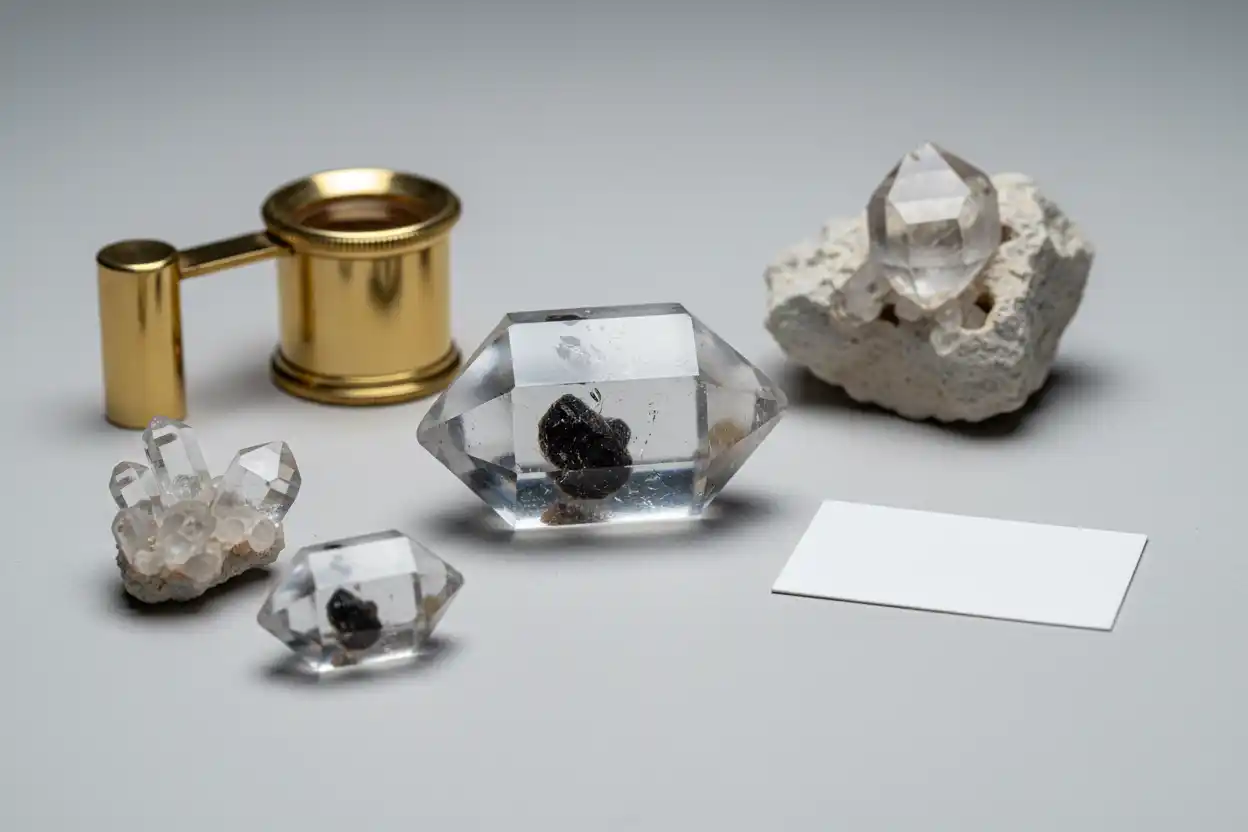
Herkimer crystals are commonly transparent to translucent and naturally doubly terminated. Many show six prism faces and two sets of termination faces, producing an often-cited eighteen-face form when fully developed.
Not every genuine crystal is perfectly symmetrical. Contacts, chips, incomplete faces and attachments to matrix are natural.
Prism faces may be short compared with the termination faces, giving the crystal a chunky, brilliant appearance.
Natural inclusions can include fluid-filled negative crystals, veils, fractures and dark carbonaceous material commonly described as anthraxolite.
Some crystals contain small cavities with liquid, gas or hydrocarbon phases. Under ultraviolet light, certain petroleum-related inclusions may fluoresce.
Inclusions can enhance collector interest, but they should be identified cautiously. A black spot alone does not prove anthraxolite or petroleum.
Herkimer Diamond Versus Herkimer-Style Quartz
Herkimer-style quartz is a useful description for clear, doubly terminated quartz from outside the New York locality.
Pakistan, Afghanistan, China, Spain and other regions can produce excellent crystals that resemble classic Herkimers.
These crystals are not fake quartz. They become misleading only when the seller removes or changes the locality.
Compare prices according to crystal quality and provenance. A beautiful Pakistani double-terminated quartz may be worth purchasing under its correct identity rather than paying a New York premium based on an inaccurate label.
Herkimer Diamond Versus Actual Diamond
Herkimer quartz has lower hardness, refractive index and dispersion than diamond. It can scratch and chip more easily.
A thermal diamond tester may not identify quartz as diamond, but testers vary and are not a substitute for full gemological identification.
Herkimer crystals also form in dolostone cavities rather than diamond-bearing kimberlite or related geological environments.
A seller should never describe the material as a genuine diamond simply because the historic name includes that word.
Herkimer Diamond Versus Clear Quartz
Every Herkimer Diamond is clear quartz, but not every clear quartz crystal is a Herkimer Diamond.
The completed guide to buying real Clear Quartz covers natural versus synthetic quartz, glass and polished points.
For Herkimer-specific buying, the additional requirement is reliable New York provenance.
A naturally double-terminated clear quartz crystal of unknown origin should be priced according to its actual form and quality rather than given a locality premium.
Herkimer Diamond Versus Glass
Glass can be molded or cut into doubly pointed forms. Round bubbles, flow lines, mold seams and abraded molded edges support glass.
Natural quartz may contain fluid inclusions with gas bubbles, so a bubble alone is not definitive.
Quartz also has different refractive and optical properties from glass. A gemologist can separate them nondestructively.
The glass-versus-crystal guide provides the broader comparison.
Natural Versus Synthetic Quartz
Hydrothermal synthetic quartz has the same essential composition and crystal structure as natural quartz.
Synthetic material can be shaped into clear points or faceted stones. Identification may require seed-plate evidence, growth features or infrared spectroscopy.
The completed treated-or-synthetic Clear Quartz guide owns the detailed natural-versus-synthetic process.
Even natural quartz does not become Herkimer Diamond without New York locality evidence. Material identity and geographic origin are separate claims.
Natural Terminations Versus Polished Points
A genuine Herkimer crystal grows with its termination faces. Those faces may show growth texture, small irregularities and natural contacts.
A polished point has machine-smoothed planes, regular facet junctions and often a flat cut base. It may have been shaped from natural Herkimer rough, imported quartz or synthetic quartz.
Polishing does not make quartz fake. However, a fully carved point should not be sold as an untouched natural crystal.
The crystal-points guide explains natural, polished and carved point terminology.
Anthraxolite and Black Inclusions
Dark carbonaceous inclusions are well known in some New York quartz and dolostone. They are commonly referred to as anthraxolite.
A genuine dark inclusion may appear as an irregular black mass, thin coating or material associated with cavities.
Artificial black pigment can also be inserted into drilled openings or fractures. Examine whether the inclusion follows natural internal structures or ends against a plug.
A seller should not guarantee petroleum, anthraxolite or another specific carbon phase without suitable evidence.
Fluid and Petroleum Inclusions
Some Herkimer crystals contain negative crystals and fluid inclusions with liquid and gas phases.
Certain hydrocarbon-bearing inclusions may fluoresce under ultraviolet light. However, fluorescence varies and should not be treated as a universal authenticity test.
Artificial oil can be introduced into surface-reaching fractures. Fresh oily residue, strong odor or fluid movement connected to an open crack deserves investigation.
Professional microscopy can distinguish many natural sealed inclusions from introduced liquid.
Drilled and Filled Crystals
Small Herkimer crystals are commonly drilled for beads and pendants. Drilling is a manufacturing step rather than evidence of a fake.
Inspect the hole for chips, fractures, resin and metal residue. A hole positioned too close to a termination can weaken the crystal substantially.
Some pieces are drilled internally and filled with pigment or decorative material. A straight channel ending in an inclusion-like mass is a warning sign.
Ask whether adhesive secures a metal bail and whether any crack was oil- or resin-filled.
Glued Matrix Specimens
Loose Herkimer crystals can be attached to dolostone or another matrix.
Inspect the base under magnification. Adhesive may form a glossy halo, fill a socket or bridge surfaces that do not match.
A crystal repaired to its original documented position is different from a fabricated cluster. Both require disclosure.
Matrix repair should also be reported. Dolostone can fracture during extraction, and a reconstructed base may support otherwise natural crystals.
How to Evaluate a Loose Crystal
Locality
Request the mine or New York collecting area and supporting evidence.
Terminations
Both ends may be complete, contacted, chipped or partly attached. Double termination is common but not mandatory for every genuine New York quartz fragment.
Faces
Natural growth surfaces should show plausible quartz geometry and texture rather than only machine polish.
Clarity
Evaluate transparency under dark and light backgrounds. Internal veils and inclusions can add character.
Condition
Inspect every point and edge. Small chips can be hidden by bright reflections.
Inclusions
Determine whether inclusions are sealed, surface-reaching or connected to drilled channels.
Repairs
Ask whether a termination was reattached or polished.
How to Evaluate a Matrix Specimen
A natural matrix association should show crystals emerging coherently from cavities or host rock.
Dolostone cavities may contain quartz with Calcite, carbonaceous material and other associated features.
Inspect the specimen’s underside and all crystal contacts. A display face can look natural while the base reveals glue and filler.
Matrix stability matters during shipping. Ask whether the specimen sheds grains or contains loose crystals.
Buying Jewelry
Small Herkimer crystals make attractive pendants and earrings because their natural forms remain visible.
Quartz has Mohs hardness 7, but sharp terminations and drilled holes can chip.
The gemstone hardness chart and toughness-versus-hardness guide explain why scratch resistance does not prevent impact damage.
Pendants should protect or recess the sharpest points. Rings are riskier because exposed terminations catch and strike objects.
Locality Documentation
Useful provenance can include:
- Original mine or dealer labels
- Receipts naming the New York locality
- Collection records
- Photographs of extraction
- Packaging from an authorized collecting site
- A documented chain through previous collections
A generic certificate printed by the retailer has little value if it does not state the source of its information.
Preserve every label. Even an old handwritten card may become important when it can be linked to a known collection.
Price and Value
Herkimer Diamonds range from inexpensive small crystals to high-value transparent specimens and aesthetic matrix clusters.
Value factors include size, clarity, luster, completeness, double termination, inclusions, condition, matrix, locality specificity, provenance and repair.
Double termination alone does not create high value. A heavily chipped crystal with vague origin should cost less than a sharp, well-documented New York specimen.
Exceptional inclusions, historical labels and aesthetic placement can increase collector value.
Imported Herkimer-style quartz may be excellent and affordable. It should simply be priced under its correct locality identity.
Questions to Ask the Seller
Ask whether the crystal was mined in Herkimer County or another documented New York Mohawk Valley locality.
Request the mine, town or collecting site and the basis for that claim.
Determine whether the point is naturally terminated, polished or recut. Confirm drilling, oil, resin, coating, glue and repair.
For included crystals, ask how the inclusion was identified. For matrix specimens, request close-ups of every contact and the base.
Finally, obtain a return policy that permits magnified inspection and provenance review.
Professional Identification
Standard gemological testing can confirm quartz and separate it from glass and diamond.
Microscopy can reveal natural fluid inclusions, drilled channels, resin and repair.
Infrared spectroscopy may assist in separating natural from hydrothermal synthetic quartz.
Laboratory testing usually cannot establish Herkimer County origin from a simple quartz identification alone. Geographic provenance relies primarily on trustworthy records and the supply chain.
Ethical Collecting and Care
Buy from authorized collecting sites, landowners, dealers and miners. Do not remove crystals from private property, closed quarries or restricted areas without permission.
The ethical crystal sourcing guide provides broader questions about legal collection, labor and provenance.
Clean sound untreated crystals with lukewarm water, mild soap and a soft brush. Avoid soaking specimens containing unknown glue, oil-filled fractures or unstable dolostone.
Protect terminations from impact and store loose crystals separately so they cannot strike one another.
Frequently Asked Questions
1. Is a Herkimer Diamond a real diamond?
No. It is quartz from the Herkimer County and Mohawk Valley region of New York.
2. What makes quartz a genuine Herkimer Diamond?
The key requirement is New York locality provenance. Double termination and clarity alone are not sufficient.
3. Are all Herkimer Diamonds double terminated?
Many are, but natural contacts and breakage can leave some genuine New York quartz incomplete.
4. Is double-terminated quartz from Pakistan a Herkimer Diamond?
No. It is genuine double-terminated quartz but should be described as Pakistani or Herkimer-style quartz.
5. Are black inclusions proof of authenticity?
No. Anthraxolite and other natural dark inclusions occur, but pigment or inserted material can imitate them.
6. Can Herkimer Diamonds contain petroleum inclusions?
Some New York quartz contains hydrocarbon-bearing fluid inclusions, but not every crystal does.
7. Can a Herkimer crystal be polished?
Yes. Natural rough can be polished or recut, but the alteration should be disclosed.
8. Can Herkimer specimens be glued to matrix?
Yes. Genuine crystals may be repaired or assembled onto matrix. Restoration must be disclosed.
9. Is synthetic quartz sold as Herkimer Diamond?
It can be. Confirm natural quartz and locality separately because they are different claims.
10. Is Herkimer Diamond suitable for jewelry?
Yes, especially pendants and earrings. Sharp points, drill holes and internal fractures require care.
11. Do small crystals need laboratory reports?
Usually not. Reliable New York provenance and clear condition photographs are more useful for ordinary specimens.
12. What is the biggest warning sign in a listing?
Be cautious when a seller claims a Himalayan, Tibetan or Pakistani crystal is an authentic Herkimer Diamond rather than Herkimer-style quartz.
Buy the New York Provenance, Not Just the Shape
The market contains many excellent double-terminated quartz crystals. What separates a true Herkimer Diamond is not perfection, energy language or the number of faces—it is a credible connection to the New York locality.
The H crystal directory, H gemstone directory and visual gemstone guide provide broader quartz comparisons. Choose the crystal whose origin, natural surfaces and restoration history remain clear after the sparkle is set aside.
Safety note: Herkimer Diamonds are quartz and can generate hazardous respirable crystalline-silica dust during cutting, drilling, sanding or grinding. Never dry-work quartz. Use professional wet methods, effective local extraction and suitable respiratory and eye protection.