9 Real Honey Calcite Benefits: Meaningful Traditions, Verified Facts, Safe Limits
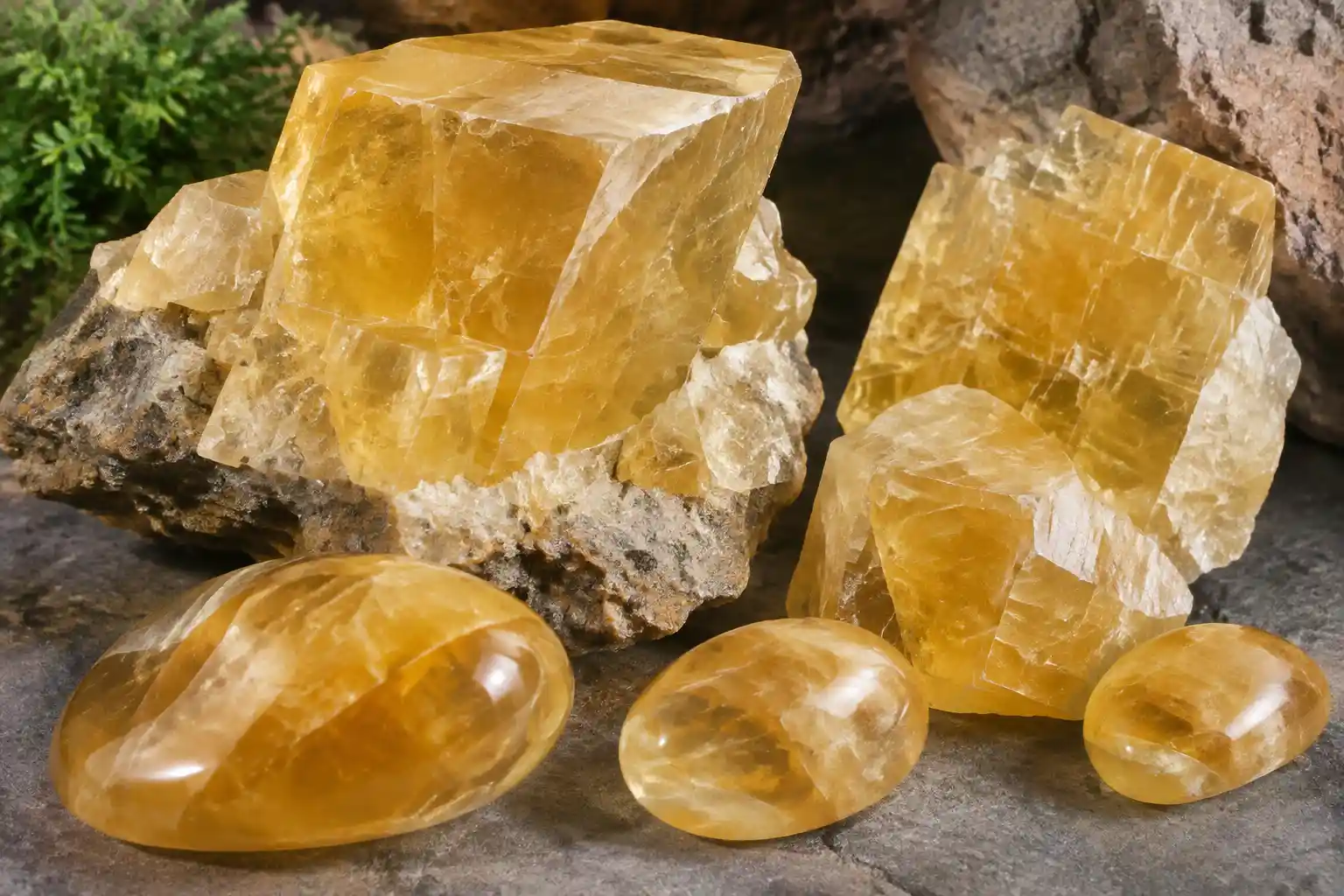
Honey Calcite benefits begin with the same mineral properties that make calcite one of the most recognizable and useful minerals in geology: calcium carbonate chemistry, perfect rhombohedral cleavage, strong birefringence in sufficiently transparent crystals, Mohs hardness 3, vigorous reaction with acids, and an extraordinary range of crystal habits. Honey Calcite is not a separate mineral species but a honey-yellow to golden-brown variety of calcite, CaCO₃, and the name is descriptive rather than a formal mineral classification. Its warm coloration may reflect iron-related impurities, inclusions, lattice defects, or combinations that differ between specimens, so the exact cause of color should not be assigned from appearance alone when analytical confirmation is unavailable.
The stone’s translucence, resinous-to-vitreous appearance, warm yellow color, and relatively easy polish have made it popular for carvings, spheres, freeforms, decorative pieces, teaching specimens, and crystal collections. Its softness, however, places clear limits on jewelry use. Calcite defines hardness 3 on the Mohs scale and also cleaves readily, so Honey Calcite can be scratched by many common objects and may split along internal structural planes after impact. These physical realities make Honey Calcite benefits strongest in collecting, education, display, carving, optical study, and protected ornamental use rather than demanding everyday rings or bracelets.
Modern spiritual traditions often associate Honey Calcite benefits with confidence, motivation, optimism, mental focus, personal power, or gradual growth because the golden color resembles sunlight, amber, and warm earth tones. Those associations can be meaningful as personal symbolism, but they are not established physiological effects. Honey Calcite does not medically increase energy, improve digestion, regulate hormones, treat anxiety, strengthen bones, or supply usable calcium to the body through ordinary wearing or handling.
9 Honey Calcite Benefits at a Glance
- Warm honey-yellow and golden coloration gives calcite distinctive decorative and collector appeal.
- Perfect rhombohedral cleavage makes Honey Calcite useful for teaching crystal structure and mineral breakage.
- Transparent examples can demonstrate strong birefringence and double refraction.
- Mohs hardness 3 provides a clear practical lesson in gemstone durability and careful handling.
- Acid reactivity makes calcite an important mineral for geological identification when testing is appropriate.
- Natural crystals, carvings, spheres, and polished pieces make Honey Calcite accessible for both beginners and experienced collectors.
- Limestone, vein, cave, and hydrothermal occurrences connect the stone with important carbonate geology.
- Identification helps distinguish Honey Calcite from aragonite, gypsum, fluorite, glass, yellow quartz, and other similarly colored stones.
- Modern symbolism can represent optimism, confidence, patience, or purposeful growth when kept separate from health claims.
Warm Golden Color Gives Honey Calcite Its Immediate Decorative Appeal
Color is one of the most obvious Honey Calcite benefits because the variety can range from pale yellow through warm honey, amber-yellow, golden brown, and slightly orange tones. Calcite itself occurs naturally in white, colorless, red, green, blue, yellow, orange, brown, gray, and many intermediate shades, so Honey Calcite belongs within an exceptionally diverse mineral species rather than standing apart chemically. The visual warmth of the yellow-brown range gives polished specimens a different character from colorless calcite or the soft green varieties commonly sold for decorative use.
The exact color mechanism is not identical in every specimen. Iron can contribute yellow, orange, or brown tones in calcite, while inclusions and structural defects may also influence appearance. For this reason, saying that every Honey Calcite crystal receives its color from one specific impurity would oversimplify natural variation. A better approach is to treat the honey color as a descriptive feature and reserve precise chemical explanations for specimens that have actually been analyzed.
These Honey Calcite benefits matter to collectors because subtle variations in translucence, saturation, luster, zoning, and crystal form can make two specimens look dramatically different even when both are sold under the same trade name. A pale translucent rhombohedron and a deep golden massive carving may both be Honey Calcite, yet their scientific and aesthetic appeal can come from entirely different features.
Rhombohedral Cleavage Makes Honey Calcite an Excellent Teaching Mineral
Perfect rhombohedral cleavage is one of the most important Honey Calcite benefits for mineral education. Calcite breaks along three directions that produce repeated rhombohedral shapes, and those surfaces reflect weaknesses built directly into the crystal structure rather than random cracking. This property allows students to see clearly how internal atomic arrangement influences the way a mineral breaks.
The same cleavage also explains why Honey Calcite requires careful handling. A large polished object may appear substantial but can chip or split after a relatively modest impact if the force reaches an unfavorable cleavage direction. A specimen dropped onto tile or stone can therefore suffer severe damage even though it looked dense and stable moments earlier.
This contrast between educational value and physical vulnerability makes Honey Calcite especially useful for understanding that beautiful minerals should not all be treated according to the same care routine. The stone’s softness and cleavage are not flaws in a geological sense. They are defining properties that help identify calcite and explain how its crystal structure behaves.
Strong Birefringence Gives Clear Calcite Exceptional Optical Interest
Sufficiently transparent calcite can show strong birefringence, commonly demonstrated as double refraction. When a clear crystal is placed over printed text or another narrow object, two images may become visible because incoming light splits into two rays traveling through the anisotropic crystal at different velocities and directions.
This phenomenon creates some of the most scientifically useful Honey Calcite benefits when the specimen is transparent enough to reveal it. Not every honey-colored piece will display obvious doubling because cloudiness, inclusions, fractures, color intensity, or massive texture can obscure the effect, but the underlying optical property belongs to calcite itself.
The mineral therefore provides an accessible introduction to crystallographic optics. A collector can move from admiring warm color to understanding how a crystal influences polarized light, refractive behavior, and viewing direction. This gives Honey Calcite a role far beyond decorative symbolism, particularly in educational collections where several calcite varieties can be compared side by side.
Mohs Hardness 3 Teaches Why Soft Gemstones Need Different Care
Calcite defines hardness 3 on the Mohs scale, so Honey Calcite can be scratched by quartz, feldspar, many metal objects, and even mineral-rich dust encountered during ordinary handling. This softness is one of the most practical Honey Calcite benefits because it demonstrates immediately why hardness should influence jewelry design, storage, polishing, and cleaning.
A highly polished sphere can gradually lose its surface sheen if wiped repeatedly with a gritty cloth, while a carving stored beside harder gemstones may develop scratches along raised edges. Rings and bracelets face even greater risk because hands regularly encounter desks, counters, tools, doors, and other hard surfaces. Pendants, display pieces, and carefully handled carvings provide much safer environments.
These considerations do not make Honey Calcite unusable. They simply define appropriate use. The general Calcite benefits of crystal education, optical study, geology, and decorative variety become easier to appreciate once softness is understood as part of the mineral’s identity rather than treated as an inconvenience.
Acid Reactivity Connects Honey Calcite with Fundamental Carbonate Geology
Calcite reacts strongly with acids because it is calcium carbonate. Even weak acids can attack the surface, while dilute hydrochloric acid produces the well-known vigorous effervescence used by geologists to identify calcite-bearing rocks. Carbon dioxide bubbles form as the carbonate component reacts, creating one of mineralogy’s most recognizable field tests.
This property gives Honey Calcite benefits a direct connection with geological practice. Limestone, marble, calcite veins, cave deposits, and other carbonate-rich rocks can often be recognized or investigated partly through acid response. At the same time, the reaction creates a practical care warning: vinegar, acidic descaling products, bathroom cleaners, citrus-based cleaners, and other acidic liquids can permanently etch polished calcite.
Testing should therefore be done responsibly. An important collector crystal or finished carving should not be damaged merely to demonstrate a property that can often be established through provenance, crystal form, professional identification, or testing on an inconspicuous fragment.
The same chemistry that helps geologists recognize calcite is exactly why ordinary household cleaning advice for harder silicate gemstones may be inappropriate for Honey Calcite.
Natural Crystals and Carvings Offer Different Ways to Appreciate the Stone
Honey Calcite benefits collectors because the stone appears in several forms that emphasize different qualities. Natural crystals can display rhombohedral or scalenohedral habits, cleavage surfaces, transparency, zoning, associated minerals, and geological context, while massive calcite can be carved into spheres, freeforms, towers, bowls, animal figures, and decorative objects that emphasize color and polish.
A natural crystal often provides more mineralogical information because growth faces and matrix relationships remain intact. A polished piece, by contrast, may reveal internal color zoning and translucence more clearly because surface irregularities have been removed. Neither form is automatically superior; each preserves a different aspect of the mineral.
This diversity also makes Honey Calcite accessible to new collectors. Small cleavage pieces and common polished objects are widely available, while unusual crystal forms, distinctive localities, fluorescent specimens, or exceptionally transparent examples can appeal to more specialized collectors.
Someone deciding where to buy Honey Calcite should therefore first decide whether the goal is a natural specimen, decorative object, carving, optical example, or spiritual keepsake, because the qualities worth prioritizing change with the intended use.
Carbonate Geology Gives Honey Calcite Scientific Value Beyond Color
Calcite is one of Earth’s most widespread carbonate minerals and occurs in sedimentary, metamorphic, hydrothermal, cave, and vein environments. It is a major component of limestone and marble, grows as stalactites and stalagmites, fills fractures, accompanies ore minerals in hydrothermal systems, and forms through numerous biological and inorganic processes.
These geological connections create Honey Calcite benefits that have nothing to do with the commercial color name. A honey-colored crystal may belong to a vein system, cavity, limestone environment, or mineralized deposit whose geological history is far more important scientifically than the hue itself.
Locality can therefore matter strongly. A documented specimen with associated minerals may reveal how fluids moved through a rock, which elements were present, and which sequence of minerals crystallized first. Removing the specimen from its context can make it more decorative while reducing the geological information it carries.
Understanding this larger role helps place Honey Calcite within carbonate mineralogy rather than treating it only as a crystal-shop product.
Identification Protects Buyers from Similar Yellow Decorative Stones
Honey-yellow stones occur across several mineral families, which makes identification another practical Honey Calcite benefit. Aragonite, gypsum, fluorite, yellow quartz, glass, resin, and other minerals or manufactured products can overlap visually with polished Honey Calcite, particularly in photographs where scale, hardness, luster, and crystal form are difficult to judge.
Calcite’s low hardness, perfect rhombohedral cleavage, acid reaction, birefringence, density, and crystal habits provide a useful combination of identification features. Professional testing becomes preferable when the specimen is valuable or when destructive methods could damage a finished object.
The commercial market can also blur names such as Honey Calcite, Golden Calcite, Yellow Calcite, and Amber Calcite. These labels often describe appearance rather than formally distinct mineral varieties, so buyers should focus on whether the stone is actually calcite and whether color, treatment, locality, and form are represented accurately.
Good identification allows the stone to be valued for what it genuinely is rather than for an attractive but misleading label.
Modern Symbolism Can Represent Optimism and Steady Personal Growth
Warm golden color explains why contemporary crystal traditions often connect Honey Calcite benefits with confidence, motivation, optimism, personal power, productivity, and gradual development. Yellow and honey tones are commonly associated with sunlight, warmth, ripeness, and energy, so the symbolism is understandable even without assuming that the stone transmits a measurable force.
Someone may keep Honey Calcite near a workspace because its color represents steady progress, choose a polished piece to mark the beginning of a new project, or use it during journaling because it reminds them to approach goals patiently. Over time, such associations can become personally meaningful because the object becomes linked with actual experience.
Beliefs surrounding Honey Calcite healing properties sometimes extend into digestion, metabolism, hormone balance, confidence disorders, physical energy, or emotional healing. Those interpretations belong to spiritual and wellness traditions rather than established clinical medicine. Honey Calcite can symbolize motivation without medically increasing energy, just as it can represent confidence without altering psychological function through skin contact.
Safe Limits Include Softness, Acid Sensitivity, Dust, and Ingestion Risks
Responsible use is essential because Honey Calcite is both physically soft and chemically reactive. Routine cleaning should generally rely on a soft dry or slightly damp cloth, while acidic cleaners, abrasive powders, steam, harsh detergents, and aggressive ultrasonic treatment are unnecessary risks. Heavily fractured or delicate crystal specimens require even gentler handling than compact carvings.
Lapidary work should control mineral dust through wet methods, ventilation, eye protection, and appropriate respiratory precautions. Although calcium carbonate is a familiar chemical compound, a collector specimen is not manufactured as a nutritional supplement and may contain impurities, surface treatments, or other minerals. Grinding Honey Calcite for ingestion or dissolving it into homemade drinking remedies is therefore inappropriate.
The best way to preserve Honey Calcite benefits is to respect what the mineral actually is: a soft calcium carbonate crystal with distinctive optical, structural, geological, and decorative qualities.
Conclusion
Honey Calcite benefits include warm golden color, rhombohedral cleavage, optical birefringence, mineral education, acid-reactivity study, carving potential, carbonate geology, identification value, collecting, and meaningful modern symbolism. Its softness and chemical sensitivity are not side notes but central characteristics that determine how the stone should be used and cared for.
The strongest Honey Calcite benefits emerge when decoration and symbolism are supported by accurate mineralogy. A well-chosen specimen can be appreciated for color, crystal form, geological history, or personal significance without promises of medical healing or guaranteed motivation. Its genuine scientific properties already provide substantial depth.
FAQs
What are the main Honey Calcite benefits?
The most practical Honey Calcite benefits include decorative appeal, mineral collecting, teaching rhombohedral cleavage, demonstrating calcite’s optical behavior, studying carbonate chemistry, carving, geological education, and mineral identification. Its warm color can also support personal symbolism involving optimism, patience, or steady growth, but those interpretations should remain separate from medical or psychological claims.
What is Honey Calcite made of?
Honey Calcite is a honey-yellow to golden-brown variety of calcite with the formula CaCO₃. The commercial color name does not define a separate mineral species, and the exact cause of coloration can vary between specimens because iron-related impurities, inclusions, defects, and other geological factors may all influence appearance.
How hard is Honey Calcite?
Honey Calcite has a Mohs hardness of 3 because it is calcite, making it much softer than quartz and most familiar transparent gemstones. The mineral also has perfect rhombohedral cleavage, so polished objects and crystals need protection from scratching, falls, strong impacts, and storage beside harder stones.
Does Honey Calcite show double refraction?
Sufficiently clear calcite can display strong birefringence, causing an object viewed through the crystal to appear doubled. Not every Honey Calcite specimen is transparent enough to show the effect dramatically, but the underlying optical property remains characteristic of calcite and makes clear specimens particularly useful for mineral education.
Why does Honey Calcite react with acid?
Calcite is calcium carbonate, and acids react with the carbonate portion of its chemistry, releasing carbon dioxide while dissolving or etching the mineral. This reaction helps geologists identify calcite, but it also means vinegar, acidic household cleaners, and similar products can damage polished Honey Calcite surfaces.
Is Honey Calcite suitable for jewelry?
Honey Calcite can be used in pendants, earrings, beads, and protected ornamental pieces, but it is poorly suited to rings or bracelets expected to withstand heavy everyday wear. Its low hardness and strong cleavage make scratches and chips relatively easy to develop, so jewelry works best when the setting and wear pattern protect the stone.
Is Honey Calcite the same as Golden Calcite?
The names Honey Calcite, Golden Calcite, Yellow Calcite, and similar commercial terms often overlap because they describe color rather than formally separate mineral species. Sellers may use the names somewhat differently, so mineral identity, actual appearance, locality, and treatment disclosure are more useful than assuming every trade label represents a distinct gemological variety.
Does Honey Calcite increase motivation or confidence?
There is no established scientific evidence that Honey Calcite directly increases motivation, confidence, concentration, or productivity through ordinary contact. A person may still use the stone as a visual reminder of a personal goal or routine, but any practical benefit comes through attention, behavior, planning, and sustained effort rather than a demonstrated physiological effect.
Does Honey Calcite have healing powers?
There is no established clinical evidence that Honey Calcite treats digestive illness, hormone problems, fatigue, anxiety, metabolic conditions, or other physical or mental-health concerns through wearing or handling. Honey Calcite benefits described as healing, motivational, confidence-related, chakra, cleansing, or energetic effects remain spiritual and personal beliefs and should not replace qualified medical or mental-health care.