Where to Buy Real Honey Calcite and Avoid Dyed Fakes
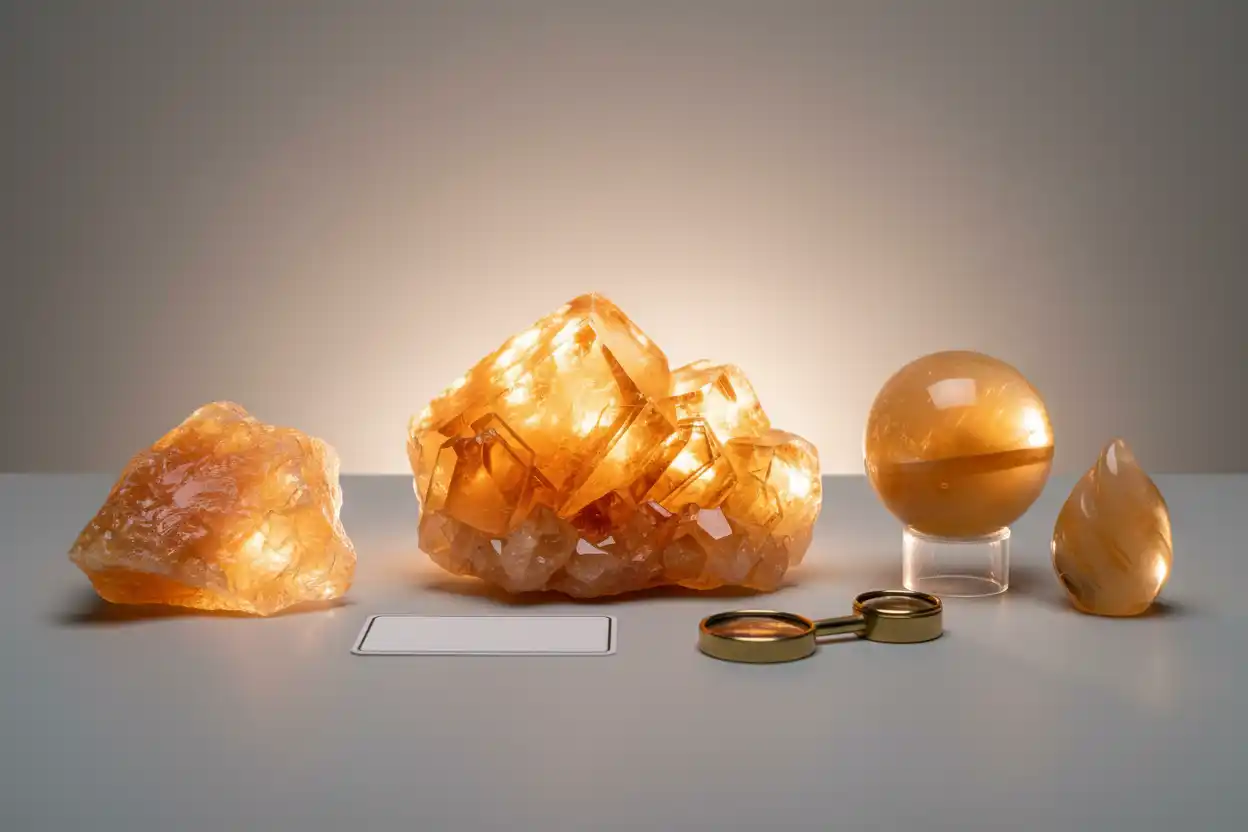
Real Honey Calcite is a honey-yellow, golden, amber-brown or warm yellow-orange variety of Calcite. It may appear as natural crystals, cleavage pieces, translucent rough, polished spheres, towers, carvings, cabochons and decorative objects.
The name describes color rather than a separate mineral species. Consequently, sellers may apply “Honey Calcite” to overlapping yellow, golden, amber and orange Calcite products. That flexible naming is not necessarily deceptive, but the item should still be identified as Calcite and its color treatment should be disclosed.
Buyers may encounter dyed white Calcite, resin-filled carvings, coated material, banded Calcite-Aragonite, yellow Fluorite, glass, Barite, Gypsum and other pale minerals under honey-related trade names.
The Honey Calcite meaning and properties guide covers the variety’s identity and traditional symbolism. This buying guide focuses on seller selection, natural color, treatment, lookalikes, durability and realistic value.
Honey Calcite Is a Color Variety of Calcite
Honey Calcite is calcium carbonate, CaCO3, with the same essential crystal structure as other Calcite varieties.
The Calcite meaning and properties guide explains the parent mineral. The types of Calcite overview separates color varieties, optical material and common crystal habits.
Commercial Honey Calcite can range from pale straw yellow to deeper golden brown. Some sellers reserve the name for warm translucent material, while others use it for almost any yellow-brown Calcite.
Those boundaries overlap with Yellow Calcite and Orange Calcite. Therefore, buy according to the actual stone’s hue, transparency, treatment and structure rather than assuming that “honey” represents a higher formal grade.
The Calcite color guide keeps color symbolism separate from mineral identification and treatment.
Choose the Product Form Before Shopping
| Honey Calcite product | Best source | Main buying concern |
|---|---|---|
| Natural crystal specimen | Specialist mineral dealer | Cleavage, repair, coating and locality |
| Cleavage rhomb | Educational mineral supplier | Correct identification and chipped edges |
| Massive rough | Lapidary supplier | Dye, internal cleavage and cutting yield |
| Sphere | Experienced carving retailer | Filled fractures, coating and hidden pale areas |
| Tower | Specialist stone seller | Repaired point, resin and misleading crystal terminology |
| Carving | Skilled lapidary retailer | Soft details, artificial color and composite construction |
| Cabochon | Independent cutter | Backing, filling and limited jewelry durability |
| Bead strand | Established bead supplier | Dyed white Calcite, glass and drill-hole fractures |
| Jewelry | Jeweler familiar with soft carbonates | Protective setting, glue and acid sensitivity |
| Banded decorative stone | Stone dealer | Calcite versus Aragonite and misleading onyx names |
The completed general Calcite buying guide owns family-wide identification. This page narrows the intent to honey-colored material and the specific treatments used to strengthen or imitate it.
Where to Buy Genuine Honey Calcite
Specialist mineral dealers
A mineral dealer is the best source for naturally crystallized specimens, documented localities and unusual crystal habits.
The listing should state the mineral, dimensions, weight, locality, condition and associated minerals. Request photographs of every face, termination and the specimen base.
Ask whether the piece was repaired, oiled, lacquered or mounted. Honey-colored oil can conceal cleavage and deepen warm color, so treatment questions matter even when the specimen is unquestionably Calcite.
Lapidary suppliers
Lapidary suppliers are appropriate for rough, slabs and carving blocks. However, Calcite’s perfect cleavage makes large finished yield uncertain.
Request dry photographs. Water and oil deepen golden color and temporarily make surface bruising less visible.
Ask whether sample spheres or carvings were produced from the same parcel. Their survival and polish provide useful evidence about structural quality.
A large block may contain several cleavage directions that reduce its practical value despite attractive color.
Gem and mineral shows
Shows let you compare Honey Calcite with Yellow Fluorite, Barite, Gypsum, Aragonite and glass under the same lighting.
Inspect the stone with a loupe. Look for rhombohedral cleavage, flat internal reflections, chipped corners, dye concentrations and resin-filled cracks.
Do not use vinegar, lemon juice or another acid. Although Calcite reacts with acid, the test permanently etches the surface and can damage the seller’s property.
Established online stores
The online gemstone buying guide explains seller verification, protected payment and return policies.
For Honey Calcite, request photographs against white and neutral-gray backgrounds. Warm photography can intensify golden color, while strong backlighting can make cloudy material appear unusually transparent.
Exact-item images are essential for spheres, towers and specimens because color and fracture density vary substantially.
Independent carvers and jewelry makers
A cutter who worked with the rough may know whether resin was needed to stabilize cleavage fractures.
Ask to see the loose cabochon or carving before mounting. Closed backs, colored adhesive and reflective foil can make pale Calcite look richer than it does by itself.
What Genuine Honey Calcite Looks Like
Natural Honey Calcite may be pale yellow, golden, amber, caramel, brownish yellow or yellow-orange. The color can be evenly distributed, zoned, clouded or concentrated near inclusions and growth features.
Transparent areas may show strong double refraction. When a clear section is placed over a line or printed mark, two images can appear because Calcite is highly birefringent.
Massive commercial material is often too cloudy for obvious doubling. Therefore, the absence of visible double refraction in a carving does not prove that it is fake.
Fresh crystal faces can have vitreous luster, while cleavage surfaces may appear pearly. Polished pieces should still show internal cleavage reflections or cloudy carbonate texture rather than the perfectly uniform body of manufactured glass.
Small surface scratches and bruised edges are common because Calcite has Mohs hardness 3. A flawless mirror-like object deserves questions about coating, although skilled polishing can also produce a strong finish.
Honey Calcite Versus Yellow Calcite
Honey Calcite and Yellow Calcite overlap substantially. Honey usually implies a warmer, deeper or browner tone, while yellow may include pale lemon and straw colors.
Neither term represents a separate approved mineral species. Consequently, two honest sellers may choose different names for the same stone.
A higher price should be based on transparency, color appeal, crystal form, size, condition or provenance—not merely on replacing “yellow” with “honey.”
Honey Calcite Versus Orange Calcite
Orange Calcite generally has a stronger orange, peach or tangerine body color. Honey Calcite tends to be more golden, amber or brownish yellow.
The boundary remains subjective, especially in stones that shift under warm and cool light.
The future guide to buying genuine Orange Calcite will own orange-specific dye, coating and color-quality questions without duplicating the honey-colored market.
Honey Calcite Versus Citrine
Citrine is yellow to orange quartz rather than Calcite. It has Mohs hardness 7, no cleavage and a different refractive character.
Honey Calcite is much softer and commonly shows rhombohedral cleavage. It may also appear cloudier and more waxy in massive carvings.
The Citrine meaning guide provides quartz-family context. A seller should not use “Honey Citrine Calcite” unless the phrase clearly distinguishes two different products.
Honey Calcite Versus Yellow Fluorite
Yellow Fluorite is calcium fluoride with Mohs hardness 4 and perfect octahedral cleavage.
Fluorite commonly crystallizes as cubes or octahedra, whereas Calcite forms numerous trigonal habits, including rhombohedra and scalenohedra.
Polished spheres can be difficult to distinguish from photographs. Raman spectroscopy, refractive testing or X-ray diffraction provides safer evidence than scratching.
Honey Calcite Versus Barite
Barite can be colorless, white, yellow, honey-colored or brown.
It is substantially denser than Calcite and may feel unusually heavy for its size. However, hand feel is not reliable enough for an expensive purchase.
Barite has different cleavage, crystal form and optical properties. A specimen sold as Honey Calcite should not receive that label based only on warm color.
Honey Calcite Versus Aragonite
Aragonite has the same calcium-carbonate formula as Calcite but a different crystal structure.
Both minerals can appear yellow, golden, brown or orange. Massive decorative material may even contain a mixture or replacement relationship between them.
An acid reaction cannot separate them because both are carbonates. Raman spectroscopy or X-ray diffraction is more appropriate.
Honey Calcite Versus Dolomite
Dolomite is a calcium-magnesium carbonate that may resemble pale Honey Calcite.
Dolomite is generally harder and has related but distinguishable rhombohedral cleavage. Mixed carbonate rock can contain both minerals.
Sellers should state whether the object is an individual Calcite crystal, massive Calcite, dolomitic marble or a mixed decorative stone.
Honey Calcite Versus Gypsum and Selenite
Gypsum is softer than Calcite and can occur in pale yellow, honey or brownish forms.
Selenite is a transparent to translucent Gypsum variety with prominent cleavage and much lower hardness.
Honey-colored polished Gypsum may be coated or stabilized. Crystal habit and instrumental testing provide safer identification than surface scratching.
Honey Calcite Versus Amber
Amber is fossilized organic resin rather than a mineral.
Amber is much lighter, often feels warmer to the touch and may contain organic debris or flow structures. Calcite is denser and shows mineral cleavage.
Color alone creates the resemblance. A seller should never use “Honey Amber Calcite” as though Amber and Calcite were the same substance.
Dyed Honey Calcite
White or pale Calcite can be dyed yellow, orange or brown.
Artificial color may concentrate along cleavage cracks, grain boundaries, cavities and surface-reaching fractures. Chipped areas may reveal a white or much paler interior.
Color can also appear blotchy beneath magnification. However, natural zoning and inclusions can create unevenness too, so several observations should be combined.
The fake-crystal buyer’s guide explains why nondestructive inspection and seller evidence are stronger than one visual clue.
A dyed stone remains Calcite, but it should not receive an untreated natural-color premium.
Oil, Wax and Surface Coatings
Oil and wax can deepen golden color and reduce the visibility of fine cleavage temporarily.
A clear lacquer or resin coating may improve gloss and protect a soft surface. However, the coating can scratch, yellow or peel differently from the underlying mineral.
Inspect corners, drill holes and worn areas for a change in luster. A thick coating may pool inside pits or create a smooth film across natural texture.
The gemstone treatments guide explains the disclosure differences among oiling, coating, filling and impregnation.
Resin Filling and Composite Construction
Large carvings and spheres may contain resin-filled cleavage cracks. Clear resin can make fractures less obvious, while color-matched filler can imitate deeper honey zoning.
Bubbles, a resinous reflection and differing ultraviolet response may support treatment.
Calcite powder or fragments can also be combined with binder and molded into decorative objects. Such composites may contain real mineral without being one solid natural piece.
A seller should distinguish minor crack filling from a polymer-rich reconstructed product.
Glass and Resin Imitations
Yellow or amber glass can imitate transparent Honey Calcite. Round bubbles, flow lines, mold seams and conchoidal chips support glass.
Resin can be molded into spheres, points and carvings. It may show soft scratches, casting seams and repeated internal swirls.
Neither glass nor resin shows Calcite’s rhombohedral cleavage and strong birefringence. Standard gemological testing separates them readily.
How to Evaluate a Natural Specimen
Crystal form
Look for plausible Calcite habits rather than molded symmetry. Rhombohedra, scalenohedra, tabular crystals and complex combinations all occur.
Color
Evaluate the piece under neutral light. Warm display lamps can shift pale yellow Calcite toward orange-brown.
Cleavage
Inspect for fresh breaks, internal flat planes and vulnerable corners. Extensive cleavage reduces value and shipping safety.
Luster
Natural faces may be vitreous, etched or partly dull. A uniform plastic gloss can indicate coating.
Transparency
Clear areas increase visual interest but can also reveal fractures. Judge transparency together with structural soundness.
Repairs
Ask whether any crystal or matrix section was reattached. Glossy adhesive should appear in the condition report.
Locality
Honey-colored Calcite is widespread. A precise mine claim requires labels or supplier records rather than appearance alone.
How to Evaluate Rough
Request dry sawn surfaces and dimensions.
Look for color depth. A thin golden surface layer over white Calcite may disappear during cutting.
Cleavage planes are more important than external size. A heavy block can split into unusable fragments before producing one sphere.
Ask whether representative pieces have survived cutting and whether resin was used.
How to Judge Spheres, Towers and Carvings
Request a complete rotation. One face may show deeper color while the reverse remains pale or heavily fractured.
A sphere should have a consistent polish without flat spots or a concealed assembly seam.
Most towers are carved rather than naturally crystallized. Check whether the tip crosses a cleavage plane or has been repaired.
Carvings should avoid thin projections. Fine details scratch and chip quickly in a Mohs 3 mineral.
Buying Beads and Jewelry
Calcite beads are vulnerable around drill holes. Inspect for radial cracks, dye and resin.
Natural strands may vary in color and translucency. Completely identical amber beads can indicate glass, resin or heavy treatment.
Pendants and earrings are more practical than rings and bracelets. The gemstone hardness chart explains Calcite’s low scratch resistance.
The gemstone cleavage guide and toughness-versus-hardness guide explain why impact and setting pressure can split the stone.
Price and Value
Common Honey Calcite rough and carvings are generally affordable. Fine natural crystals, strong transparency, attractive zoning, large intact forms and documented localities may command more.
Value depends on color, crystal development, transparency, size, condition, treatment, cutting quality and provenance.
A large carving with several filled cleavage cracks should not automatically cost more than a smaller untreated crystal.
Similarly, the word “honey” should not create a premium without observable quality.
The gemstone pricing guide explains how labor, usable yield, treatment and seller overhead affect retail cost.
Questions to Ask the Seller
Ask whether the item is natural-color Calcite and how the seller distinguishes Honey Calcite from Yellow or Orange Calcite.
Request disclosure of dye, oil, wax, lacquer, resin, filling, coating and repair.
For specimens, ask for the base and every crystal face. For spheres and towers, request a full rotation. For beads, request close-ups of drill holes.
Ask whether the exact pictured piece will ship and whether photographs were taken while the item was wet or oiled.
Finally, obtain a return policy that allows ordinary visual and gemological inspection.
Professional Identification
A gemologist can identify Calcite through refractive properties, strong birefringence, specific gravity and microscopy.
Raman spectroscopy and X-ray diffraction can separate it from Aragonite, Dolomite, Fluorite, Barite, Gypsum and glass.
Microscopy may reveal dye concentrations, coatings and resin-filled fractures. Spectroscopic testing can provide stronger evidence for artificial color and polymers.
Confirming Calcite does not automatically prove that the honey color is natural. Treatment assessment must examine the colored areas directly.
Ethical Sourcing and Care
The ethical crystal sourcing guide provides practical questions about legal extraction, cutting labor and traceability.
Avoid acids, descalers, vinegar, lemon juice and abrasive cleaners. Even weak acids etch Calcite.
Use a soft dry cloth or a slightly damp cloth followed by prompt drying. Do not soak dyed, filled, coated or glued objects.
For traditional practices, the completed Calcite cleansing and charging guide offers non-destructive options without presenting metaphysical beliefs as scientific effects.
Store Honey Calcite away from quartz and harder gemstones. Support specimens from their bases rather than lifting them by exposed crystals.
Frequently Asked Questions
1. Is Honey Calcite a separate mineral species?
No. It is a honey-colored commercial variety of Calcite.
2. Is Honey Calcite the same as Yellow Calcite?
The names overlap. Honey usually implies a warmer golden or brownish-yellow color, but no formal boundary separates them.
3. How is Honey Calcite different from Orange Calcite?
Honey Calcite generally appears more golden or amber, while Orange Calcite has stronger peach, tangerine or orange tones.
4. Can Honey Calcite be dyed?
Yes. Pale Calcite can be dyed yellow, orange or brown, particularly along cleavage cracks and porous areas.
5. Does deep golden color prove treatment?
No. Natural Calcite can be strongly honey-colored. Color distribution, mineral structure and seller evidence matter more than intensity alone.
6. Is Honey Calcite the same as Citrine?
No. Citrine is quartz, while Honey Calcite is calcium carbonate.
7. Is Honey Calcite the same as Amber?
No. Amber is fossilized organic resin, whereas Honey Calcite is a mineral.
8. Can Honey Calcite contain resin?
Yes. Cleavage cracks in spheres, towers and carvings may be filled or stabilized.
9. Is Honey Calcite suitable for everyday rings?
Generally, no. Its low hardness, perfect cleavage and acid sensitivity make exposed daily wear impractical.
10. Should I test it with vinegar?
No. Vinegar permanently etches Calcite and should not be used as a home authenticity test.
11. Do ordinary pieces need laboratory reports?
Usually not. Testing is most useful for valuable crystals, uncertain polished objects or disputed natural color.
12. What is the biggest warning sign in a listing?
Be cautious when a flawless dark-gold carving has no cleavage, treatment, dry-photo or reverse-view information.
Buy the Calcite Beneath the Honey-Colored Label
Honey Calcite should remain identifiable as Calcite after the color description is removed. Cleavage, softness, optical behavior, construction and treatment matter more than whether a seller calls the same shade honey, golden or amber.
The H crystal directory, H gemstone directory and visual gemstone guide provide broader comparisons. Choose the piece whose color and physical limitations are explained as clearly as its appearance.
Safety note: Calcite dust can irritate the eyes and respiratory system, while acids permanently damage the mineral. Avoid dry cutting, drilling, grinding or sanding. Lapidary work requires wet methods, effective extraction and appropriate eye and respiratory protection.