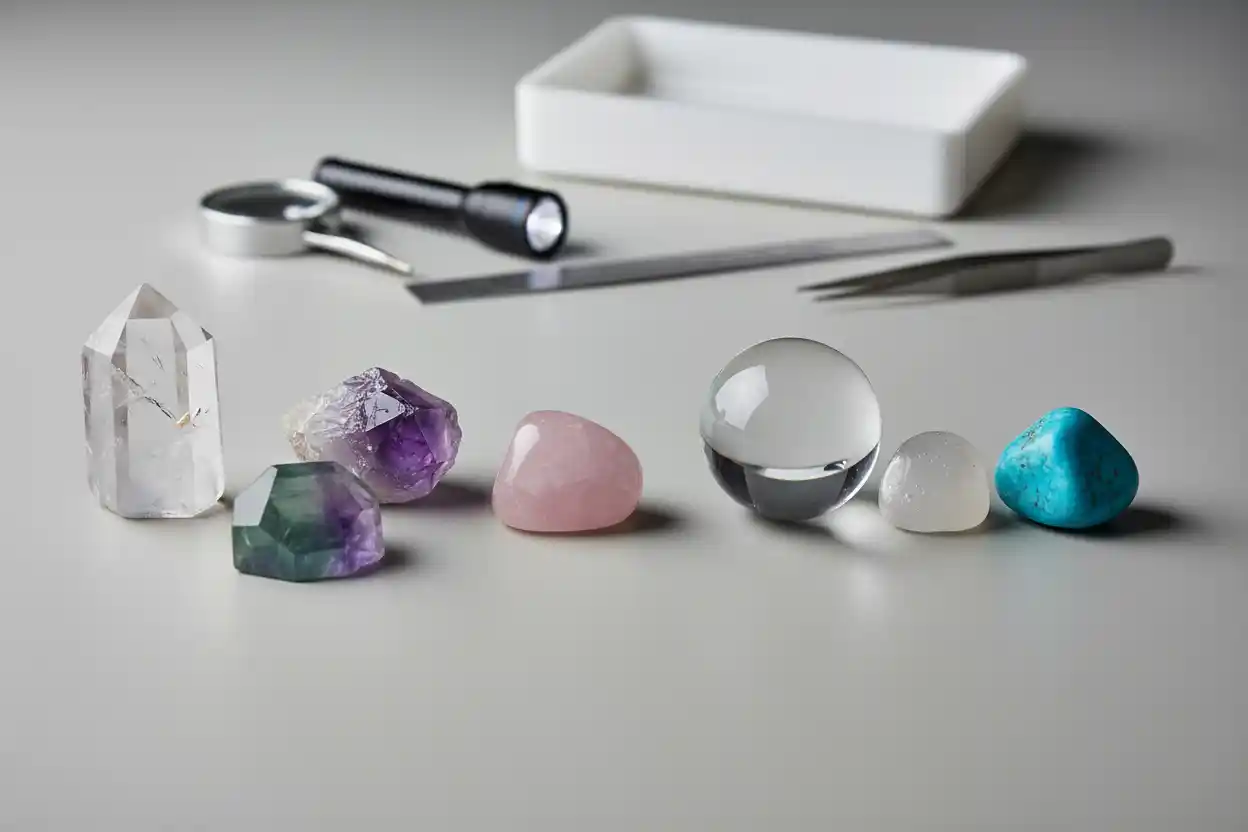
How to Tell If a Crystal Is Real: 5 Reliable Checks Before You Buy
Learning how to tell if a crystal is real starts with defining what “real” means. A natural quartz crystal, laboratory-grown quartz, dyed natural agate, glass imitation, reconstructed turquoise, and coated stone can all look convincing, yet they belong to different gemological categories. A synthetic gem is not automatically fake because it can share essentially the same chemistry and crystal structure as its natural counterpart, while an imitation only resembles another gem without sharing its fundamental identity.
The safest way to tell if a crystal is real is to combine several observations rather than trust one viral trick. Color, inclusions, crystal habit, hardness, luster, density, optical behavior, treatments, seller disclosure, and provenance can all provide clues. Expensive or difficult stones may require professional gemological testing because natural and laboratory-grown crystals can sometimes look virtually identical without specialized instruments.
Home inspection is most useful for spotting obvious warning signs and deciding when more evidence is needed. Scratch tests, fire, chemicals, knives, ice, and other destructive tricks can damage genuine gemstones and still produce misleading results.
How to Tell If a Crystal Is Real in 5 Reliable Steps
- Identify what mineral or gem the seller claims it is before testing anything.
- Examine color, transparency, inclusions, bubbles, growth features, and surface texture under magnification.
- Compare hardness, luster, density, cleavage, and other physical properties with the claimed identity.
- Check whether dye, coatings, heat, irradiation, filling, stabilization, assembly, or laboratory growth could explain the appearance.
- Use a qualified gemologist or reputable laboratory when origin or treatment affects substantial value.
Step 1: Start With the Claimed Identity, Not a Generic “Real Crystal” Test
The first step in how to tell if a crystal is real is asking what it is supposed to be. There is no universal test that separates every natural mineral from every imitation. Quartz, fluorite, calcite, tourmaline, turquoise, amber, obsidian, ruby, and opal have different chemistry and physical properties, so each requires different evidence.
This also explains the crystals vs gemstones difference. Quartz can be both a mineral crystal and a gemstone, while obsidian is natural volcanic glass and amber is fossilized resin. Calling an item a crystal in a shop does not establish its scientific category.
Ask the seller for the specific mineral name, whether it is natural or laboratory-grown, whether it has been treated, and whether the color is natural. For an expensive specimen, ask for locality information or an independent gem report when appropriate.
How to tell if a crystal is real becomes much easier once the claim is specific enough to test. “Natural untreated amethyst from Brazil” contains far more verifiable information than “high-vibration purple crystal.”
Step 2: Examine Inclusions, Bubbles, Color, and Growth Features
A hand lens can reveal some of the strongest clues when learning how to tell if a crystal is real. Natural gems often contain internal crystals, fluid inclusions, needles, partially healed fractures, growth zoning, clouds, or other features created during geological formation. These inclusions are not universal proof of natural origin, but their character can provide useful evidence.
Glass imitations may contain rounded gas bubbles, flow lines, or molded surface features. Plastic may show scratches, seams, unusually low density, or surface wear unlike the claimed mineral. Dyed stones can concentrate color inside fractures, cavities, or porous regions rather than displaying a natural distribution.
Yet bubbles do not prove every transparent stone is fake, and a perfectly clean gem is not automatically synthetic. Laboratory-grown crystals can contain their own distinctive inclusions and growth patterns. Some natural gems are exceptionally clean, while some synthetics deliberately mimic natural appearance.
How to tell if a crystal is real therefore requires patterns of evidence. One inclusion should rarely decide the diagnosis by itself.
Step 3: Compare Hardness and Physical Properties Carefully
Physical properties can narrow identification when they are used correctly. A crystal hardness chart shows that gypsum sits around Mohs 2, calcite at 3, fluorite at 4, quartz at 7, topaz at 8, corundum at 9, and diamond at 10.
If a supposed quartz specimen scratches extremely easily, something deserves investigation. If a supposed calcite piece effortlessly scratches genuine quartz, the identification is probably wrong. Hardness can therefore contribute to how to tell if a crystal is real, but deliberate scratch testing is a poor choice for valuable finished pieces because it causes permanent damage.
Other properties can be equally informative. Calcite shows strong cleavage and may display double refraction in clear pieces. Fluorite has characteristic cleavage. Quartz has conchoidal fracture and no true cleavage. Pyrite has a metallic luster and substantial density. Genuine amber feels much lighter than most mineral gems of similar size.
Professional gemologists add refractive index, specific gravity, microscopic examination, spectroscopy, fluorescence, polarization behavior, and other tests. These methods show why simple home tricks cannot replace proper identification when the financial stakes are high.
Step 4: Separate Natural, Synthetic, Treated, and Imitation Stones
One of the most important lessons in how to tell if a crystal is real is that the answer is not always yes or no. Gemology recognizes several categories that sellers and buyers sometimes blur together.
A laboratory-grown ruby is synthetic corundum. It has essentially the same fundamental chemical composition and crystal structure as natural ruby but formed through human-controlled growth rather than geological processes. It is a real synthetic ruby, not natural ruby.
Cubic zirconia used to resemble diamond is different. It is a simulant because its chemistry and structure differ from diamond even though the appearance can be similar. Glass can imitate quartz, emerald, malachite, opal, and numerous other gems without becoming those substances.
Treatment creates another category. Natural amethyst may be heated, turquoise may be stabilized, agate may be dyed, topaz may be irradiated and heated, and fractures in some gems can be filled. The underlying gemstone can remain genuine while its appearance has been altered.
How to tell if a crystal is real therefore includes asking whether the description accurately discloses natural origin, synthesis, treatment, assembly, or imitation.
Step 5: Use Professional Testing When the Answer Affects Value
Some distinctions cannot be made reliably by sight. High-quality natural and synthetic ruby, sapphire, emerald, diamond, quartz, and other gems can require trained examination and specialized instruments.
This is particularly important when how to tell if a crystal is real affects a substantial purchase. A stone offered as a valuable untreated natural sapphire deserves a higher standard of evidence than a $5 decorative quartz pebble. Origin, treatment, and laboratory growth can change market value dramatically even when two gems look nearly identical.
A professional report can establish identity and, depending on the gem and laboratory service, may address natural versus laboratory-grown origin, detectable treatments, or geographic origin. Reports should come from reputable independent laboratories rather than a certificate created only by the seller.
Home tests remain useful for obvious imitations, but confidence should match the quality of the evidence. The more expensive or unusual the claim, the less sensible it is to rely on a freezer, flashlight, lighter, or social-media trick.
Why Perfect Color Does Not Automatically Mean a Crystal Is Fake
People learning how to tell if a crystal is real are often told that natural stones must contain imperfections. That rule is too simple. Natural gems range from heavily included to exceptionally clean, and some naturally occurring crystals develop intense, even color.
What matters is whether the observed features fit the claimed mineral and origin. Natural amethyst can display strong purple color and zoning. Fine aquamarine can appear remarkably clear. High-quality quartz can contain few eye-visible inclusions.
Conversely, an imitation can contain deliberate flaws. Glass may be manufactured with color variation, while synthetic gems can contain inclusions produced by their growth method. Some treated stones begin as genuine natural crystals before humans alter color or clarity.
How to tell if a crystal is real requires interpretation rather than an imperfection checklist. Too much uniformity can justify closer examination, but it does not prove artificial origin.
Why the Temperature Test Is Weak Evidence
A popular claim says real crystals always feel cold while plastic or glass warms immediately. Thermal conductivity and heat capacity do affect how objects feel, but the test is highly dependent on size, room temperature, skin temperature, thickness, and the substance being compared.
Glass can also feel cool. A small genuine mineral warms quickly in the hand. Two natural stones with different thermal properties may feel different despite both being authentic.
Temperature can therefore form only a minor clue in how to tell if a crystal is real. It cannot establish species, natural origin, treatment, or laboratory growth.
Similar caution applies to weight. Plastic often feels unusually light, but glass and cubic zirconia may be relatively heavy. Density becomes useful when measured properly rather than guessed by holding the object.
Why Bubbles Do Not Create a Universal Fake-Crystal Rule
Rounded bubbles inside an apparent gemstone often suggest glass, particularly when they occur with flow structures or other glass-like features. This makes magnification valuable when investigating how to tell if a crystal is real.
However, the rule should not become “any bubble means fake.” Natural minerals can contain fluid inclusions, negative crystals, cavities, or multiphase inclusions that an inexperienced viewer may describe as bubbles. Synthetic growth can create additional inclusion types.
Shape, context, optical appearance, and association with other features matter. A gemologist distinguishes a gas bubble in manufactured glass from a natural fluid inclusion by examining more than the fact that something round appears under magnification.
One suspicious feature should trigger closer investigation rather than an immediate verdict.
Why Scratch, Burn, and Chemical Tests Can Cost More Than They Prove
Destructive internet tests are among the worst ways to approach how to tell if a crystal is real. Scratching a polished stone can lower its value even when the result supports the identification. Flame can damage amber, resin, coatings, adhesives, fracture fillers, and heat-sensitive gemstones. Acid tests can permanently etch carbonate minerals and create chemical hazards.
Some tests are also logically weak. Scratching glass only establishes that the test object is harder than that piece of glass. Quartz, topaz, corundum, several garnets, beryl, and numerous other minerals can all do that. It does not prove a particular identity.
Protect the specimen first. Observation, seller disclosure, documentation, non-destructive gemological measurements, and professional testing usually provide better evidence than deliberately damaging the object you are trying to authenticate.
Seller Language Can Reveal Identification Problems
How to tell if a crystal is real also involves evaluating the description. Trade names are not always mineral names. “Cherry quartz” commonly describes manufactured glass rather than a natural quartz variety, while other marketing names can obscure dye, coatings, composites, or unrelated minerals.
Ask direct questions: What mineral species is this? Is it naturally mined or laboratory-grown? Has it been dyed, heated, irradiated, filled, coated, stabilized, or assembled? What locality is claimed, and what supports that claim?
A trustworthy seller does not need to know everything, but should distinguish fact from uncertainty. Statements about healing power, rarity, vibration, or spiritual strength cannot substitute for mineral identification.
When how to tell if a crystal is real influences your buying decision, clear disclosure is often as important as visual inspection.
Conclusion
How to tell if a crystal is real requires more than checking for bubbles or seeing whether it feels cold. Start with the claimed identity, inspect inclusions and growth features, compare appropriate physical properties, distinguish natural stones from synthetics and imitations, and seek professional testing when value justifies it.
“Real” is not one simple category. A laboratory-grown ruby can be genuine synthetic corundum, a dyed agate can be genuine treated agate, and glass can imitate both. Accurate terminology produces a much more reliable answer than any one home trick.
FAQs
How to Tell If a Crystal Is Real at Home?
Start with its claimed mineral identity, inspect it under magnification, compare known physical properties, and look for signs of glass, plastic, dye, coating, or assembly. Avoid destructive tests.
How to Tell If a Crystal Is Real by Looking at It?
Natural inclusions, growth zoning, crystal habit, luster, surface texture, and fracture features can provide clues, but visual inspection alone cannot identify every synthetic or treated gem.
Do Bubbles Mean a Crystal Is Fake?
Rounded gas bubbles may indicate glass, but natural fluid inclusions can also appear rounded. The complete inclusion pattern needs interpretation.
Does a Real Crystal Have to Contain Imperfections?
No. Some natural gems are exceptionally clean, while synthetic and imitation stones can contain inclusions. Imperfections alone do not prove natural origin.
Can Real Crystals Be Laboratory-Grown?
Yes. Synthetic quartz, ruby, sapphire, emerald, and other gems can have essentially the same basic chemistry and crystal structure as natural counterparts while forming in a laboratory.
Is Dyed Agate Still a Real Crystal?
The underlying agate can be genuine natural chalcedony even when its color has been altered by dye. Accurate disclosure should describe the treatment.
Can Hardness Tell If a Crystal Is Real?
Hardness can help rule out some possibilities, but it rarely proves identity by itself. Destructive scratch tests should be avoided on valuable specimens.
What Is the Most Reliable Way to Tell If an Expensive Crystal Is Real?
Independent gemological testing is the strongest approach when natural origin, treatment, or synthesis significantly affects value.
How to Tell If a Crystal Is Real Before Buying Online?
Ask for exact mineral identity, natural or synthetic origin, treatment disclosure, clear close-up images, dimensions, locality information when claimed, and an independent report for valuable gems.