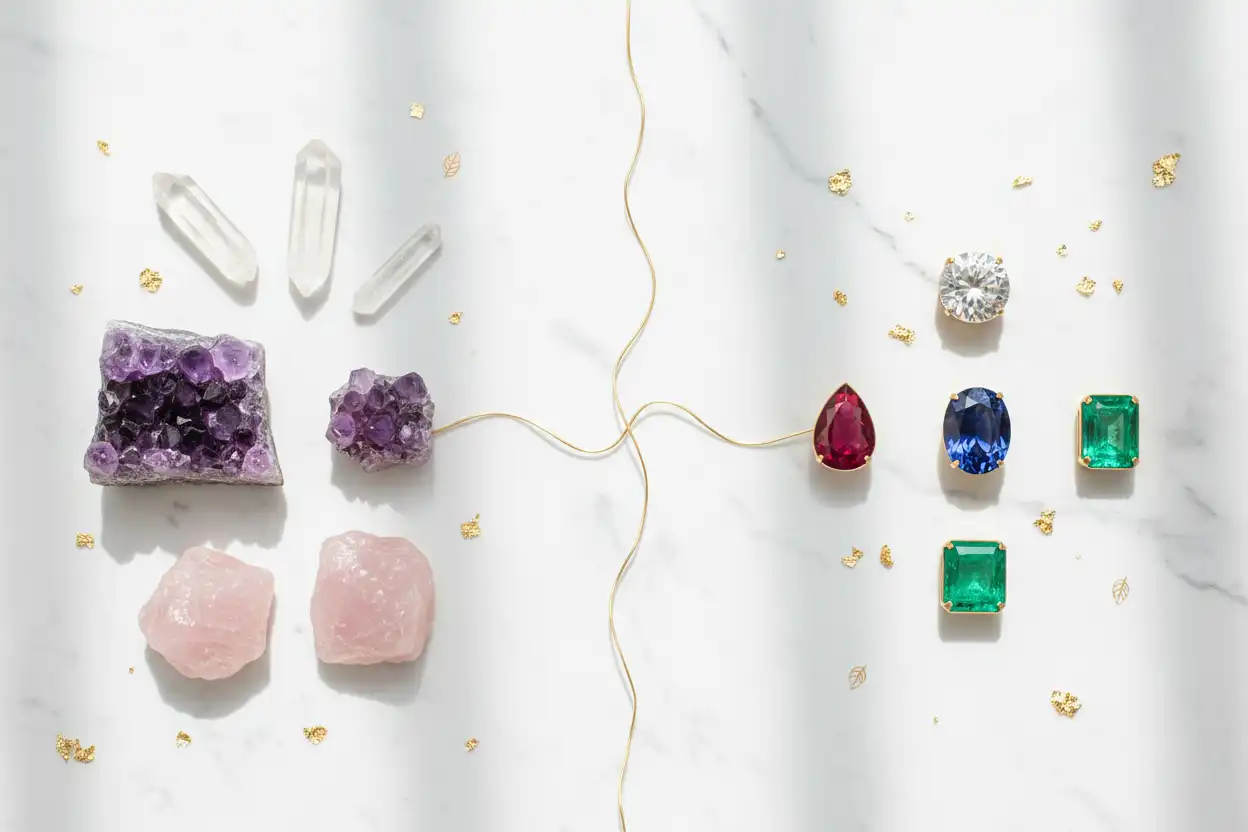
Crystals vs Gemstones Difference: 7 Key Distinctions That Actually Matter
The crystals vs gemstones difference is mainly a difference between structure and use. In mineralogy, a crystal is a solid with an orderly, repeating internal arrangement of atoms. A gemstone is a natural or laboratory-grown gem substance valued for qualities such as beauty, durability, rarity, optical appearance, and suitability for cutting, polishing, jewelry, carving, or collecting. Those definitions overlap, but they are not interchangeable.
Many familiar gemstones are crystalline minerals. Diamond, ruby, sapphire, emerald, quartz, topaz, spinel, and tourmaline all have ordered crystal structures. Yet not every crystal is a gemstone, and not every gemstone is a crystal in the strict scientific sense. Amber is fossilized resin, pearl is organic, lapis lazuli is a rock, and obsidian is natural volcanic glass without long-range crystal structure.
Understanding the crystals vs gemstones difference helps with identification, buying, care, and pricing because an attractive object sold in a crystal shop may actually be a mineral, rock, glass, organic gem, synthetic crystal, or imitation.
7 Crystals vs Gemstones Difference Facts That Clear Up the Confusion
- Crystal describes orderly internal atomic structure, while gemstone describes a substance valued for gem use.
- Many gemstones are crystals, but only a small fraction of crystalline minerals become important gems.
- Some accepted gemstones are rocks, organic substances, or amorphous solids rather than crystals.
- A crystal does not need visible natural faces to remain crystalline after cutting or polishing.
- Laboratory-grown ruby, sapphire, quartz, and other synthetic gems can be crystals even though they did not form naturally.
- Gem value depends on quality, rarity, demand, treatment, craftsmanship, and provenance rather than crystal structure alone.
- Accurate identification requires more than deciding whether something looks like a crystal or gemstone.
Crystals vs Gemstones Difference Starts With the Scientific Meaning of Crystal
The first crystals vs gemstones difference comes from crystallography. A crystal has an ordered internal arrangement that repeats through three dimensions. That organization can produce recognizable symmetry and natural faces when growth conditions allow enough room, although visible faces are not required for something to remain crystalline.
Quartz provides an easy example. A natural quartz point may show a six-sided prism and termination because its external shape reflects its trigonal structure. If the same quartz is cut into a sphere, bead, cabochon, or faceted gem, the natural faces disappear while the internal crystalline structure remains.
Minerals are usually crystalline, but the scientific definition of a mineral also normally requires natural formation. Laboratory-grown quartz can be a genuine crystal without being a naturally formed mineral specimen. This distinction explains why commercial use of the word crystal can be loose. Obsidian, amber, opal, and other noncrystalline substances may be sold within the crystal trade even though scientific terminology is narrower.
Gemstone Is a Use and Quality Category, Not a Crystal System
The second crystals vs gemstones difference is that gemstone is not a crystal system or mineral class. Gemologists use the term for substances prized for appearance and suitable gem use. Beauty, durability, rarity, fashion, cutting potential, cultural importance, and demand all influence whether a substance gains gemstone status.
Corundum shows how selective the category can be. Corundum is a mineral species, red gem-quality corundum is ruby, and other gem colors are sapphire. Large quantities of natural corundum are not desirable gemstones. Quartz is abundant, yet amethyst, citrine, rock crystal, agate, and other attractive varieties have established gem uses.
The crystals vs gemstones difference therefore does not make gemstones scientifically superior crystals. A common quartz specimen can show excellent natural crystal form without high gem value, while an included emerald can remain a valuable gemstone because color, identity, rarity, and demand matter.
Not All Gemstones Are Crystals
One of the clearest examples of the crystals vs gemstones difference comes from accepted gems that are not conventional mineral crystals. Amber is fossilized plant resin. Pearl forms biologically within mollusks and combines calcium carbonate with organic components. Both have major gemological importance without fitting the normal definition of a mineral crystal.
Lapis lazuli is a rock composed of several minerals, commonly including blue lazurite with calcite, pyrite, and other constituents. Obsidian is natural volcanic glass whose atoms lack the long-range ordered arrangement of a true crystal. Opal is generally treated as a mineraloid because its silica structure lacks the long-range crystalline order of quartz.
These examples make the crystals vs gemstones difference straightforward: gem status can extend beyond crystals. Color, polish, rarity, history, cultural importance, and decorative use can all create gem significance.
Not All Crystals Are Gemstones
The reverse is equally important. Thousands of mineral species form crystals, but only a relatively small group has sustained gem use. A mineral can be scientifically fascinating without having the color, transparency, durability, size, polish, rarity, or demand usually associated with a gemstone.
Mineral collectors may value a specimen because its crystals remain uncut. Sharp faces, rare habits, unusual mineral associations, locality, matrix, luster, and intact terminations can make a natural specimen desirable even when nobody would facet it for jewelry. Some fragile minerals are outstanding collection crystals but poor choices for wearable gems.
The crystals vs gemstones difference also changes how quality is judged. A collector may prioritize crystal form and locality, while a sapphire buyer may focus on color, clarity, cut, carat weight, treatment, and origin. Asking are crystals worth it therefore depends on what the buyer wants from the specimen rather than whether it carries one label or the other.
Natural Crystal Shape and Cut Gem Shape Are Different
A common crystals vs gemstones difference misconception is that raw points are crystals while anything polished becomes a gemstone. Cutting does not decide whether a substance is crystalline. A faceted ruby still has a crystal lattice, a polished quartz sphere remains crystalline quartz, and a raw piece of obsidian remains noncrystalline glass.
Natural crystal habit develops during growth. Quartz commonly forms prisms, pyrite can form cubes, fluorite can form cubes or octahedral shapes, and tourmaline commonly forms elongated prisms. Lapidaries later turn rough into cabochons, beads, faceted gems, spheres, carvings, or freeforms.
External shape can therefore change completely without changing internal structure. A carved six-sided tower is not automatically a naturally terminated crystal, and a polished gemstone does not stop being crystalline simply because its original faces have been removed.
Synthetic Crystals Can Be Real Gems Without Being Natural Minerals
Laboratory-grown stones add another important crystals vs gemstones difference. Synthetic ruby, sapphire, spinel, emerald, and quartz can have essentially the same fundamental chemistry and crystal structure as their natural counterparts. They are genuine synthetic crystals rather than automatically being fake glass.
Origin is the key difference. Natural ruby forms through geological processes, while synthetic ruby grows under controlled laboratory conditions. An imitation is different again. Red glass can resemble ruby without having corundum chemistry, while cubic zirconia and moissanite can resemble diamond while remaining distinct crystalline substances.
Knowing how to tell if a crystal is real starts with defining what “real” means: natural, synthetic, treated, assembled, or imitation. Visual appearance alone often cannot establish origin.
The crystals vs gemstones difference therefore helps with terminology, but gemological testing may still be needed for expensive or uncertain stones.
Hardness, Durability, and Value Do Not Define the Difference
Another crystals vs gemstones difference myth is that gemstones are hard while crystals are fragile. Both categories vary widely. Gypsum is crystalline at Mohs 2, quartz at 7, corundum at 9, and diamond at 10. Gemstones range from soft amber and turquoise to very hard sapphire and diamond.
The crystal hardness chart helps compare scratch resistance, but hardness alone cannot determine gemstone status. Toughness, cleavage, porosity, treatments, heat stability, and chemical sensitivity all matter to durability.
Value also crosses both categories. An ordinary polished stone may cost only a few dollars, while exceptional mineral crystals can command very high prices because of rarity, form, locality, condition, aesthetics, or provenance. Gemstones gain value through factors such as color, transparency, optical effects, size, cutting, treatment status, origin, and market demand.
The useful crystals vs gemstones difference is not cheap versus expensive or weak versus durable. It is structure versus gem use.
How Buyers Can Use the Crystals vs Gemstones Difference
Understanding the crystals vs gemstones difference makes shopping questions more precise. Instead of asking only whether an item is a crystal, ask for its actual identity. Is it quartz, fluorite, obsidian, amber, lapis lazuli, glass, synthetic corundum, dyed agate, or something else? Then ask whether it is natural, synthetic, treated, assembled, or imitated.
For a mineral specimen, locality and crystal condition may matter greatly. For a cut gemstone, treatment disclosure, color, cutting, durability, and gemological identification may be more important. A carved decorative stone can fall between those collecting traditions.
Care also becomes easier once identity is established. Quartz and amber should not receive the same treatment, while fluorite and sapphire tolerate abrasion very differently. Accurate identification is more useful than relying on the generic word crystal.
Conclusion
The crystals vs gemstones difference becomes simple once structure and use are separated. A crystal has an orderly repeating internal structure, while a gemstone is valued for gem use because of beauty, durability, rarity, optical qualities, craftsmanship, or cultural significance.
Many gemstones are crystals, but some gems are rocks, organic substances, or amorphous solids. Many crystals never become gemstones. Knowing identity, origin, treatment, durability, and intended use tells you far more than either label by itself.
FAQs
What Is the Main Crystals vs Gemstones Difference?
The main crystals vs gemstones difference is that crystal describes internal atomic order, while gemstone describes a substance valued and used as a gem.
Are All Gemstones Crystals?
No. Amber is fossilized resin, pearl is organic, lapis lazuli is a rock, and obsidian is natural glass. All can have gem use without being conventional mineral crystals.
Are All Crystals Gemstones?
No. Many crystalline minerals have scientific or collector interest but lack the qualities or demand that give them established gemstone use.
Is Quartz a Crystal or a Gemstone?
Quartz is a crystalline mineral. Desirable varieties such as amethyst, citrine, rock crystal, agate, and chalcedony can also have gemstone use.
Is Obsidian a Crystal or a Gemstone?
Obsidian is amorphous volcanic glass rather than a true crystal. It can still function as a gem or ornamental stone when cut and polished.
Are Lab-Grown Gemstones Real Crystals?
Many are. Synthetic ruby, sapphire, emerald, spinel, and quartz can possess ordered crystal structures and essentially the same fundamental chemistry as their natural counterparts.
Does Polishing a Crystal Turn It Into a Gemstone?
No. Polishing changes external shape and surface finish but does not determine whether the substance has an internal crystal structure or commercial gemstone status.
Are Gemstones Always More Valuable Than Crystals?
No. Value depends on rarity, quality, provenance, condition, demand, treatment, craftsmanship, and many other factors.
Why Does the Crystals vs Gemstones Difference Matter When Buying?
It helps buyers ask better questions about identity, origin, treatment, durability, quality, and value instead of relying on vague trade labels.