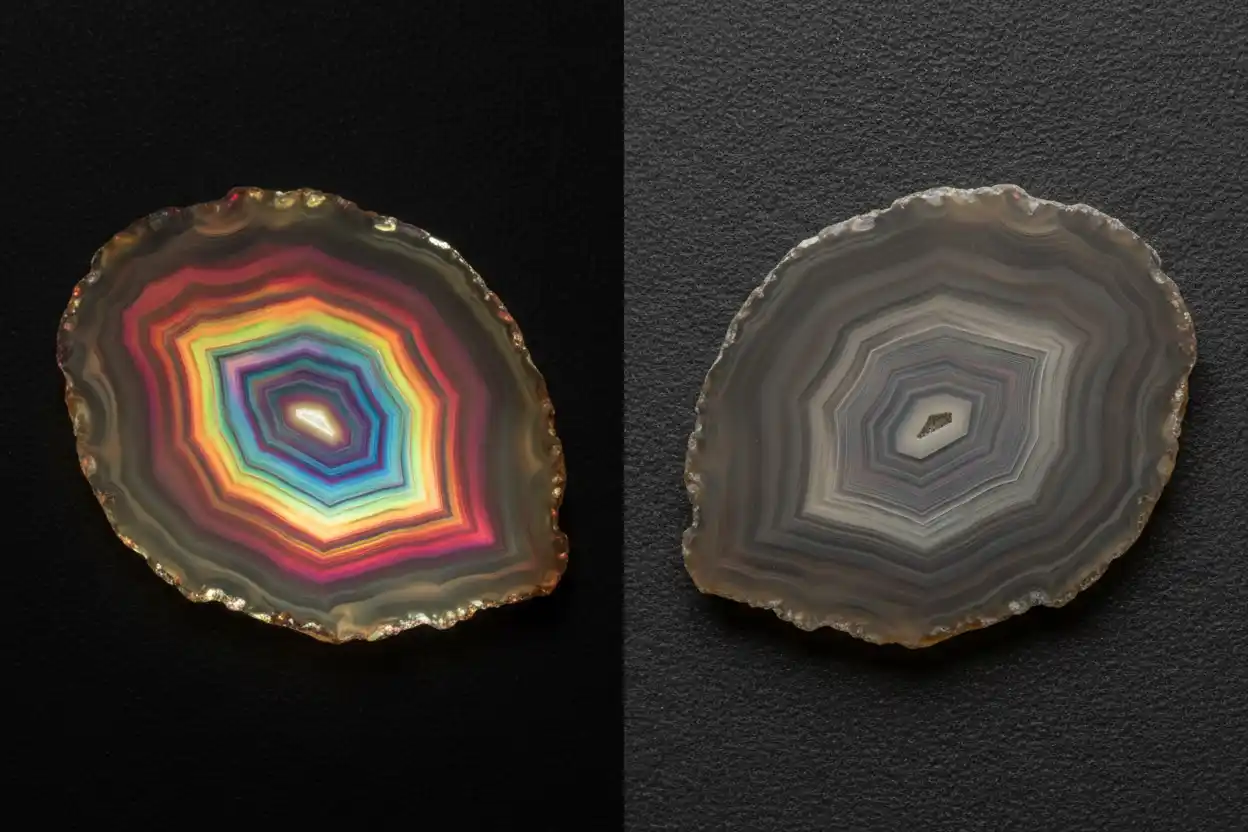
Iris Agate Meaning: Properties, Uses & Symbolism
Iris agate is not a separate mineral species with a mysterious rainbow pigment hidden inside it. It is agate—a banded form of chalcedony—that can display spectral colors when sufficiently fine internal banding interacts with transmitted light. GIA describes agate as fibrous cryptocrystalline silica composed largely of quartz intergrown with moganite, and specifically applies the term iris agate to agate that reveals iridescence when cut into suitably thin, doubly polished slabs and viewed with light passing through the material. The rainbow is therefore an optical phenomenon produced by microscopic structure rather than a permanent multicolored body color painted through the stone.
That distinction is central to iris agate meaning because many commercial descriptions blur three different subjects: what the material physically is, what produces its rainbow appearance, and what people symbolically associate with that appearance. Mineralogically, iris agate belongs to the chalcedony-agate family. Historically, its unusual transmitted-light effect attracted scientific investigation because its periodic internal structure behaves as a natural diffraction grating. Symbolically, modern crystal traditions may interpret its spectrum as representing perspective, variety, creativity, or change, but those interpretations are cultural and personal rather than experimentally demonstrated properties of silica.
This article keeps those levels separate. It explains the stone’s identity, formation, optical behavior, diagnostic traits, documented history, responsible symbolism, and safe ownership. More specialized Iris Agate topics remain on their own mapped pages, while the broader Gemstone Guides category provides context for other material-first gemstone references.
Iris Agate at a Glance
| Feature | Evidence-based description |
|---|---|
| Material identity | Agate, a banded variety of chalcedony |
| Principal material | Silica, dominated by fibrous microcrystalline quartz with moganite intergrowth |
| Defining feature | Iridescent spectral colors seen in transmitted light in suitably structured, thin material |
| Cause of rainbow effect | Diffraction associated with extremely fine periodic internal structure |
| Normal body appearance | Often pale, translucent, grayish, white, brownish, or conventionally banded before strong backlighting |
| Separate mineral species? | No |
| Same as fire agate? | No; the optical behavior and observation geometry differ |
| Same as dyed “rainbow agate”? | Not necessarily; dye can create body color but does not establish an iris diffraction effect |
| Best viewing condition | Transmitted light through a thin polished section |
| Can a photograph prove identity? | No; photography can document the effect but not establish the entire material identity |
| Symbolic interpretations | Modern cultural or personal associations, not scientifically demonstrated powers |
| Safety principle | Handle intact specimens normally, but protect thin slices from impact, flexing, extreme heat, and destructive testing |
What Iris Agate Actually Is
Agate is a structural variety of chalcedony rather than a single large quartz crystal. Its apparent bands arise from variations in microstructure, porosity, crystallite size, mineral proportions, and sometimes pigmentation. GIA describes agate as fibrous cryptocrystalline silica in which quartz and moganite occur in complex intergrowths. Its familiar concentric or wall-following patterns develop as silica-rich material fills cavities, most commonly in volcanic rocks, although agate can also occur in other geological environments.
The term iris does not change that mineral identity. It describes an optical behavior expressed by certain agates whose internal banding is sufficiently fine and regular to interact with transmitted white light. The material may look relatively subdued under ordinary reflected illumination and then display narrow spectral bands when a strong light source is placed behind it. GIA notes that many specimens show only diffuse, weak iridescence, while particularly favorable examples can display much more brilliant spectral color.
This is why an Iris Agate specimen should first be understood as agate and only then as a phenomenal optical variety. The deeper microstructural evidence belongs in the Iris Agate microscope inclusion notebook, while this reference focuses on what those observations mean for recognizing and interpreting the material.
Identity Table: Material Before Meaning
| Property | Iris Agate interpretation |
|---|---|
| Mineralogical family | Quartz/chalcedony |
| Variety relationship | Agate showing a transmitted-light iris effect |
| Basic chemistry | Silica-rich material |
| Structure | Fibrous cryptocrystalline aggregate rather than one transparent macrocrystal |
| Banding | Characteristic agate banding may range from obvious to extremely fine |
| Optical phenomenon | Diffraction-generated spectral color in transmitted light |
| Typical hardness context | Approximately the quartz range, around Mohs 7, although aggregate texture matters |
| Fracture behavior | Can chip or fracture despite relatively good scratch resistance |
| Common treatment concern | Chalcedony can be dyed; body color must not automatically be assumed natural |
| Definitive identification | May require microscopy, optical testing, spectroscopy, or other laboratory methods when appearance is ambiguous |
Quartz itself is the Mohs reference mineral at hardness 7, and massive microcrystalline quartz materials can be notably tough because force is distributed through intergrown crystallites. Hardness, however, is only resistance to scratching; it does not mean that a thin agate slice cannot snap, chip, or fracture.
How Iris Agate Forms
The geological story begins before the rainbow effect exists as something visible to a collector. Agate commonly develops where silica-rich fluids deposit microscopic silica material inside cavities. GIA notes that these cavities are especially common in volcanic rocks, while agate can also occur in hydrothermal veins and some sedimentary settings. Repeated growth creates bands with differences in microstructure, transparency, porosity, mineral proportions, and inclusions. Scientists continue to investigate the exact processes responsible for the full complexity of agate formation, so simplistic claims that every band represents one easily defined event should be treated cautiously.
The iris phenomenon requires an additional structural condition. Certain extremely fine, repetitive features run in relation to the agate banding and can function optically as a transmission grating. When white light travels through a suitably prepared section, different wavelengths are redirected at different angles. The viewer then sees portions of the visible spectrum as rainbow-like bands. GIA describes iris agate as a natural example of diffraction created by repetitive transparent substructures.
The geology of cavities, silica deposition, band development, and host-rock context is treated separately in the Iris Agate formation and deposit geology guide. The important point here is that the rainbow is a consequence of structure produced during mineral growth and exposed effectively by later cutting—not evidence that the stone contains a literal rainbow-colored chemical layer.
Why Iris Agate Shows Rainbow Colors
Diffraction is the central physical explanation. When light encounters a regularly repeating structure with appropriate spacing, different wavelengths can reinforce in different directions. White light contains many visible wavelengths, so the structured material can separate that light into colors that appear red, orange, yellow, green, blue, and violet depending on viewing geometry. GIA explicitly identifies iris agate as one of the naturally occurring mineral examples of diffraction.
This mechanism explains several observations collectors can make without invoking unusual chemistry. The color may become dramatically stronger when the specimen is backlit because the phenomenon is primarily observed in transmitted light. Tilting the specimen or moving the light source can change which colors are visible because diffraction is angle-dependent. A thick or poorly oriented section may show little effect even if very fine banding is present, while a carefully prepared thin slice may reveal much stronger spectral separation.
The exact optical behavior deserves more detail than a general meaning page can provide. The relationships among band spacing, transmitted-light geometry, color angle, and surface preparation are addressed in the Iris Agate optical properties and color behavior reference.
Iris Agate Is Not Fire Agate
Iris agate and fire agate can both display iridescent colors, but their names should not be treated as interchangeable. GIA describes iris agate color as a transmitted-light phenomenon in thin agate slabs. Fire agate is typically botryoidal chalcedony with a predominantly brown body appearance whose green-to-orange “fire” is observed in reflected light. The proposed mechanism for fire agate involves thin-film interference associated with iron-bearing layers rather than the same transmission-grating behavior used to explain iris agate.
That difference is diagnostically useful. A transparent or translucent slice that reveals spectral bands mainly when light passes through it fits the iris-agate model much better than a brown botryoidal surface showing color in reflected light. Neither observation alone proves every aspect of identity, but observation geometry is more informative than simply saying that both stones are “rainbow agate.”
Original Claim-Audit Table: Similar Names That Should Not Be Treated as Synonyms
One recurring problem in iris agate descriptions is terminology drift. The table below separates names by what the observed evidence actually supports.
| Label encountered | What the label may reasonably mean | What it does not prove |
|---|---|---|
| Iris agate | Agate displaying diffraction-related iridescence in transmitted light | A separate mineral species |
| Rainbow iris agate | Commercial emphasis on a strong spectral iris effect | A formal mineralogical grade |
| Rainbow agate | Ambiguous marketing expression that may describe naturally colorful, dyed, or iris-producing agate | Natural iris diffraction without further evidence |
| Fire agate | A different iridescent chalcedony phenomenon usually observed in reflected light | Iris agate |
| Dyed agate | Chalcedony whose body color has been altered by introduced colorants | Natural structural rainbow diffraction |
| “Aura” agate | Usually a commercial or metaphysical expression and potentially a treatment-related label | A recognized mineral species or demonstrated energetic property |
| Natural rainbow colors | Could refer to diffraction in a genuine iris specimen | Natural body pigmentation unless independently demonstrated |
The distinction between structural color and added color is especially important because chalcedony is porous enough to accept dyes, and GIA documents dyeing as a long-established treatment for chalcedony and quartz materials. A saturated multicolored agate is therefore not automatically iris agate simply because a seller calls it “rainbow.”
Diagnostic Traits: What to Look for First
The most characteristic screening observation is not simply a rainbow appearance. It is the relationship between fine agate banding and transmitted light. A credible iris specimen should behave like agate structurally, and the spectral effect should emerge from the stone under appropriate illumination rather than appearing as obviously painted, coated, or uniformly dyed surface color. GIA’s description specifically connects the iris effect with very fine periodic structure and thin, doubly polished sections.
Banding itself may be subtle. Under ordinary light, a specimen can look pale or only moderately patterned. Backlighting may then reveal narrow spectral bands that track structural zones in the agate. Under magnification, the stone should remain consistent with chalcedony rather than displaying evidence of a manufactured film, surface foil, resin layer, or another material entirely. However, visual inspection cannot establish every treatment, and unusual material may require laboratory instrumentation.
The way a lapidary cuts the material is therefore part of whether the iris effect becomes visible. Orientation and thickness can determine whether a potentially phenomenal zone is revealed or lost. Cutting-specific considerations are covered in the Iris Agate cutting, orientation, and polish guide.
Original Specimen and Photo Checklist
A useful Iris Agate record should document what can actually be observed instead of starting from a seller’s grade. This checklist can be applied to a specimen in hand or to a listing that provides sufficiently detailed photographs.
| Observation | Record | Why it matters |
|---|---|---|
| Ordinary reflected light | Body color, translucency, visible banding | Establishes baseline appearance before backlighting |
| Transmitted white light | Presence or absence of spectral color | Tests the defining observation associated with iris agate |
| Light direction | Front, rear, edge, or oblique | Distinguishes transmitted effects from surface reflection |
| Viewing-angle change | Colors stationary, shifting, appearing, or disappearing | Helps characterize diffraction behavior |
| Slice thickness | Exact measurement if supplied | Thin preparation strongly affects visibility |
| Band orientation | Relative to the cut face | Orientation can determine whether the effect is exposed |
| Surface condition | Polished, frosted, chipped, coated, resin-filled | Surface alteration can change apparent optical behavior |
| Color distribution | Following bands, occupying fractures, or concentrated at edges | Helps separate structural effect from possible dye concentration |
| Magnified features | Fibrous/banded texture, pores, fractures, foreign layers | Provides supporting identification evidence |
| Provenance claim | Seller-stated, documented, or unknown | Prevents locality claims from being treated as proven facts |
| Treatment disclosure | None stated, dyed, stabilized, coated, unknown | Changes interpretation of body color |
| Image conditions | Backlit, reflected light, editing disclosed, white balance known | Prevents photography from being mistaken for inherent appearance |
A photograph showing a spectacular spectrum is useful documentation, but it should ideally be accompanied by an ordinary-light image. Without that comparison, a viewer cannot tell how dependent the appearance is on transmitted illumination, exposure, saturation adjustments, or other photographic variables.
What Does Not Count as Reliable Identification?
A rainbow alone is insufficient. Optical films, coated materials, dyed chalcedony, glass, edited photography, and other visually colorful objects can all create convincing images. Likewise, an online label does not establish mineralogical identity. “Natural,” “rare,” “museum grade,” “healing grade,” and similar adjectives can be commercial descriptions without standardized diagnostic meaning.
Scratch testing is also a poor identification strategy for a valuable specimen. Although quartz sits at Mohs 7, deliberately scratching a polished slice can permanently damage it while providing only partial information. The same applies to deliberate heating, burning, chemical exposure, crushing, grinding, or drilling. If an intact specimen cannot be resolved with observation and non-destructive gemological testing, the appropriate next step is laboratory analysis rather than escalating to destructive home experiments.
Microscopy, refractive-index methods where geometry permits, Raman spectroscopy, X-ray diffraction, and related analytical approaches can help characterize silica materials. GIA notes that Raman and X-ray techniques are widely useful for phase identification in gem materials, while the visual rainbow effect itself is not enough to replace compositional analysis when identity is uncertain.
The Documented History of the Iris Effect
Scientific interest in iris agate predates modern crystal marketing by a considerable margin. GIA’s review of phenomenal gemstones traces formal observations of the special optical property to physicist David Brewster in the early nineteenth century. His work recognized a periodic texture associated with the agate banding that behaved as a transmission grating. Later investigators photographed and studied the effect, while subsequent optical and microscopic work strengthened the connection between agate’s internal structure and its spectral colors.
The history matters because it places the rainbow phenomenon in optics and mineralogy rather than in modern metaphysical explanation. Researchers were interested in how regular microscopic structure could separate white light into spectral components. Modern high-resolution work has revealed that agate contains complex hierarchical intergrowths of quartz, moganite, twinning, and other nanoscale structural features, although GIA notes that important questions remain about precisely how variations in internal periodicity control the quality of iridescence from one specimen to another.
That unresolved detail is scientifically important. It is more accurate to say that diffraction from periodic internal structure explains the iris effect than to imply that every microscopic structural variable has already been completely mapped.
Color Causes: Structural Rainbow vs Body Color
An Iris Agate slice can contain two fundamentally different types of visible color. Its underlying agate may have ordinary body color caused by mineral pigments, inclusions, natural compositional differences, or treatment. On top of that appearance, transmitted light can generate spectral diffraction colors. These two color systems should not be merged into one explanation.
GIA notes that stronger conventional agate colors commonly relate to iron or manganese compounds, while the iris phenomenon arises from periodic structural relationships that disperse transmitted light. A yellow-brown zone may therefore remain yellow-brown in ordinary illumination while rainbow bands appear only when white light passes through a sufficiently fine adjacent structure.
This distinction is useful when examining marketplace images. If bright pink, blue, purple, or green color remains uniformly visible without transmitted light, dye or another color source may need consideration. GIA documents that chalcedony can readily be colored by dye treatment, so natural-origin claims should be evaluated rather than assumed.
Iris Agate Meaning in Modern Symbolism
Once the mineralogical facts are separated from interpretation, iris agate meaning becomes easier to discuss responsibly. Modern crystal and spiritual communities often use rainbow imagery as a metaphor for multiple perspectives, creativity, transitions, hope, or finding complexity within something that initially appears plain. Because Iris Agate can look comparatively restrained until illuminated from behind, some people also use it symbolically as a reminder that context can change what becomes visible.
Those interpretations are cultural and personal. There is no established mineralogical mechanism by which iris agate can medically treat anxiety, depression, sleep disorders, pain, cardiovascular disease, hormonal conditions, infertility, immunity problems, neurological disorders, or any other disease. Its diffraction of visible light does not imply an ability to alter human physiology, guarantee emotional change, attract money, manifest outcomes, or control relationships.
A responsible symbolic practice can therefore treat the stone as a visual prompt rather than a therapeutic device. Someone might use its shifting colors in journaling, art, meditation, or personal reflection because the imagery is meaningful to them. The experience can be personally valuable without being presented as measurable medical or financial causation.
This material-first distinction is also useful when comparing other meaning pages. The Iolite meaning guide deals with a different mineral and its own cultural interpretations, while Jadarite meaning and Indigo Gabbro meaning require different mineralogical boundaries before symbolism can be discussed responsibly.
Uses of Iris Agate
Iris Agate is especially suited to display and lapidary contexts in which transmitted light can be used intentionally. Thin polished slabs can be placed near a controlled light source, photographed in transmitted illumination, studied under magnification, or incorporated into carefully protected display objects. The attraction comes from the relationship between an otherwise recognizable agate structure and the optical spectrum that appears under specific viewing conditions.
Jewelry use is possible, but the iris effect presents a design challenge. A metal backing can block the transmitted light that makes the phenomenon most visible, while an exposed thin slice can be mechanically vulnerable. Designs that aim to preserve the effect therefore need to consider both optical access and physical protection. Those engineering choices belong in the Iris Agate setting and wear engineering guide rather than being reduced to a generic statement that the stone is “good for jewelry.”
Collector specimens present another use case. Provenance, cutting quality, thickness, visible banding, strength of diffraction, condition, and documentation can all matter to a collection. Long-term handling and record-keeping considerations are covered separately in the Iris Agate specimen conservation record.
Safe Ownership and Handling
An intact Iris Agate specimen can be handled like other ordinary agate materials, but thin slices deserve more mechanical care than a hardness number alone might suggest. Quartz-based material resists scratching reasonably well, yet a thin polished section can still fracture if flexed, dropped onto a hard surface, struck at an edge, or exposed to severe thermal stress. Store delicate slices so they are supported rather than bearing weight against a narrow contact point.
For viewing, a cool, diffuse LED source is preferable to placing a specimen against a hot lamp. Bright transmitted light is useful because the phenomenon depends on light passing through the material, but there is no reason to heat the stone to see the effect. Do not place a specimen in flames, ovens, boiling water, or other extreme conditions.
Cleaning should also account for uncertainty. Plain untreated agate is generally robust, but a specimen may contain fractures, dyes, coatings, adhesives, labels, stabilizers, or attached matrix whose behavior is different. If treatment history is unknown, begin conservatively with a soft dry cloth and avoid soaking, harsh chemicals, steam, or ultrasonic cleaning until the material and construction are understood.
No form of iris agate should be ingested, powdered for consumption, placed in drinking water to make an “elixir,” or treated as a nutrient source. The fact that a mineral contains chemical elements does not make those elements nutritionally available or medically useful.
A Practical Evidence Hierarchy for Iris Agate Claims
Not every claim deserves equal weight. The strongest identification statements come from material evidence: mineralogical characterization, microscopy, spectroscopy, diffraction analysis, and reproducible optical observation. Detailed photographs under controlled transmitted and reflected lighting can provide useful supporting evidence, especially when the specimen geometry and treatment history are documented.
Seller descriptions and locality labels occupy a lower evidential tier unless supported by records. Personal symbolism belongs to a different category entirely: it can describe an individual’s interpretation but cannot establish mineral composition, treatment status, provenance, or physiological effect.
For technical questions, the most responsible conclusion is sometimes “not established from the available evidence.” This page does not claim first-hand laboratory testing, mine visits, private specialist examination, or unpublished measurements. When a conclusion requires analytical confirmation, a qualified gemological or mineralogical laboratory is the appropriate source of certainty.
Common Misunderstandings About Iris Agate
One common misunderstanding is that the visible rainbow must come from many differently colored mineral bands. In true iris behavior, white light is being separated by microscopic structure. Another is that every colorful agate sold as “rainbow agate” is Iris Agate. Because chalcedony can be dyed, the name alone does not establish the optical phenomenon. A third is that Iris Agate and fire agate are the same because both can look iridescent; GIA’s descriptions show that their light geometry and probable physical mechanisms differ.
A fourth misunderstanding treats rarity as proof of extraordinary properties. An unusual optical structure can make a specimen fascinating without implying healing ability, supernatural energy, guaranteed value, or investment performance. Mineralogical rarity and metaphysical claims are separate questions.
A fifth mistake is assuming that Mohs hardness answers every durability question. The general principle explained in Is Garnet Durable applies here as well: scratch resistance, resistance to breakage, structural condition, thickness, mounting, and actual use all contribute to whether a specimen is safe in a given situation.
Frequently Asked Questions
What is iris agate?
Iris Agate is agate that displays an iridescent spectral effect when light passes through suitably fine internal banding in a thin section. It remains agate/chalcedony mineralogically rather than becoming a separate mineral species.
What causes the rainbow in iris agate?
The rainbow is principally a diffraction phenomenon. Periodic microscopic structure acts like a natural transmission grating, separating components of white light into different directions and producing spectral colors.
Does iris agate look rainbow-colored all the time?
Not necessarily. Many specimens show their strongest iris effect only under transmitted light and may look much less colorful under ordinary reflected illumination. The thickness, orientation, internal structure, viewing angle, and lighting geometry all influence the appearance.
Is iris agate a separate type of quartz?
It is better described as a phenomenal variety of agate, which is itself banded chalcedony within the quartz family. The word iris describes the optical effect rather than a new mineral species.
Is iris agate the same as fire agate?
No. Iris Agate is principally known for transmitted-light diffraction in thin agate, whereas fire agate usually shows iridescence over a brown botryoidal surface in reflected light. GIA discusses them as distinct phenomenal chalcedony materials.
Is rainbow agate always natural iris agate?
No. “Rainbow agate” is an ambiguous commercial description. Chalcedony can be dyed into many colors, so a rainbow appearance or name alone does not establish a natural iris diffraction effect.
Can I identify iris agate from one photograph?
A photograph can show features consistent with Iris Agate, particularly spectral bands under transmitted light, but it cannot provide absolute identification. Unknown treatments, edited color, coatings, and other materials can require microscopic or laboratory examination.
What does iris agate symbolize?
Modern symbolic interpretations commonly connect the rainbow appearance with themes such as perspective, creativity, transition, or seeing hidden complexity. These are cultural or personal interpretations, not scientifically demonstrated effects of the mineral.
Does iris agate have healing powers?
There is no established scientific evidence that Iris Agate treats medical or psychological conditions. It can be appreciated as a mineral specimen, optical phenomenon, decorative material, or personal symbolic object without assigning unsupported therapeutic claims to it.
Is iris agate safe to handle?
Ordinary intact handling is generally straightforward. Thin polished slices should nevertheless be protected from hard impacts, flexing, excessive heat, and destructive testing. Cutting, drilling, sanding, or grinding creates a different exposure situation because silica-containing dust requires appropriate occupational controls.
How should an iris agate specimen be documented?
Record ordinary-light and transmitted-light photographs, dimensions and thickness, orientation of the bands, color behavior as the stone is tilted, visible fractures, treatment disclosure, provenance documentation, and any laboratory findings. Consistent documentation is more useful than an unsupported commercial grade.
Gems Lore’s approach to separating verifiable gemstone information from cultural interpretation is explained on the About page. Site-wide limits on educational information are stated in the Disclaimer, questions or factual corrections can be sent through Contact, and information about data handling is available in the Privacy Policy.