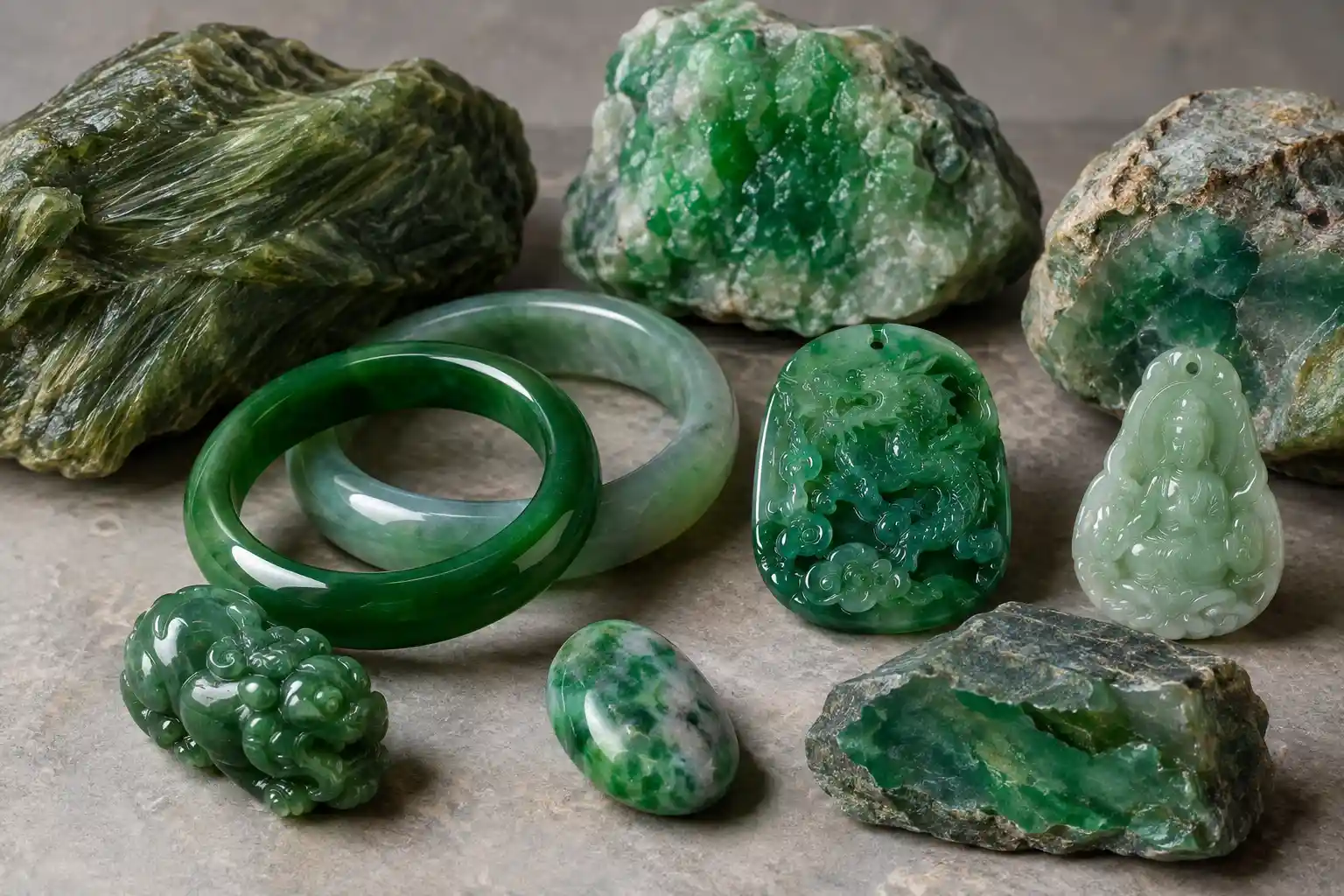
9 Popular Jade Benefits: Deep Uses, Hidden Facts, Responsible Use
Jade benefits are unusually diverse because the word jade does not describe one mineral. It traditionally refers to two different gemstones: jadeite, a pyroxene mineral, and nephrite, an exceptionally tough aggregate of amphibole minerals dominated by tremolite-actinolite composition. Both have been carved, worn, traded, and valued for centuries, yet their structures, geological origins, colors, market behavior, and treatment concerns differ substantially. Understanding that distinction is the starting point for appreciating jade accurately.
The most important physical Jade benefits include exceptional toughness, suitability for carving, durability in bangles and pendants, a wide natural color range, strong cultural heritage, and the ability to take a smooth attractive polish. Nephrite’s interlocking fibrous structure makes it extraordinarily resistant to breaking, while jadeite can combine fine-grained texture, vivid color, translucency, and excellent toughness. These properties explain why jade became important not only for jewelry but also for tools, ritual objects, weapons, ornaments, vessels, seals, and sculpture in several parts of the world.
Modern spiritual traditions often add Jade benefits involving luck, prosperity, protection, harmony, fertility, emotional healing, and physical health. Some of these themes have genuine historical roots in particular cultures, while others are modern simplifications or commercial interpretations. Jade should therefore be discussed with cultural specificity rather than treated as though every society shared one universal meaning. Wearing jade does not clinically treat kidney disease, fertility problems, cardiovascular conditions, anxiety, or other illnesses.
9 Jade Benefits at a Glance
- Exceptional toughness makes jade one of the most durable ornamental gemstones for carving and jewelry.
- Jadeite and nephrite provide two distinct mineral systems with different textures, colors, geology, and value factors.
- Fine polish and compact structure support bangles, pendants, beads, seals, carvings, and sculptural work.
- Wide natural color ranges extend far beyond green, including white, lavender, yellow, orange, brown, black, gray, and mottled combinations.
- Jade has deep historical importance in China, Mesoamerica, New Zealand, and several other cultural traditions.
- Mineral identification protects buyers from serpentine, quartz, treated stones, glass, composites, and other jade imitations.
- Treatment knowledge is essential because dyed, bleached, polymer-impregnated, coated, and assembled jade products occur in the market.
- Collecting and connoisseurship encourage attention to texture, translucency, color distribution, carving, provenance, and workmanship.
- Symbolism involving protection, prosperity, harmony, or continuity can remain meaningful when kept culturally specific and separate from medical claims.
Exceptional Toughness Is Jade’s Most Important Physical Benefit
One of the strongest Jade benefits is toughness. Nephrite in particular is famous for its interlocking fibrous structure, which allows the stone to absorb impact exceptionally well relative to many other ornamental gems. Jadeite is also very tough because of its fine-grained interlocking crystalline texture, although the microscopic structure differs from nephrite.
This toughness helps explain why jade was historically used for more than decoration. In several cultures, dense jade or jade-like stones were shaped into tools, blades, ornaments, ceremonial objects, and durable carvings long before modern metal tools became widespread. The stone could withstand impacts and edge stress better than many visually similar minerals.
Toughness should not be confused with hardness. Jadeite generally falls around 6.5 to 7 on the Mohs scale, while nephrite is commonly around 6 to 6.5. Neither is as hard as sapphire or diamond, yet both can be exceptionally resistant to fracture because toughness and scratch resistance measure different properties.
This combination makes jade particularly suitable for bangles and carved objects that benefit from structural resilience.
Jadeite and Nephrite Give Jade Two Very Different Mineral Identities
Understanding the two main jade types is one of the most important Jade benefits for gem education. Jadeite is a sodium aluminum pyroxene, while nephrite is composed mainly of tightly intergrown amphibole minerals in the tremolite-actinolite series. They can look similar after polishing but differ in mineral structure, density, refractive properties, geological occurrence, and market behavior.
Historically, both were grouped under the broad jade name because visual appearance and toughness mattered long before modern mineralogical classification separated them. Today, gemological identification can distinguish the two reliably.
This distinction is especially important in value. Fine imperial-green translucent jadeite occupies a very different market category from common opaque nephrite, while exceptional nephrite carvings and historically important pieces can still command major value based on quality, craftsmanship, rarity, and provenance.
Someone preparing to buy Jade should therefore begin by determining whether the stone is jadeite or nephrite before comparing price or quality.
Fine Texture and Toughness Make Jade Ideal for Carving
Carving is central to Jade benefits because the stone’s compact interlocking structure allows skilled artisans to produce thin sections, curved surfaces, perforations, relief work, beads, bangles, plaques, seals, and sculptural forms that would be difficult in more brittle gems.
Traditional carving can transform natural color zoning into part of the design. A white-and-green jadeite boulder may be oriented so a green patch becomes foliage or clothing, while brown skin on nephrite rough may be preserved intentionally as part of an animal carving or landscape scene. The cutter therefore works with color distribution rather than simply removing every irregularity.
Polish quality is equally important. Fine jade can develop a smooth, almost waxy or glassy surface depending on type and texture, and good finishing emphasizes both tactile and visual appeal.
These Jade benefits explain why workmanship can influence value dramatically. A modest piece of rough can become culturally or artistically significant through exceptional carving, while valuable rough can be diminished by poor design or excessive removal.
Jade Occurs in Far More Colors Than Green
Green dominates public perception, but Jade benefits include an extensive natural palette. Jadeite can appear white, colorless, lavender, green, yellow, orange, brown, gray, black, and mottled combinations, while nephrite occurs in white, cream, gray, green, yellowish, brown, black, and related shades.
Color quality depends on several factors. Chromium can contribute to vivid green jadeite, while iron and other trace components influence many additional colors. Texture, translucency, saturation, distribution, and stone thickness all affect the final appearance.
This range makes jade unusually versatile in jewelry and carving. White nephrite can support understated traditional carving, lavender jadeite can provide a soft distinctive color, and black jade can create dramatic polished surfaces. Fine green remains commercially important, but judging all jade according to one green ideal oversimplifies the category.
These color differences also reinforce the need for accurate treatment disclosure because dyeing can create or intensify attractive colors artificially.
Jade Has Deep Cultural Importance Across Several Regions
Few gemstones have cultural histories as extensive as jade. In China, nephrite and later jadeite became associated with status, ritual, scholarship, burial, ornament, morality, and artistic craftsmanship over long periods. Mesoamerican societies, including the Maya and Olmec, highly valued jadeite for elite objects, ritual use, ornaments, and symbolism connected with life, power, and sacred status. Māori communities in New Zealand developed profound traditions around pounamu, which includes nephrite and related greenstones used for tools, ornaments, weapons, heirlooms, and culturally significant objects.
These traditions give Jade benefits enormous cultural depth, but they should not be collapsed into one universal meaning. A Chinese jade bi disc, a Maya jade funerary object, and a Māori pounamu hei-tiki belong to different historical and cultural systems with different meanings, practices, and responsibilities.
Responsible jade writing therefore avoids turning these traditions into generic statements such as “jade always means luck.” Cultural context matters, and some objects remain connected with living communities rather than existing only as decorative antiques.
Identification Protects Buyers from Numerous Jade Lookalikes
Jade identification is one of the most practical Jade benefits because the market contains many stones that resemble jade. Serpentine, aventurine quartz, grossular garnet, prehnite, dyed quartz, calcite, glass, polymer products, and other substances can all appear jade-like after polishing.
Visual inspection alone is unreliable, especially with carvings and bangles where color and polish dominate the appearance. Professional testing may consider refractive index, specific gravity, spectroscopy, microscopic texture, fluorescence, infrared analysis, and other methods to determine whether a piece is jadeite, nephrite, treated jade, or an imitation.
The workbook’s real vs fake Jade topic is particularly relevant because destructive home tests can permanently damage genuine jade while still producing ambiguous results. Scratch tests, flame tests, and impact tests are poor choices for valuable pieces.
Accurate identification protects both buyers and culturally important objects by replacing guesswork with evidence.
Treatment Knowledge Is Essential in the Jade Market
Treatment awareness is another major part of Jade benefits because jadeite in particular is sold under trade categories that reflect enhancement. Untreated natural jadeite is commonly called Type A, while Type B refers to jadeite that has been chemically bleached and polymer impregnated, and Type C refers to dyed jadeite. Stones may also combine treatments.
These processes can improve apparent transparency, color, or surface appearance, but they can also affect durability, stability, and value. Polymer-impregnated jadeite should not be priced or represented as equivalent to comparable untreated stone.
Nephrite can also be dyed, waxed, coated, or otherwise altered, although commercial treatment terminology is not always applied identically across markets. Laboratory testing becomes particularly important when a high-value piece is claimed to be untreated.
Someone evaluating Jade quality should therefore consider mineral identity, color, translucency, texture, treatment status, size, carving quality, and condition together rather than relying on appearance alone.
Collecting Jade Rewards Attention to Texture, Provenance, and Workmanship
Jade benefits collectors because appreciation extends far beyond simple color. Fine texture can produce a remarkably smooth polish, translucency can create visual depth, natural color distribution can guide carving, and workmanship can transform rough into objects of exceptional artistic value.
Provenance matters especially for antique or culturally significant jade. A well-documented object may carry historical importance that cannot be reconstructed merely from mineral testing. At the same time, provenance claims require evidence because jade markets have long included reproductions, altered pieces, and uncertain attributions.
Collectors therefore benefit from developing visual literacy alongside technical knowledge. Understanding the difference between jadeite and nephrite, recognizing treatment risks, studying carving traditions, and examining wear patterns can all improve judgment.
This connoisseurship is one of the most rewarding Jade benefits because the stone sits at the intersection of geology, art history, craftsmanship, trade, and culture.
Practical Durability Makes Jade Excellent for Wearable Objects
Jade’s toughness makes bangles, beads, pendants, rings, earrings, and carved talismans practical when the stone is sound and appropriately set. Bangles are particularly important in several jade traditions because a single continuous piece can take advantage of the stone’s structural strength.
Ordinary cleaning is generally straightforward for untreated stable jade, using lukewarm water, mild soap, and a soft cloth or brush. Treatment complicates care because polymers, dyes, coatings, glues, and assembled structures can react differently to heat, chemicals, ultrasonic cleaning, or steam.
These practical Jade benefits become strongest when the owner’s care routine matches the actual stone. A Type A jadeite bangle and a polymer-impregnated piece may look similar, but they should not automatically receive the same cleaning treatment.
Good care therefore begins with identification and treatment disclosure rather than assuming every green bangle behaves identically.
Cultural Symbolism Can Remain Meaningful Without Medical Claims
Jade symbolism can include protection, status, continuity, prosperity, virtue, life, ancestry, harmony, and spiritual significance depending on culture and historical context. These meanings are not interchangeable, and responsible interpretation should preserve the setting in which a particular tradition developed.
Modern crystal culture sometimes extends Jade benefits into claims about kidney health, fertility, cardiovascular function, detoxification, emotional balance, or physical healing. These claims are not established clinical effects of jadeite or nephrite. The English word jade itself has historical associations with beliefs about kidney and side pain, but etymology does not prove therapeutic effectiveness.
A jade pendant can carry profound personal or cultural meaning without being treated as medicine. Family inheritance, religious significance, traditional carving, artistic craftsmanship, and memory can all give an object value far beyond its mineral composition.
Conclusion
Jade benefits include exceptional toughness, two distinct mineral identities, carving versatility, wide natural color ranges, deep cultural history, identification value, treatment education, collecting depth, practical jewelry durability, and meaningful symbolism. Few gemstones combine geology, craftsmanship, history, and living cultural traditions so extensively.
The strongest Jade benefits appear when jadeite and nephrite are identified accurately, treatments are disclosed, cultural context is respected, and medical claims remain separate from tradition. Jade does not need to cure illness or guarantee luck to be extraordinary. Its structural toughness, artistic heritage, and cultural significance already give it remarkable depth.
FAQs
What are the main Jade benefits?
The most substantial Jade benefits include exceptional toughness, carving suitability, jewelry durability, mineral education, cultural history, collecting, treatment awareness, and artistic value. Symbolic associations involving prosperity, protection, continuity, harmony, or virtue can also be meaningful when tied to specific cultural traditions, but they should not be treated as established medical effects.
Is jade one mineral?
No. The traditional term jade refers mainly to two different gemstones: jadeite and nephrite. Jadeite is a pyroxene mineral, while nephrite is a compact intergrowth of amphibole minerals dominated by tremolite-actinolite composition, and the two differ in structure, density, geology, optical properties, and market behavior.
Why is jade so tough?
Jade’s toughness comes from its tightly interlocking microscopic structure. Nephrite contains dense interwoven fibers, while jadeite has a fine interlocking granular texture, allowing both to resist breakage exceptionally well compared with many ornamental gemstones even though their Mohs hardness is only moderate.
Is all jade green?
No. Jadeite and nephrite occur in several colors, including white, cream, lavender, gray, yellow, orange, brown, black, and mottled combinations in addition to green. Fine green jadeite is commercially famous, but color alone does not determine identity or quality.
What does Type A jade mean?
Type A generally refers to natural jadeite that has not undergone bleaching and polymer impregnation, although surface waxing associated with finishing is usually accepted within the category. Type B jadeite has been chemically bleached and polymer impregnated, while Type C refers to dyed jadeite, making treatment disclosure especially important for value and care.
Is jade culturally important?
Yes. Jade has profound historical and living cultural significance in several regions, including China, Mesoamerica, and New Zealand, but the meanings and uses differ greatly among those traditions. Responsible interpretation should preserve those differences rather than reducing all jade symbolism to one generic idea such as luck or protection.
How can someone tell whether jade is real?
Reliable identification usually requires gemological testing because serpentine, glass, quartz, treated stones, and other substances can resemble jade visually. Refractive index, specific gravity, spectroscopy, microscopic structure, and other laboratory methods provide stronger evidence than destructive home tests, which can damage valuable objects while still producing uncertain conclusions.
Is jade good for everyday jewelry?
Both jadeite and nephrite can be excellent for everyday jewelry because of their exceptional toughness, particularly in bangles, pendants, beads, and carved pieces. Care still depends on treatment status, since polymer impregnation, dye, coatings, or glued assemblies can make some pieces more sensitive to heat, chemicals, or aggressive cleaning.
Does jade have healing powers?
There is no established clinical evidence that jade treats kidney disease, infertility, cardiovascular problems, anxiety, pain, detoxification needs, or other physical or mental-health concerns through ordinary wearing or handling. Jade benefits described as healing, protective, fertility-related, kidney-related, chakra, or energetic effects remain cultural, spiritual, and personal beliefs and should not replace qualified medical or mental-health care.