Buy Jade: Smart Buying Tips & Red Flags
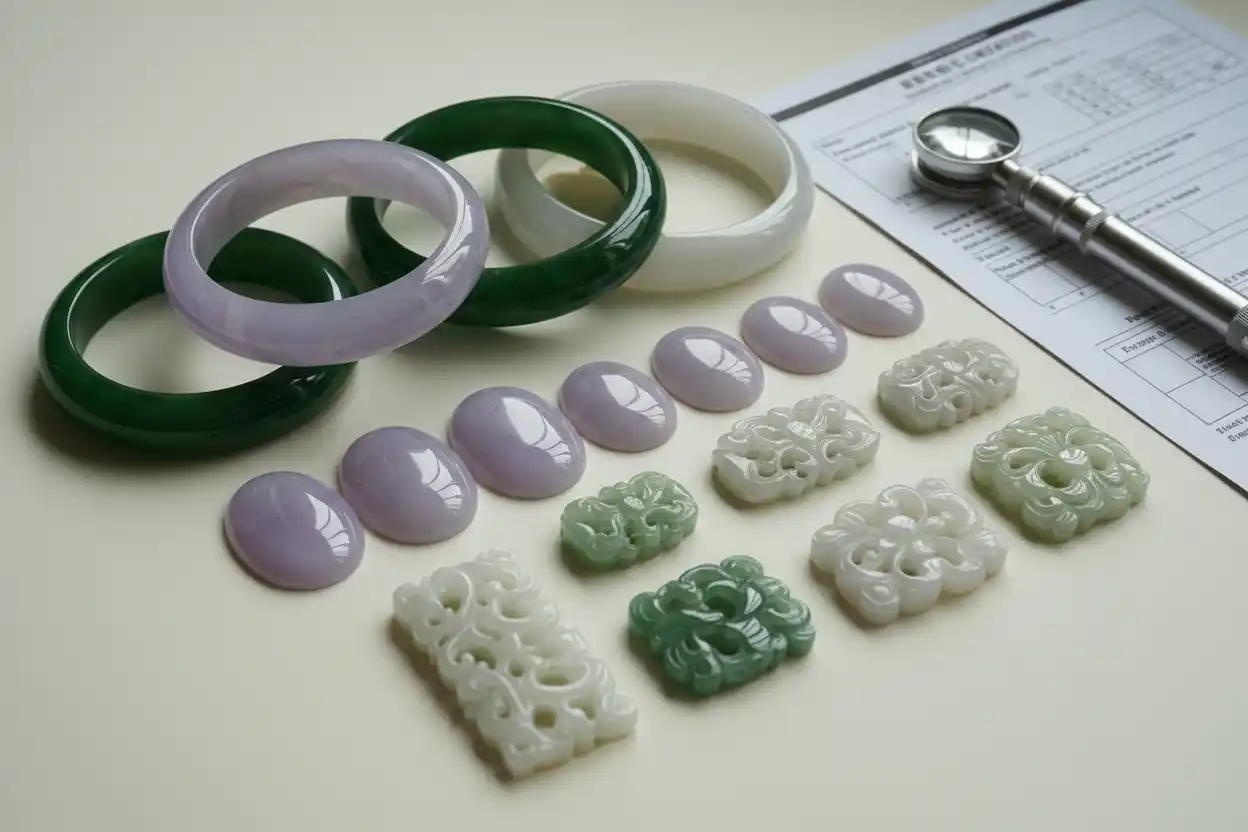
If you want to buy jade intelligently, the first question is not whether the piece is an attractive shade of green. It is what material the seller means by jade, because genuine jade in ordinary jewelry trade refers primarily to jadeite and nephrite, two different aggregate gem materials with different structures, colors, treatments, source traditions, and value hierarchies. The same market also contains dyed jadeite, polymer-impregnated jadeite, coated material, treated nephrite, glued composites, glass, serpentine, quartz-based imitations, and products carrying jade-like names without being jadeite or nephrite at all.
That makes jade one of the gemstones where visual appeal and gemological identity must be evaluated together. A vivid emerald-green cabochon may be naturally colored fine jadeite, dyed commercial material, polymer-treated jadeite, another green mineral, or an imitation. Conversely, a creamy white nephrite carving may be genuine high-quality jade even though it has none of the saturated green color many buyers associate with the word jade.
The strongest methodology when you buy jade is therefore material identity first, treatment status second, species-specific quality third, structural condition and workmanship fourth, dimensions and object type fifth, provenance sixth, and price last. This hierarchy prevents terms such as Imperial, Type A, old mine, mutton-fat, icy, Hetian, Burmese, Grade A, or museum quality from becoming substitutes for understanding what you are actually purchasing.
The broader jade properties guide explains the mineralogy, physical properties, colors, cultural history, and uses of jade. This guide focuses specifically on the purchase decision: identifying the material correctly, separating natural quality from enhancement, judging the individual object, and recognizing when laboratory evidence becomes more important than a seller’s assurances.
What to Judge First When You Buy Jade
The word jade covers more than one gem material, so no single color-and-clarity formula works for every purchase. Fine green jadeite, translucent lavender jadeite, creamy white nephrite, dark green nephrite, a seamless bangle, a matched bead strand, and an intricate carving each require a somewhat different hierarchy.
Use this framework when you buy jade:
| Priority | What to evaluate | Why it matters |
|---|---|---|
| 1 | Jadeite vs nephrite identity | These are different materials with different market structures |
| 2 | Treatment status | Bleaching, polymer impregnation and dye can radically change value |
| 3 | Color | Desirable colors depend on jade type and object |
| 4 | Translucency | Especially important in fine jadeite and some white nephrite |
| 5 | Texture | Fine compact structure improves visual refinement and polish |
| 6 | Structural condition | Cracks, repairs and drill-hole damage can matter enormously |
| 7 | Workmanship | Carving, matching and polishing can contribute substantial value |
| 8 | Dimensions | Bangles, beads and carvings should not be judged by weight alone |
| 9 | Provenance | Myanmar, Hetian and other source claims need evidence when they add value |
| 10 | Laboratory report | Essential when identity or treatment materially affects the transaction |
| 11 | Price | Price is meaningful only after the material and quality tier are known |
When you buy jade in this order, you reduce the risk of paying premium natural-jade prices for a treated or incorrectly identified object.
Understand What Jade Actually Means
Jade is not one simple mineral species. In ordinary jewelry and gem-buying contexts, the name primarily covers jadeite jade and nephrite jade, both of which are genuine jade despite their different mineral compositions.
Jadeite is a pyroxene mineral that forms tightly interlocking granular aggregates. Nephrite is an aggregate dominated by extremely fine interwoven tremolite-actinolite amphibole fibers.
Both structures produce remarkable toughness.
The detailed jadeite versus nephrite comparison explains the mineralogical distinction, while the broader types of jade separates recognized colors, materials, and commercial terminology.
When you buy jade, a listing that simply says “100% genuine jade” has not answered the first important question.
Ask:
Is this jadeite or nephrite?
If the seller cannot answer, treat every other quality claim cautiously.
Nephrite Is Not Fake Jade
One persistent misunderstanding is that jadeite is “real jade” while nephrite is a substitute.
That is incorrect.
Nephrite is a legitimate jade material with an extensive carving and jewelry tradition, exceptional toughness, and its own high-value categories. The nephrite properties guide explains its fibrous structure, colors, sources, and identification separately from jadeite.
When you buy jade, therefore, nephrite should not be discounted simply because it is not jadeite.
The important issue is whether the seller identifies it correctly and charges a price appropriate to the quality, provenance, carving, and market for nephrite rather than borrowing the prestige of fine jadeite.
Jadeite Has a Different Value Structure
Jadeite occurs in green, lavender, white, nearly colorless, yellow, orange-red, brown, gray, black, and combinations of these colors. The highest-profile market centers on fine green jadeite with strong saturation, useful translucency, and exceptionally fine texture, but fine material exists outside that narrow appearance.
The jadeite properties guide provides the material-specific background.
When you buy jade that is jadeite, evaluate color, translucency, and texture together rather than grading one factor in isolation.
A vivid green stone with poor transparency and coarse granular texture can be less desirable than a slightly lighter stone whose fine structure creates a luminous internal glow.
Likewise, an intensely colored piece may look spectacular but belong to a much lower value category if its color is dyed or its transparency depends heavily on polymer impregnation.
Color Is the First Visible Jadeite Quality Factor
Fine jadeite can show remarkable color, but green quality is not simply a question of darkness.
When you buy jade in a premium green jadeite category, evaluate:
Hue: whether the green appears pure, slightly bluish, slightly yellowish, grayish, or brownish.
Tone: whether it is light, medium, medium-dark, or excessively dark.
Saturation: how strong and vivid the green appears.
Distribution: whether the color is even, attractively mottled, spotted, veined, or concentrated unevenly.
Depth: whether the color seems to exist through the material rather than sitting unnaturally at the surface.
A slightly bluish or yellowish green can remain highly attractive. Gray and brown generally reduce the vivid quality associated with top green jadeite.
When you buy jade, however, remember that a vivid photograph is not proof that the color is natural.
“Imperial Jade” Requires Exceptional Evidence
Imperial jade is associated with exceptionally fine green jadeite combining vivid saturated green, useful translucency, fine texture, and excellent overall appearance.
It is not simply another name for bright green jade.
When you buy jade marketed as Imperial, ask whether the seller can support the complete claim rather than showing one strongly saturated photograph.
A defensible high-end stone should combine:
natural jadeite identity, natural green color, no polymer impregnation, fine texture, useful translucency, strong polish, attractive color distribution, and appropriate independent documentation.
“Imperial green,” “Imperial color,” and “Imperial grade” are frequently used as promotional descriptions. They should not receive an exceptional premium until the actual jadeite and its treatment status are established.
Type A Jade Is a Treatment Category, Not a Quality Grade
This distinction is essential when you buy jade.
In the widely used jadeite treatment terminology, Type A jadeite refers to natural jadeite that has not undergone acid bleaching and polymer impregnation or dyeing. Traditional surface waxing associated with normal finishing may be present.
Type A does not mean top quality.
A Type A jadeite can be pale, opaque, coarse, fractured, poorly polished, or commercially inexpensive. It can also be spectacularly fine and extremely valuable.
The letter describes treatment status.
It does not tell you how beautiful the jade is.
A seller saying “Grade A jade” can create further confusion because Grade A may be used casually as a quality label rather than specifically as Type A treatment terminology. When you buy jade, ask the seller to confirm explicitly whether “A” means untreated jadeite apart from traditional waxing.
Type B Jade Has Been Bleached and Polymer Impregnated
Type B jadeite undergoes chemical bleaching intended to remove unwanted staining or discoloration, followed by impregnation with polymer resin that fills spaces created or exposed through the process.
The finished stone can appear cleaner, brighter, and more translucent than the original material.
When you buy jade, that visual improvement can be substantial enough to make treated material resemble a higher natural quality tier.
The key issue is not that Type B jadeite is automatically unattractive. Some treated material can look very appealing.
The problem occurs when Type B jadeite is sold as untreated Type A material.
Polymer impregnation can also alter long-term care and durability expectations, particularly when the stone is exposed to heat, chemicals, repair procedures, or environmental aging.
The treated jade guide explains treatment identification and disclosure in greater depth.
Type C Jade Has Been Dyed
Type C jadeite has received artificial color.
Green is the obvious concern, but jadeite can also be dyed to imitate attractive lavender or other commercial colors.
When you buy jade, possible dye clues can include unusually intense color concentrated in cracks, grain boundaries, pits, recessed areas, drill holes, or damaged surfaces.
However, sophisticated dye should not be expected to announce itself visually.
Natural jadeite can also contain highly uneven color distribution, vivid green veins, or concentrated patches.
Therefore, color concentration can raise a question but cannot settle treatment status reliably.
An important Type A natural-color premium deserves laboratory verification rather than a home inspection alone.
Type B+C Combines Treatment Categories
Type B+C jadeite has undergone bleaching and polymer impregnation as well as dyeing.
This combination can improve both apparent transparency and color, potentially transforming relatively unattractive starting material into a much stronger-looking finished object.
When you buy jade, B+C material should be disclosed clearly because neither the face-up appearance nor a seller’s statement that the stone is “natural jadeite” tells you the complete story.
The base material can indeed be natural jadeite.
Its finished appearance can nevertheless depend heavily on enhancement.
Natural identity and natural appearance are different claims.
A, B and C Terminology Applies Mainly to Jadeite
Do not assume the familiar A/B/C shorthand describes every nephrite treatment situation equally well.
Nephrite can also be dyed, coated, filled, repaired, waxed, stained, or otherwise modified, but the Type A/B/C system is most strongly associated with jadeite disclosure.
When you buy jade that is nephrite, ask direct treatment questions rather than assuming an A label provides a complete answer.
Has the color been dyed?
Has artificial skin been created?
Has the surface been coated?
Have cracks been filled?
Has the piece been glued or reconstructed?
These questions matter especially with high-value white nephrite and material sold using prestigious source terminology.
Laboratory Testing Matters More Than Home Treatment Tests
Polymer impregnation can be difficult to identify reliably without appropriate equipment. Laboratories may use infrared spectroscopy and other analytical techniques to distinguish treated jadeite from untreated material.
When you buy jade at substantial value, this is why home tests should not replace a report.
A cold feel proves little.
A ringing sound proves little.
A scratch test can damage the object.
A flashlight cannot exclude polymer.
A magnifying loupe can reveal clues but may not establish treatment.
A specific gravity measurement can be difficult to perform accurately on carvings or mounted jewelry and cannot by itself answer the complete treatment question.
The real versus fake jade guide explains why identification requires multiple forms of evidence rather than one popular household test.
Do Not Strike Jade Bangles Together
The “sound test” is particularly risky with bangles.
Jade’s toughness can produce a clear ringing sound in some objects, but sound varies according to material, thickness, shape, suspension, fractures, treatments, and construction. Glass and other hard materials can also produce convincing tones.
When you buy jade, never allow a seller to convince you that striking expensive bangles against one another is a definitive authenticity test.
A bangle can be genuinely valuable and still crack after a poorly controlled impact.
A test that can damage the item while failing to prove its identity is not a useful test.
Translucency Is a Major Jadeite Value Factor
Fine jadeite can transmit and scatter light in a way that creates a glowing internal appearance rather than simple surface color.
When you buy jade, judge translucency under realistic conditions.
Begin with ordinary diffused light.
Then move the piece near a light source to see how deeply the illumination enters.
Do not evaluate translucency exclusively by pressing a powerful flashlight directly behind the stone.
Strong backlighting can make ordinary jadeite look dramatically more transparent than it will appear during normal wear.
Thickness also matters. A thin plaque will naturally transmit more light than a thick cabochon made from comparable material.
Therefore, compare translucency only when dimensions are reasonably similar.
Polymer Treatment Can Improve Apparent Translucency
Treatment and quality cannot be evaluated independently.
Polymer impregnation can make jadeite appear more transparent or clearer by reducing the visibility of internal voids and damaged areas.
When you buy jade because of an attractive translucent glow, make sure that treatment status has been established before paying a Type A premium.
A beautiful optical effect does not reveal whether it is entirely natural.
This principle becomes increasingly important as the material moves toward the fine-jade market where small differences in natural color, translucency, and texture can produce large differences in value.
Texture Is One of Jade’s Most Important Quality Factors
Jade is an aggregate material composed of many interlocking microscopic crystals or fibers.
That structure produces texture.
Fine jadeite texture appears smooth, compact, and refined. Coarser material can look granular or uneven, particularly under close inspection or strong reflected light.
When you buy jade, examine broad polished areas under angled light and look for:
smoothness, luster, grain visibility, orange-peel texture, pits, polishing irregularities, and areas where the surface becomes dull.
Fine texture generally supports better translucency, smoother polish, and more even visual depth.
Coarse texture can still work beautifully in an artistic carving, but it should not automatically receive fine-jade pricing.
“Old Mine” Does Not Necessarily Mean an Old Artifact
Old-mine and related expressions can be used in jade trading to describe texture or desirable material characteristics, yet retail listings may imply that the phrase automatically proves antique age, historic extraction, or superior provenance.
When you buy jade, separate those claims.
A fine-textured piece may be described commercially as old-mine quality without being an antique.
An antique jade object may contain relatively ordinary material but gain value through craftsmanship, cultural significance, provenance, or age.
Material quality and object history require separate evidence.
Nephrite Requires Its Own Quality Hierarchy
Fine nephrite should not be evaluated as though it were simply less transparent jadeite.
Nephrite’s interlocking fibrous structure produces remarkable toughness and commonly creates a softer, waxier, or oilier-looking luster than jadeite.
When you buy jade that is nephrite, evaluate:
color, color evenness, texture fineness, translucency at appropriate thickness, oily or waxy polish, distracting inclusions, structural condition, workmanship, and provenance when relevant.
Dark green commercial nephrite and fine creamy-white collector material occupy very different markets.
The strongest stone is the one that performs well within its correct nephrite category.
White Nephrite Is Not Simply “Less Colorful Jade”
Fine white nephrite can be among the most culturally and commercially important forms of nephrite.
Its appearance may be warm white, cream, ivory, gray-white, or subtly yellowish rather than stark paper white.
The white jade guide explains the difference between white nephrite and white jadeite, both of which can legitimately be called white jade.
When you buy jade in pale material, ask which of those materials is present.
Color alone cannot tell you.
Fine nephrite should generally show dense fine texture, a smooth oily-looking polish, and an attractive subtle translucency rather than a chalky or plastic appearance.
“Mutton-Fat Jade” Is a Premium Trade Description
Mutton-fat jade is associated with exceptionally fine white nephrite, particularly material connected in the market with Hetian or Hotan traditions.
The term should not be interpreted literally as the brightest white possible.
Fine examples can appear creamy, warm, subtly translucent, and exceptionally smooth.
When you buy jade described as mutton-fat, do not pay a major premium for whiteness alone.
Ask:
Is the material independently confirmed as nephrite?
Is the texture exceptionally fine?
Does it show the expected soft translucency?
Is the surface naturally polished rather than coated?
Has artificial coloration or skin treatment been excluded?
What supports the claimed source?
“Mutton-fat” is not one universal laboratory quality grade.
Hetian Jade Claims Need Careful Documentation
Hetian or Hotan jade terminology carries substantial cultural and commercial importance, particularly for fine nephrite.
That prestige creates incentives for overly broad sourcing claims.
When you buy jade described as Hetian nephrite, determine what exactly the seller means. A stone sold, carved, or traded in the region is not necessarily mined from the specific source implied by the marketing.
High-value river-worn material can also have natural brown, yellow, or orange weathered skin that contributes to collector appeal. Because attractive skin can increase value, artificial staining or manufactured pebble surfaces may be used to imitate that appearance.
When provenance materially affects the price, ask for evidence instead of accepting the skin color as proof.
Canadian or Russian Nephrite Is Not Automatically Inferior
Fine nephrite occurs outside the most prestigious Asian trade categories.
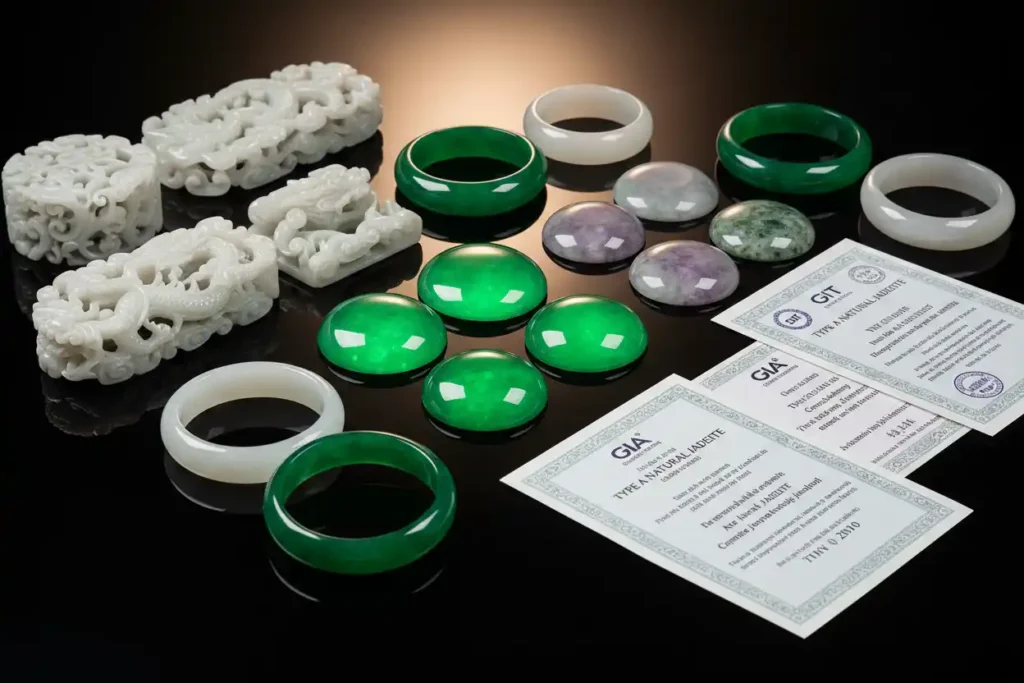
Canada, Russia, New Zealand, and other regions have produced significant nephrite material with strong toughness, attractive colors, and good carving properties.
When you buy jade, do not let geographic prestige override the individual object.
A fine-textured, well-polished green nephrite carving can be a stronger purchase than a mediocre piece carrying a more fashionable source claim.
Origin should increase value only when the provenance is credible and the underlying material deserves the premium.
Color Distribution Can Add or Reduce Value
Perfectly uniform color is not always the goal.
Jadeite and nephrite can show mottling, veins, spots, clouds, skins, patches, and contrasting zones that a skilled cutter or carver can use deliberately.
When you buy jade as a cabochon, look at whether the strongest color occupies the center effectively or disappears toward a thin edge.
When you buy jade as a bangle, inspect the entire circumference. A seller may photograph only the brightest green section while leaving a large gray, white, brown, or fractured area outside the main image.
In carvings, contrasting zones can increase artistic quality when the carver uses them intentionally—for example, placing a green area within foliage while leaving lighter stone for another part of the subject.
Uneven color becomes a strength when the workmanship makes it purposeful.
Evaluate Jade Cabochons by More Than Color
A fine jadeite cabochon should display balanced proportions, an attractive dome, strong polish, useful thickness, and color positioned effectively through the face.
When you buy jade in cabochon form, inspect whether the stone has been cut unnecessarily thin to improve apparent translucency.
A very thin cabochon can look luminous against a bright backing but may contain much less material than its face-up photograph suggests.
At the opposite extreme, excessive thickness can add weight without improving the visible result.
The best cabochon uses the rough efficiently while maximizing natural color and glow.
Closed-Back Settings Need Extra Scrutiny
A closed setting can hide the back of a jade cabochon, making it harder to evaluate thickness, cracks, color distribution, backing materials, foil, adhesive, or repaired damage.
When you buy jade already mounted, ask whether the back can be inspected safely.
A closed metal backing is not automatically deceptive. It may be part of the design.
The problem arises when a backing changes apparent color or hides information that materially affects value.
For an expensive jadeite center stone, the buyer should know what lies behind the gem before treating the face-up appearance as representative of the complete material.
Jade Bangles Require a Separate Buying Method
A jade bangle is not simply a gemstone enlarged into a circle. It is a structural object that must fit the hand, survive repeated impact, and remain sound throughout its circumference.
When you buy jade as a bangle, record:
inner diameter, outer diameter, wall width, wall thickness, cross-section shape, weight, color distribution, translucency, treatment, and every visible fracture.
Inspect both edges and the complete interior.
The jade bracelet guide covers fit and design after material identity has been established.
A crack crossing the wall can be far more consequential than a superficial mark because impact stress may extend it through the bangle.
Bangle Size Is Not Optional Information
Unlike an adjustable chain bracelet, a solid jade bangle must pass over the hand while remaining appropriately sized at the wrist.
When you buy jade online, the inner diameter is therefore one of the most important dimensions in the entire listing.
Do not assume small, medium, or large labels will be consistent between sellers.
Request millimeter measurements.
Forcing an undersized bangle over the hand can injure the wearer or break the object, while an excessively loose bangle can strike hard surfaces more frequently and fall off more easily.
The correct fit is part of the purchase quality.
Inspect Jade Beads Individually
Matched jade bead strands can carry substantial value because matching color, texture, translucency, diameter, polish, and drilling across many natural beads can be difficult.
When you buy jade as a necklace or bracelet strand, do not inspect only the most attractive front-facing beads.
Look through the entire strand.
Check drill holes for:
color concentration, fractures radiating outward, rough drilling, chips, filler, glue, and differences in material.
The jade necklace guide addresses finished necklace construction and wear after the gemstone quality has been established.
A natural matched strand should look harmonious without requiring every bead to be visually identical.
Matching Can Carry a Genuine Premium
A pair of fine jade earrings or a long bead strand can cost more than the same total quantity of unmatched material because finding stones with sufficiently similar color, texture, translucency, and size requires greater selection.
When you buy jade in matched jewelry, compare the pieces side by side under the same neutral lighting.
The jade earrings guide covers style and construction considerations for paired pieces.
One earring should not be strongly translucent green while the other is opaque gray-green unless the asymmetry is clearly intentional.
Matching is part of workmanship.
Carving Quality Can Be More Important Than Weight
Jade’s toughness makes it exceptionally suitable for detailed carving, but a large carving is not automatically more valuable simply because it weighs more.
When you buy jade as a carved pendant, plaque, figurine, vessel, seal, or decorative object, examine:
proportion, detail, finish, use of color zoning, depth, undercut areas, recesses, drill work, symmetry where appropriate, polished surfaces, thin projections, hidden fractures, repairs, and dead weight.
A skilled carver can turn uneven color into an artistic advantage.
An unskilled carver can retain excessive bulk simply to preserve weight.
The best carving makes the material and subject strengthen one another.
Inspect Recessed Areas for Treatment and Repair Clues
Polished front surfaces receive most of a buyer’s attention, but recessed areas can reveal more.
When you buy jade carvings, examine drill holes, grooves, undersides, deep relief cuts, and cavities.
Dye can accumulate where polishing is limited.
A coating may look different inside a recess.
Glue can remain visible along replacement sections.
Rough polish can expose the underlying grain.
An old fracture may have been filled or concealed within the design.
Good workmanship should remain convincing when you look beyond the main face.
Composite and Glued Jade Must Be Disclosed
A jade object can be assembled from multiple sections, backed with another material, repaired with adhesive, or combined with glass or resin.
These products can be decorative and perfectly usable when represented accurately.
When you buy jade, the issue is whether the object is being sold as one solid natural piece when it is actually composite.
Look for straight boundaries, glue lines, bubbles, mismatched translucency, unusually uniform layers, inconsistent polish, and changes in texture.
A seamless hololith ring or bangle carved from a single piece belongs to a different construction category from an assembled product.
Coatings Can Improve Color and Luster
Jadeite can receive surface coatings that enhance apparent color, luster, or transparency.
A coating can make lower-quality material look smoother or more saturated while concealing the natural surface character underneath.
When you buy jade, possible clues include unusual glossy films, wear at facet or carving edges, scratches revealing a different underlying surface, or inconsistent coating in recessed areas.
Sophisticated coatings can be difficult to identify conclusively by eye.
For a valuable piece, laboratory testing remains more reliable than trying to scrape or chemically test the surface.
Avoid Destructive Jade Tests
Many popular jade tests are either unreliable, destructive, or both.
Do not scratch jade with a knife.
Do not strike it against another stone.
Do not burn hair on its surface.
Do not expose it to solvents to see whether color comes off.
Do not heat it.
Do not rely on whether it feels cold.
Do not assume a heavy stone must be jade.
When you buy jade, non-destructive professional identification provides better information without risking the object.
The more expensive the jade, the less logical it becomes to perform improvised tests.
Jade Lookalikes Are Common
Green appearance alone has never been enough to establish jade.
Materials that can appear in jade-like products include serpentine, quartz or quartzite, aventurine, calcite, glass, plastic, prehnite, and other ornamental stones.
Some of these materials are attractive in their own right.
They simply should not be priced as jadeite or nephrite.
Trade names containing the word jade can create additional confusion. “New jade,” “mountain jade,” “Malaysian jade,” and similar names may refer to materials outside the two principal jade categories.
When you buy jade, ask for the actual mineral identity rather than treating the commercial name as proof.
Aventurine Is Not Jade
Green aventurine can resemble commercial green jade in photographs, especially when its reflective inclusions are subtle.
Aventurine is quartz-based material rather than jadeite or nephrite.
Its granular texture, sparkle, density, optical properties, and structure differ.
A seller can legitimately sell beautiful aventurine jewelry.
The problem begins when the material is relabeled simply as jade to increase perceived value.
When you buy jade at more than decorative cost, a clear species identification should remove this uncertainty.
Serpentine Can Look Extremely Convincing
Certain serpentine materials can have attractive green, yellow-green, white, or translucent appearances and take a smooth polish, making them common sources of jade-like trade names.
Some serpentine can be significantly softer than jadeite or nephrite, but scratch testing is still a poor consumer identification method.
An object should not be damaged simply to prove that the seller described it incorrectly.
When you buy jade, use mineral identification rather than hardness guessing.
“Ice Jade” and “Icy Jadeite” Need Context
Ice jade or icy jadeite generally refers to highly translucent, fine-textured jadeite with a clear or softly cloudy appearance rather than to a separate mineral species.
The term can describe beautiful material.
It can also be overused.
When you buy jade marketed as ice quality, judge actual translucency under realistic lighting, thickness, texture, inclusions, and treatment.
A thin heavily backlit piece should not receive the same premium as a thicker untreated jadeite that remains highly translucent under ordinary conditions.
Again, the word describes an appearance.
It does not replace treatment testing.
Lavender Jadeite Needs Natural-Color Verification
Lavender jadeite can range from delicate grayish violet through stronger lavender tones and can be highly attractive when fine texture and translucency accompany the color.
Photography can exaggerate lavender readily, especially under cool light or aggressive saturation.
Dye is another concern.
When you buy jade in lavender, request neutral-light video and independent treatment information when the price is substantial.
Do not assume a grayish tone means low quality automatically, but do compare candidates directly because some stones become much duller outside optimized photographs.
Black Jade Should Not Escape Treatment Checks
Black jade can refer to very dark jadeite or nephrite, depending on the object.
Dark color can conceal coarse texture, fractures, inclusions, treatments, and repairs.
When you buy jade in black or nearly black material, examine thin edges or transmitted-light areas where the underlying green, brown, or gray character may become visible.
A completely opaque face-up appearance should not prevent the same identity and treatment checks used for green jade.
Darkness is not proof of natural color or quality.
Jade Is Exceptionally Tough but Not Exceptionally Hard
One reason jade became so important as a carving and tool material is the interlocking structure that resists fracture propagation.
That toughness is extraordinary.
Its hardness is more moderate.
Jadeite generally sits around 6.5–7 on the Mohs scale, while nephrite is commonly around 6–6.5. Both can therefore be scratched by harder materials.
When you buy jade, do not interpret toughness as scratch immunity.
A bangle can survive a meaningful impact and still accumulate surface wear after rubbing repeatedly against quartz-bearing dust, sapphire, diamond, or other harder gemstones.
Existing Cracks Still Matter
Jade’s toughness does not neutralize every fracture.
A natural crack, repaired break, thin carved projection, drilled hole, or weakened treated area can create a local vulnerability even when the surrounding material is exceptionally tough.
When you buy jade jewelry, inspect cracks according to where they occur.
A minor surface mark in a thick carving is not equivalent to a fracture crossing the wall of a bangle.
A small internal feature in a cabochon is not equivalent to a crack beneath a ring prong.
Structural context matters.
Jade Rings Need Setting Inspection
Jade rings range from cabochons mounted in metal to rings carved entirely from a single piece of jade.
The jade ring guide explains the design-specific trade-offs.
When you buy jade in a metal-set ring, inspect whether the mounting conceals cracks, fillers, foil, or backing. Check prong condition and determine whether the cabochon moves within the setting.
A hololith ring needs different inspection because the jade itself forms the entire ring structure.
Look for impact chips, hairline fractures, thin sections, and sizing limitations.
A carved jade ring cannot be resized like an ordinary gold band.
Geographic Origin Should Not Be Guessed From Color
Myanmar is exceptionally important in the jadeite trade, while Guatemala is another major source of jadeite-bearing material. Nephrite has important sources across China, Canada, Russia, New Zealand, and other regions.
When you buy jade, color does not establish any of these localities.
Vivid green does not prove Myanmar.
Creamy white does not prove Hetian.
Spinach green does not prove Russia or Canada.
Origin claims should be treated as a separate evidentiary question when they materially affect price.
For ordinary commercial jade, spending heavily on geographic-origin analysis may not make sense.
For exceptional fine jadeite or provenance-driven nephrite, it can.
Source Prestige Comes After Material Quality
A weak stone from a prestigious source remains a weak stone.
When you buy jade, first establish species, treatment, color, translucency, texture, workmanship, and condition.
Only then consider whether provenance adds something meaningful.
A beautifully fine untreated jadeite can remain desirable even if a precise mine cannot be established.
A coarse, dyed, fractured piece does not become high quality because its seller attaches a prestigious geographic label.
The gemstone should deserve the purchase before the location deserves the premium.
When a Laboratory Report Is Worth Paying For
The report threshold should follow financial and gemological risk.
An inexpensive nephrite bead or small commercial carving may not justify sophisticated laboratory testing.
A report becomes much more important when you buy jade and:
- Type A status carries a substantial premium;
- the object is represented as Imperial jadeite;
- polymer impregnation must be excluded;
- natural green or lavender color materially affects value;
- a large valuable bangle is being purchased;
- an expensive matched bead strand is involved;
- fine white nephrite is sold at a collector premium;
- Hetian or another prestigious provenance materially affects price;
- the material might be a jade lookalike;
- or treatment cannot be resolved visually.
The gemstone laboratory report guide explains why identification, treatment analysis, origin opinions, seller certificates, and financial appraisals should not be treated as the same document.
What a Good Jade Report Should Answer
For an important jade purchase, the most useful report begins with material identity.
Does it identify jadeite?
Nephrite?
Another jade-related aggregate?
A non-jade material?
Then read the treatment conclusion.
Does the laboratory detect polymer impregnation?
Dye?
Coating?
Another treatment?
If geographic origin is part of the service and commercially important, what does the laboratory actually conclude?
When you buy jade, focus on the wording printed by the laboratory rather than the seller’s interpretation of that wording.
A Seller Certificate Is Not Independent Evidence
Retailer-issued cards can record useful information, but they should not be confused automatically with independent gemological analysis.
When you buy jade at substantial value, ask who examined the piece.
Was it tested by an independent laboratory?
What instruments or methods were used?
Does the document identify treatment?
Can the report be verified?
A beautiful plastic card stating “Grade A Natural Imperial Jade” may contain less useful information than a restrained independent report simply identifying natural jadeite with no relevant treatment detected.
Evidence matters more than presentation.
Match the Report to the Exact Jade Object
A valid laboratory report offers little protection if it belongs to another piece.
When you buy jade with documentation, compare the report with the object itself.
For cabochons and carvings, compare dimensions, weight, color pattern, shape, photograph, and distinctive natural features.
For bangles, compare dimensions, shape, color distribution, weight where recorded, and photographs.
For bead strands, determine whether the report covers the entire strand or only sampled beads.
A copied report number from a genuine jadeite object does not authenticate another object.
Report and Appraisal Answer Different Questions
A laboratory report addresses gemological identity and treatment within its scope.
An appraisal estimates monetary value for a defined purpose.
When you buy jade, a high insurance appraisal does not prove Type A status, Imperial quality, Myanmar origin, Hetian provenance, or future resale value.
Likewise, a laboratory report confirming untreated natural jadeite does not guarantee that the asking price is fair.
The stone still needs to be judged for color, translucency, texture, workmanship, size, and market comparables.
Jade Is Commonly Sold by the Piece, Not Just by Carat
Jade pricing does not map neatly onto the per-carat habits buyers may know from faceted gemstones.
Cabochons, bangles, beads, carvings, plaques, and finished jewelry are frequently valued as complete objects.
When you buy jade, two objects of similar weight can have radically different prices because color placement, thickness, translucency, carving skill, matching, treatment, provenance, and structural condition differ.
The jade price guide addresses value separately, but the key buying principle is that carat weight alone is a weak comparison tool.
Small Differences Can Matter Enormously at the Fine End
Top-quality jadeite combines several difficult attributes simultaneously.
Once color, translucency, texture, treatment status, and workmanship all reach an exceptional level, seemingly modest differences in size or quality can create disproportionate price differences.
That does not mean every green cabochon deserves exponential pricing.
When you buy jade at the fine end, the premium should result from several scarce characteristics occurring together rather than one impressive adjective.
Large Carvings Should Not Be Priced by Weight Alone
A large carving can contain inexpensive material, substantial dead weight, coarse texture, internal cracks, or mediocre artistic execution.
When you buy jade carvings, ask whether the size contributes to the design or simply preserves more mass.
A smaller work with exceptional material and masterful carving can be more valuable than a much heavier object of commercial rough.
The same principle applies to thick bangles and oversized pendants.
Visible quality should lead.
Online Jade Photography Needs Several Lighting Conditions
Jade is especially easy to exaggerate because backlighting can increase apparent translucency and saturation while dark backgrounds can make green appear richer.
When you buy jade online, request actual-item media in several conditions.
A useful presentation includes:
neutral face-up light, white background, gray background, skin or hand scale where appropriate, controlled backlighting, side views, back views, close-ups of fractures, drill holes, and a full rotation or circumference view.
The online gemstone buying safeguards cover payment protection, seller verification, shipping, documentation, and return procedures.
For jade, photography should show both the strongest and weakest parts of the object.
Do Not Judge a Bangle From One Green Section
A seller may position the most saturated portion of a mottled bangle toward the camera while leaving paler, brown, gray, white, or fractured areas on the hidden side.
When you buy jade as a bangle, require a continuous complete-circumference video.
The same principle applies to bead strands.
Every bead should pass visibly through the frame.
For carvings, rotate the piece enough to expose the back, base, drill holes, and recessed sections.
The more expensive the jade, the less acceptable selective photography becomes.
Ask for Realistic Scale
Close-up images can make a tiny cabochon or thin carving look substantial.
When you buy jade, use millimeter dimensions rather than photographic intuition.
For bangles, inner diameter and wall dimensions matter.
For beads, diameter and hole size matter.
For cabochons, length, width, and thickness matter.
For carvings, overall dimensions and thickness matter.
Weight should complement these measurements, not replace them.
Return Terms Are Part of the Buying Decision
Jade treatment can be difficult for consumers to assess visually, so a meaningful inspection period becomes especially important with online purchases.
When you buy jade at substantial value, confirm whether the return policy permits independent non-destructive gemological examination.
Do not scratch, chemically test, heat, strike, or alter the item during the return period.
Do not resize or reset jewelry before making the final decision.
A seller asking a substantial Type A premium while prohibiting reasonable independent inspection transfers too much uncertainty to the buyer.
The Invoice Should Preserve Important Claims
When you buy jade based on specific representations, those claims should not disappear after payment.
Useful wording can include:
natural jadeite or natural nephrite, treatment status, Type A designation where supported, weight, dimensions, geographic-origin claim where material to value, repair disclosure, metal composition, and laboratory report number.
If a seller repeatedly describes an object as untreated Myanmar Type A jadeite before the purchase but writes only “green stone bracelet” on the invoice, ask for clarification.
A premium-bearing claim should survive into the written transaction record.
Responsible-Sourcing Claims Need Separate Evidence
Country of origin and responsible sourcing are not the same thing.
A seller may know that a jadeite object originated commercially from Myanmar without knowing every intermediary, labor condition, mine, or environmental impact involved in its supply chain.
When you buy jade based partly on ethical or responsible-sourcing claims, ask what the seller can actually document.
The appropriate evidence may involve supplier traceability, sourcing policies, chain-of-custody records, or clear disclosure of what is known and unknown.
Do not assume that an authenticity report proves ethical sourcing.
Care Depends on Treatment Status
Untreated jadeite and nephrite are exceptionally tough, but treatment can alter the care requirements.
Polymer-impregnated jadeite may respond differently to heat and chemicals from untreated jadeite.
Dyed material may have color-stability concerns.
Glued composites and repaired pieces require additional caution.
When you buy jade, keep treatment information with the object so future jewelers and cleaners know what they are handling.
The jade jewelry cleaning guide provides a conservative approach centered on mild soap, suitable water temperature, gentle wiping or brushing, and avoiding unnecessarily aggressive methods.
Major Red Flags When You Buy Jade
| Red flag | Why it matters |
|---|---|
| Listing says only “genuine jade” | Jadeite vs nephrite identity remains unanswered |
| Seller says nephrite is fake jade | Established jade terminology is being misrepresented |
| Type A described as the highest visual quality grade | Type A is primarily treatment terminology |
| “Grade A” used without defining what A means | Seller quality grading may be confused with treatment status |
| Vivid green color with no treatment information | Dye or other enhancement remains possible |
| Strong translucency with no polymer testing | Type B treatment may be improving appearance |
| “Imperial” applied to opaque bright-green material | Color alone does not establish fine Imperial-type quality |
| Dye concentrated around cracks or drill holes | Artificial color should be investigated |
| Every photograph is heavily backlit | Ordinary translucency may be overstated |
| Black background used exclusively | Green saturation can appear stronger |
| Seller recommends a scratch test | The method can damage the object and remains weak evidence |
| Seller strikes bangles together | Sound is not definitive and impact can cause damage |
| “Mutton-fat” used for any white stone | Material, texture, treatment, and provenance remain unresolved |
| Hetian origin based on skin color | Artificial staining and unsupported provenance are possible |
| Myanmar origin assumed from vivid green | Color does not prove geographic source |
| One attractive bangle section shown repeatedly | The rest of the circumference may contain weaker color or cracks |
| Bead strand shown only as a group | Individual bead treatment, drilling, and matching remain unclear |
| Carving has unexplained straight seams | Composite construction or repair may be present |
| Closed backing prevents inspection | Thickness, color distribution, or treatment clues can be hidden |
| Seller certificate used as proof of Type A status | Independent treatment analysis may be absent |
| Appraisal used as authenticity evidence | Monetary valuation does not establish identity or treatment |
| Report dimensions do not match the piece | Documentation may belong to another object |
| Final-sale terms on expensive unverified jade | Independent treatment testing becomes difficult |
Several of these warning signs together are a strong reason not to buy jade until the material, treatment, and documentation become clearer.
A Practical Buy Jade Decision Matrix
Strong jadeite purchase: The material is independently identified as natural jadeite, treatment status is clear, color is attractive under neutral lighting, translucency and texture support the appearance, workmanship is strong, structural condition is sound, and the price reflects the documented quality.
Strong nephrite purchase: The piece is correctly identified as nephrite, has fine compact texture, appealing color or creamy-white appearance, strong polish, good structural condition, appropriate workmanship, and provenance claims proportional to available evidence.
Strong value purchase: The jade is Type A or otherwise accurately disclosed, but sacrifices one expensive characteristic—perhaps vivid saturation, exceptional translucency, prestigious origin, perfect color uniformity, or large size—while retaining genuine beauty and sound workmanship.
Artistic carving purchase: Material quality is good rather than exceptional, but skilled carving uses natural color zones and form intelligently. The premium is based partly on workmanship rather than pretending every dollar belongs to raw jade rarity.
Treatment-dependent purchase: Type B, Type C, B+C, coated, filled, repaired, or other treated material is disclosed openly, remains visually attractive, and is priced according to its actual category rather than implied Type A scarcity.
Provenance-driven purchase: Myanmar jadeite, Hetian nephrite, collector river material, antique objects, or another origin substantially influences value. The evidence should support provenance separately from gem identity.
Documentation-dependent purchase: A large part of the price depends on Imperial quality, natural color, Type A status, exceptional translucency, fine white nephrite, prestigious origin, or another claim that cannot be secured from photographs alone.
Poor purchase: The object is vivid but heavily treated, coarse, damaged, poorly carved, badly matched, excessively bulky, or marketed mainly through unsupported terminology.
Walk away: Material identity is unclear, treatment is concealed, the report belongs to another object, a major bangle crack or repair is hidden, or the seller refuses meaningful inspection.
Where the Best Value Often Appears
The strongest value when you buy jade frequently appears below the most prestigious terminology.
A naturally colored Type A jadeite with attractive apple-green mottling and moderate translucency can provide remarkable beauty without entering the exceptional Imperial market. A fine green or creamy nephrite carving can offer exceptional tactile quality and craftsmanship without the premium attached to famous white-nephrite provenance.
Likewise, a smaller well-matched bead strand can be a stronger purchase than a larger strand whose beads vary significantly in color, treatment, drilling quality, and texture.
Value improves when you decide which attributes actually matter to you.
If natural untreated material matters most, sacrifice some color intensity before accepting treatment.
If artistic workmanship matters most, accept ordinary material when the carving is exceptional.
If historical provenance matters most, spend the budget on documentation rather than merely on saturation.
Final Buying Method
The smartest way to buy jade is to refuse to let the word jade answer questions it cannot answer.
First determine whether the object is jadeite, nephrite, or another material. Then establish treatment status before paying for color, translucency, or texture, because bleaching, polymer impregnation, dye, coatings, filling, and composite construction can change the appearance substantially.
After identity and treatment are secure, apply the correct quality hierarchy.
For jadeite, prioritize attractive natural color, translucency, fine texture, polish, and workmanship.
For nephrite, prioritize texture, color, soft translucency, polish, structural soundness, carving, and provenance where relevant.
Then inspect the object according to its form. A bangle requires sizing and complete circumference inspection. A bead strand requires matching and drill-hole checks. A cabochon requires thickness and backing inspection. A carving requires scrutiny of recessed areas, repairs, hidden fractures, and artistic use of natural color.
Only after these qualities are understood should you pay premiums for Imperial terminology, Type A status, mutton-fat descriptions, Myanmar provenance, Hetian provenance, matched sets, exceptional size, or collector history.
When you buy jade through this hierarchy, the strongest purchase is not simply the greenest or heaviest piece. It is the object whose material identity, treatment status, natural color, translucency, texture, craftsmanship, structural condition, documentation, and price all support the same credible quality level.
The wider Buying & Value section connects these principles with additional gemstone verification, pricing, treatment, and purchasing topics.
Frequently Asked Questions
What should I check first when I buy jade?
Determine whether the material is jadeite or nephrite, then establish treatment status. Color and translucency should be judged only after those questions are answered because dye, polymer impregnation, coatings, and imitations can create convincing appearances.
Are jadeite and nephrite both real jade?
Yes. Jadeite and nephrite are different gem materials, but both are recognized forms of genuine jade. Nephrite should not be described as fake simply because it is not jadeite.
Which is more valuable, jadeite or nephrite?
Fine jadeite generally occupies the highest-priced part of the commercial jade market, particularly exceptional green semitransparent material. However, fine white nephrite, important provenance, exceptional carvings, and historically significant objects can also be highly valuable.
What does Type A jade mean?
Type A generally refers to natural jadeite that has not undergone acid bleaching and polymer impregnation or dyeing, although traditional surface waxing after polishing may be present. Type A indicates treatment status rather than visual quality.
Does Type A mean the best jade?
No. A Type A jadeite can be pale, opaque, coarse, fractured, or inexpensive. Fine color, translucency, texture, workmanship, and condition still need to be evaluated separately.
What is Type B jade?
Type B jadeite has been chemically bleached and then impregnated with polymer resin. This can improve apparent clarity and translucency but materially changes treatment status, value, and care considerations.
What is Type C jade?
Type C jadeite has been dyed to alter or enhance its color. The underlying material can still be natural jadeite, but the finished color is treated.
What is B+C jade?
B+C jadeite has received both bleaching and polymer impregnation as well as dye. It should be disclosed and valued differently from untreated Type A material.
Is Grade A jade the same as Type A jade?
Not necessarily. Some sellers use Grade A as an informal quality designation, while Type A has a specific treatment meaning in the jadeite trade. When you buy jade, ask exactly what the seller means by the letter.
What makes Imperial jade valuable?
Fine Imperial-type jadeite combines vivid attractive green color, strong saturation, useful translucency, fine texture, and excellent overall quality. Natural color and absence of polymer impregnation should be supported when the price is substantial.
Can dyed jade look natural?
Yes. Sophisticated dye can be difficult to identify visually. Color concentrated in cracks, grain boundaries, pits, or drill holes can raise suspicion, but laboratory testing provides stronger treatment evidence.
Can treated jade still be genuine jade?
Yes. Type B and Type C jadeite can consist of genuine natural jadeite that has been treated after mining. The treatment must still be disclosed because it affects value and care.
How can I tell jadeite from nephrite?
Professional identification can use density, refractive properties, microscopic texture, spectroscopy, and other observations. Color alone is not reliable because both materials occur in overlapping green, white, gray, and dark appearances.
Is white jade real jade?
Yes, but white jade can be jadeite or nephrite. Fine white nephrite and translucent white jadeite have different structures, appearance, treatment concerns, and market traditions, so the material should be identified specifically.
What is mutton-fat jade?
Mutton-fat jade is a traditional premium description associated with exceptionally fine creamy-white nephrite showing dense texture, soft translucency, and an oily or waxy appearance. It is not a universal laboratory grade.
Is all mutton-fat jade from Hetian?
The term is strongly associated commercially and culturally with fine Hetian nephrite, but the label alone does not prove geographic origin. High-value provenance should be documented separately.
Is Canadian nephrite real jade?
Yes. Canadian nephrite is genuine nephrite jade. Geographic origin does not determine whether nephrite qualifies as jade.
Is Burmese jade always valuable?
No. Myanmar is an important jadeite source, but jadeite from any source ranges widely in color, translucency, texture, treatment, and quality. Origin does not replace evaluation of the actual object.
Can I identify Myanmar jadeite by color?
No. Vivid green appearance does not prove geographic origin. When source materially affects price, use appropriate documentation rather than color stereotypes.
Is jade supposed to be transparent?
Jade ranges from opaque to translucent or semitransparent depending on material and quality. Fine jadeite often gains value from strong translucency, but full glass-like transparency is not the ordinary standard.
Why is jade texture important?
Jade consists of interlocking microscopic crystals or fibers. Fine compact texture generally produces smoother polish, greater visual refinement, and better-looking translucency than coarse granular material.
Is jade harder than glass?
Jadeite and nephrite have moderate-to-good Mohs hardness, but hardness varies between the two materials. Scratch testing is still an inappropriate way to authenticate a valuable jade object because it can cause permanent damage.
Why is jade so difficult to break?
Jadeite’s interlocking granular structure and nephrite’s interwoven fibrous structure resist crack propagation exceptionally well, giving both materials extraordinary toughness. Toughness does not mean they cannot scratch, chip, or fracture.
Does a jade bangle sound test prove authenticity?
No. Sound varies according to material, thickness, cracks, treatment, suspension, and shape. Other materials can also ring convincingly, while striking bangles risks damaging them.
What should I check when buying a jade bangle?
Confirm species and treatment, measure the inner diameter accurately, inspect the entire circumference, examine both edges, look for cracks or repairs, evaluate color and translucency around the complete bangle, and verify that the size fits safely.
What should I check when buying jade beads?
Inspect every bead for color, translucency, texture, size matching, drilling quality, cracks, dye concentration near holes, treatment, and polish. Matched natural-color strands can command meaningful premiums.
Does jade need a laboratory report?
Not every inexpensive jade item needs one. A report becomes increasingly important when Type A status, Imperial quality, natural color, fine white nephrite, prestigious provenance, major bangle value, or expensive matched jewelry materially influences the price.
Is an appraisal enough to prove jade is Type A?
No. An appraisal provides a monetary opinion, while gemological treatment analysis is needed to establish whether jadeite has been bleached, polymer impregnated, dyed, coated, or otherwise treated.
Can jade be cleaned in an ultrasonic cleaner?
Conservative hand cleaning is safer when treatment status is uncertain. Polymer, dye, glue, repairs, fractures, and assembled construction can make aggressive cleaning inappropriate even though untreated jade itself is exceptionally tough.
What is the biggest mistake when you buy jade?
The biggest mistake is purchasing the appearance before confirming the material and treatment. When you buy jade, identify jadeite versus nephrite first, establish whether enhancement is present, and only then judge color, translucency, texture, workmanship, provenance, and price.