Jeremejevite Benefits: 9 Real Uses, Deep Symbolism & Hidden Facts, Responsible Use
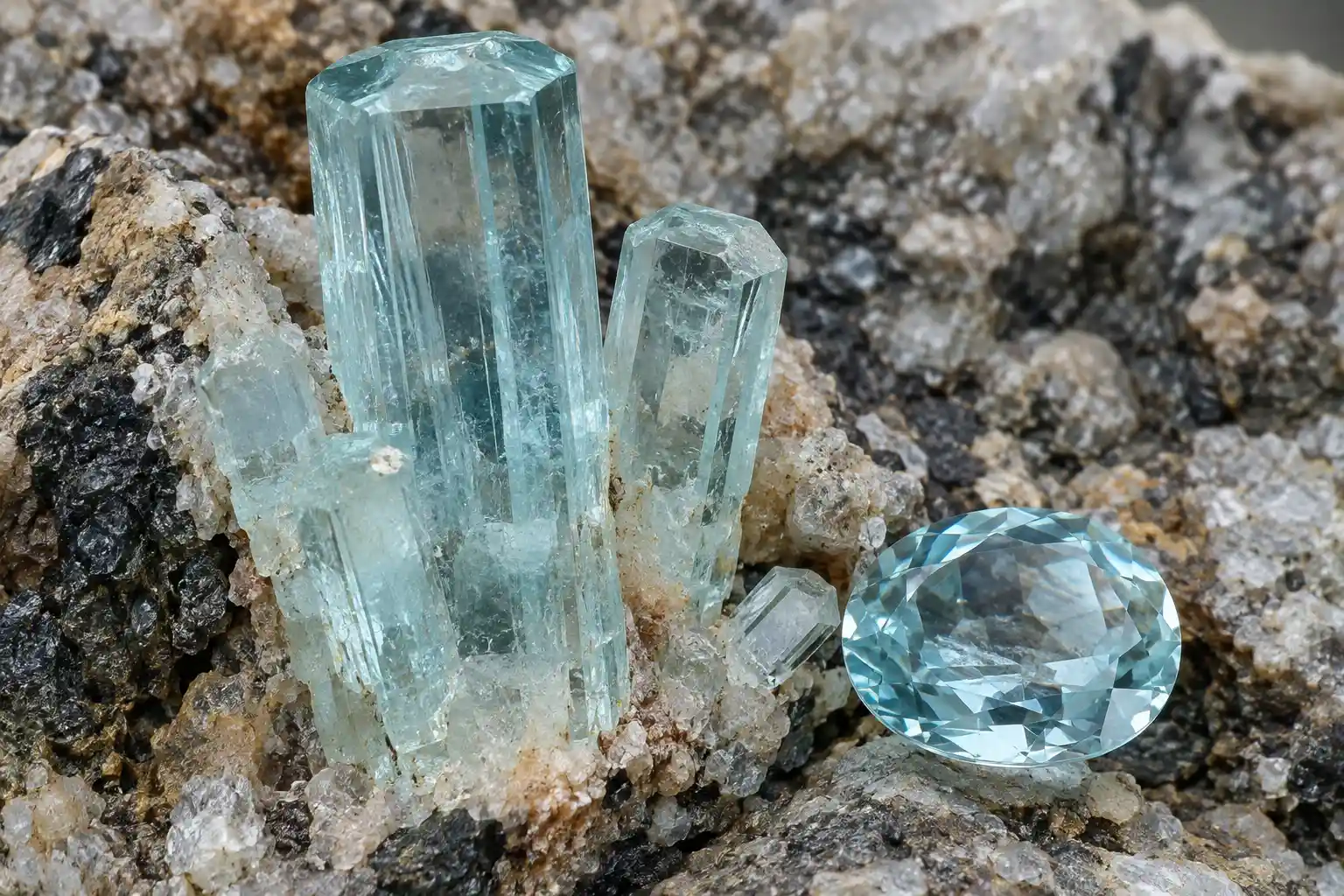
Jeremejevite benefits begin with rarity. Jeremejevite is an uncommon aluminum borate mineral with the formula Al₆(BO₃)₅(F,OH)₃, and transparent crystals suitable for faceting remain scarce compared with familiar gems such as sapphire, aquamarine, tourmaline, quartz, or topaz. The mineral crystallizes in the hexagonal system and commonly forms elongated prismatic crystals. Fine specimens may be colorless, pale yellow, yellow-brown, light blue, or aquamarine blue, with blue crystals from Namibia becoming especially recognizable among mineral collectors.
The physical properties add practical value. Jeremejevite has a Mohs hardness around 7, a vitreous luster, no prominent cleavage reported in standard mineral references, and a specific gravity close to 3.3. Transparent crystals can therefore be faceted into attractive collector gemstones when the rough is sufficiently clean and large, although scarcity means complete natural crystals may be equally or more desirable than cut stones. Because gem-quality rough is uncommon, decisions about cutting often involve preserving mineralogical form as carefully as maximizing brilliance.
Modern crystal communities sometimes describe Jeremejevite benefits in terms of clarity, spiritual insight, communication, calm, or personal transformation. Those themes can serve as personal symbolism, particularly because the stone is rare and frequently pale blue, but they should not be mistaken for measurable medical or psychological effects. Jeremejevite does not scientifically treat anxiety, neurological conditions, sleep problems, communication disorders, or other illnesses through ordinary wearing or handling.
9 Jeremejevite Benefits at a Glance
- Exceptional rarity gives fine Jeremejevite strong mineral-collector and specialty-gem appeal.
- Pale blue, aquamarine-blue, yellow, and colorless crystals offer visual variety within one rare mineral species.
- Mohs hardness around 7 provides useful scratch resistance for carefully designed jewelry.
- Transparent crystals can produce elegant faceted collector gems with bright vitreous luster.
- Natural prismatic crystals preserve valuable crystallographic and geological information.
- Geographic occurrences in Russia, Namibia, Tajikistan, Madagascar, Myanmar, Sri Lanka, and a small number of other localities add provenance interest.
- Gemological identification teaches buyers to distinguish Jeremejevite from aquamarine, topaz, tourmaline, glass, and other pale blue gems.
- Scarcity makes documentation, locality information, condition, and accurate species identification especially important for collectors.
- Modern symbolism can represent rarity, clarity, persistence, or thoughtful discovery when kept separate from health claims.
Exceptional Rarity Is the Most Important Jeremejevite Benefit
Among the strongest Jeremejevite benefits is the simple fact that relatively few collectors ever encounter a fine specimen in person. The mineral was first described from Russia, but the early material was extremely limited. Later discoveries, particularly in Namibia, demonstrated that Jeremejevite could occur as transparent crystals with attractive blue or yellow coloration, yet even productive occurrences yielded modest quantities compared with commercial gemstones mined on a large scale.
Rarity affects the stone in several ways. Complete crystals are valued for mineral collections, transparent rough attracts gem cutters, and documented locality can become an important part of the specimen’s identity. Large, clean, well-formed crystals with strong color sit in a very different collecting category from tiny fragments, heavily included pieces, or pale stones with substantial surface damage.
Rarity should still be evaluated carefully rather than treated as a guarantee of quality. A scarce mineral can remain poorly cut, damaged, weakly colored, or undocumented. When assessing Jeremejevite quality, collectors benefit from considering transparency, color, crystal condition, size, locality, cutting, inclusions, and provenance together instead of assuming rarity alone establishes exceptional value.
Blue and Yellow Colors Give Jeremejevite Distinctive Collector Appeal
Jeremejevite is frequently associated with pale aquamarine-blue crystals, particularly from Namibia, but its natural color range is wider. Colorless, pale yellow, yellow-brown, blue-green, and blue specimens are documented, creating useful diversity within a mineral that many people know only through photographs of blue crystals.
Blue Jeremejevite can show distinct dichroism, meaning the color changes in intensity according to viewing direction. This directional behavior adds visual interest to transparent crystals and requires attention during faceting because orientation can influence the finished gem’s face-up color. A cutter who ignores crystal direction may preserve more weight but produce a stone that appears weaker or less evenly colored than the rough suggested.
The softer color range also gives Jeremejevite a different identity from saturated blue sapphire or vivid Paraíba-type tourmaline. Its appeal often comes from delicacy, transparency, rarity, and crystal form rather than overwhelming color saturation. These Jeremejevite benefits are strongest when the gem is appreciated on its own terms instead of being treated as a substitute for another blue stone.
Mohs Hardness Around 7 Supports Careful Jewelry Use
Jeremejevite has a Mohs hardness of about 7, which provides reasonable resistance to ordinary scratching and allows transparent stones to be used in jewelry. Pendants, earrings, brooches, and carefully protected rings can therefore display a faceted Jeremejevite without requiring the extreme caution appropriate to calcite or fluorite.
Hardness does not make an exceptionally rare gemstone disposable, however. Natural crystals can contain fractures, inclusions, thin terminations, or internal structural weaknesses, while faceted stones can chip if struck sharply along exposed edges. The rarity of replacement material makes conservative wear especially sensible even when the gem’s hardness is respectable.
Jewelry settings should protect corners and the girdle without placing excessive pressure on the stone. Rings deserve more caution than earrings or pendants because hands encounter hard surfaces repeatedly during ordinary activities. These practical Jeremejevite benefits become most useful when the gem is worn selectively rather than treated as though hardness 7 means complete immunity to damage.
Transparent Jeremejevite Can Produce Exceptional Collector Gems
Fine transparent crystals can be faceted into remarkably clean gemstones with a bright vitreous appearance. The refractive properties are moderate rather than diamond-like, so successful cutting depends on proportion, transparency, color orientation, polish, and symmetry rather than extreme brilliance or dispersion.
Step cuts suit some elongated rough well, while emerald-style shapes, rectangles, ovals, cushions, and other designs may be chosen according to the crystal. Because the rough is scarce, cutters face an unusual dilemma: preserving a complete natural crystal may be more important than producing a slightly larger faceted gem.
A well-formed natural crystal can display crystallographic information that disappears permanently once the stone is cut. Conversely, broken or incomplete transparent rough may gain substantially in beauty when faceted. These Jeremejevite benefits therefore create room for both specimen collecting and lapidary art, with the best choice determined by the individual stone rather than a universal preference for cutting.
Natural Prismatic Crystals Have Strong Mineralogical Value
Jeremejevite commonly forms elongated prismatic crystals within the hexagonal system, and complete specimens can show attractive natural terminations, growth features, surface textures, and internal structures. Some crystals appear nearly colorless while others show blue or yellow bands, inclusions, hollow channels, or subtle growth zoning.
These natural forms give Jeremejevite benefits beyond gem use because a complete crystal preserves information about how the mineral developed. Growth steps, terminations, inclusions, associations with surrounding minerals, and remnants of matrix can all reveal details that a faceted stone no longer retains.
For serious mineral collectors, condition can therefore matter as much as transparency. A smaller crystal with an intact termination and reliable locality may be more scientifically desirable than a larger piece with heavy damage. Photography and magnification can also reveal internal channels or growth features that remain nearly invisible to the unaided eye, giving one specimen several layers of interest.
Geographic Rarity Makes Provenance Especially Important
Jeremejevite was first described from the type locality in Russia and later became famous through discoveries in Namibia. Gem-quality or collectible material has also been documented from Tajikistan, Madagascar, Myanmar, Sri Lanka, and a limited number of additional occurrences, though production from each locality has differed greatly in color, crystal size, quality, and quantity.
This geographic scarcity gives provenance an important role among Jeremejevite benefits. A documented Namibian specimen has a different collecting story from a yellow crystal from Tajikistan or a near-colorless gem from Madagascar. Locality information connects the specimen with geological history that cannot be reconstructed confidently once labels and records are lost.
Collectors should therefore keep mine, district, country, acquisition, and previous-owner information whenever it is available. With a rare mineral, reliable provenance may become increasingly valuable over time because visual inspection alone cannot always distinguish geographic origin.
Identification Protects Buyers from Pale Blue Lookalikes
Rare gemstones attract misidentification because buyers may encounter them far less often than common alternatives. Pale blue Jeremejevite can resemble aquamarine, blue topaz, tourmaline, pale sapphire, glass, or other transparent stones in photographs, particularly when sellers use strong lighting and magnification.
Professional identification can consider refractive indices, birefringence, specific gravity, optical character, spectroscopy, inclusions, and crystal morphology. Jeremejevite’s gemological profile differs clearly from beryl, topaz, and tourmaline when appropriate tests are performed, but those differences may not be obvious from appearance alone.
Someone preparing to buy Jeremejevite should therefore place species identification and provenance ahead of dramatic rarity claims. Laboratory reports become especially useful for valuable faceted stones because the original crystal form has been removed and the commercial consequences of mistaken identity can be substantial.
Scarcity Makes Price Education and Documentation Especially Valuable
Because Jeremejevite appears infrequently in ordinary jewelry markets, buyers have fewer direct comparisons than they would for sapphire, emerald, or quartz. This makes pricing more dependent on individual stone quality, size, color, transparency, cutting, crystal condition, provenance, and current collector demand.
A transparent blue gem with attractive saturation may command very different attention from a pale heavily included stone of similar weight, while a complete museum-quality crystal may be valued according to specimen criteria rather than faceted-gem standards. Comparing only price per carat can therefore obscure important differences.
Understanding Jeremejevite price becomes more useful when value is connected with the characteristics of the actual specimen rather than with generalized statements that every example is extraordinarily expensive. Rarity establishes scarcity, but quality determines how strongly a particular stone benefits from that scarcity.
Modern Symbolism Can Represent Discovery, Clarity, and Persistence
The unusual history of Jeremejevite makes discovery one of the most natural symbolic Jeremejevite benefits. For many years the mineral was known from very few specimens, and later finds changed what collectors understood about its colors, sizes, and geographic occurrence. That history provides a real foundation for themes involving curiosity and the value of continuing to investigate uncommon possibilities.
Pale blue specimens can also support symbolism involving clarity, calm, or thoughtful communication, while the scarcity of fine crystals may represent appreciating qualities that are not immediately obvious or common. A person may choose Jeremejevite to mark a difficult achievement, an unusual professional path, or a period of sustained study because the stone’s rarity resonates with the experience.
These associations remain personal. Jeremejevite does not transmit clarity, cure anxiety, improve communication, or create opportunity through an established physical mechanism. Its mineralogical history already provides enough depth to support meaningful symbolism without extending into unsupported health or metaphysical promises.
Responsible Care Protects a Gem That Is Difficult to Replace
Jeremejevite’s rarity makes careful ownership especially important. Stable faceted stones can generally be cleaned with lukewarm water, mild soap, and a soft brush, while valuable natural crystals deserve gentler handling if they contain delicate terminations, fractures, or associated matrix. Strong thermal shock and unnecessarily aggressive mechanical cleaning should be avoided.
Lapidary work requires normal mineral-dust precautions, including wet methods, eye protection, ventilation, and appropriate respiratory controls when sawing or grinding. Because rare rough cannot easily be replaced, cutting decisions should also consider whether an intact natural crystal has greater specimen value than it would after faceting.
Jeremejevite should not be ground for ingestion, dissolved into homemade remedies, or used as a substitute for medical treatment. Its aluminum, boron, fluorine, and hydroxyl chemistry describes a mineral species, not a nutritional or therapeutic formulation.
Conclusion
Jeremejevite benefits include exceptional rarity, attractive blue and yellow coloration, useful hardness, faceting potential, natural crystal beauty, provenance value, gemological education, collector interest, and meaningful modern symbolism. Its unusual distribution and limited quantities give each documented specimen a significance that extends beyond simple appearance.
The strongest Jeremejevite benefits come from accurate identification, preservation of provenance, realistic quality evaluation, and careful use. A rare mineral does not need unsupported healing powers to be extraordinary. Its chemistry, crystal form, history, colors, and scarcity already make Jeremejevite one of the more distinctive collector gems.
FAQs
What are the main Jeremejevite benefits?
The most practical Jeremejevite benefits include mineral collecting, rare-gem ownership, crystallographic study, gem identification, faceting, provenance collecting, and carefully designed jewelry. Fine crystals also offer unusual color and natural prismatic form, while symbolic themes involving discovery, persistence, or clarity can carry personal meaning without being treated as medical or psychological effects.
What is Jeremejevite made of?
Jeremejevite is an aluminum borate mineral with fluorine and hydroxyl, commonly represented by the formula Al₆(BO₃)₅(F,OH)₃. It crystallizes in the hexagonal system, has a vitreous luster, and generally occurs as elongated prismatic crystals that may be colorless, yellowish, blue-green, or aquamarine blue.
How hard is Jeremejevite?
Jeremejevite has a Mohs hardness around 7, giving it useful resistance to everyday scratching and allowing transparent specimens to function as gemstones. Rare faceted stones should still be protected from strong impact, exposed edges, and unnecessary rough wear because hardness does not prevent every form of chipping or fracture.
Why is Jeremejevite so rare?
Jeremejevite has been documented from only a limited number of localities, and most occurrences have not produced large continuous supplies of transparent gem-quality crystals. Even productive discoveries have yielded relatively modest quantities compared with commercially mined gemstones, making fine color, large size, transparency, complete crystal form, and documented provenance uncommon combinations.
Where is Jeremejevite found?
The mineral was first described from Russia and later became particularly famous through Namibian discoveries, including Cape Cross and Erongo-area material. Additional gem or collector specimens have been documented from Tajikistan, Madagascar, Myanmar, Sri Lanka, and a small number of other locations, with each occurrence differing in color, crystal form, and production.
Is blue Jeremejevite suitable for jewelry?
Transparent blue Jeremejevite can be used successfully in earrings, pendants, brooches, and carefully protected rings because hardness around 7 provides reasonable scratch resistance. Its rarity makes conservative wear sensible, especially when a gem contains fractures or has exposed corners that could chip after impact.
Is Jeremejevite more valuable as a crystal or a faceted gemstone?
The answer depends on the individual specimen. A complete, sharply terminated, transparent crystal with strong color and documented provenance may be more desirable intact, while broken or incomplete gem-quality rough may achieve greater aesthetic value after skilled faceting. Collector and gemstone markets therefore evaluate different characteristics.
Can Jeremejevite be confused with aquamarine?
Yes. Pale blue transparent Jeremejevite can resemble aquamarine visually, particularly in photographs, but the two are different minerals with different chemistry, optical properties, density, and crystal structure. Proper gemological testing can separate them reliably, which is particularly important when a rare-stone premium is involved.
Does Jeremejevite have healing powers?
There is no established clinical evidence that Jeremejevite treats anxiety, sleep disorders, neurological conditions, communication difficulties, pain, or other physical or mental-health concerns through ordinary wearing or handling. Jeremejevite benefits described as healing, calming, clarity-enhancing, spiritual, or energetic effects remain personal and metaphysical beliefs and should not replace qualified medical or mental-health care.