Jeremejevite Meaning: Properties, Uses & Symbolism
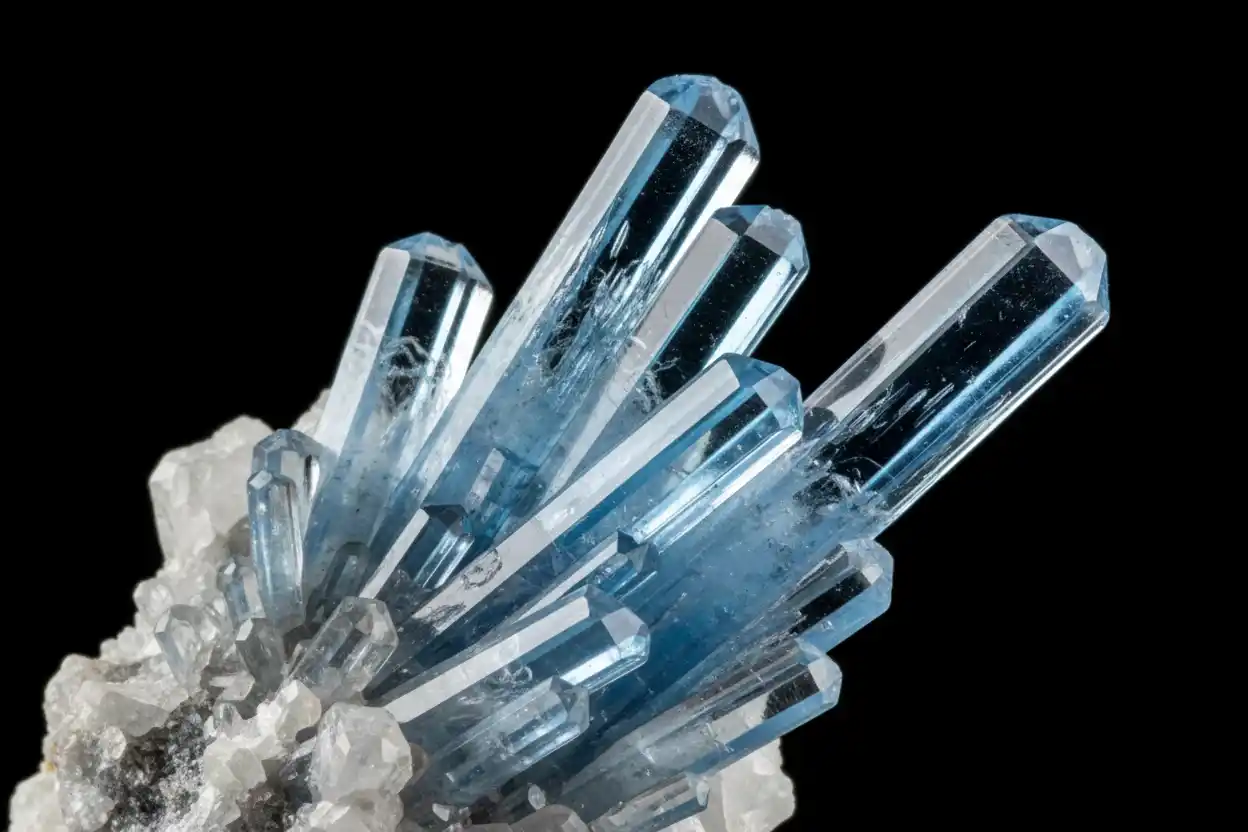
Jeremejevite meaning begins with a mineral that is genuinely unusual without requiring supernatural embellishment. Jeremejevite is a rare aluminum borate mineral belonging to the hexagonal crystal system. Its composition is commonly written Al₆(BO₃)₅(F,OH)₃, reflecting variable fluorine and hydroxyl occupancy, while modern mineralogical references recognize a fluorine-dominant ideal end-member. Natural crystals are commonly transparent and prismatic, with documented colors including colorless, light yellow-brown, aquamarine blue, and related pale blue shades. Mindat records vitreous luster, hardness around Mohs 7, measured specific gravity near 3.28, conchoidal fracture, no observed cleavage, and a hexagonal crystal structure.
Gemological measurements reinforce that identity. GIA examined blue and yellow jeremejevites with refractive indices spanning approximately 1.640–1.651, birefringence around 0.009, and measured specific gravity from about 3.27 to 3.31. Blue specimens showed distinct dichroism between blue and near-colorless directions, while yellow material showed weaker light-yellow to near-colorless directional change. These measurements are much more useful for identification than assumptions based on rarity, color, or a seller’s claim.
Jeremejevite’s scarcity and attractive blue crystals have also made it a desirable collector and faceting material, especially when transparent crystals provide usable gem rough. That commercial importance belongs separately in the Jeremejevite price guide and buy Jeremejevite guide. This page instead owns material identity, formation, color causes, diagnostic evidence, documented history, responsible symbolism, and safe ownership within the broader Gemstone Guides.
Jeremejevite at a Glance
| Feature | Evidence-based description |
|---|---|
| Mineral | Jeremejevite |
| Mineral class | Borate |
| Common formula representation | Al₆(BO₃)₅(F,OH)₃ |
| Crystal system | Hexagonal |
| Typical habit | Elongated prismatic crystals |
| Documented colors | Colorless, light yellow-brown, aquamarine blue, blue, occasionally violet-toned material |
| Luster | Vitreous |
| Transparency | Commonly transparent in gem-quality material |
| Mohs hardness | About 7 |
| Specific gravity | Roughly 3.27–3.31 in measured gem material |
| Refractive index | Approximately 1.640–1.651 in studied specimens |
| Birefringence | About 0.009 in the principal GIA comparison sample |
| Pleochroism | Distinct blue to near-colorless in blue material; weaker in yellow material |
| Cleavage | None observed in standard mineral references |
| Fracture | Conchoidal |
| Important occurrences | Russia, Namibia, Tajikistan, Myanmar, and a small number of other documented localities |
| Common geological association | Pegmatitic environments are important for several gem occurrences |
| Routine medical use | None |
| Symbolic meaning | Modern personal or metaphysical interpretation, not a measurable mineral property |
What Jeremejevite Actually Is
Jeremejevite is a defined mineral species rather than a trade-name rock or broad gemstone family. That distinction matters because its chemical composition, crystal structure, optical behavior, and diffraction pattern can be measured and compared with reference data. Mindat classifies it among the borates and records the hexagonal space group P6₃/m, while structural data from Cape Cross material support the hexagonal architecture used in modern mineral identification.
The formula is sometimes presented differently across mineralogical and gemological references. GIA commonly writes the ideal chemistry as Al₆B₅O₁₅[F,OH]₃, while Mindat displays Al₆(BO₃)₅(F,OH)₃ and separately records the IMA fluorine-dominant ideal formula. These expressions describe the same basic aluminum-borate structural framework while acknowledging the fluorine-hydroxyl relationship rather than indicating several unrelated minerals.
That precision is useful because online descriptions sometimes reduce jeremejevite to “a rare blue crystal.” Blue is visually important, but it does not define the species. Colorless and yellow material is documented, and a pale blue transparent crystal is not jeremejevite merely because it resembles photographs from Namibia. Mineral identity must ultimately agree with physical, optical, spectroscopic, and crystallographic evidence.
Jeremejevite Identity Table
| Property or claim | Jeremejevite evidence | Identification significance |
|---|---|---|
| Borate mineral | Supported | Establishes mineral class |
| Hexagonal crystal system | Supported | Separates it from many visually similar gems |
| Long prismatic habit | Common | Useful visual clue, not proof |
| Colorless material | Documented | Blue is not required |
| Yellow material | Documented | Color range is broader than popular images suggest |
| Blue material | Well documented, especially from Namibia | Commercially important but not species-defining |
| RI near 1.64–1.65 | Supported by gemological testing | Strong routine identification evidence |
| SG near 3.3 | Supported | Useful supporting measurement |
| Birefringence around 0.009 | Supported in studied material | Helps separate look-alikes |
| Blue/near-colorless dichroism | Documented | Useful clue in transparent blue material |
| No observed cleavage | Standard reference property | Does not make the stone unbreakable |
| Mohs hardness about 7 | Supported | Indicates useful scratch resistance |
| “One of the rarest gems” | Context-dependent | Rarity should be tied to gem quality, locality, size, and available supply |
| “Healing borate crystal” | Unsupported as a medical claim | Symbolic description only |
| “Blue color proves Namibia origin” | Unsupported | Color is not sufficient for geographic origin |
How Jeremejevite Forms
Jeremejevite is strongly associated with specialized boron- and fluorine-bearing geological systems, particularly pegmatitic environments. The type locality in Russia is recorded from granitic debris with quartz and orthoclase, while the famous Cape Cross occurrence in Namibia is associated with pegmatites containing minerals such as feldspar, quartz, schorl, fluorapatite, and other boron- or fluorine-related phases.
The Namibian story is especially important because Cape Cross produced some of the mineral’s classic blue crystals. GIA’s review of the locality describes jeremejevite recovered from pegmatites at Mile 72 near Cape Cross, and later discoveries in the Erongo region yielded additional fine transparent crystals suitable for faceting. In parts of the Erongo Mountains, gem minerals occur in narrow fissures, veins, pockets, and pegmatite-related structures containing quartz, tourmaline, aquamarine, and jeremejevite.
Gem jeremejevite has also been documented from eastern Tajikistan pegmatites, while Myanmar material has been reported from pegmatite-associated and alluvial environments in the Mogok region. These occurrences show that “jeremejevite formation” cannot be reduced to one exact sequence copied from one mine. Boron availability, aluminum-rich host chemistry, fluorine or hydroxyl conditions, fluid evolution, temperature, pressure, and the architecture of individual pegmatites all influence whether the mineral can crystallize.
The locality-by-locality geological evidence, associated minerals, and deposit models are covered separately in Jeremejevite formation and deposit geology. For this meaning reference, the critical point is that jeremejevite is a product of specific geological chemistry—not a crystal whose existence can be explained by symbolic “energy.”
Why Jeremejevite Can Be Blue, Yellow, or Colorless
Colorless jeremejevite demonstrates that strong body color is not required by the mineral’s fundamental structure. Blue specimens often show color zoning, including pale blue bands against near-colorless areas. GIA’s examination of several faceted stones documented both wide and narrow blue zones within otherwise colorless material, producing an overall blue appearance. Yellow specimens examined in the same work showed more evenly distributed pale-yellow color.
The blue coloration has been linked to iron. GIA reported that more sensitive elemental analysis detected iron in blue jeremejevite from the Erongo Mountains and cited an interpretation in which Fe²⁺–Fe³⁺ intervalence charge transfer produces the blue appearance. That mechanism is more defensible than vague claims that the blue comes from “high vibration,” but it should still be described as a mineralogical interpretation tied to studied material rather than assumed for every blue crystal from every locality.
Yellow material requires similar restraint. Its visible absorption differs from blue jeremejevite, but a simple universal statement assigning every yellow crystal to one trace element would exceed the evidence available from the principal gemological studies. Color can also interact with growth zoning and crystallographic orientation.
Jeremejevite is uniaxial and blue material can be distinctly dichroic. Turning the stone relative to polarized light can reveal blue and near-colorless directional appearances, making color orientation important both for identification and cutting. A deeper treatment of absorption, pleochroism, zoning, refractive behavior, and viewing geometry belongs in Jeremejevite optical properties and color behavior.
Diagnostic Traits
A transparent pale-blue elongated crystal with vitreous luster can be consistent with jeremejevite, but that appearance overlaps with other minerals. Aquamarine, topaz, tourmaline, danburite, beryl varieties, and other transparent prismatic materials can create visual confusion when a specimen lacks matrix or reliable provenance.
Routine gemological measurements provide a stronger foundation. GIA’s studied jeremejevites showed RI values approximately between 1.640 and 1.651 and specific gravity values between roughly 3.27 and 3.31. Their measured birefringence clustered around 0.009 in the main comparison set. The blue stones displayed clear dichroism, and Raman spectroscopy supplied a diagnostic spectral match when GIA investigated unusual material.
Microscopy can reveal growth tubes, partially healed fractures, fluid inclusions, negative-crystal-like features, and mineral inclusions. A recent GIA observation documented unusual hollow channels forming dendritic and lightning-like patterns aligned with crystal-growth directions, while earlier GIA work recorded tube-like features and several mineral inclusions. Those structures can support interpretation, but no single inclusion pattern should be declared universally diagnostic.
The dedicated Jeremejevite microscope inclusion notebook owns the detailed inclusion workflow. On a general meaning page, the safer rule is straightforward: visual appearance narrows possibilities; consistent measurements and spectroscopy establish much stronger confidence.
Original Jeremejevite Claim-Audit Table
Rare minerals attract repeated claims that gradually become detached from their original evidence. The following audit separates mineralogical statements from marketing and metaphysical assertions.
| Claim encountered | Evidence status | More defensible interpretation |
|---|---|---|
| “Jeremejevite is an aluminum borate.” | Supported | Core mineralogical identity |
| “Jeremejevite is always blue.” | False | Colorless and yellow material is well documented |
| “All blue jeremejevite comes from Namibia.” | Unsupported | Namibia is famous for blue material, but color cannot prove locality |
| “Cornflower blue is an official grade.” | False | It is a descriptive color expression, not a standardized laboratory grade |
| “Jeremejevite has a single fixed F/OH composition in every crystal.” | Oversimplified | Fluorine and hydroxyl relationships vary within the structural formula |
| “Every long pale-blue prism is jeremejevite.” | False | Several gem minerals can look similar |
| “Rarity proves authenticity.” | False | A rare label cannot substitute for identification |
| “A certificate proves market value.” | False | Identification documentation does not establish a universal price |
| “Namibian origin can be seen from color alone.” | Unsupported | Geographic provenance needs appropriate evidence |
| “Blue jeremejevite heals communication problems.” | Unsupported medical/behavioral claim | Modern symbolism, not mineral science |
| “Jeremejevite detoxifies the body.” | Unsupported | No established physiological mechanism |
| “Boron in the stone provides nutritional boron.” | Unsupported | Structural elements in a mineral are not automatically bioavailable nutrients |
| “Its rarity guarantees investment returns.” | Unsupported financial claim | Scarcity does not guarantee resale value or liquidity |
| “Holding it changes another person’s behavior.” | Unsupported | No established causal mechanism |
| “Jeremejevite has ancient crystal-healing traditions.” | Historically doubtful | The species was only scientifically recognized in modern mineralogical history |
The last point matters particularly for jeremejevite meaning. Unlike materials such as jade or jasper, which were used and interpreted by cultures long before modern mineral classification, jeremejevite entered documented mineralogical knowledge comparatively recently. Claims of a specific ancient jeremejevite spiritual tradition therefore require unusually strong documentary evidence.
Original Specimen and Photo Checklist
A responsible record of a suspected jeremejevite should document what is observable before assigning rarity, locality, quality, or symbolism.
| Observation | Record | Why it matters |
|---|---|---|
| Crystal color | Colorless, yellow, pale blue, blue, violetish blue, zoned | Prevents “blue only” assumptions |
| Color zoning | Uniform, longitudinal bands, patches, near-colorless zones | Jeremejevite can show pronounced zoning |
| Crystal habit | Long prism, broken prism, etched crystal, faceted gem | Habit provides context |
| Termination | Complete, rounded, etched, broken, indented | Useful for specimen documentation |
| Luster | Vitreous, dull, weathered | Supports comparison with reference material |
| Transparency | Transparent, included, translucent | Important for gem versus specimen interpretation |
| Dimensions | Exact measurements | Prevents scale exaggeration in photographs |
| Weight | Carat or gram weight | Useful with density calculations |
| Pleochroism | Directional colors under controlled viewing | Can support blue jeremejevite identification |
| RI | Measured values and method | Strong routine gemological evidence |
| Specific gravity | Measured value and method | Supports separation from look-alikes |
| UV response | Wavelength plus observed result | Variable and therefore supporting rather than decisive |
| Inclusions | Tubes, healed fractures, fluids, crystals, channels | Can support growth interpretation |
| Matrix minerals | Quartz, feldspar, tourmaline or other documented associates | Adds geological context |
| Provenance | Documented, seller-stated, or unknown | Keeps origin claims separate from mineral identity |
| Treatment disclosure | Reported, tested, or unknown | Avoids assuming natural appearance from photographs |
| Laboratory report | Laboratory and exact conclusion | Stronger than the generic word “certified” |
| Image conditions | Lighting, white balance, magnification, editing | Essential when evaluating blue saturation online |
The checklist deliberately avoids a points-based authenticity score. A stone should not become “90% jeremejevite” because several weak clues happen to match. Identification is strongest when independent observations converge.
Documented Discovery and Naming History
Jeremejevite was first described from Soktuj Gora in the Transbaikal region of Russia. The type material occurred as rare crystals associated with granitic debris, quartz, and orthoclase. The mineral was named in honor of Russian mineralogist Pavel Vladimirovich Jeremejev, who collected the first specimens and recognized that they might represent a previously undescribed mineral. Mindat preserves the type-locality record and the original mineralogical description.
For a long period, very little material was known. Discovery of jeremejevite at Cape Cross in Namibia transformed the mineral’s collector profile because the locality produced transparent crystals ranging from colorless to striking blue. GIA’s historical review describes only limited production from that pegmatite despite repeated mining efforts, which helps explain why high-quality crystals became well known among specialist collectors while remaining unfamiliar to the general jewelry market.
Later finds in the Erongo Mountains expanded the supply of gemmy blue material and produced some unusually large crystals and faceted gems. GIA reported that only a small fraction of cut stones from one important Erongo discovery exceeded one carat and described the largest faceted examples as exceptional. Additional occurrences in Tajikistan, Madagascar, Myanmar, Sri Lanka, and elsewhere broadened the known color and locality range without turning jeremejevite into a common gem.
This history is much more useful than unsupported claims of ancient ceremonial use. Jeremejevite’s documented story is fundamentally one of mineral discovery, pegmatite exploration, scientific characterization, specialist collecting, and rare-gem cutting.
Jeremejevite Meaning in Modern Symbolism
Contemporary crystal descriptions sometimes associate jeremejevite with clarity, communication, personal direction, spiritual insight, calmness, transformation, or heightened awareness. Its rarity can also inspire symbolism centered on individuality or appreciating uncommon opportunities, while its pale-blue appearance naturally encourages comparison with culturally familiar ideas about sky, openness, or reflection.
These are modern interpretations rather than properties demonstrated by mineralogical testing. A person can reasonably use a jeremejevite specimen as a personal reminder to communicate carefully, examine a difficult decision, value rarity, or remain curious. The psychological meaning comes from the person’s chosen association with the object, not from a measurable therapeutic field emitted by aluminum borate.
Jeremejevite therefore offers a useful contrast with Jaspilite meaning, where symbolism is often inspired by ancient banded geological structures, and Jet meaning, where the material has organic origin and a much deeper documented cultural history. Similar modern words such as “protection,” “grounding,” or “clarity” appearing across unrelated materials do not establish a shared scientific mechanism.
Symbolism Boundary: What Jeremejevite Cannot Scientifically Promise
No established evidence shows that jeremejevite treats anxiety, depression, neurological disease, cardiovascular conditions, hormonal disorders, infertility, immune problems, pain, sleep disorders, or other medical conditions. Its boron, fluorine, aluminum, oxygen, and hydrogen-bearing structural chemistry does not make the crystal a medicine, nutrient source, or transdermal supplement.
It also cannot scientifically guarantee wealth, improve investment returns, ensure manifestation, repair relationships, change another person’s behavior, or produce predetermined life events. Rarity can affect collector interest and market price, but rarity is not a mechanism for supernatural causation.
A responsible symbolic statement therefore sounds like “I use the stone as a reminder to think clearly before communicating,” not “jeremejevite changes brain chemistry and makes communication successful.” One describes intentional personal practice; the other makes a physiological and causal claim requiring evidence that mineralogy does not provide.
Uses of Jeremejevite
Jeremejevite’s principal documented uses are mineral collecting, scientific study, gemological reference work, and limited faceting of transparent material. Well-formed crystals can be desirable as specimens because of their rarity, prismatic habit, vitreous surfaces, attractive blue zoning, and association with classic pegmatite localities.
Transparent crystals can also produce faceted gems, although usable rough is limited by crystal dimensions, inclusions, fractures, color zoning, and rarity. GIA has studied both step-cut blue and yellow stones as well as larger faceted examples from Namibia and other sources. Those cut stones demonstrate that jeremejevite can function as a genuine gem material rather than merely a cabinet mineral.
Lapidary choices become highly specimen-specific because retaining rare material can conflict with optimizing color, brilliance, and clarity. Those tradeoffs belong in Jeremejevite cutting, orientation, and polish rather than being repeated on a general meaning reference.
Durability and Wear
A Mohs hardness around 7 gives jeremejevite useful resistance to ordinary scratching, and Mindat records no observed cleavage. That combination is favorable compared with many softer collector minerals, but it does not make a rare transparent crystal immune to damage. Jeremejevite can fracture conchoidally, while inclusions, internal tubes, healed fractures, sharp faceting points, and pre-existing damage can reduce practical robustness.
The rarity of high-quality material adds another reason for conservative ownership: replacement can be difficult even when physical durability is acceptable. A protective pendant or occasional-wear jewel presents a different risk profile from a high-set ring exposed to desk edges, tools, sports, or repeated impact.
Detailed setting geometry, exposed corners, prongs, girdle protection, and wear-frequency decisions belong in Jeremejevite setting and wear engineering.
Safe Ownership and Handling
Ordinary handling of an intact jeremejevite crystal or finished gemstone is different from cutting, drilling, grinding, sanding, or crushing mineral material. A collector examining a stable crystal does not face the same exposure conditions as a lapidary creating airborne particulate matter.
Jeremejevite should not be powdered for consumption, placed in drinking water to make a gemstone elixir, or treated as a nutritional source of boron, fluorine, or any other element. Chemical elements being present in a mineral formula do not establish biological availability, therapeutic dosage, or safety.
Rare crystals should also be handled in ways that preserve their scientific and collector information. Avoid unnecessary scratch testing, deliberate impact, heating, acid exposure, or aggressive attempts to “prove” authenticity. Original labels, locality documentation, crystal orientation, repairs, and condition history can materially increase the usefulness of a specimen record. Those long-term documentation questions belong in the Jeremejevite specimen conservation record.
What a Photograph Can Establish
A strong photograph can record crystal habit, color zoning, termination form, surface etching, fractures, attached matrix, transparency, and apparent luster. Multiple views under neutral lighting can also reveal whether blue coloration is evenly distributed or concentrated in directional bands.
Photography cannot prove formula, refractive index, density, spectroscopy, treatment status, or geographic origin. Camera white balance can shift pale aquamarine toward stronger blue, backlighting can exaggerate transparency, and selective saturation can make weakly colored material appear far more vivid than it is in hand.
A supposed “Namibian jeremejevite” photograph therefore supports only what is genuinely visible unless provenance accompanies it. Location, rarity, and authenticity should remain separate claims.
What Laboratory Evidence Can Add
When certainty matters, standard gemological testing can measure refractive index, specific gravity, optical character, pleochroism, and microscopic features. GIA has additionally used Raman spectroscopy, infrared spectroscopy, UV-visible absorption analysis, and elemental methods to characterize jeremejevite and distinguish it from other materials. In an unusual near-colorless specimen, chemical analysis and Raman spectra were consistent with jeremejevite and helped rule out tourmaline.
Raman spectroscopy is especially valuable because an unknown transparent crystal can visually resemble several unrelated minerals. Matching a specimen’s Raman spectrum to reliable reference data gives far stronger identification evidence than color, rarity, or a product listing.
The appropriate conclusion from incomplete data is sometimes “consistent with jeremejevite but not confirmed.” That is scientifically stronger than pretending certainty where the available observations do not support it.
The publication’s mineral-first scope is summarized on About and its educational limits are set out in the Disclaimer; Contact and the Privacy Policy remain site-administration resources rather than evidence about an individual specimen.
Common Jeremejevite Misunderstandings
One common misconception is that jeremejevite is always blue. Colorless and yellow specimens are well documented. Another is that blue color automatically establishes Namibian origin. Namibia is the source of many famous blue examples, but color alone cannot prove locality.
A third error is assuming that rarity makes visual identification easier. The opposite is often true: because few people encounter confirmed jeremejevite regularly, unfamiliarity can make seller photographs and anecdotal identification unusually persuasive. Reliable RI, SG, optical, microscopic, and spectroscopic data become more important, not less.
A fourth misconception treats hardness around 7 as proof that the stone cannot break. Hardness describes resistance to scratching, while fracture and internal condition affect breakage. A fifth assumes that no observed cleavage makes every crystal suitable for unrestricted ring wear; geometry, fractures, rarity, and mounting still matter.
A sixth mistake converts boron content into health claims. Jeremejevite containing boron does not make it a boron supplement. A seventh converts scarcity into guaranteed financial appreciation. Rare minerals can have specialized markets with limited liquidity, highly variable quality, and substantial differences between retail asking prices and resale opportunities.
A Practical Evidence Hierarchy
The weakest evidence is an unsupported seller name or a photograph selected to resemble famous Namibian examples. Better evidence includes reliable provenance, multiple neutral-light photographs, accurate dimensions, crystal habit, measured weight, and observations of pleochroism.
Refractive index and specific gravity add substantially stronger objective evidence. Microscopy can document growth structures and inclusions. Raman spectroscopy, infrared spectroscopy, UV-visible spectroscopy, X-ray techniques, and chemical analysis can provide still stronger confirmation depending on the exact question.
Historical meaning requires an entirely different evidence hierarchy. Mineralogical publications and documented type-locality history support the story of discovery and scientific naming. They do not support claims of ancient jeremejevite healing systems merely because modern crystal websites repeat them.
Modern symbolism can be stated honestly as modern symbolism. It does not need to be disguised as mineral science to have personal meaning.
Frequently Asked Questions
What is jeremejevite?
Jeremejevite is a rare hexagonal aluminum borate mineral commonly represented by the formula Al₆(BO₃)₅(F,OH)₃. It occurs as transparent prismatic crystals and can be colorless, yellow-brown, aquamarine blue, or blue.
How hard is jeremejevite?
Mindat records jeremejevite at about Mohs 7. That provides useful scratch resistance, but the mineral can still fracture, and existing internal features or damage affect practical durability.
What is the refractive index of jeremejevite?
GIA measured approximately 1.640–1.651 across a comparison set of blue and yellow stones, with birefringence around 0.009 in those samples.
Is jeremejevite always blue?
No. Colorless, pale yellow-brown, yellow, aquamarine-blue, and blue material are documented. Some unusual violetish-blue material has also been reported.
What causes blue jeremejevite?
GIA reported iron in blue material from the Erongo Mountains and cited Fe²⁺–Fe³⁺ intervalence charge transfer as a proposed cause of the blue color. The conclusion should be applied to studied material rather than assumed for every specimen without analysis.
Does jeremejevite show pleochroism?
Yes. GIA documented distinct dichroism in blue specimens, changing from blue toward near-colorless depending on crystallographic viewing direction. Yellow stones showed weaker directional color differences.
Where was jeremejevite first discovered?
The type locality is Soktuj Gora in the Transbaikal region of Russia. The mineral was named for Pavel Vladimirovich Jeremejev, who collected the first specimens and recognized their unusual nature.
Is Namibian jeremejevite different from Russian jeremejevite?
They are the same mineral species, but individual occurrences can differ in color, crystal quality, associated minerals, size, and geological context. Namibia became especially famous for transparent blue gem-quality crystals.
Is jeremejevite rarer than most gemstones?
Fine gem-quality jeremejevite is uncommon and production from individual discoveries has often been limited. Rarity should nevertheless be defined by quality, size, locality, and current availability rather than turned into one absolute ranking.
Can jeremejevite be faceted?
Yes. Transparent jeremejevite has been faceted successfully, and GIA has examined cut blue, yellow, and colorless examples. Suitable rough is limited, so larger clean faceted stones can be unusual.
How can I tell jeremejevite from aquamarine?
Color alone is insufficient. Refractive index, specific gravity, optical behavior, microscopy, and Raman spectroscopy can provide much stronger separation. Jeremejevite’s measured gemological properties differ from beryl even when both appear pale aquamarine blue.
Does jeremejevite have healing properties?
No medical or psychological healing effect has been scientifically established from wearing or holding jeremejevite. Contemporary healing descriptions should be understood as metaphysical or symbolic beliefs rather than clinical evidence.
What does jeremejevite symbolize?
Modern interpretations often associate jeremejevite with clarity, communication, awareness, individuality, transformation, or personal direction. These are contemporary symbolic associations and not measurable properties produced by the mineral’s chemical structure.
Can boron in jeremejevite benefit the body?
There is no evidence that ordinary skin contact with jeremejevite provides a useful nutritional dose of boron. Elements within a stable mineral structure are not automatically bioavailable nutrients or medicines.
Can jeremejevite go in drinking water?
Jeremejevite should not be used to prepare gemstone drinking water or elixirs for supposed health effects. Mineral composition does not establish safe ingestion or therapeutic benefit.
Is jeremejevite safe to wear?
A well-cut, properly mounted gem can be wearable, with hardness around Mohs 7 and no standard cleavage reported. However, rarity, fractures, inclusions, setting exposure, and the intended activity should be considered before frequent wear.
Can a photograph prove that a crystal is jeremejevite?
No. Photographs can document compatible color, habit, zoning, and transparency, but they cannot establish the complete mineral identity. Valuable or scientifically important specimens may require gemological measurements or laboratory testing.