7 Hidden Lab Emerald Benefits: Deep Uses, Evidence, Safe Use & Clear Limits
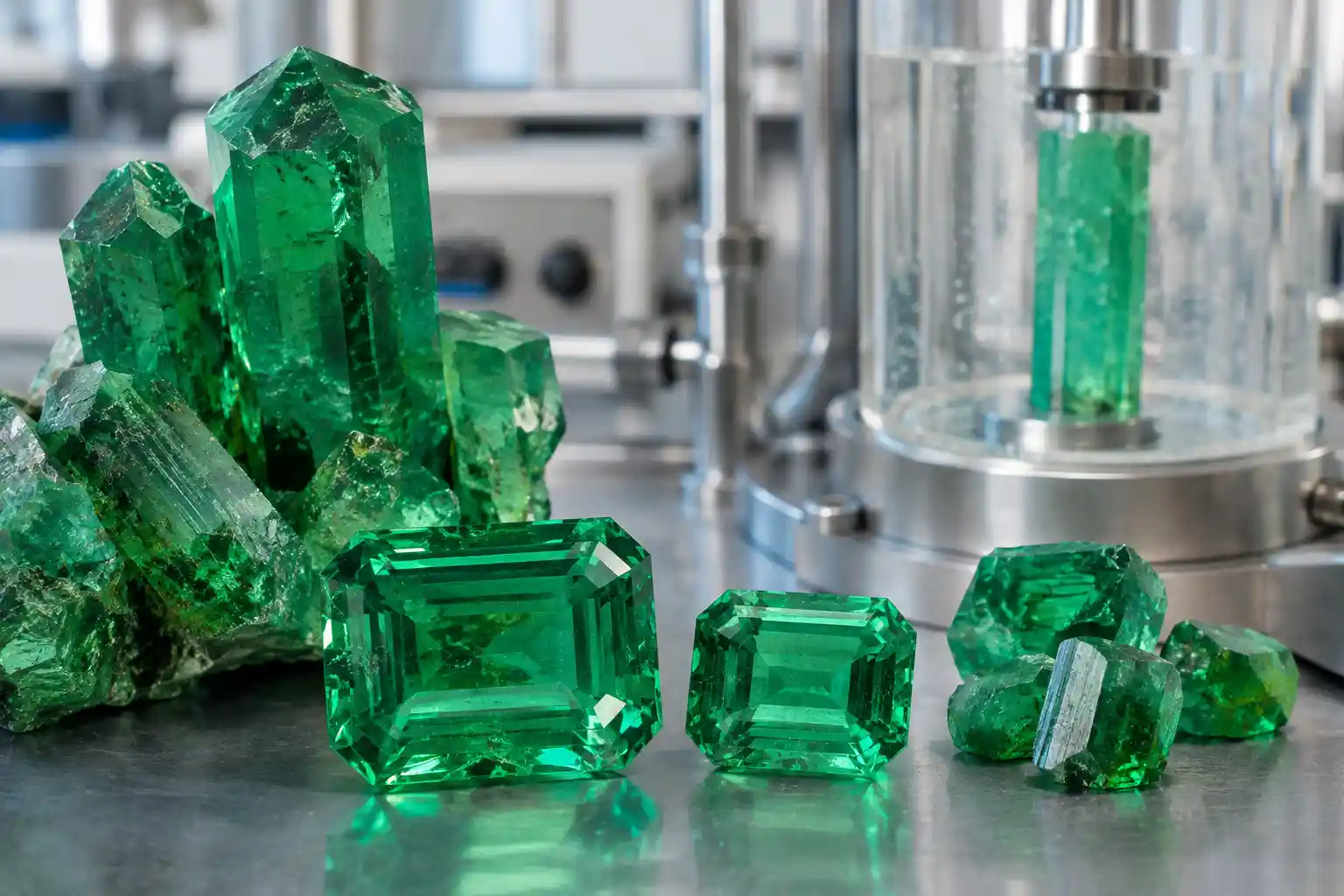
Lab Emerald benefits begin with a fundamental gemological fact: a properly identified laboratory-grown emerald is emerald, not green glass or another lookalike. Emerald is the green variety of beryl, Be₃Al₂Si₆O₁₈, colored principally through chromium, vanadium, or combinations of chromophoric elements. Laboratory-grown emerald reproduces the beryl crystal structure and essentially the same core physical, chemical, and optical properties as natural emerald while forming in a controlled manufacturing environment rather than inside natural geological deposits.
Two important growth approaches dominate the history of laboratory-created emerald: flux growth and hydrothermal growth. Flux methods dissolve the necessary components in a molten chemical solvent and allow emerald crystal to develop slowly around a seed or nucleation point, while hydrothermal processes grow beryl in hot pressurized water-rich solutions designed to imitate aspects of natural crystal growth. Both methods can produce attractive green crystals, but they often leave microscopic growth features or inclusions that help experienced gemologists distinguish laboratory-grown from natural emerald.
The strongest Lab Emerald benefits include genuine emerald identity, rich green color, access to comparatively clean or large gems, lower pricing than many equivalent natural emeralds, known manufactured origin, useful jewelry properties, and significant educational value. Important limits remain. Emerald has a Mohs hardness around 7.5 to 8 but only fair-to-good toughness, some laboratory-grown stones may still contain fractures or growth features, environmental claims depend on actual production conditions, and sellers should disclose laboratory origin clearly.
7 Lab Emerald Benefits at a Glance
- Laboratory-grown emerald has essentially the same beryl chemistry, crystal structure, and core gemological properties as natural emerald.
- Chromium- and vanadium-related green color can produce vivid emerald appearance without requiring natural geological rarity.
- Flux and hydrothermal growth can produce transparent crystals suitable for fine faceting and jewelry.
- Laboratory production can make larger or cleaner emeralds financially accessible compared with many natural stones of similar appearance.
- Known manufactured origin allows buyers to understand how the crystal formed rather than relying on uncertain geographic provenance.
- Microscopic growth structures and inclusions make Lab Emerald useful for advanced gemological identification and synthetic-gem education.
- Emerald hardness supports jewelry use when brittleness, fractures, treatments, and cleaning limitations are respected.
Lab Emerald Is Genuine Emerald Rather Than a Green Simulant
The most important Lab Emerald benefits begin with mineral identity. Emerald is green beryl, and laboratory-grown emerald reproduces the beryl crystal lattice rather than merely imitating its appearance. This separates it fundamentally from green glass, cubic zirconia, synthetic spinel, YAG, or other substances that can be colored to resemble emerald without actually being beryl.
The difference matters because genuine emerald properties come from crystal structure and chemistry. Laboratory-grown emerald has the characteristic hardness, refractive behavior, birefringence, specific gravity range, and optical response associated with emerald rather than those of an unrelated simulant.
A buyer does not therefore need to choose between “real emerald” and “lab emerald” as though one were emerald and the other were not. The accurate distinction is natural versus laboratory-grown origin.
Someone preparing to buy a Lab Emerald should expect the manufactured origin to be disclosed clearly so that genuine mineral identity and growth history are both understood.
Rich Green Color Provides Strong Visual Appeal
Color is one of the most obvious Lab Emerald benefits. Emerald is valued for green to bluish-green appearance, with chromium, vanadium, and sometimes iron influencing hue and saturation. Controlled crystal growth can produce attractive stones with vivid color and sufficient transparency for faceting.
The best-looking stone is not automatically the darkest. An excessively dark emerald may lose brightness, while very pale green beryl may not produce the visual impact traditionally expected from emerald. Fine appearance usually depends on a balance among hue, tone, saturation, transparency, cut, and overall liveliness.
Laboratory growth can sometimes produce color that looks strikingly even, although zoning and growth features may still occur. The resulting gem can therefore offer the saturated green associated with emerald without requiring the extreme rarity or price attached to some natural stones.
When evaluating Lab Emerald quality, face-up color should be judged together with cut, transparency, inclusions, windowing, extinction, durability, and disclosure rather than treated as the only quality factor.
Flux and Hydrothermal Growth Create Different Synthetic Emerald Features
Understanding production provides another important set of Lab Emerald benefits. Flux-grown emerald develops from components dissolved in a molten flux, allowing crystal to form gradually under conditions designed to support beryl growth. Hydrothermal emerald grows from high-temperature, high-pressure aqueous solutions and uses seed crystals to guide formation.
These methods can produce stones whose chemical and optical properties correspond closely with natural emerald while leaving different microscopic evidence. Flux residues, characteristic inclusions, seed-related features, growth zoning, or hydrothermal patterns may appear depending on the process and producer.
Such features are valuable because laboratory-grown does not mean visually featureless. Some stones contain inclusions deliberately similar in overall appearance to natural emerald, while others are much cleaner. Experienced gemologists interpret combinations of internal features rather than relying on one simple clue.
The gemstone therefore offers an excellent example of how identical mineral species can form through different growth environments and still preserve evidence of those origins.
Larger and Cleaner Gems Can Be More Accessible
Natural emerald frequently contains fissures, mineral inclusions, fluid inclusions, growth structures, and other internal features, which are so common that clarity expectations differ from those applied to diamond. High-quality natural stones combining strong color, transparency, attractive size, and relatively limited inclusions can become expensive.
Laboratory production changes that scarcity equation. One of the most commercially important Lab Emerald benefits is access to attractive green stones with comparatively favorable size and clarity at prices below many equivalent-looking natural emeralds.
This does not mean every laboratory-grown stone is flawless or that perfect cleanliness is automatically desirable. Growth features may be visible, poor cutting can still create windows or extinction, and some synthetic emeralds are designed with inclusions that give a more natural-looking appearance.
Understanding Lab Emerald price is therefore more useful than assuming all laboratory-grown emeralds should cost nearly the same. Growth method, producer, color, size, transparency, cut, treatment, and retail positioning can still affect what buyers pay.
Known Manufactured Origin Creates a Different Kind of Provenance
Natural emerald provenance often centers on geographic source, with places such as Colombia, Zambia, Brazil, Afghanistan, Pakistan, and Ethiopia carrying distinct geological and commercial associations. Laboratory-grown emerald cannot truthfully claim natural mine origin, but it offers a different kind of provenance: manufacturer and growth process.
This can be one of the more practical Lab Emerald benefits for buyers who want clarity about where the gem entered the supply chain. A stone may be associated with a known producer, technology, facility, or growth method rather than a mining region.
Manufactured origin should not automatically be described as more ethical or environmentally preferable. Energy use, chemical processes, factory conditions, and electricity sources differ among producers, so sustainability requires evidence rather than assumption.
Clear provenance still has value because it allows the buyer to understand whether the crystal came from a hydrothermal reactor, flux-growth process, or natural geological deposit.
Laboratory-Grown Emerald Is Excellent for Gemological Education
Synthetic gems have played a major role in modern gemology because they force identification to move beyond color and simple visual comparison. A high-quality Lab Emerald may look convincingly natural to the unaided eye, yet microscopic examination can reveal growth-related evidence that points to hydrothermal or flux synthesis.
This creates valuable Lab Emerald benefits for students and collectors. A comparison set containing natural emerald, hydrothermal synthetic emerald, flux-grown synthetic emerald, and green simulants can teach crystal growth, inclusions, refractive behavior, spectroscopy, and disclosure more effectively than photographs alone.
The lesson extends beyond emerald. A gemstone’s appearance may establish interest, but it does not establish origin. Two green beryl crystals can share essential mineral properties while having completely different formation histories.
Laboratory-grown emerald therefore demonstrates why modern gemology separates species identification from origin determination.
Emerald Hardness Supports Jewelry but Toughness Requires Care
Emerald has a Mohs hardness around 7.5 to 8, so Lab Emerald benefits include useful resistance to ordinary surface scratching. Earrings, pendants, necklaces, brooches, and rings can all be appropriate when the stone is set and worn thoughtfully.
Toughness is less impressive than hardness. Emerald can contain fractures and possesses structural characteristics that make sharp impact a concern. Laboratory-grown stones may sometimes be cleaner than natural examples, but they should not be assumed automatically to be fracture-free or immune to chipping.
The traditional emerald cut uses beveled corners partly because this design reduces vulnerable sharp corners while working well with the elongated shape and optical character commonly associated with emerald rough. Other cuts can also perform beautifully when proportions and protection are handled well.
Daily-wear rings benefit from secure settings and removal during heavy physical work, while stones with visible fissures require greater caution.
Lab Emerald Can Require Less Clarity Enhancement, but Treatment Should Still Be Checked
Natural emerald is famously associated with fracture filling using oils, resins, or other substances to reduce the visibility of surface-reaching fissures. Some laboratory-grown emeralds can be comparatively clean and may not require the same degree of clarity enhancement, which can be an advantage for buyers seeking a transparent green stone.
This should not become a blanket assumption. Synthetic emerald can still contain fissures, and individual stones may be treated, coated, filled, or otherwise altered after growth. Treatment disclosure therefore remains relevant.
Cleaning should consider the actual stone rather than only its laboratory origin. Warm soapy water and gentle brushing provide a conservative default, while steam and ultrasonic cleaning should be avoided when fractures, fillings, or treatment uncertainty are present.
Laboratory-grown does not mean maintenance-free. It means the crystal’s origin is controlled, not that every later handling choice is identical.
Lab Emerald Offers Jewelry Design Flexibility Without Natural-Rarity Pricing
Another group of Lab Emerald benefits comes from design flexibility. Larger green center stones can be used in rings, pendants, earrings, and statement jewelry without demanding the same budget often associated with high-quality natural emeralds of comparable apparent size and color.
This can allow designers to work with wider emerald cuts, elongated octagons, ovals, cushions, pears, or matched pairs that might be prohibitively expensive in fine natural material. A larger face-up area also allows emerald green to become the dominant visual element rather than a small accent.
Design value still depends on proportion and craftsmanship. A large stone with severe windowing can appear less attractive than a smaller, well-cut gem, while careless setting can expose vulnerable corners or edges.
Lab-grown origin expands options; it does not eliminate the importance of good jewelry design.
Symbolism Can Borrow from Emerald Tradition Without Inventing Ancient Lab-Grown History
Natural emerald has centuries of cultural associations involving renewal, spring, prosperity, status, love, royalty, and fertility in different historical settings. Laboratory-grown emerald is much newer and cannot truthfully claim those ancient traditions as part of its own production history.
A modern wearer can still choose a laboratory-grown emerald because the green color represents renewal, a May birthday, a relationship milestone, or another personal idea. Symbolism does not require the stone to have been mined from the same deposits used by historical civilizations.
The distinction is similar to laboratory-grown diamond: an established gemstone meaning can influence modern jewelry while the manufacturing method contributes a new story.
Lab Emerald benefits therefore include participation in familiar emerald aesthetics and symbolism without pretending that hydrothermal or flux-grown crystals existed in ancient courts.
Environmental and Ethical Claims Need Specific Evidence
Laboratory production removes mining from the immediate origin of the gemstone, but this does not make every Lab Emerald automatically environmentally harmless or ethically superior. Hydrothermal systems use pressure, heat, water, chemicals, equipment, and electricity, while flux growth also requires controlled high-temperature industrial processes.
Actual impact depends on manufacturing scale, power source, chemical management, facility practices, worker conditions, and supply chains. A producer using lower-carbon electricity may have a different footprint from one relying on energy-intensive fossil-fuel power.
Buyers who prioritize sustainability can therefore ask for specific information rather than relying on the word laboratory-grown as proof. The strongest environmental claim is one supported by measurable evidence.
Conclusion
Lab Emerald benefits include genuine emerald chemistry and structure, vivid green color, sophisticated hydrothermal and flux growth, access to larger or cleaner stones, known manufactured origin, gemological education, and practical jewelry use. These advantages make laboratory-grown emerald a legitimate part of the fine-gem market rather than merely a green imitation.
The strongest Lab Emerald benefits become clear when laboratory origin is disclosed openly and quality is judged on the actual stone. Color, cut, inclusions, growth method, durability, treatment, price, and jewelry design all matter. Laboratory growth can reduce the scarcity premium associated with natural emerald, but it does not remove the need for informed buying or careful wear.
FAQs
What are the main Lab Emerald benefits?
The most practical Lab Emerald benefits include genuine emerald identity, vivid green color, access to attractive larger stones, potentially favorable clarity, lower pricing than many comparable natural emeralds, known manufactured origin, and strong educational value for understanding synthetic gemstones. Jewelry buyers still need to consider cut, fractures, treatments, setting design, and actual durability rather than assuming laboratory growth guarantees perfection.
Is a lab-grown emerald a real emerald?
Yes. A correctly identified laboratory-grown emerald is green beryl with essentially the same core chemical, crystal, physical, and optical properties as natural emerald. The difference is origin: one grew in a controlled laboratory environment while the other formed through natural geological processes.
How are laboratory-grown emeralds made?
Two major approaches are flux growth and hydrothermal growth. Flux methods use a molten chemical solvent in which emerald-forming components dissolve and crystallize gradually, while hydrothermal processes use hot pressurized water-rich solutions and seed crystals to grow beryl under controlled conditions that imitate some aspects of natural crystal formation.
Are lab emeralds flawless?
Not necessarily. Laboratory-grown emeralds can contain growth structures, flux residues, seed-related features, fractures, zoning, and other inclusions associated with synthesis. Some may be much cleaner than typical natural emeralds, but cleanliness varies by growth method, producer, crystal, and cutting decisions.
Are lab emeralds as hard as natural emeralds?
Yes, their hardness is essentially that of emerald because both are beryl, around 7.5 to 8 on the Mohs scale. Hardness does not make emerald exceptionally tough, however, so both laboratory-grown and natural stones should be protected from sharp impacts, vulnerable corners, and cleaning methods inappropriate for fractured or filled gems.
Is Lab Emerald suitable for an engagement ring?
It can be, particularly when the stone has good structural condition and the setting protects vulnerable edges and corners. Emerald is less tough than ruby or sapphire despite respectable hardness, so a ring intended for daily wear benefits from thoughtful design, careful handling, periodic inspection, and removal during activities likely to produce hard impact.
Is a hydrothermal Lab Emerald better than a flux-grown one?
Neither growth method is automatically superior in every case. Both can produce attractive emerald, while individual stones differ in color, transparency, growth features, inclusions, size, cut, and price. The finished gem should be evaluated on its actual appearance and condition rather than assuming one manufacturing method guarantees higher quality.
Are lab emeralds treated with oil?
Some laboratory-grown emeralds may require little or no clarity enhancement, but laboratory origin does not guarantee that every stone is untreated. Fracture filling, coatings, or other post-growth processes are possible, so meaningful purchases should include clear disclosure about treatments when known.
How should a Lab Emerald be cleaned?
Warm water, mild soap, and gentle brushing are conservative choices for most stable laboratory-grown emeralds. Steam and ultrasonic cleaning are best avoided when fractures, fillers, or treatment history are uncertain because heat and vibration can worsen existing fissures or affect substances used to fill them.
Are Lab Emeralds more sustainable than mined emeralds?
They can avoid the direct mining associated with natural emerald extraction, but laboratory production still consumes electricity, heat, equipment, chemicals, and other resources. Environmental performance depends on the producer and energy source, so sustainability claims are strongest when supported by specific manufacturing and emissions information.
Do Lab Emeralds have healing powers?
There is no established clinical evidence that laboratory-grown emerald treats vision problems, heart disease, fertility issues, anxiety, depression, or other physical or mental-health concerns. Lab Emerald benefits are gemological, aesthetic, technological, practical, and personal, while healing or energetic interpretations remain spiritual beliefs rather than medical effects.