Buy Lab Emerald: Smart Buying Tips & Red Flags
If you want to buy lab emerald intelligently, begin with the finished gemstone rather than with the growth method. Laboratory-grown emerald is genuine emerald material produced through controlled crystal growth rather than geological formation, and the two principal commercial methods—hydrothermal and flux growth—can both produce attractive green beryl. Neither method automatically guarantees stronger color, better clarity, superior durability, or a more valuable finished stone.
That distinction matters because sellers sometimes turn technical manufacturing terminology into a quality hierarchy that does not really exist. A deeply colored hydrothermal emerald can be poorly cut, while a flux-grown stone can have excellent color and transparency. A clean laboratory-grown emerald may still contain fractures, growth features, seed-related structures, or post-growth filling, while another stone may intentionally retain visible inclusions that make its appearance more naturalistic.
The strongest methodology when you buy lab emerald is laboratory-grown emerald identity first, face-up color second, transparency third, structural condition fourth, cut and dimensions fifth, post-growth treatment disclosure sixth, report verification seventh, setting quality eighth, and price last. This sequence prevents impressive carat weights, growth-method claims, seller-created grades, or comparisons with expensive natural emerald from replacing direct evaluation of the stone you will actually wear.
The broader lab emerald properties guide explains laboratory-grown emerald composition, crystal growth, inclusions, optical properties, and material background. This buying guide concentrates on the practical decision: which specifications matter, which premiums are defensible, and which warning signs should make you reconsider the purchase.
What to Judge First When You Buy Lab Emerald
Laboratory-grown emerald has the beryl crystal structure and essentially the same core composition as natural emerald, with chromium, vanadium, or related chemistry responsible for its green color. The difference lies in formation history rather than whether the material belongs to the emerald species.
When you buy lab emerald, use this quality hierarchy:
| Priority | What to evaluate | Why it matters |
|---|---|---|
| 1 | Laboratory-grown emerald identity | Green glass and other simulants are not emerald |
| 2 | Green color | Hue, tone, saturation, and distribution dominate visible appeal |
| 3 | Transparency | Fine material should remain lively rather than cloudy or opaque |
| 4 | Structural condition | Fractures and open fissures affect durability regardless of origin |
| 5 | Cut | Windowing, extinction, excessive depth, and weak symmetry reduce beauty |
| 6 | Millimeter dimensions | Weight can be hidden beneath a deep pavilion |
| 7 | Growth method | Flux and hydrothermal are manufacturing routes, not automatic quality grades |
| 8 | Post-growth treatment | Filling, coating, or other modification should be disclosed |
| 9 | Laboratory report | Valuable when identity or treatment materially affects price |
| 10 | Jewelry construction | Setting quality can matter as much as the center stone |
| 11 | Price | Manufacturing supply creates a very different value structure from natural emerald |
When you buy lab emerald in this order, the purchase becomes a comparison of visible quality and documented facts rather than marketing terminology.
Laboratory-Grown Emerald Is Emerald, Not an Imitation
One of the first distinctions to understand when you buy lab emerald is the difference between synthetic origin and simulant identity.
A laboratory-grown emerald crystallizes as emerald.
Green glass does not.
Green cubic zirconia does not.
Synthetic spinel does not.
Green YAG does not.
A coated colorless stone does not.
Those materials may imitate emerald color, but they are different substances.
The real versus fake emerald guide explains the distinction among natural emerald, laboratory-grown emerald, treated stones, composite products, and common imitations.
When you buy lab emerald, the seller should use direct language such as laboratory-grown emerald, lab-created emerald, or synthetic emerald rather than vague wording that makes it difficult to determine whether the product is emerald or merely emerald-colored.
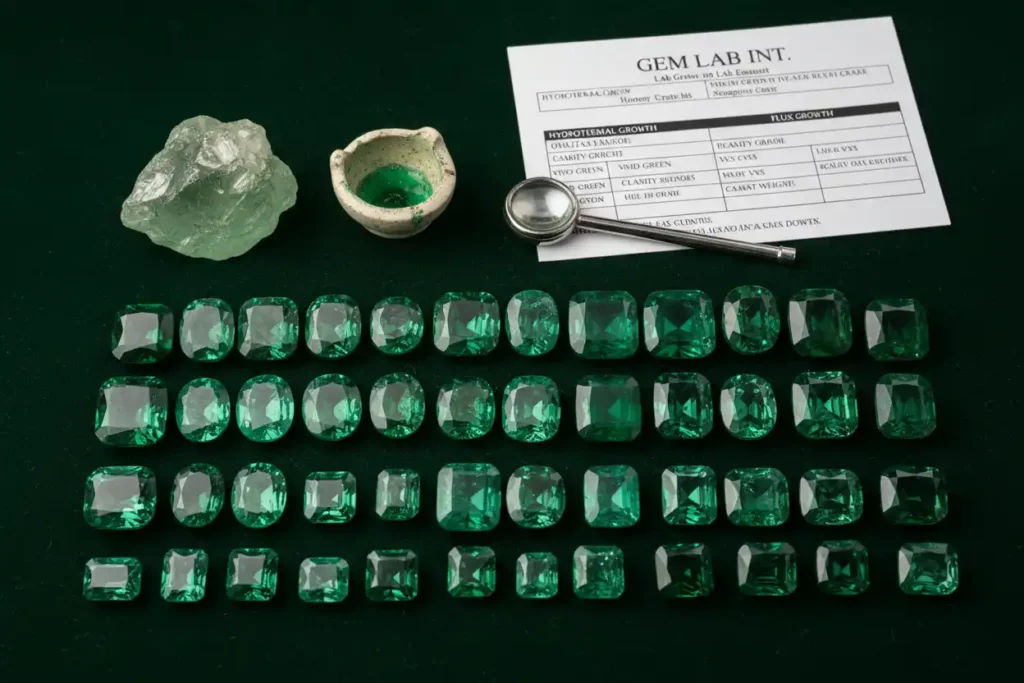
Natural Emerald and Lab Emerald Differ in Origin, Not Basic Species Identity
Natural emerald formed through geological processes.
Laboratory-grown emerald developed through a controlled crystal-growth process.
Both belong to the beryl mineral family and can share the same characteristic green-to-bluish-green color range, similar refractive properties, comparable hardness, and the hexagonal beryl structure.
When you buy lab emerald, this distinction explains why the stone can look extremely convincing without being mined.
It also explains why visual inspection alone is not always sufficient to determine growth origin. Modern laboratory-grown emerald can contain inclusions, zoning, and internal structures that require trained microscopy or spectroscopy to interpret correctly.
Buyers specifically considering geological material should use the separate natural emerald buying methodology because natural origin, geographic source, fissure filling, rarity, and collector premiums create a fundamentally different market.
Color Is the Most Important Visible Quality Factor
Once laboratory-grown identity is secure, color should usually lead the visual comparison.
Fine lab emerald should show an attractive green to bluish-green face-up appearance with enough saturation to look unmistakably emerald while remaining bright enough for internal light return.
When you buy lab emerald, judge four separate properties.
Hue describes the balance between green, blue, and yellow.
Tone describes how light or dark the stone appears.
Saturation describes the strength of the green.
Distribution describes whether that color is reasonably balanced across the visible face.
A rich green stone can be beautiful, but darkness should not be mistaken automatically for quality.
An emerald can become so dark that large areas look black.
A pale emerald can remain lively but fail to show enough green strength for your preference.
The best buy lab emerald decision balances saturation with transparency and brightness.
Pure Green and Bluish Green Can Both Be Attractive
There is no need to insist that every fine laboratory-grown emerald have exactly the same hue.
Some buyers prefer a classic green.
Others prefer a cooler bluish-green appearance.
A slightly yellowish modifier may still produce an attractive stone when the overall color remains vivid and balanced.
When you buy lab emerald, compare candidates under the same lighting rather than relying on color names written by different retailers.
One seller’s vivid green may resemble another seller’s bluish green.
The gemstone itself is the more reliable reference.
Excessive Darkness Is a Major Red Flag
Laboratory growth can produce strongly colored emerald material, but stronger saturation is useful only while enough light remains visible through the finished gem.
When you buy lab emerald, place the stone face-up under broad neutral lighting and watch the center.
If much of the stone appears nearly black, the issue may be excessive tone, poor cutting, or a combination of both.
A seller may describe that appearance as deep emerald green.
You should decide whether you actually see green.
The best laboratory-grown emerald should not require powerful backlighting to reveal the color you are paying for.
Pale Lab Emerald Can Still Offer Good Value
Not every buyer needs maximum saturation.
A lighter green lab emerald can provide strong transparency, large size, and attractive brilliance at a lower price than the most saturated material.
When you buy lab emerald in a paler range, pay particular attention to cut because a broad window can make a light stone look nearly colorless through the center.
Strong polish and intelligent proportions become more important as body color becomes lighter.
A pale but lively emerald can be preferable to a darker stone whose center appears dead.
Evaluate Color Under Neutral Lighting
Green gemstones can be manipulated easily through photography.
A cool light may emphasize blue.
A warm light may suppress blue and strengthen yellow.
A dark background can increase perceived saturation.
Green surroundings can reflect color into a transparent stone.
When you buy lab emerald online, ask for photographs or video against white and neutral-gray backgrounds under broad light.
Check supposedly neutral objects in the image. If a white card looks noticeably green or blue, the gemstone may also have been shifted.
A strong stone should remain attractive after the photographic advantages are removed.
Backlighting Should Not Be the Main Presentation
A powerful light behind a gemstone can make almost any transparent green material appear more saturated.
When you buy lab emerald, first evaluate the stone in reflected face-up light, as it will normally appear in jewelry.
Backlighting can then provide additional information about zoning, fractures, growth features, and internal color.
The order matters.
A laboratory-grown emerald that looks vivid only when light passes directly through its pavilion may appear much weaker once mounted.
Color Distribution Matters
Laboratory-grown emerald can display growth-related color zoning depending on the method, chemistry, seed orientation, and growth conditions.
When you buy lab emerald, inspect whether the color looks balanced across the face.
Possible quality issues include:
a pale central band, one dark end, a noticeably lighter side, uneven green zones, or growth structures that become visually distracting.
Zoning is not automatically a defect.
A well-cut stone can use natural-looking variation effectively.
The question is whether the distribution strengthens or weakens the face-up appearance.
Hydrothermal and Flux Are the Two Main Growth Methods
Two principal approaches dominate laboratory-grown emerald production: hydrothermal growth and flux growth.
Hydrothermal growth uses a nutrient-rich solution under elevated temperature and pressure, allowing emerald to crystallize onto a seed in a controlled environment.
Flux growth dissolves emerald-forming components in a molten chemical medium from which emerald crystals gradually form.
When you buy lab emerald, both methods can produce legitimate laboratory-grown emerald.
Neither method automatically means higher quality.
The growth method explains how the crystal formed.
Color, transparency, cut, fractures, and finished appearance determine how good the gemstone is.
Hydrothermal Emerald Is Not Automatically Better
Hydrothermal manufacturing can produce comparatively large, transparent green crystals with convincing appearance and strong color.
That does not make every hydrothermal stone superior.
When you buy lab emerald grown hydrothermally, inspect:
color balance, transparency, seed-related structures, chevron-like growth, internal tubes, fractures, windowing, pavilion depth, polish, and face-up dimensions.
Some hydrothermal stones can be extremely clean.
Others display clearly visible internal growth structures.
Quality must be assessed stone by stone.
Flux-Grown Emerald Is Not Automatically More Natural-Looking
Flux-grown emerald can develop inclusion scenes that some buyers find appealing because wispy veils, flux residues, crystals, or other internal features may resemble the complex appearance associated with natural emerald.
That does not make the stone geologically natural.
When you buy lab emerald grown through a flux process, value the inclusions according to whether they improve or weaken the finished gem rather than according to how successfully they imitate natural material.
A visible flux veil can add character.
A large central inclusion that interrupts transparency should still affect the price.
Growth Method Is Not a Quality Grade
One retailer may claim hydrothermal emerald is superior because it can produce clean crystals.
Another may claim flux-grown emerald is superior because its inclusion pattern looks more natural.
Neither statement establishes a universal ranking.
When you buy lab emerald, compare the finished stones.
A well-cut flux-grown emerald with vivid color can be better than a dark hydrothermal stone.
A transparent hydrothermal emerald can be better than a heavily included flux-grown stone.
Growth method is useful disclosure.
It should not replace evaluation.
Inclusions Can Help Identify Growth Origin
Laboratory-grown emerald does not necessarily mean inclusion-free emerald.
Hydrothermal synthetic emerald may show features such as chevron-like growth patterns, seed-related structures, tubes, nail-head-like spicules, roiled growth, or characteristic internal zoning.
Flux-grown synthetic emerald may show wispy veil-like flux remnants, healed-looking structures, small crystals, metallic platelets, or other growth-related features.
When you buy lab emerald, these inclusions can be useful evidence for a trained gemologist.
They should not be treated as a simple consumer checklist, because some features overlap visually with natural emerald inclusions and modern synthetic material can be exceptionally clean.
Professional identification considers multiple properties together.
Do Not Assume a Clean Emerald Must Be Lab-Grown
Natural emerald can occasionally be very clean.
Laboratory-grown emerald can be visibly included.
Therefore, when you buy lab emerald, clarity alone cannot establish origin.
A seller who says “it is obviously laboratory-grown because it has no inclusions” is oversimplifying the identification problem.
Likewise, an included stone should not be described automatically as natural.
Growth origin should come from appropriate evidence rather than assumptions about how much internal material you can see.
Transparency Matters More Than Microscopic Perfection
Because laboratory-grown material can be produced with excellent clarity, buyers do not need to tolerate severe cloudiness in an ordinary faceted stone.
When you buy lab emerald, prioritize an open, lively internal appearance.
A few visible growth features may be completely acceptable.
Broad haze, severe cloudiness, large opaque crystals, or extensive fractures that reduce brilliance should lower the value unless the stone is being purchased specifically for an unusual included aesthetic.
Transparency should support color.
A vivid green gem that looks dull through the center has lost one of the major advantages laboratory growth can provide.
Do Not Overpay for “Flawless”
Laboratory-grown emerald can be substantially cleaner than much natural material, so the word flawless should not create an automatic rarity premium.
When you buy lab emerald, ask whether moving from an eye-clean stone to a microscopically cleaner one changes anything you can see.
If not, the money may be better spent on stronger color, better cutting, larger visible dimensions, or higher-quality jewelry construction.
A tiny growth feature near the girdle can be economically irrelevant.
A large window through the center is not.
Fractures Matter More Than Small Growth Features
A harmless internal feature and a surface-reaching fracture belong to different risk categories.
When you buy lab emerald, inspect the entire stone for cracks that reach the polished surface, particularly near:
the girdle, corners, pavilion edges, table edges, and future setting points.
Laboratory-grown origin does not eliminate brittleness.
Emerald remains beryl, and fractures can chip or extend after a hard impact or inappropriate setting pressure.
A small internal inclusion can be far less important than a nearly invisible fissure reaching a vulnerable corner.
Lab Emerald Can Receive Post-Growth Clarity Treatment
Laboratory-grown emerald and untreated emerald are not synonymous.
A synthetic emerald can develop or retain surface-reaching fractures after growth and cutting. Those fissures can potentially be filled with oil, resin, or another transparent substance to reduce their visibility.
When you buy lab emerald, ask separately:
Was the emerald laboratory grown?
Was it fracture filled afterward?
Those are different questions.
A clean-looking hydrothermal or flux-grown stone should not automatically be assumed unfilled.
The presence of filling can affect value, durability, cleaning, and repair.
Oil and Resin Are Not the Same Disclosure
Colorless oil and artificial resin can both reduce the visual prominence of a surface-reaching fissure, but they may differ in stability, removability, and behavior under heat or chemicals.
When you buy lab emerald with visible fractures, ask whether a filler has been detected and whether the seller knows what type.
An inexpensive stone may not justify detailed filler analysis.
A more expensive piece should come with disclosure proportional to the premium being charged.
“Lab-grown” answers the growth-origin question.
It does not answer the post-growth treatment question.
A Filled Lab Emerald Can Still Be a Reasonable Purchase
Treatment does not automatically make the gemstone unacceptable.
A laboratory-grown emerald with a small filled fracture can still be attractive and suitable for jewelry when the condition is disclosed honestly and priced appropriately.
The problem arises when a filled stone is sold at the same price as an equivalent clean unfilled stone while the treatment remains hidden.
When you buy lab emerald, treatment should influence the decision according to:
visibility, extent, location, filler type, durability implications, and price.
Color Coating Should Be Disclosed
A surface coating can modify the apparent green color of a gemstone.
When you buy lab emerald with unusually intense or highly uniform surface color, examine facet junctions and the girdle under magnification for inconsistencies, wear, scratches, or color concentration.
Do not scrape the gemstone to test it.
Sophisticated coatings can require laboratory analysis, and destructive experimentation is unnecessary.
A coated stone can be decorative.
It should not be represented as possessing entirely body-derived emerald color.
Cut Quality Is a Major Value Factor
Once color and transparency are strong, cut becomes one of the best places to separate a good laboratory-grown emerald from an ordinary one.
When you buy lab emerald, examine:
center brightness, windowing, extinction, symmetry, step alignment, pavilion depth, girdle thickness, polish, corner condition, and face-up dimensions.
Laboratory-grown rough can be more affordable than fine natural emerald rough, so buyers generally have less reason to accept severely compromised cutting merely for weight retention.
A stone should be cut to look attractive.
Not simply to remain heavy.
Emerald Cut Is Popular for Good Reasons
The rectangular step cut traditionally associated with emerald can display color and transparency effectively while using clipped corners that reduce vulnerability.
When you buy lab emerald in this shape, inspect whether:
the steps align cleanly, the corners are balanced, the center remains green, the pavilion is not excessively deep, and a broad window does not dominate the table.
Step cuts are unforgiving.
They reveal both beautiful transparency and weak cutting clearly.
Other Shapes Can Be Excellent
Laboratory-grown emerald is also available in ovals, cushions, rounds, pears, radiants, and numerous custom shapes.
When you buy lab emerald, do not assume rectangular emerald cut is automatically superior.
Round and brilliant-style cuts can create more active scintillation.
Ovals and cushions can provide strong face-up spread.
Pears can create elegant length.
Precision custom cuts may provide exceptional symmetry and light return.
Choose shape according to visual preference and setting requirements rather than tradition alone.
Watch for Windowing
A broad transparent center is one of the most common cut problems to identify.
When you buy lab emerald, place the gemstone face-up over a neutral background.
If the background remains clearly visible through a large central area while the green concentrates mainly around the edge, the stone has a significant window.
Windowing reduces brilliance and can make a pale emerald look even weaker.
A smaller stone with more effective pavilion angles can easily look superior to a heavier windowed example.
Extinction Is the Opposite Problem
A stone can also be too dark.
Extinction appears as areas that return little useful light and remain black or heavily shadowed through normal viewing positions.
When you buy lab emerald, rotate the gem slowly under broad lighting.
Some dark contrast is necessary to create movement.
Large areas that remain nearly black are different.
Do not pay extra merely because the seller describes severe extinction as rich depth.
Deep Pavilions Can Hide Weight
Laboratory-grown emerald can be cut deeply to strengthen color or preserve carat weight.
Some depth can be justified.
Too much depth can result in a stone that sounds large on paper but looks surprisingly small once mounted.
When you buy lab emerald, compare length, width, and depth rather than carat weight alone.
Two stones of the same weight can have very different face-up dimensions.
Buy visible gemstone rather than hidden pavilion mass.
Carat Weight Carries a Different Rarity Meaning
Large clean natural emerald is difficult to obtain because geological rough with fine color, transparency, and structural integrity is scarce.
Laboratory growth changes that scarcity structure.
When you buy lab emerald, large size should not receive the same rarity premium automatically.
Producing large fine synthetic material still requires technical skill, equipment, energy, time, successful crystal growth, and cutting, so size is not free.
But the economic meaning of a five-carat lab-grown emerald is very different from the meaning of a five-carat fine natural emerald.
Compare within the correct market.
Compare Face-Up Dimensions Before Paying for Size
Suppose two laboratory-grown emeralds have almost identical face-up length and width, but one weighs substantially more because of its deeper pavilion.
Unless that added depth improves color or optical performance meaningfully, the heavier stone may provide little practical advantage.
When you buy lab emerald, ask for exact millimeter measurements.
Do not let the carat number alone determine which stone seems larger or more valuable.
Large Stones Can Reveal Color Zoning More Clearly
As emerald size increases, uneven color distribution and growth structures become easier to see.
When you buy lab emerald in substantial dimensions, inspect the complete stone rather than assuming larger automatically means more impressive.
A large gem may reveal:
pale central zones, darker edges, seed-related growth areas, obvious hydrothermal structures, flux veils, or strong internal directional differences.
Some of these can be fascinating.
They should still be factored into the price.
Laboratory Reports Become Useful at the Right Threshold
An inexpensive laboratory-grown emerald does not automatically need an expensive independent report.
The testing cost can approach the stone’s value.
A report becomes more useful when you buy lab emerald that is:
high priced, unusually large, exceptionally vivid, represented ambiguously as natural, sold as unfilled, difficult to distinguish from another material, or part of valuable finished jewelry.
The gemstone certification guide explains the difference between independent identification reports, seller certificates, treatment findings, and financial appraisals.
The amount of documentation should reflect the financial consequences of being wrong.
A Report Should Identify Laboratory-Grown Origin Clearly
A useful gemological report should not leave the buyer guessing whether the emerald is natural or synthetic.
When you buy lab emerald with documentation, look for a conclusion that clearly identifies laboratory-grown or synthetic emerald.
Depending on the laboratory and service, the report may also include:
weight, measurements, shape, cutting style, color, growth method, and detectable treatment.
Growth-process identification may be possible in many cases but should not be assumed to appear on every report.
Read the actual wording rather than relying on the retailer’s summary.
GIA Evaluates Emerald Rather Than Assigning a Universal Quality Grade
Colored-stone reporting should not be confused with standardized diamond-style grading.
An independent laboratory can identify an emerald as natural or laboratory grown, record physical characteristics, and disclose detectable treatments according to the available service.
That does not mean the laboratory has declared your lab emerald AAA, premium, or investment grade.
When you buy lab emerald, use the report for factual verification.
Use your own quality comparison for beauty.
Use market evidence for price.
Match the Report to the Exact Stone
A legitimate report belonging to another gemstone provides little protection.
When you buy lab emerald with documentation, compare:
carat weight, exact dimensions, shape, cutting style, color description, photograph where available, and distinctive internal features.
Hydrothermal growth lines, a flux veil, a visible crystal, a fracture, or an unusual cut can function as visual fingerprints.
If the measurements differ materially, resolve the discrepancy before payment.
Seller Certificates Are Not Automatically Independent Reports
A retailer may provide a branded authenticity card describing the gemstone as laboratory-grown emerald.
That can be useful documentation of the seller’s representation.
It is not necessarily independent testing.
When you buy lab emerald at a price where identity or treatment matters significantly, ask who examined the stone and whether the testing organization is separate from the seller.
An attractive certificate design does not strengthen the gemological evidence.
A Report Is Not an Appraisal
A gemological report addresses identity and other physical observations.
An appraisal estimates monetary value for a defined purpose.
When you buy lab emerald, a high replacement appraisal does not prove superior growth quality, exceptional color, absence of filling, or strong resale value.
Likewise, an independent identification report does not tell you whether the asking price is competitive.
Separate science from valuation.
Lab Emerald Pricing Should Be Compared With Lab Emerald
One of the most misleading sales tactics is to compare a laboratory-grown emerald directly with the retail price of a visually similar fine natural emerald and present the difference as a huge discount.
The two materials share emerald identity but have very different rarity structures.
When you buy lab emerald, compare it primarily with other laboratory-grown emeralds of similar:
color, transparency, size, growth method where relevant, cut quality, treatment, documentation, and setting.
The lab emerald price guide provides the appropriate value framework.
Natural emerald pricing belongs to a different market and can be reviewed separately through the emerald price guide.
Do Not Pay Natural-Emerald Rarity Premiums
A laboratory-grown emerald can be extraordinarily beautiful.
That does not mean it should carry the same geological rarity premium as a comparable natural stone.
When you buy lab emerald, understand what the price actually represents.
You may be paying for:
crystal growth, technical yield, cutting, strong color, larger size, branded production, laboratory testing, jewelry construction, retailer margin, and after-sales service.
Those are legitimate costs.
Geological scarcity is not one of them.
Extremely Low Prices Still Need Scrutiny
Lower price does not automatically indicate a fake lab emerald because synthetic emerald can be considerably more affordable than natural material.
However, an unusually inexpensive large vivid stone may also be green glass or another simulant.
When you buy lab emerald at very low cost, make sure the seller clearly identifies the material and provides a meaningful return policy.
A bargain is useful only when the object is actually what the listing claims.
Resale Expectations Should Be Conservative
Laboratory-grown gemstones generally have a different secondary market from fine natural stones because equivalent new material can continue to be produced.
When you buy lab emerald, make the purchase primarily for appearance, jewelry use, size, and initial value rather than assuming substantial long-term appreciation.
A beautiful synthetic emerald can remain personally valuable.
That does not guarantee strong dealer buyback or private resale.
Retail price and resale price should be treated as separate numbers.
Hydrothermal Versus Flux Should Not Drive Price Alone
Growth method can affect production cost, characteristic inclusions, rough availability, and collector interest, but it does not produce a simple rule in which one method always costs more or deserves a premium.
When you buy lab emerald, ask whether the higher-priced stone actually provides:
better color, stronger transparency, cleaner cutting, more desirable inclusions, better dimensions, superior documentation, or stronger jewelry craftsmanship.
If not, the growth method alone may not justify the difference.
Brand Names Can Add Cost Without Improving the Stone
Some laboratory-grown emerald producers have longstanding reputations and recognizable proprietary growth methods.
Brand history may matter to collectors or buyers who value consistent manufacturing provenance.
When you buy lab emerald from a known producer, determine whether the brand premium matters personally to you.
A branded synthetic emerald is not automatically better looking than an unbranded stone from another competent producer.
Compare the exact gems.
Do Not Confuse Brand Provenance With Natural Origin
A manufacturer name can tell you who produced the laboratory-grown stone.
It does not transform synthetic origin into geological origin.
When you buy lab emerald marketed using a famous laboratory-growth brand, the invoice should still identify it clearly as laboratory grown.
Transparency benefits the entire market.
Actual-Stone Video Matters Online
Laboratory-grown emerald can vary substantially even within one producer’s inventory.
When you buy lab emerald online at meaningful cost, request media of the exact gemstone rather than stock images.
Useful evidence includes:
neutral face-up video, side profile, pavilion view, macro inclusion imagery, exact weight, full dimensions, treatment disclosure, and report information where applicable.
A stock photograph proves that the seller has access to attractive emerald imagery.
It does not tell you what your stone looks like.
Compare Neutral and Ordinary Lighting
Jewelry-store spotlights can make green stones look exceptionally brilliant.
When you buy lab emerald, ask for footage under broad ordinary light as well.
The emerald should remain attractive outside concentrated display lamps.
Look for a stone whose green color and transparency survive multiple reasonable environments rather than one perfect setup.
Side Views Reveal Hidden Problems
A face-up photograph cannot show everything.
When you buy lab emerald, side images can reveal:
excessive pavilion depth, thick girdles, fractures, chips, filling, asymmetry, unusual growth zones, and color concentration.
For mounted jewelry, side views can also reveal whether the setting hides substantial portions of the emerald.
The more the seller refuses to show, the more uncertainty remains with the buyer.
Return Terms Are Part of the Buying Method
A reasonable inspection period allows you to confirm that the lab emerald matches its listing under your own lighting.
When you buy lab emerald online, check whether you can:
inspect the stone with magnification, obtain non-destructive professional identification where appropriate, return it if color differs materially, and reject jewelry with manufacturing defects.
Do not resize, repolish, reset, engrave, or otherwise alter the piece before the decision is final.
A return policy has practical value because green color and windowing can look significantly different away from sales photography.
The Invoice Should Say Laboratory-Grown Emerald
Accurate invoice wording protects both sides of the transaction.
When you buy lab emerald, useful information may include:
laboratory-grown emerald, weight, dimensions, growth method if represented, known post-growth treatment, laboratory report number, metal purity, and side-stone identity.
Avoid vague wording such as “emerald ring” when the rest of the sales process depends on laboratory-grown origin.
Disclosure should remain consistent from advertisement to invoice.
Jewelry Setting Quality Can Matter More Than the Stone Price
Because laboratory-grown emerald can be affordable relative to a similar-looking natural emerald, a gold or platinum setting may represent a large portion of the total jewelry cost.
When you buy lab emerald already mounted, evaluate:
metal purity, metal weight, prong construction, setting height, craftsmanship, side stones, resizing limitations, and repair quality.
A well-built setting can justify a meaningful premium.
A thin poorly constructed mounting should not become expensive merely because a large bright-green stone sits in it.
Ask What the Side Stones Are
A laboratory-grown emerald center does not tell you whether accent stones are natural diamonds, laboratory-grown diamonds, cubic zirconia, moissanite, white sapphire, or another material.
When you buy lab emerald jewelry, ask for those details explicitly.
Mixed materials can create attractive jewelry.
They simply need accurate disclosure.
Lab Emerald Has Good Hardness but Can Still Fracture
Emerald belongs to beryl and typically ranks around 7.5–8 on the Mohs scale, giving it good resistance to ordinary scratching.
That does not make emerald tough.
Beryl is brittle, and fractures or internal growth features can create impact vulnerabilities.
When you buy lab emerald, do not assume synthetic origin makes the stone indestructible.
A relatively clean laboratory-grown stone may be structurally stronger than a heavily fissured natural emerald, but the condition of the individual gem remains what matters.
Rings Need Structural Inspection
When you buy lab emerald for a ring, inspect the girdle, corners, and any surface-reaching fissures carefully.
Emerald cuts have clipped corners partly because this design helps reduce vulnerability compared with sharp rectangular points.
A low or moderately protective setting can reduce impact exposure.
Prongs should not apply excessive pressure directly over a fracture.
A bezel can provide additional protection when executed by a jeweler familiar with emerald.
Pendants and Earrings Are Lower-Risk Choices
A large laboratory-grown emerald can be especially attractive in a pendant because the stone can display substantial color and transparency with less exposure to hard impacts than a ring.
Earrings provide similar advantages.
When you buy lab emerald primarily for large visual size, these jewelry forms can let you enjoy more gemstone without demanding the same level of mechanical protection required by frequent hand wear.
Emerald Cleaning Should Remain Conservative
Natural and laboratory-grown emerald share the same basic mineral structure, so synthetic origin does not make aggressive cleaning automatically appropriate.
The emerald jewelry cleaning guide explains why warm water, mild soap, and gentle hand cleaning are the safer general approach.
Avoid steam and routine ultrasonic cleaning when the gemstone contains fractures, filling, uncertain treatment, or a vulnerable setting.
A synthetic emerald can still have fissures.
It can still have filler.
It can still chip.
Filled Lab Emerald Needs Additional Care
If a laboratory-grown emerald contains oil or resin in surface-reaching fissures, heat, solvents, prolonged soaking, or ultrasonic vibration may affect the filler.
When you buy lab emerald, keep the treatment information with the jewelry so future cleaning and repair decisions account for it.
A jeweler should know not only that the stone is synthetic emerald but also whether significant post-growth filling is present.
Major Red Flags When You Buy Lab Emerald
| Red flag | Why it matters |
|---|---|
| Listing says only “emerald” while obscuring laboratory origin | Growth origin should be disclosed clearly |
| Green glass called lab emerald | A simulant is not laboratory-grown emerald |
| “Created emerald” used without explaining the material | The term may be too vague for an expensive purchase |
| Hydrothermal advertised as automatically superior | Growth method is not a universal quality grade |
| Flux-grown marketed as automatically more natural-looking | Inclusion style does not establish higher quality |
| Very dark green treated as automatically finest | Excessive tone can destroy transparency |
| Color appears strong only when backlit | Ordinary face-up saturation may be weak |
| Every image uses green or black backgrounds | Apparent saturation may be exaggerated |
| Large central transparent window | Weak pavilion proportions reduce light return |
| Permanently black center | Excessive extinction may be present |
| High carat weight with small face-up dimensions | Pavilion depth may be hiding weight |
| Large obvious fracture described only as “natural character” | Structural condition and filling risk matter |
| “Lab-grown” used to imply unfilled | Synthetic emerald can still receive post-growth clarity enhancement |
| “Flawless” used to justify an extreme premium | Clean synthetic material can be relatively available |
| Giant size compared directly with natural-emerald rarity | Manufacturing changes the scarcity structure |
| Seller certificate used as independent laboratory evidence | The seller may simply be restating its own claim |
| Report does not identify laboratory-grown origin clearly | Documentation may be unsuitable or misunderstood |
| Report measurements do not match the stone | The document may belong to another gem |
| Appraisal used as proof of strong resale | Valuation and resale are different questions |
| “Investment lab emerald” paired with guaranteed returns | Manufactured supply weakens scarcity-based investment claims |
| Side stones are not identified | Finished jewelry may contain undisclosed materials |
| Final-sale terms combined with uncertain identity | Independent verification becomes difficult |
Several of these warning signs appearing together are a strong reason not to buy lab emerald until the seller provides clearer evidence.
A Practical Buy Lab Emerald Decision Matrix
Strong purchase: The gemstone is clearly disclosed as laboratory-grown emerald, shows attractive green or bluish-green color under neutral light, remains transparent and lively, has limited structural fractures, is competently cut, uses its weight efficiently, and comes with treatment disclosure proportional to the price.
Strong value purchase: The stone may have slightly lighter color, visible but attractive growth features, an ordinary producer, or a common shape, yet provides excellent transparency, good cutting, useful dimensions, and accurate disclosure at a competitive price.
Hydrothermal purchase: You knowingly choose hydrothermal material because you like its appearance or manufacturing provenance. The premium comes from the actual stone rather than the assumption that hydrothermal means higher grade.
Flux-grown purchase: You prefer the characteristic inclusion scene or producer history of flux-grown material, and the gem still has strong color, transparency, cutting, and condition.
Clarity-priority purchase: The stone is exceptionally clean, but the additional clarity premium remains reasonable and does not force you to sacrifice color or cutting.
Inclusion-character purchase: Visible flux veils, growth structures, or other synthetic features give the emerald character you appreciate, and the price reflects appearance rather than pretending those features prove natural origin.
Filled purchase: A surface-reaching fracture has been filled after growth, the treatment is disclosed, the condition is acceptable, and the stone is priced below an equivalent unfilled example.
Jewelry-value purchase: The laboratory-grown emerald itself is affordable, while much of the total price reflects high-quality gold or platinum, accent stones, and strong craftsmanship. Those components are documented separately.
Documentation-dependent purchase: The stone is expensive enough that laboratory-grown identity, treatment, or growth method materially affects the transaction. Independent testing is proportionate to the amount at risk.
Poor purchase: The stone is large but dark, badly windowed, excessively deep, heavily fractured, cloudy, weakly polished, or promoted mainly through unsupported seller grades.
Walk away: The seller hides synthetic origin, substitutes glass or another simulant, contradicts the laboratory report, conceals significant filling, or refuses realistic inspection and return protection.
Where the Best Value Often Appears
The strongest value when you buy lab emerald often appears in stones with excellent color and cutting rather than maximum size or maximum clarity.
A medium-to-medium-dark green emerald with strong transparency can look far better than a darker stone carrying a more dramatic description. A modest internal growth feature can reduce the price without affecting normal face-up beauty. A stone slightly below a round carat threshold can offer essentially the same visual presence as a heavier gem when its dimensions are better.
Growth method can also create value opportunities.
If two emeralds look equally good and one costs substantially more merely because it is flux grown or hydrothermal, choose the stone whose visible quality and documentation better justify the final price.
Final Buying Method
The smartest way to buy lab emerald is to treat laboratory-grown origin as a disclosure category rather than a quality grade.
First establish that the material is genuine laboratory-grown emerald rather than green glass or another imitation. Then judge face-up green color under neutral lighting, paying attention to hue, saturation, tone, brightness, and distribution.
Next, evaluate transparency and inclusions. Synthetic emerald does not need to be flawless, but heavy cloudiness or broad fractures should influence the price. Inspect every surface-reaching fissure separately because laboratory-grown emerald can still receive oil, resin, or another post-growth filling treatment.
Then evaluate cutting. Reject severe windowing and excessive extinction, compare carat weight with millimeter dimensions, and determine whether pavilion depth actually improves color or merely preserves weight.
Only after the physical stone passes those tests should you compare hydrothermal versus flux growth, producer branding, laboratory documentation, jewelry construction, return terms, and price.
When you buy lab emerald through this hierarchy, the strongest stone is not necessarily the largest, cleanest, darkest, or most technically marketed specimen. It is the emerald whose green color, transparency, structural condition, cutting, treatment disclosure, dimensions, documentation, setting quality, and price all support the same convincing purchase.
The wider Buying & Value section connects these principles with additional gemstone identification, treatment, pricing, and purchase guidance.
Frequently Asked Questions
What should I check first when I buy lab emerald?
Confirm that the material is genuinely laboratory-grown emerald, then judge face-up green color and transparency. Growth method and carat weight should come after those visible fundamentals.
Is lab emerald a real emerald?
Yes. Laboratory-grown emerald is emerald crystallized through a controlled manufacturing process rather than geological formation. It has the beryl structure and essential emerald composition while differing from natural emerald in origin and typical growth features.
Is synthetic emerald fake emerald?
No. Synthetic emerald is another term for laboratory-grown emerald. A simulant such as green glass or cubic zirconia is a different material and should not be described as synthetic emerald.
What color should a good lab emerald have?
Attractive stones generally show green to bluish-green color with enough saturation to look rich while remaining bright and transparent. Excessively pale, gray, yellowish, or nearly black material usually belongs to a lower quality tier.
Is darker lab emerald more valuable?
Not automatically. Greater saturation can improve appearance, but excessive darkness can suppress transparency and brilliance. When you buy lab emerald, judge visible green under ordinary lighting rather than equating darkness with quality.
What is a hydrothermal lab emerald?
Hydrothermal emerald is grown from a nutrient-rich solution under controlled elevated temperature and pressure, typically using a seed crystal on which synthetic emerald develops.
What is a flux-grown lab emerald?
Flux-grown emerald forms from components dissolved in a molten chemical flux. As conditions change, emerald crystals grow from that medium.
Is hydrothermal emerald better than flux emerald?
Neither method is universally better. A hydrothermal stone can be excellent or poor, and the same is true of flux-grown material. Compare finished color, transparency, cut, inclusions, structural condition, and price.
Can flux emerald have natural-looking inclusions?
Yes. Flux-grown synthetic emerald can contain wispy veils, flux remnants, crystals, and other internal features that may appear naturalistic. Their presence does not make the emerald geologically natural.
What inclusions occur in hydrothermal emerald?
Hydrothermal synthetic emerald can show seed-related structures, chevron-like growth, tubes, nail-head-like spicules, roiled growth patterns, zoning, and other diagnostic features. Professional interpretation is more reliable than consumer identification from one inclusion.
Can lab emerald be completely clean?
Yes. Some laboratory-grown emerald can be extremely clean, although other stones contain obvious growth structures or fractures. Clean appearance alone does not prove synthetic origin.
Can natural emerald be cleaner than lab emerald?
Yes. Exceptional natural emerald can be highly transparent, while some laboratory-grown stones can be visibly included. Clarity alone cannot determine growth origin.
Can lab emerald be fracture filled?
Yes. Laboratory-grown emerald can contain surface-reaching fissures that are subsequently filled with oil, resin, or another material to reduce their visibility.
Does lab-grown mean untreated?
No. Laboratory-grown describes crystal origin. Post-growth treatment such as fracture filling or coating is a separate issue and should be disclosed when present.
Does lab emerald need a laboratory report?
An inexpensive stone may not justify the cost, but independent documentation becomes useful when the purchase is expensive, unusually large, represented ambiguously, or priced partly on treatment or growth-method claims.
Can a laboratory tell natural and lab emerald apart?
Yes. Professional gemological laboratories can distinguish natural from synthetic emerald by combining microscopy, spectroscopy, growth features, chemical characteristics, and other advanced observations.
Can I identify lab emerald with a Chelsea filter?
No. Natural and laboratory-grown emeralds can both show strong red reactions in a Chelsea filter. The test is not sufficient to establish synthetic origin by itself.
Can I tell lab emerald from natural emerald by inclusions?
Inclusions can provide valuable clues, but interpretation can be difficult and overlapping features exist. An independent laboratory is safer when origin materially affects the price.
Is flawless lab emerald rare?
Extremely clean material can require careful growth and cutting, but laboratory production makes high clarity much more accessible than in natural emerald. Do not pay a large premium for microscopic perfection unless it matters personally.
Why do lab emerald dimensions matter?
Carat measures weight rather than visible size. A deep pavilion can hide substantial mass below the girdle, so length, width, and depth help reveal how large the gemstone will actually appear.
What is windowing in lab emerald?
Windowing is a broad central area through which the background remains visible because pavilion proportions fail to return enough light. It can make the emerald look pale and empty through the center.
What is extinction in lab emerald?
Extinction describes dark areas that return little visible light. Some contrast is normal, but large permanent black areas can make an emerald appear much darker and less lively.
Are large lab emeralds rare?
Large high-quality synthetic emeralds still require successful crystal growth and cutting, but manufactured supply makes large clean stones much more accessible than equivalently fine natural emeralds. The same geological size premium should not be applied automatically.
Is lab emerald cheaper than natural emerald?
Usually substantially so for comparable visual size and apparent quality because laboratory growth does not carry the same geological rarity premium. The exact price still varies with growth method, color, transparency, size, cutting, brand, documentation, and seller.
Does lab emerald hold its value?
Resale should be approached conservatively because equivalent new material can continue to be manufactured. Buy lab emerald primarily for beauty, jewelry use, and initial value rather than assuming strong appreciation.
Is a seller certificate enough for lab emerald?
It may document the seller’s representation, but it is not automatically equivalent to independent laboratory analysis. For significant purchases, independent identification provides stronger evidence.
Is an appraisal proof that a lab emerald is valuable?
No. An appraisal estimates monetary value for a particular purpose. It does not prove identity, treatment status, superior growth quality, or future resale.
Is lab emerald suitable for an engagement ring?
Yes, provided the stone is structurally sound and set carefully. Emerald has good hardness but remains brittle, so corners and fractures should be protected from strong impact.
Is lab emerald more durable than natural emerald?
A relatively clean lab-grown stone may have fewer serious fractures than a heavily included natural emerald, but synthetic origin alone does not guarantee greater durability. Individual fractures, cutting, and setting remain decisive.
How should lab emerald jewelry be cleaned?
Use conservative hand cleaning with lukewarm water, mild soap, and a very soft brush for a sound stone. Avoid assuming ultrasonic or steam cleaning is safe when fractures, filling, or setting problems may be present.
What is the biggest mistake when you buy lab emerald?
The biggest mistake is paying for size, growth-method terminology, or natural-emerald comparisons before judging the actual stone. When you buy lab emerald, prioritize genuine synthetic-emerald identity, green color, transparency, structural condition, cutting, dimensions, treatment disclosure, documentation, and price before marketing language.