Lab Ruby Price: Cost, Value Factors & Buying Tips
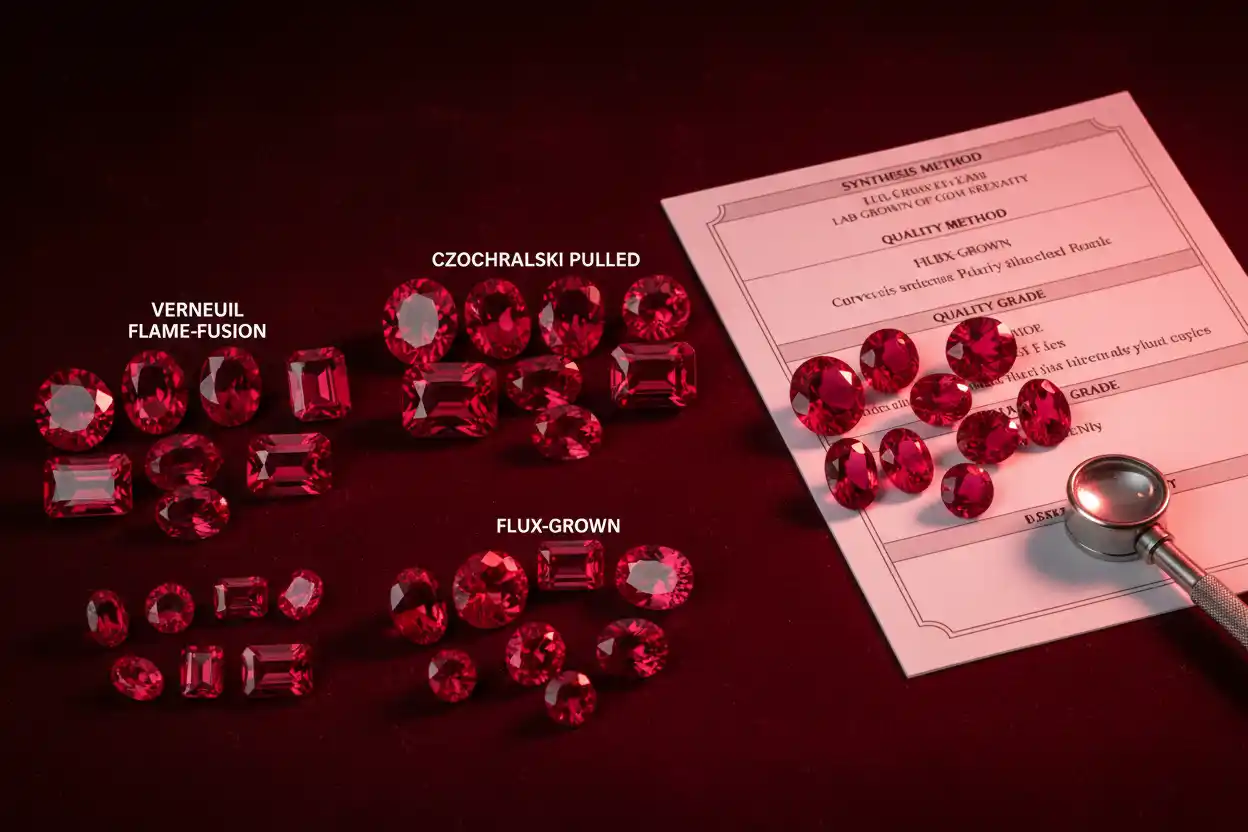
Lab ruby price varies far more than the material name alone suggests. A laboratory-grown ruby is synthetic red corundum rather than a ruby-colored imitation, so its baseline mineral properties are those of ruby: aluminum oxide, Mohs hardness 9, and the optical characteristics of corundum. The market price, however, is determined by a different set of scarcity and retail forces from those governing exceptional natural ruby. Laboratory synthesis can produce additional ruby material as manufacturing capacity expands, while natural ruby supply is constrained by geology, mining, recovery, quality distribution, treatment status, and locality. The underlying identity is explained separately in Lab Ruby meaning; this page focuses specifically on valuation and market methodology.
Color remains important even when geological rarity is removed from the equation. GIA identifies color as the most important quality factor for ruby generally: vivid pure red to slightly purplish red is preferred, while excessive darkness, weak saturation, or unwanted orange and purple components can reduce desirability. Transparency, cut, inclusions, size, and treatment also affect ruby quality. Those principles remain useful for evaluating laboratory material, but the rarity premiums attached to fine natural ruby cannot simply be copied onto synthetic stones.
The current market demonstrates why a single “lab ruby price per carat” is misleading. Calibrated flame-fusion stones can sell for tens of dollars, specialist custom-cut synthetic ruby can reach several hundred dollars, and premium branded loose lab-created ruby may be listed above a thousand dollars. Those prices can all be legitimate because they represent different growth materials, sizes, cutting standards, distribution channels, selection processes, branding, and service packages. The useful question is therefore not “What does lab ruby cost?” but “What exactly is being priced, and what assumptions make the comparison fair?”
Lab Ruby Price at a Glance
| Price factor | Why it matters |
|---|---|
| Color | Strong, balanced red is usually more desirable than weak, brownish, orangy, or excessively dark material |
| Saturation | Vivid color can support a premium |
| Tone | Very dark stones can lose brightness; very light material can approach pink sapphire appearance |
| Transparency | Haze, cracks, or conspicuous inclusions can reduce face-up performance |
| Growth method | Flame-fusion, flux, hydrothermal, and other synthetic methods have different costs and collector contexts |
| Size | Larger finished stones usually cost more in total |
| Shape | Cutting yield and labor differ among rounds, cushions, emerald cuts, pears, and precision designs |
| Cut quality | Windowing, extinction, symmetry, polish, and color orientation influence visible quality |
| Manufacturer | Recognized producers or historic material can command premiums |
| Post-growth treatment | Filling, coating, diffusion, or other modification should be evaluated separately |
| Documentation | A report can verify corundum identity, laboratory origin, and detectable treatment |
| Retail channel | Wholesale calibrated supply, marketplace retail, specialist precision cutting, and luxury retail are different markets |
| Jewelry setting | Metal, side stones, fabrication, and brand can cost much more than the ruby itself |
| Resale | Original retail price is not guaranteed recoverable value |
| Provenance | Historic synthetic material can have collector value unrelated to ordinary jewelry pricing |
What Is Actually Being Priced?
Before comparing two listings, establish whether both products are genuinely comparable.
A small calibrated flame-fusion stone intended for mass jewelry production is a different commercial product from a custom-cut ten-carat synthetic ruby fashioned from historic laboratory crystal. A premium loose ruby selected and sold by a luxury-oriented retailer includes another layer of curation, cutting, presentation, fulfillment, warranties, and margin. Rough boule material belongs to yet another category.
A useful lab ruby price comparison should therefore classify the product as one of the following:
- calibrated faceted stone;
- individually selected loose gem;
- custom precision-cut gem;
- rough synthetic corundum;
- historic or collectible synthetic material;
- finished jewelry.
Do not calculate the loose ruby’s value by dividing a completed ring price by carat weight. The ring may contain precious metal, diamonds, labor, design, resizing services, warranties, and brand markup that have little relationship to the synthetic ruby’s wholesale value.
Seller-specific transaction questions are intentionally separated into buy Lab Ruby so this page remains focused on market value rather than repeating generic retailer-selection advice.
Color Is Still the First Quality Variable
Laboratory growth makes red corundum more reproducible, but not every synthetic ruby has equally attractive color.
GIA’s ruby-quality guidance identifies pure, vibrant red to slightly purplish red as the most prized color range and notes that stones can lose quality when they become overly dark, too light, too orange, or excessively purple.
For lab-created material, compare color through four separate observations:
| Color field | What to evaluate |
|---|---|
| Hue | Red, slightly purplish red, orangy red, strongly purplish red |
| Tone | Light, medium, medium-dark, excessively dark |
| Saturation | Weak, moderate, strong, vivid |
| Distribution | Even, zoned, streaked, concentrated, patchy |
A seller calling a stone “pigeon blood” does not create an independent laboratory grade. That wording should be translated into actual hue, tone, saturation, fluorescence, and face-up brightness.
The optical causes of ruby color, chromium absorption, fluorescence, and pleochroism are treated separately in Lab Ruby optical properties and color behavior.
“AAA” Is Not a Universal Lab Ruby Grade
Several current synthetic-ruby retailers use terms such as AAA, Prestige, premium, vivid, pigeon blood, or eye clean. Those terms can be useful descriptions within one seller’s own inventory, but they are not a universal independent ruby grading scale.
GIA explicitly states that it evaluates ruby but does not assign an overall ruby grade. Its colored-stone reports can identify whether a ruby is natural or laboratory-grown, record measurable characteristics, and name detectable treatments.
Therefore:
AAA from Seller A is not automatically equivalent to AAA from Seller B.
The label becomes useful only after it is translated into visible and measurable attributes such as color, transparency, cut, size, treatment, and growth origin.
Practical Lab Ruby Quality Bands
The following bands are an editorial comparison system, not official laboratory grades.
| Band | Typical characteristics | Market implication |
|---|---|---|
| Commercial calibrated | Attractive red but produced for volume, ordinary cutting, standardized sizes | Lowest cost |
| Good jewelry grade | Balanced red, useful transparency, acceptable symmetry and polish | Moderate |
| Fine synthetic ruby | Strong vivid red, good transparency, careful orientation and cutting | Premium |
| Precision or specialist cut | High-quality synthetic rough plus advanced custom faceting | Premium based heavily on cutting labor |
| Historic/collector synthetic | Documented older growth material, unusual manufacturer, scientific or technological interest | Provenance can dominate |
| Luxury branded lab ruby | Strong appearance plus retailer curation, packaging, service, warranty, and brand positioning | Highest consumer-retail tier |
These categories explain why two laboratory rubies of similar carat weight can differ dramatically in price without either listing necessarily being fraudulent.
Documented Market Sample
A useful price article needs real market observations rather than invented precision. The following sample uses several current or recently displayed sources representing different parts of the laboratory-ruby market.
| Source type | Material / description | Observed asking-price context | Important limitation |
|---|---|---|---|
| Calibrated synthetic-gem supplier | Flame-fusion ruby baguettes, multiple sizes | $19.50–$340 | Wide size range; exact price changes with dimensions |
| Calibrated synthetic-gem supplier | Flame-fusion ruby rounds | $18–$199 | Same supplier; seller uses its own AAA terminology |
| Rough supplier | Full flame-fusion ruby boule, about 160 g | $44.80 | Rough, not comparable with finished faceted stones |
| Marketplace retail | Lab-created included faceted/cabochon ruby | Starting around $16.99 | Broad quality and size variation; marketplace seller claims require verification |
| Precision/specialist cutting | Custom synthetic ruby cutting | Starting around $450 | Significant price reflects custom cutting and production service |
| Specialist-cut historic synthetic ruby | Roughly 11.55 ct vivid red lab ruby | $600 displayed example | Sold/reference example rather than standardized current inventory |
| Specialist-cut historic synthetic ruby | Roughly 10.92 ct vivid red lab ruby | $640 displayed example | Cut design and historic crystal context materially affect price |
| Premium retail | 5.5 ct cushion lab-created ruby, seller-described AAA/eye-clean | $1,480 | Premium branded retail channel and seller-defined grade |
| Premium retail | 8 ct oval lab-created ruby, seller-described AAA/eye-clean | $1,615 | Retail selection, branding, services, and cut included |
| Premium retail | 5 ct emerald-cut lab-created ruby, seller-described AAA/eye-clean | $1,795 | Shape, cut, branding, and seller positioning differ |
This table deliberately combines unlike market tiers because the spread itself is the information gain. It demonstrates why quoting one universal lab ruby price without declaring the channel is methodologically weak.
What the Sample Shows
The lowest part of the sample represents high-volume flame-fusion synthetic corundum. One current supplier lists baguette material from $19.50 to $340 and round material from $18 to $199 across a wide range of calibrated dimensions, while a complete flame-fusion boule of roughly 160 grams is offered for $44.80.
At the specialist-cut level, the material itself may not be extraordinarily expensive, but custom faceting becomes a major component of price. A current precision-cutting offer begins around $450, while examples of large, vividly colored synthetic ruby around eleven carats have been displayed near $575–$640.
Premium retail occupies another tier. One luxury-positioned seller lists a 5.5 ct cushion lab ruby at $1,480, an 8 ct oval at $1,615, and a 5 ct emerald-cut example at $1,795, describing the stones using its own AAA, eye-clean, precision-faceted, and “pigeon blood” terminology.
Those prices cannot be reduced to differences in corundum chemistry. The supply chain and retail proposition are doing substantial work.
Approximate Price-per-Carat Comparisons
Price per carat becomes useful only when stones are already reasonably comparable.
Using the premium-retail examples:
| Example | Asking price | Approx. price per carat |
|---|---|---|
| 5.5 ct cushion | $1,480 | ~$269/ct |
| 8 ct oval | $1,615 | ~$202/ct |
| 5 ct emerald cut | $1,795 | ~$359/ct |
Using specialist-cut examples:
| Example | Asking price | Approx. price per carat |
|---|---|---|
| 11.55 ct specialist-cut ruby | $600 | ~$52/ct |
| 10.92 ct specialist-cut ruby | $640 | ~$59/ct |
| 11.25 ct specialist-cut ruby | $575 | ~$51/ct |
These figures do not prove that the higher-priced channel has higher-quality crystal. They demonstrate that retailer positioning, cut style, branding, service, and selection can produce a many-fold difference in asking price.
Price per carat is therefore a normalization tool, not a universal value verdict.
Growth Method Can Affect Cost Without Defining Quality
Laboratory ruby can be produced by flame fusion, flux growth, hydrothermal methods, and other technical crystal-growth processes. Each route has different equipment requirements, growth times, yields, rough shapes, inclusion patterns, and production economics.
Flame fusion is highly efficient and can supply large amounts of synthetic corundum at low cost. Current full-boule pricing demonstrates just how inexpensive raw Verneuil ruby can be relative to luxury finished gems.
Flux and hydrothermal growth can require slower or more complicated processes and may create material with inclusion scenes or crystal shapes valued by collectors and specialist cutters. A recognized producer can add another provenance premium.
That does not make flux-grown ruby inherently “better” than flame-fusion ruby for every purpose. A precision-cut flame-fusion stone may outperform a poorly cut flux stone visually.
The synthesis-versus-geological distinction is handled in Lab Ruby formation and deposit geology.
Manufacturer Provenance Can Matter
Synthetic gemstones can develop manufacturer-specific collector markets.
Chatham, for example, describes its laboratory-grown ruby as a distinct branded product and distributes loose stones through authorized retailers rather than ordinary direct consumer loose-stone inventory. It also states that its ruby receives no color treatment.
Historic Djeva synthetic corundum can attract another kind of interest because some material survives from older technological production and is deliberately cut as a collectible manufactured gemstone. Specialist examples in that market may sell for hundreds of dollars even when much cheaper newly produced flame-fusion rough is readily available.
This is an important market distinction:
synthetic rarity can exist as provenance rarity even when the material itself can still be manufactured.
A specific historic batch, discontinued composition, recognizable manufacturer, unusual growth structure, or documented technological history may be scarce even though synthetic ruby generally is not.
Origin Claims Need Precise Language
A laboratory-grown ruby cannot acquire natural Burmese, Mozambican, Vietnamese, or other geological mine origin merely because its color resembles famous natural material.
A seller may use phrases such as “pigeon blood color,” “Burma color,” or another locality-inspired color description. That should be interpreted as a color-style claim unless documentation clearly establishes something different.
GIA specifically warns buyers not to confuse geographic origin with quality even in the natural-ruby market. Famous sources produce a wide range of qualities, and origin premiums apply only in appropriate quality and documentation contexts.
For synthetic ruby, the useful origin fields are usually:
- growth method;
- manufacturer;
- production batch or provenance;
- laboratory-created disclosure;
- post-growth treatment.
The broader difference between manufactured and geological rarity is explored in Lab Grown vs Natural Gemstones.
Treatment Must Be Separated From Growth Origin
“Lab-grown” describes how the crystal originated. It does not automatically answer whether something was done after growth.
Natural ruby markets include heating, diffusion, glass filling, cavity filling, and other enhancements. GIA notes that heated natural ruby is common, that unheated fine ruby can command a premium, and that diffused or glass-filled material generally trades below comparable conventionally heated ruby.
A laboratory-grown ruby should be evaluated with the same conceptual separation:
growth method ≠ treatment status
If a synthetic ruby has been filled, coated, diffused, assembled, or otherwise modified after growth, the treatment can affect care, durability, disclosure, and price.
Conversely, a seller should not imply that a laboratory ruby deserves a large “untreated rarity” premium merely because no post-growth treatment was needed. Untreated status can be desirable, but manufacturing can produce more comparable material.
Color Treatment Versus Color Created During Growth
Chromium deliberately added during synthetic corundum growth is not best described as a surface color treatment. It is part of the crystal-growth chemistry responsible for ruby’s red coloration.
That differs fundamentally from applying a coating or diffusing color into a finished stone after the crystal has already formed.
A good listing should therefore distinguish:
- chromium-bearing color grown into the crystal;
- growth method;
- post-growth treatment;
- surface modification;
- filling.
This terminology prevents the word “treated” from becoming so broad that it stops being useful.
Clarity: Eye-Clean Is Less Scarce in the Laboratory Market
Natural ruby commonly contains inclusions, and GIA notes that inclusion-free natural ruby is rare. In natural fine stones, increasing transparency while retaining excellent color can therefore produce very large premiums.
Laboratory synthesis changes that scarcity relationship. Manufacturers can produce synthetic corundum with excellent transparency far more consistently than geology produces large, naturally clean ruby.
Consequently, a seller description such as “eye clean” or even “loupe clean” should not automatically justify the same premium it might imply in exceptional natural ruby.
The right questions are:
- Does the stone look transparent face-up?
- Are inclusions distracting?
- Do they reduce brilliance?
- Do they create durability concerns?
- Are they scientifically or historically interesting growth features?
Some flux veils, curved striae, seed structures, or other features can actually be valuable evidence of synthesis.
Those features are examined more closely in the Lab Ruby microscope inclusion notebook.
Size Effect: Bigger Usually Costs More, but Not Like Natural Ruby
GIA notes that the per-carat price of fine natural ruby can rise dramatically with size because high-quality natural stones above modest weights become exceptionally rare.
Laboratory-grown ruby does not face the same geological constraint.
Large synthetic crystals can be produced repeatedly, and current specialist listings include clean laboratory ruby above ten carats at prices that would be impossible for equivalent fine natural ruby.
Larger lab rubies can still cost more because they require:
- enough usable rough;
- successful crystal growth;
- cutting yield;
- additional faceting labor;
- greater face-up precision;
- more demanding color consistency.
The size premium is real, but it is primarily a manufacturing and retail premium rather than a geological-rarity premium.
Shape Changes Yield and Labor
Rounds, cushions, ovals, emerald cuts, hearts, pears, and custom precision designs do not use rough equally efficiently.
A cutter may sacrifice more synthetic material to produce a particular outline or optical pattern. Custom faceting can also involve significantly more planning and labor than ordinary calibrated commercial cutting.
The premium-retail sample demonstrates that shape-specific pricing is not uniform: a five-carat emerald-cut stone can be listed above a larger cushion or oval from the same seller.
That difference cannot be assigned to shape alone because individual color and selection may differ, but it demonstrates why same-shape comparisons are preferable.
Detailed yield, orientation, polish, and faceting considerations belong in Lab Ruby cutting, orientation, and polish.
Windowing Can Make a Large Ruby Look Cheap
A shallow ruby can show a pale transparent area through the center known as a window. GIA discusses windowing as a consequence of weight-retaining cutting in natural ruby.
Laboratory rough is usually less expensive, so a synthetic cutter theoretically has more freedom to sacrifice weight for improved optical performance. Yet commercial calibrated stones can still be cut primarily to meet dimensions or maximize yield.
A well-proportioned 4 ct lab ruby can therefore look richer and more valuable than a poorly cut 6 ct stone.
This is why the price method should record:
- carat weight;
- millimeter dimensions;
- depth;
- windowing;
- extinction;
- symmetry;
- polish.
Carat weight alone does not describe visual size or beauty.
Seller-Defined “Pigeon Blood” Needs Verification
Some current premium synthetic-ruby listings describe laboratory-created stones as “pigeon blood red.”
The term should not be treated as a universal lab grade.
For a useful comparison, translate it into:
- face-up hue;
- saturation;
- tone;
- fluorescence;
- lighting behavior;
- visible secondary colors.
A stone should not receive a major premium merely because the phrase appears in a product title.
The same principle applies to terms such as “royal,” “investment,” “museum grade,” or “heirloom.”
Laboratory Reports and Price
Independent gemological documentation can become useful as the purchase value rises.
GIA states that a colored-stone report can identify whether ruby is natural or laboratory-grown and name detectable treatments. GIA does not issue an overall ruby quality grade.
That creates an important distinction:
Identification report: What is the stone, what is its origin category, and what detectable treatment is present?
Appraisal: What monetary value should be assigned within a defined market?
The first can strengthen confidence in the second, but they are not the same service.
A certificate supplied only by the retailer should likewise be understood as retailer documentation unless it comes from an independent laboratory.
A Report Does Not Prove the Asking Price Is Fair
Suppose two synthetic rubies are both independently confirmed as laboratory-grown corundum.
Stone A is priced at $300.
Stone B is priced at $1,200.
The report does not automatically explain the fourfold difference.
You still need to compare:
- color;
- dimensions;
- carat weight;
- transparency;
- cutting;
- growth method;
- manufacturer;
- provenance;
- post-growth treatment;
- retailer channel;
- services.
Identification tells you what the gemstone is. Market comparison tells you what the price means.
Original Lab Ruby Price-Normalization Method
Before comparing two listings, record these fields.
| Field | Stone A | Stone B | Why it matters |
|---|---|---|---|
| Product type | Loose / rough / jewelry | Record | Must compare like with like |
| Material | Synthetic ruby/corundum | Record | Excludes imitations |
| Growth method | Flame fusion / flux / hydrothermal / other / unknown | Record | Production context |
| Manufacturer | Known / unknown | Record | Provenance can affect value |
| Carat weight | Record | Record | Mass |
| Dimensions | Record | Record | Face-up size |
| Shape | Record | Record | Yield and demand |
| Hue | Record | Record | Primary quality factor |
| Tone | Record | Record | Affects brightness |
| Saturation | Record | Record | Affects desirability |
| Transparency | Record | Record | Face-up performance |
| Inclusions | None / subtle / distracting | Record | Appearance and provenance |
| Windowing | None / moderate / severe | Record | Cut quality |
| Extinction | Low / moderate / high | Record | Brightness |
| Symmetry | Record | Record | Finish |
| Polish | Record | Record | Surface quality |
| Post-growth treatment | None stated / disclosed / unknown | Record | Comparability |
| Independent report | Yes/no | Record | Verification |
| Retail channel | Wholesale / marketplace / specialist / luxury | Record | Major price driver |
| Asking price | Record | Record | Starting number |
| Price per carat | Calculate | Calculate | Secondary normalization |
| Returns/service | Record | Record | Part of consumer value |
A price comparison becomes meaningful only after most of these fields are aligned.
Example Comparison 1: $20 Commercial Stone Versus $500 Precision Cut
Suppose a calibrated flame-fusion ruby costs about $20 while a specialist custom-cut synthetic ruby costs $500.
It would be misleading to conclude that the specialist stone contains twenty-five times more valuable corundum.
The price difference can largely reflect cutting labor, design complexity, individual rough selection, polish standard, photography, customer service, and small-scale production.
The lower-priced stone may be ideal for standardized jewelry manufacturing.
The higher-priced stone may be appropriate for someone who values precision faceting.
Different purposes create different markets.
Example Comparison 2: Five-Carat Premium Retail Versus Large Specialist Synthetic
A premium-retail 5 ct emerald-cut lab ruby has been listed at $1,795, or roughly $359 per carat. A specialist synthetic ruby around eleven carats has been displayed near $600, or just over $50 per carat.
The difference demonstrates why per-carat price alone does not define quality.
The premium seller includes branded selection and luxury positioning.
The specialist-cut material may derive value from historic laboratory rough and unusual faceting.
Without viewing the stones under the same lighting and comparing actual cutting, color, provenance, and services, neither price can be declared intrinsically “right.”
Example Comparison 3: Rough Boule Versus Finished Gem
A complete flame-fusion ruby boule of roughly 160 grams is currently listed at $44.80.
That does not imply hundreds of finished stones should cost only pennies each.
Rough contains unusable sections, requires sawing, preforming, orientation, faceting, polishing, inspection, inventory handling, and distribution.
Finished gemstone pricing reflects the transformation from raw manufactured crystal into a jewelry-ready product.
This is why comparing raw boule cost directly with luxury retail price exaggerates apparent markup.
Example Comparison 4: Eye-Clean Versus More Interesting Growth Features
Stone A is perfectly clean flame-fusion ruby.
Stone B contains attractive flux veils from a documented historic producer.
For ordinary jewelry, Stone A may be visually preferable.
For a collector interested in crystal-growth history, Stone B may be more desirable despite having more inclusions.
The value factor has changed from clarity to provenance and information content.
This is a good example of why one universal quality scale cannot serve every buyer.
Retail Channel Is Often the Largest Price Variable
The documented sample runs from low-cost calibrated supply through premium retail and specialist cutting.
A retailer may legitimately add costs for:
- stone sorting;
- individual inspection;
- custom cutting;
- discarded inventory;
- insured shipping;
- returns;
- resizing coordination;
- customer support;
- product photography;
- packaging;
- warranties;
- marketing;
- showroom overhead;
- financing;
- brand margin.
The question is not whether markup exists. Retail always includes margin.
The question is whether the total price and service proposition make sense relative to genuinely comparable alternatives.
Finished Jewelry Creates Another Pricing Layer
A $1,000 laboratory-ruby ring may contain a center stone that would cost a fraction of the completed retail price as a loose gem.
Gold or platinum, side diamonds, labor, custom fabrication, engraving, resizing, pavé setting, design, and brand can dominate the final total.
For jewelry comparisons, separate:
center-stone value
from
mounting and design value.
The durability implications of prong pressure, bezel design, exposed corners, and high-impact wear belong in Lab Ruby setting and wear engineering.
Cleaning Does Not Increase Grade, but Damage Can Reduce Value
Synthetic ruby’s Mohs 9 hardness gives it excellent scratch resistance, but jewelry condition still matters.
Routine cleaning can restore brightness by removing oil and residue; it does not transform the ruby into a higher quality grade.
Chips, abrasion, badly damaged facet junctions, coatings, filler deterioration, or structural fractures can reduce desirability.
Care procedures should follow actual treatment status and jewelry construction rather than relying solely on laboratory origin. Practical cleaning guidance is separated into how to clean Lab Ruby jewelry.
Comparing Lab Ruby With Lab Sapphire Pricing
Ruby and sapphire are both corundum, yet their synthetic markets can differ because color demand, manufacturing recipes, branding, calibrated availability, and consumer preferences differ.
A price premium for red synthetic corundum should therefore not automatically be copied to blue synthetic corundum of the same size.
The separate Lab Sapphire price reference allows those markets to be compared on their own evidence rather than assuming one corundum price curve.
Natural Ruby Prices Are Not a Fair Synthetic Benchmark
Fine natural ruby can command extraordinary prices because top color, good transparency, significant size, limited treatment, and documented origin are rare combinations. GIA notes that fine natural ruby above one carat is exceptionally scarce and that per-carat prices rise significantly as size increases.
Laboratory synthesis intentionally removes much of that geological scarcity.
Therefore an advertisement saying:
“Natural equivalent: $50,000; our lab ruby: $1,000; you save $49,000”
is not a complete valuation argument.
The products occupy different rarity frameworks.
A more defensible comparison asks whether the $1,000 lab ruby is competitively priced against other comparable lab rubies.
Resale Value
Laboratory-grown ruby should not be purchased using a guaranteed resale percentage.
A secondhand buyer can compare the stone against newly manufactured synthetic material, and continued production can limit scarcity-based appreciation.
Historic manufacturer provenance, unusual crystal-growth features, precision faceting, famous craftsmanship, or documented experimental material can create specialist resale interest, but those are individual cases.
Ordinary retail markup may not be recoverable.
Terms such as “guaranteed value,” “investment grade,” and “always appreciates” should therefore be treated cautiously.
The site’s broader limits around valuation and financial interpretation are explained in the Disclaimer.
Is Lab Ruby an Investment?
Laboratory-grown ruby can be durable jewelry, an attractive gem, a teaching specimen, or a technological collectible.
None of those categories creates a guaranteed financial investment.
Future price depends on:
- manufacturing supply;
- producer reputation;
- replacement cost;
- cutting labor;
- brand;
- demand;
- fashion;
- transaction fees;
- condition;
- documentation;
- collector interest.
A synthetic stone can become collectible, but future collectibility should not be promised at the point of sale.
Collector and Historic Synthetic Ruby
A laboratory-grown ruby with documented historical or technological significance should be evaluated differently from generic calibrated jewelry supply.
Possible collector attributes include:
- known manufacturer;
- discontinued growth process;
- early synthetic production;
- unusual dopant chemistry;
- preserved boule morphology;
- diagnostic flux or hydrothermal inclusions;
- experimental laser material;
- original packaging or factory label;
- documented cutting provenance.
In these cases, cutting the crystal purely to maximize saleable carat weight can destroy information.
Long-term documentation and preservation belong in the Lab Ruby specimen conservation record.
When a Lab Ruby Price Looks Too Low
A very low price does not automatically prove imitation material.
Current calibrated flame-fusion ruby can legitimately cost only tens of dollars, and rough synthetic corundum can be extremely inexpensive at supplier level.
Possible reasons for a low price include:
- efficient flame-fusion production;
- small calibrated size;
- volume inventory;
- ordinary cutting;
- wholesale distribution;
- limited individual inspection;
- no independent report;
- low retailer overhead.
The correct response is to verify material identity rather than assuming cheap means fake.
When a Lab Ruby Price Looks Too High
A premium lab ruby should have an explainable premium.
Possible justifications include:
- exceptional cutting;
- unusually attractive color;
- large dimensions;
- documented flux or hydrothermal origin;
- recognized manufacturer;
- historic crystal provenance;
- independent laboratory documentation;
- custom faceting;
- luxury retail service.
Marketing language without evidence is weaker.
“AAA++++,” “museum grade,” “investment ruby,” and similar phrases should be converted into measurable characteristics before they justify a premium.
A Better Lab Ruby Pricing Workflow
Start by defining what you want.
For example:
Loose laboratory-grown ruby, cushion cut, approximately 8–10 mm, strong balanced red, transparent, no large window, eye-clean face-up, treatment disclosed.
Then compare several stones within the same market channel.
Record millimeter dimensions and carat weight.
View color under similar lighting.
Check whether “pigeon blood” or “AAA” is seller language or supported by independent documentation.
Compare cut quality.
Identify growth method if it matters to you.
Separate post-growth treatment from growth origin.
Verify the report if one exists.
Only after those variables are aligned should asking price determine the winner.
The editorial basis for separating measurable gemstone evidence from promotional language is outlined on About, while general site-related questions can be directed through Contact.
Frequently Asked Questions
How much does a lab ruby cost?
There is no single lab ruby price. Current market examples range from roughly tens of dollars for calibrated flame-fusion stones to hundreds for specialist precision-cut material and above a thousand dollars for some premium-retail loose stones.
Why are some lab rubies only $20?
Flame-fusion corundum can be manufactured efficiently in large quantities. Small calibrated stones may therefore have low material and production cost compared with individually selected premium gems.
Why can another lab ruby cost $1,500?
Premium retail pricing can include larger size, strong color selection, precision cutting, branding, insurance, packaging, returns, customer service, warranties, and retailer margin.
What affects lab ruby price the most?
Color, transparency, size, cut, growth method, manufacturer provenance, treatment, documentation, and retail channel are the most useful variables.
Is color still important if the ruby is lab grown?
Yes. Strong vivid red generally remains more desirable than weak, overly dark, excessively orangy, or strongly purplish material. GIA identifies color as the dominant quality factor for ruby generally.
Is “pigeon blood” lab ruby more expensive?
Sellers may charge a premium for stones they describe this way, but “pigeon blood” is not a universal synthetic-ruby grading system. Evaluate actual hue, saturation, tone, fluorescence, and transparency.
Is AAA lab ruby an official grade?
No universal AAA laboratory-ruby grade exists. GIA evaluates ruby but does not issue an overall ruby grade.
Does clarity matter?
Yes, especially when inclusions reduce transparency or brilliance. However, eye-clean material is less scarce in laboratory-grown ruby than in natural fine ruby, so clarity premiums should be evaluated within the synthetic market.
Are inclusions bad in lab ruby?
Not automatically. Growth features can provide evidence of flame-fusion, flux, hydrothermal, or other synthesis and may be interesting to collectors.
Does growth method affect lab ruby price?
It can. Flame fusion is highly efficient, while flux, hydrothermal, specialty, or historic production can involve different costs and collector demand. Growth method alone does not determine beauty.
Is flux-grown ruby always more valuable?
No. A flux-grown stone may command a premium because of manufacturer reputation, growth time, inclusion character, or provenance, but a poorly colored or badly cut example can still be less desirable than excellent flame-fusion material.
Is Chatham ruby lab grown?
Yes. Chatham identifies its ruby as laboratory grown and distributes loose material through authorized retailers.
Are Djeva rubies natural?
Djeva laboratory ruby is manufactured corundum. Some surviving Djeva material can be valued for historic production and specialist cutting rather than natural geological origin.
Does bigger lab ruby mean higher price per carat?
Not necessarily. Total price usually increases with size, but laboratory supply means price-per-carat behavior does not follow the steep geological rarity curve of fine natural ruby.
Should I compare lab ruby by carat or millimeter size?
Use both. Carat records mass, while millimeter dimensions describe visible size. A deeply cut ruby can carry more hidden weight without looking larger.
Why can a 5 ct lab ruby cost more than an 8 ct one?
Shape, color, cut, transparency, retailer, manufacturer, provenance, and service can outweigh simple carat weight. Current premium listings demonstrate that price is not strictly proportional to size.
Is a lab report worth paying for?
It can be useful for a higher-value transaction when confirmation of corundum identity, laboratory origin, or treatment materially affects the purchase.
Does GIA grade synthetic ruby?
GIA can identify ruby as natural or laboratory-grown and report detectable treatments, but it does not issue an overall quality grade for ruby.
Does a GIA report tell me what my lab ruby is worth?
No. Identification and monetary appraisal are separate questions.
Is untreated lab ruby worth more?
It can be desirable, but no-post-growth-treatment status does not automatically create the same rarity premium seen in exceptional unheated natural ruby. Manufacturing supply remains different.
Can lab ruby be filled or treated after growth?
Yes, laboratory growth and post-growth treatment are separate issues. Treatment disclosure should therefore be considered independently from synthetic origin.
Is lab ruby cheaper than natural ruby?
Generally, laboratory synthesis allows attractive red corundum to be produced without the geological rarity premium of fine natural ruby. Exact comparisons still depend on quality and market channel.
Does lab ruby hold its value?
There is no guaranteed retention rate. Secondary-market value depends on replacement cost, supply, condition, manufacturer, cutting, documentation, brand, and collector demand.
Is lab ruby a good investment?
It should not be purchased on a promise of predictable appreciation. Its strongest case is as jewelry, a gemstone, or in some cases a technological collectible rather than a guaranteed financial-return product.
Why is flame-fusion ruby so inexpensive?
The Verneuil process can produce large quantities of synthetic corundum efficiently, and current supplier pricing for calibrated stones and rough boules reflects that manufacturing efficiency.
Is the cheapest lab ruby always the best value?
No. Compare color, transparency, dimensions, cut, treatment, and seller context first. A cheap stone with a large window or poor color may provide less visual value than a better-cut alternative.
Is the most expensive lab ruby always the best?
No. Luxury positioning and retail services can contribute substantially to price. The stone itself still needs to justify the premium through appearance, cutting, provenance, or documentation.
What is the best way to compare lab ruby prices?
Match material, growth method, product type, size, shape, color, transparency, cut, treatment, documentation, and sales channel first. Only then compare total price and price per carat.