12 Larimar Healing Properties: Popular Claims, Clear Evidence Limits & Safe Use
Larimar healing properties are commonly associated with calm, emotional balance, communication, confidence, compassion, relationship harmony, patience, creativity, adaptability, resilience, meditation, and spiritual reflection. Its blue-and-white patterns can resemble tropical water, clouds, or sea foam, so themes of tranquility and emotional flow emerged naturally in modern crystal culture. Those visual associations do not establish a therapeutic mechanism. Larimar has not been demonstrated to treat anxiety, depression, high blood pressure, thyroid disease, hormonal conditions, inflammation, pain, sleep disorders, or other medical problems, and its copper-related blue coloration does not mean that wearing the stone delivers a therapeutic dose of copper. Mineralogically, Larimar is the blue gem variety of pectolite, NaCa₂Si₃O₈(OH), found commercially in the Dominican Republic. Pectolite crystallizes in the triclinic system, has Mohs hardness around 4.5 to 5, perfect cleavage in two directions, and brittle tenacity, although compact fibrous aggregates can be tougher than the hardness number alone suggests.
12 Larimar Claims Inspired by Ocean-Like Blue, Soft Patterning, and Caribbean Identity
- Calm during stressful periods
- Emotional balance and perspective
- Clearer communication
- Confidence in honest self-expression
- Compassion and empathy
- Relationship harmony
- Patience during frustration
- Creativity and imaginative thinking
- Adaptability during personal change
- Resilience after emotional setbacks
- Meditation and reflective attention
- Spiritual reflection on peace and personal values
These twelve themes can support different routines without becoming twelve scientifically verified healing effects. Many Larimar benefits become more practical when translated into behaviors such as pausing before reacting, preparing for a conversation, journaling, setting boundaries, brainstorming, or deliberately slowing the pace of a stressful day.
Larimar Mineral Science: Blue Pectolite, NaCa₂Si₃O₈(OH), Fibrous Structure, and Perfect Cleavage
Larimar is a trade name for a blue variety of pectolite rather than an independent mineral species. Pectolite is a sodium calcium hydroxide silicate with the formula NaCa₂Si₃O₈(OH). It belongs to the wollastonite group and crystallizes in the triclinic system.
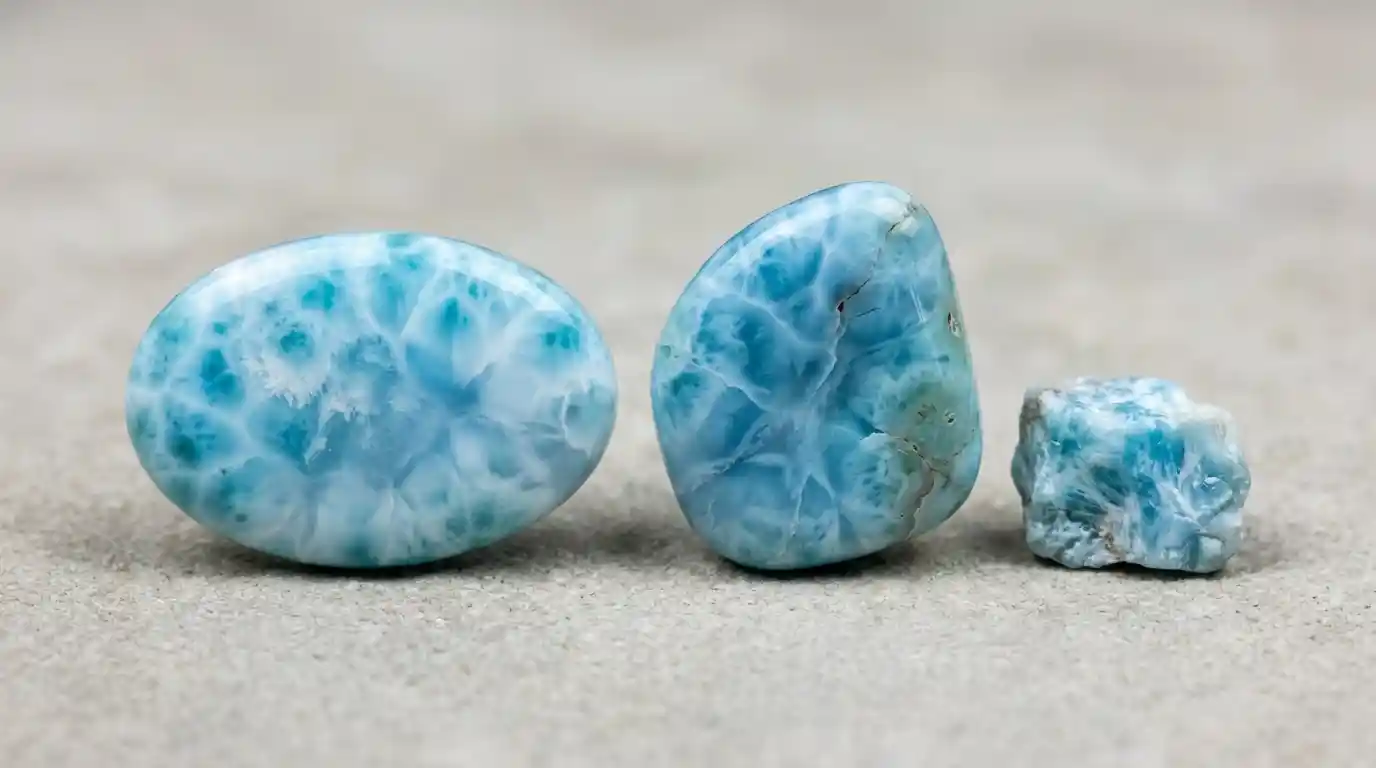
Typical pectolite elsewhere in the world is colorless, white, gray, pinkish, or pale green and commonly occurs as fibrous, radiating, acicular, or massive aggregates. Dominican Larimar became commercially important because its pale blue to intense sky-blue color gives pectolite a dramatically different appearance from the ordinary white or gray mineral.
The blue color is widely believed to be connected with small quantities of Cu²⁺ within the stone, although natural color development is more complex than simply saying “copper makes Larimar blue.” White areas are common, and some pieces show greenish, gray, reddish, or brown inclusions and matrix.
Pectolite has Mohs hardness around 4.5 to 5. It is therefore softer than quartz, feldspar, topaz, sapphire, ruby, and diamond and can develop scratches if worn carelessly. Its cleavage is perfect on two crystallographic directions, while fracture is uneven. Individual pectolite crystals are brittle, but compact fibrous aggregates can display better practical toughness because the fibers interlock.
Luster is sub-vitreous to silky. Larimar used in jewelry is normally massive and opaque to translucent rather than transparent. Fine cabochons are valued for strong blue color, attractive white patterning, smooth polish, and limited cracks or brown matrix.
The OH group in NaCa₂Si₃O₈(OH) is structural hydroxyl rather than freely removable molecular water. Larimar is therefore not an opal-like hydrated gem that needs to be kept wet.
Larimar’s Dominican Republic Origin, Modern Discovery, and Volcanic Setting
Larimar has a distinctly modern gemstone history. Blue pectolite from the Dominican Republic entered gemological literature during the 1970s and had been actively mined from the Barahona area by about 1974. Its commercial identity therefore belongs to recent history rather than to ancient Mediterranean or Indigenous gemstone traditions.
The name Larimar was created by combining “Larissa,” the name of a daughter of Dominican artisan Miguel Méndez, with mar, the Spanish word for sea. The name reflects both personal history and the stone’s blue Caribbean appearance rather than an ancient mineral term.
Commercial Larimar is associated with the Sierra de Baoruco area of Barahona Province in the Dominican Republic, particularly the Filipinas Larimar mining district near Los Checheses. Waterworn pieces were initially encountered in river gravels and later traced upstream toward their geological source.
The gemstone occurs in cavities and veins within altered volcanic basalt. Pectolite developed in open spaces associated with volcanic rocks, creating compact blue aggregates suitable for cutting and carving. Copper-bearing minerals can occur in the deposit as well, consistent with the proposed role of copper in the blue color.
Although ordinary pectolite occurs in many countries, Larimar in strict trade usage refers to the distinctive Dominican blue variety. Sellers sometimes apply the name loosely to blue imitations or similarly colored stones, so identification and origin deserve attention.
The workbook-verified real vs fake Larimar topic is particularly relevant because dyed chalcedony, glass, resin, ceramic products, and other substitutes can resemble blue-and-white Larimar patterns.
Calm, Emotional Balance, and Communication Claims
1. Calm Through a Deliberate Reduction in Stimulation
Larimar is frequently called a calming or soothing stone because its colors resemble clear tropical water. The gemstone has not been shown to reduce anxiety biologically or alter stress hormones. A practical ritual is to use it as a cue to lower stimulation: stop multitasking, put the phone aside, slow the breathing, and decide which problem actually requires attention now.
2. Emotional Balance and Perspective
Another common claim says Larimar balances emotions. It cannot regulate mood chemistry or remove emotional distress. A grounded exercise is to write down what happened, what emotion is present, what interpretation is intensifying that emotion, and what action remains available. The structure may create perspective while the gemstone acts only as a reminder.
3. Clearer Communication
Blue stones are frequently linked with communication in modern crystal systems, and Larimar is no exception. It does not alter language processing or improve speech through contact with the body. Before an important conversation, use it as a signal to define the main issue, state the request clearly, and remove unrelated complaints from the discussion.
Confidence, Compassion, and Relationship Harmony Claims
4. Confidence in Honest Self-Expression
Larimar is often associated with speaking gently but honestly. A gemstone cannot biologically increase confidence. Someone can instead use it before a difficult conversation to rehearse the first sentence, identify what must be communicated, and decide which part of the outcome is outside personal control.
5. Compassion and Empathy
Soft blue-and-white patterns have encouraged symbolism around kindness and emotional understanding. Larimar does not directly make a person more empathetic. It can become a cue to consider another person’s perspective while still asking whether their actions are respectful and whether personal boundaries are being maintained.
6. Relationship Harmony Through Better Communication
Larimar is sometimes marketed for love, partnership, and peaceful relationships. It cannot make another person loyal, cooperative, or emotionally available. A more useful practice is to connect the stone with relationship behaviors that can actually be observed: direct communication, listening, reliability, appreciation, accountability, and appropriate boundaries.
Patience, Creativity, and Adaptability Claims
7. Patience During Frustration
The gemstone’s ocean-like appearance naturally supports symbolism involving slower rhythms and patience. Larimar does not alter impulse control. When frustration rises, use it as a reminder to delay the response, identify whether the issue requires immediate action, and revisit the problem after emotional intensity decreases.
8. Creativity and Imaginative Thinking
Larimar’s irregular blue-and-white patterns can resemble waves, clouds, islands, or underwater scenes, making it an interesting creative prompt. It has not been shown to enhance creativity neurologically. A writer or artist can instead use the pattern as a starting point for free association or brainstorming before evaluating ideas.
9. Adaptability During Personal Change
Water symbolism often leads to claims that Larimar helps people “go with the flow.” The stone cannot make someone psychologically flexible. A practical interpretation is to distinguish the goal from the original method. If circumstances change, ask which part of the plan can be modified while preserving what actually matters.
Resilience, Meditation, and Spiritual Peace Claims
10. Resilience After Emotional Setbacks
Larimar is sometimes associated with recovery after conflict, disappointment, or loss. It cannot biologically heal grief or emotional trauma. A more realistic ritual is to identify what cannot be changed, what remains under personal control, and which next action would reduce further harm or restore a useful routine.
11. Meditation and Reflective Attention
The stone’s pale colors and flowing patterns can make it an appealing meditation object. A person may observe one white-blue boundary, notice when attention wanders, and return to the stone or the breath. This is a genuine attention exercise without demonstrating that pectolite changes consciousness through an energetic frequency.
12. Spiritual Reflection on Peace and Personal Values
Modern spiritual users often associate Larimar with peace, emotional softness, and living according to deeply held values. A person might use it while reflecting on whether daily behavior matches those values. The ritual can be meaningful without claiming that the gemstone transmits ocean energy or changes spiritual awareness through a physical mechanism.
Larimar Chakra Associations: Throat Symbolism and Heart-Centered Calm
Larimar is most commonly associated with the throat chakra in modern crystal practice because of its blue color and themes involving communication, truthful expression, and calm speech. Some practitioners also connect pale blue-green pieces with the heart chakra, particularly when emphasizing compassion or relationships.
Chakras are a spiritual framework rather than anatomical structures. Larimar has not been demonstrated to affect the thyroid, vocal cords, heart, circulation, nervous system, endocrine glands, or another physiological system through chakra placement.
Its modern chakra associations should not be presented as ancient Dominican tradition. Larimar’s commercial gemstone identity developed recently, and today’s energy language belongs to contemporary crystal culture.
Larimar Physical Care: Mohs 4.5 to 5, Cleavage, Heat Sensitivity, Water, and Jewelry Wear
Larimar requires more care than quartz, jade, garnet, or many other jewelry stones because pectolite is relatively soft. At Mohs 4.5 to 5, it can be scratched by ordinary quartz dust, glass, steel, feldspar, topaz, corundum, and diamond. Store polished Larimar separately from harder jewelry.
Perfect cleavage creates additional vulnerability. Although compact fibrous Larimar can be reasonably tough in polished form, hard impacts may still create chips, fractures, or separation along weaker zones. Earrings and pendants generally face less risk than rings and bracelets.
Brief contact with plain lukewarm water is generally acceptable for sound untreated Larimar. Mild soap and a soft cloth are suitable for routine cleaning. Prolonged soaking offers no advantage and should be avoided when the stone contains open fractures, fillers, glue, coatings, or assembled jewelry components.
Heat is more important. Gemological research has shown that Larimar can react adversely to the heat of a jeweler’s torch. Direct flame, steam cleaning, soldering heat near the stone, boiling water, and rapid temperature changes should therefore be avoided.
Ultrasonic cleaning is also inappropriate as a default because vibration can exploit fractures or cleavage. Hand cleaning is safer.
Strong acids, bleach, abrasive powders, alcohol-heavy cleaners, and harsh jewelry dips are unnecessary. Perfume, hairspray, cosmetics, and household cleaners should be allowed to dry before Larimar jewelry is worn.
Color appears generally stable to ordinary light, but prolonged extreme heat and unnecessary intense exposure are still poor care choices. The workbook-verified Larimar quality grading focuses on blue intensity, pattern, condition, polish, and other physical quality factors.
Ritual Cleansing Larimar Without Heat, Saltwater, or Harsh Chemicals
Larimar’s sea-like appearance often inspires water-based rituals, but there is no need to keep the stone submerged. There is no scientifically demonstrated negative energy that must be physically washed from pectolite.
Sound, meditation, intention-setting, dry placement, or a brief gentle wipe are safer options. A communication-centered ritual can involve writing down one thing that needs to be expressed clearly and then using the stone as a reminder to communicate it calmly.
Avoid prolonged saltwater immersion, steam, flame, abrasive salt contact, chemical sprays, and harsh sunlight combined with heat. A simple dry ritual preserves the polished surface and respects Larimar’s relatively low hardness.
Conclusion
Larimar’s verified identity is distinctive enough without exaggerated wellness claims. It is blue pectolite from the Dominican Republic, formed in altered volcanic rocks and recognized commercially only in recent history. Its twelve healing themes can still support calmer routines, communication, boundaries, creativity, adaptability, and reflection when the useful effect comes from deliberate behavior rather than from an unproven therapeutic property.
Frequently Asked Questions About Larimar Healing Properties
What are the main Larimar healing properties people claim?
Common claims include calm, emotional balance, communication, confidence, compassion, relationship harmony, patience, creativity, adaptability, resilience, meditation, and spiritual peace. These are modern wellness or spiritual beliefs rather than scientifically proven therapeutic effects.
What is Larimar made of?
Larimar is the blue gem variety of pectolite, a sodium calcium hydroxide silicate with the formula NaCa₂Si₃O₈(OH).
How hard is Larimar?
Pectolite is approximately Mohs 4.5 to 5. Larimar is therefore softer than quartz and requires protection from scratches and hard impacts.
What gives Larimar its blue color?
Research indicates that small amounts of Cu²⁺ are likely involved in producing the blue coloration. The exact natural color mechanism is more complex than simply having visible copper inclusions.
Where does genuine Larimar come from?
Commercial Larimar is associated with the Sierra de Baoruco area of Barahona Province in the Dominican Republic, particularly the Filipinas Larimar mining district.
Does Larimar have ancient healing traditions?
No deep ancient Larimar tradition is documented. The blue pectolite became a recognized commercial gemstone in the twentieth century, so today’s chakra and healing claims are modern.
Which chakra is Larimar associated with?
Modern crystal practice most commonly associates Larimar with the throat chakra and sometimes the heart chakra. These are spiritual correspondences rather than anatomical effects.
Can Larimar go in water?
Brief cleaning with plain lukewarm water is generally acceptable for sound untreated Larimar. Prolonged soaking is unnecessary, particularly when fractures, glue, coatings, or jewelry settings are present.
Can Larimar be cleaned with steam or an ultrasonic cleaner?
No. Steam introduces damaging heat, while ultrasonic vibration can exploit cleavage and fractures. Mild soap, lukewarm water, and a soft cloth are safer.
What should buyers check when purchasing Larimar?
Look for genuine Dominican pectolite, attractive blue color, appealing white patterning, good polish, limited fractures, and truthful disclosure of imitation or treatment. The workbook-verified buy Larimar topic focuses specifically on purchasing and authenticity checks.
Crystal healing claims are traditional or personal beliefs and should not replace qualified medical or mental health care.