Buy Larimar: How to Choose, Origin, Quality & Red Flags
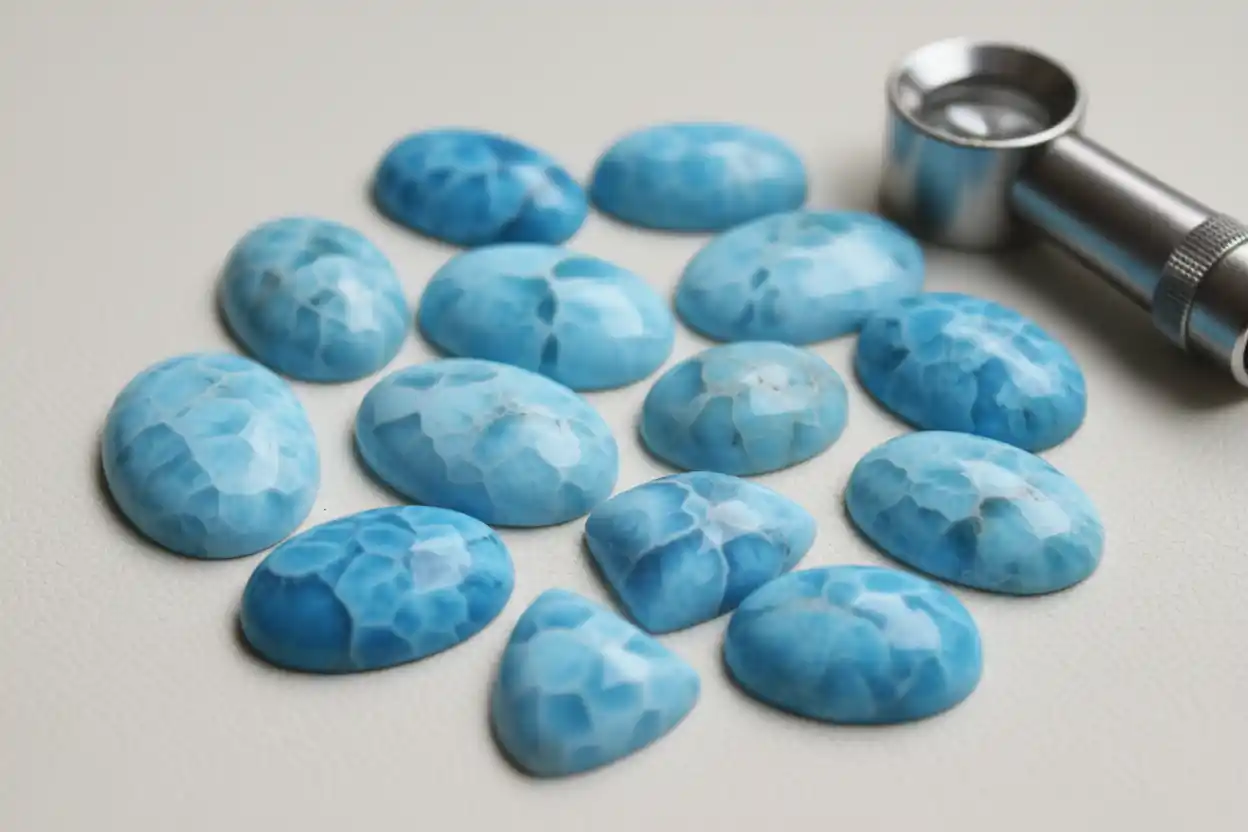
If you want to buy Larimar confidently, look first for attractive natural blue color, distinctive white patterning, good polish, sound condition, clear Dominican Republic origin, and honest seller disclosure. Fine pieces often show strong sky blue, turquoise blue, or deeper blue areas with white branching, cloud-like, or wave patterns. Pale gray-blue, large dull white zones, heavy green tones, surface damage, poor cutting, or suspiciously uniform manufactured patterns usually deserve a lower price.
Authenticity also matters because convincing glass, ceramic, resin, dyed stone, and composite imitations now appear in both online and physical markets. Larimar is blue pectolite associated with the Dominican Republic, so a seller claiming Larimar from another country should immediately raise questions. Current untreated Dominican Republic cabochons commonly appear around roughly $10 to $16 per carat in the retail examples checked for this article, although color, pattern, cutting, size, and seller positioning can move the Larimar price significantly higher or lower.
Larimar Should Come From the Dominican Republic
Larimar is the trade name used for blue pectolite associated with the Dominican Republic. Its geographic connection is one of its defining commercial characteristics, not merely a fashionable source claim. Recent gemological research on Larimar imitations describes genuine Larimar as originating only from the Dominican Republic.
That makes origin unusually straightforward compared with gems found across many countries. A listing that claims Mexican Larimar, Chinese Larimar, African Larimar, or another non-Dominican geological source should be treated cautiously. The product might be another blue stone, glass, ceramic, resin, or a seller using the name loosely.
Origin claims still need sensible verification when the price is high. A seller saying Dominican Larimar is more credible when the listing also provides exact dimensions, weight, real photographs, treatment information, return terms, and consistent identification.
Current Larimar Retail Examples
Current loose-stone listings show that natural untreated Larimar is not necessarily inexpensive, especially when the color and polish are attractive. The following examples are Dominican Republic cabochons sold as untreated.
| Current retail example | Weight | Asking price | Approx. price per carat |
|---|---|---|---|
| Light blue oval | 5.08 ct | $65.25 | $12.84 |
| Baby blue pear | 5.66 ct | $89.65 | $15.84 |
| Baby blue pear | 7.72 ct | $122.28 | $15.84 |
| Light blue oval | 14.77 ct | $161.64 | $10.94 |
| Light sky blue oval | 17.70 ct | $228.95 | $12.94 |
| Blue oval | 20.33 ct | $249.46 | $12.27 |
| Turquoise oval | 18.93 ct | $183.35 | $9.69 |
| Blue cushion | 58.94 ct | $645.76 | $10.96 |
These are current asking prices rather than fixed values. They show why Larimar price per carat can vary even among stones sold by the same retailer. A smaller piece with more attractive color or a desirable calibrated shape may cost more per carat than a larger cabochon.
Color Has the Strongest Visual Impact
Larimar ranges from very pale blue through sky blue, turquoise blue, blue-green, and deeper saturated blue. Buyers often pay more for stronger blue that remains attractive across most of the face.
Pale color is not automatically poor quality. A beautifully patterned light blue cabochon can be highly appealing, especially if the white structures create a clean ocean-like appearance. However, intense blue tends to receive stronger demand because vivid color is less common within good-quality rough.
Greenish areas may occur naturally, but large green zones usually attract less interest than clean blue. Brown, gray, or dull areas can also lower appeal when they dominate the stone.
The best choice is not simply the darkest specimen. Look for color that remains lively and balanced under ordinary lighting rather than a stone that appears impressive only in heavily edited photographs.
White Patterning Can Add Character
One of Larimar’s most recognizable features is its blue-and-white pattern. White areas can appear as waves, clouds, branching structures, feathers, webs, or radial forms created by its internal growth.
Fine patterning can add substantial visual interest when it is integrated with strong blue rather than overwhelming it. A cabochon with dramatic white waves over rich turquoise blue may be more desirable than a nearly plain stone of similar size.
Pattern preference remains partly personal. Some buyers favor clean blue with minimal white, while others specifically seek strong wave-like structures. That makes Larimar quality grading less about one rigid visual formula and more about balancing color intensity, pattern, polish, condition, and overall appeal.
Do Not Assume Every Perfect Pattern Is Genuine
Larimar’s distinctive appearance also makes it a target for imitation. A 2025 gemological study documented convincing partly crystallized glass that reproduced blue color and white web-like patterns closely enough to be submitted for professional identification.
Ceramic, resin, dyed howlite, magnesite, reconstructed products, blue chalcedony, and other blue stones can also resemble Larimar in photographs.
The real vs fake Larimar comparison becomes particularly important when a stone has extremely regular white patterns, unusually uniform color, suspiciously low pricing, or an unclear origin story. Visual clues can narrow the possibilities, but difficult cases require proper gemological testing.
Glass Imitations Are Becoming More Convincing
Recent laboratory research is especially important because modern glass imitations can reproduce Larimar’s familiar white-on-blue appearance surprisingly well. Some documented samples contained radiating whitish zones and blue-green color that looked convincing even in cabochon form.
Glass may reveal bubbles, flow structures, unusual transparency, or a different internal texture under magnification, but a polished imitation may not show obvious problems to an inexperienced buyer.
This is why simple internet tests should not be treated as proof. Temperature, scratch behavior, or visual pattern alone cannot reliably establish Dominican pectolite. For a costly piece, laboratory identification provides much stronger evidence.
Extremely Low Prices Need an Explanation
Natural Larimar is not so rare that every small cabochon must be expensive, but current specialist retail inventory commonly places untreated loose stones in the low double-digit dollars per carat.
A supposedly top-grade 30-carat cabochon offered for only a few dollars deserves closer inspection. The price could reflect wholesale sourcing, lower color quality, rough workmanship, undisclosed treatment, another blue stone, or imitation.
Conversely, a high asking price does not prove authenticity. Some imitation products are priced aggressively because buyers associate Larimar with scarcity. Price should therefore trigger investigation rather than replace it.
Size Alone Does Not Determine Quality
Large Larimar cabochons can be impressive, but weight should not outrank color and pattern. Current retail examples show substantial stones above 50 carats without an extreme per-carat premium.
A 10-carat cabochon with vivid blue and attractive white waves may therefore be more desirable than a 40-carat pale piece with dull areas. Large rough can also contain fractures, matrix, uneven color, or sections that do not polish attractively.
Compare dimensions as well as carat weight. Larimar is usually cut as a cabochon, and two stones of equal weight may have very different face-up sizes depending on thickness.
Cut and Polish Matter More Than They First Appear
Larimar is usually shaped into ovals, pears, cushions, rounds, freeforms, beads, and carvings rather than faceted for brilliance. A good cabochon should have smooth contours, pleasing symmetry where appropriate, and an even polish that makes the blue and white structures look crisp.
Poor polish can leave scratches, flat dull areas, pits, or uneven reflections. Thin edges can be vulnerable to damage, while an excessively thick base may add weight without improving visible size.
For jewelry, inspect the setting as carefully as the stone. A pendant usually receives less impact than a ring, while a bezel can protect edges better than an exposed design.
Larimar Needs More Care Than Harder Gems
Pectolite is not among the hardest jewelry gems, so Larimar can scratch or chip more easily than sapphire, topaz, or quartz. Thin edges and naturally fractured zones deserve particular care.
That does not prevent Larimar from being used in rings, bracelets, pendants, or earrings, but jewelry intended for frequent wear should have a secure and reasonably protective setting.
Avoid judging durability only by how smooth the polished surface looks when new. Check for cracks, chips, cavities, weak corners, and visible structural lines before buying.
Treatment Is Not the Main Story, but Disclosure Still Matters
Gemological references do not describe routine treatment as the defining feature of the Larimar market in the way dye is common with some other blue gems. Genuine Larimar is valued for its naturally occurring blue appearance.
Still, sellers should disclose any dye, filling, coating, stabilization, assembly, or other artificial alteration if present. General gem trade rules require treatments that affect appearance, durability, care, or value to be disclosed.
An unusually intense stone should not automatically be assumed treated, because vivid blue Larimar does occur naturally. The correct response is to evaluate the individual piece and ask for disclosure rather than relying on color alone.
Origin and Authenticity Are Different Questions
A seller can truthfully say that a piece was purchased in the Dominican Republic without proving that the stone itself is Larimar. Tourist markets can sell genuine stones alongside imitations.
Likewise, a certificate or seller card stating “Dominican stone” does not automatically establish identity. The most useful evidence combines geological source, actual gemological identification, treatment disclosure, and a seller willing to stand behind the item.
For inexpensive jewelry, a strong return policy may provide sufficient practical protection. For expensive collector pieces or high-end jewelry, more formal verification becomes reasonable.
Seller Grades Are Not Universal
AAA, AAAA, premium, volcanic blue, Caribbean blue, top grade, and collector grade may appear in Larimar listings, but these terms do not represent one standardized international scale.
A retailer may classify stones according to its own color and pattern preferences. Another shop can use the same grade for noticeably different quality.
Compare visible factors instead. Color saturation, pattern coverage, cutting, polish, fractures, dimensions, origin disclosure, and authenticity provide more useful information than a letter grade.
Ask for Actual Photos and Video
Larimar can look substantially different under studio lighting, outdoor sunlight, and ordinary indoor light. Product photography may also exaggerate blue saturation.
Ask whether the listing shows the actual cabochon rather than a representative image. Video is particularly helpful because it reveals polish, surface defects, color distribution, thickness, and how the white patterns move across the curved face.
Multiple views also reduce the chance that a crack, dull zone, dark matrix area, or chipped edge is hidden outside the main photograph.
Return Policy Matters for Online Purchases
A practical return window gives you time to inspect the stone under neutral lighting and compare it with the listing. Check its color, pattern, surface condition, dimensions, weight, and setting if it is already mounted.
Pay attention to whether the seller’s written description matches what arrived. If a listing promises untreated Dominican Larimar but the invoice simply says blue stone, that inconsistency deserves clarification.
Good documentation does not have to be elaborate for a modest purchase. It simply needs to state clearly what you are buying.
Do Not Treat Symbolism as a Quality Grade
The Larimar benefits described in crystal traditions may include associations with calmness, reflection, communication, or personal balance. These interpretations can have personal significance but do not determine commercial grade.
The same distinction applies to Larimar healing properties discussed in belief-based wellness traditions. Market value should remain tied to genuine identity, Dominican origin, color, pattern, treatment disclosure, cutting, condition, workmanship, and current demand.
FAQs
How much should natural Larimar cost?
Current untreated Dominican Republic cabochons reviewed for this article commonly fall around roughly $10 to $16 per carat, although lower and higher prices are possible depending on color, pattern, size, cutting, and seller.
Is darker blue Larimar more valuable?
Strong blue often commands more attention and can receive a premium, but color must still be attractive and natural-looking. Pattern, polish, condition, and overall balance also matter.
Where does real Larimar come from?
Genuine Larimar is blue pectolite associated with the Dominican Republic. Claims of natural Larimar mined in unrelated countries should be treated cautiously.
Is white patterning good in Larimar?
It can be. Attractive white waves, clouds, or branching structures are a distinctive feature. Excessive pale areas that overwhelm the blue may lower value.
Are there fake Larimar stones?
Yes. Glass, ceramic, resin, dyed stones, reconstructed products, and other blue gems can imitate Larimar. Recent gemological research has documented particularly convincing glass imitations.
Is Larimar usually treated?
Routine treatment is not considered the defining feature of the market, and many retail stones are sold as untreated. Any dye, filling, coating, stabilization, or other alteration should still be disclosed when present.
What does AAA Larimar mean?
AAA is generally a seller-created grade rather than a universal gemological standard. Judge the actual color, pattern, polish, condition, origin, and authenticity.
Is large Larimar rare?
Large pieces exist, so carat weight alone does not establish rarity. Large size combined with exceptional blue color and attractive patterning is more significant.
Is Larimar suitable for a ring?
Yes, but it needs sensible care because it is softer than many common jewelry gems. Protective settings and avoiding hard impacts can reduce damage.
Does Larimar hold its value?
Resale depends on quality, authenticity, provenance, jewelry workmanship, and buyer demand. Retail asking price should not be treated as a guaranteed future resale value.
Conclusion
To buy Larimar well, prioritize genuine Dominican pectolite, attractive natural blue color, pleasing white patterning, good polish, sound condition, and clear seller disclosure. Current untreated loose examples often sit around roughly $10 to $16 per carat, but the individual stone matters more than a simple weight calculation. Be particularly cautious with unclear origin claims, perfect-looking manufactured patterns, unusually low prices, vague certificates, and sellers who avoid direct questions about identity or treatment.