Moldavite Healing Properties: 9 Claims, Tektite Facts & Safe Use
Moldavite healing properties are commonly associated with transformation, intuition, emotional release, confidence, adaptability, resilience, meditation, spiritual awareness, and purposeful change. Few stones attract as much dramatic modern storytelling, partly because Moldavite has an extraordinary verified origin: it is natural green impact glass formed when the Ries meteorite impact in southern Germany melted and ejected terrestrial rock roughly 14.7 million years ago. The glass later fell mainly across parts of what is now the Czech Republic. That impact origin does not make Moldavite a meteorite and does not demonstrate supernatural power. Moldavite has not been shown to accelerate personal transformation, trigger physiological energy surges, improve psychic ability, treat anxiety or depression, change heart rate, cure disease, or alter consciousness through a tektite-specific mechanism. Scientifically, Moldavite is a variety of tektite, a silica-rich natural glass with no crystal lattice or crystal system. Its real geology is already exceptional without converting an ancient impact event into medical or paranormal evidence.
9 Moldavite Healing Claims
- Personal transformation and major change
- Intuition and reflective judgment
- Emotional release and perspective
- Confidence during unfamiliar situations
- Adaptability when life changes quickly
- Resilience after disruption
- Meditation and focused awareness
- Spiritual reflection and meaning
- Purposeful renewal and new direction
These nine themes can support distinct reflective practices without becoming nine scientifically established effects. The Moldavite benefits commonly described in crystal culture become more useful when translated into actions such as reviewing a major decision, journaling after a transition, adapting a failed plan, beginning a new routine, or setting aside uninterrupted time for reflection.
What Moldavite Really Is
Moldavite is natural impact glass belonging to the tektite family. It formed when an extraterrestrial body struck the area now occupied by the Ries crater in southern Germany. The impact generated extreme heat and pressure, melting near-surface terrestrial rock and ejecting molten droplets over long distances.
Those droplets cooled rapidly into glass while traveling through the atmosphere and later landed primarily across southern Bohemia and Moravia in the Czech Republic, with smaller occurrences reported elsewhere around the strewn field.
Moldavite is therefore not a meteorite fragment. Its chemistry comes overwhelmingly from melted terrestrial rock rather than from the impacting body. Calling it “extraterrestrial glass” without explanation can create the false impression that the green glass itself arrived from space.
Like other natural glasses, Moldavite is amorphous and has no crystal system. Its chemistry varies, but it is unusually silica-rich among tektites, with geological studies reporting silica around 80 weight percent in many examples. Aluminum, potassium, iron, magnesium, calcium, sodium, titanium, and other components occur in smaller proportions.
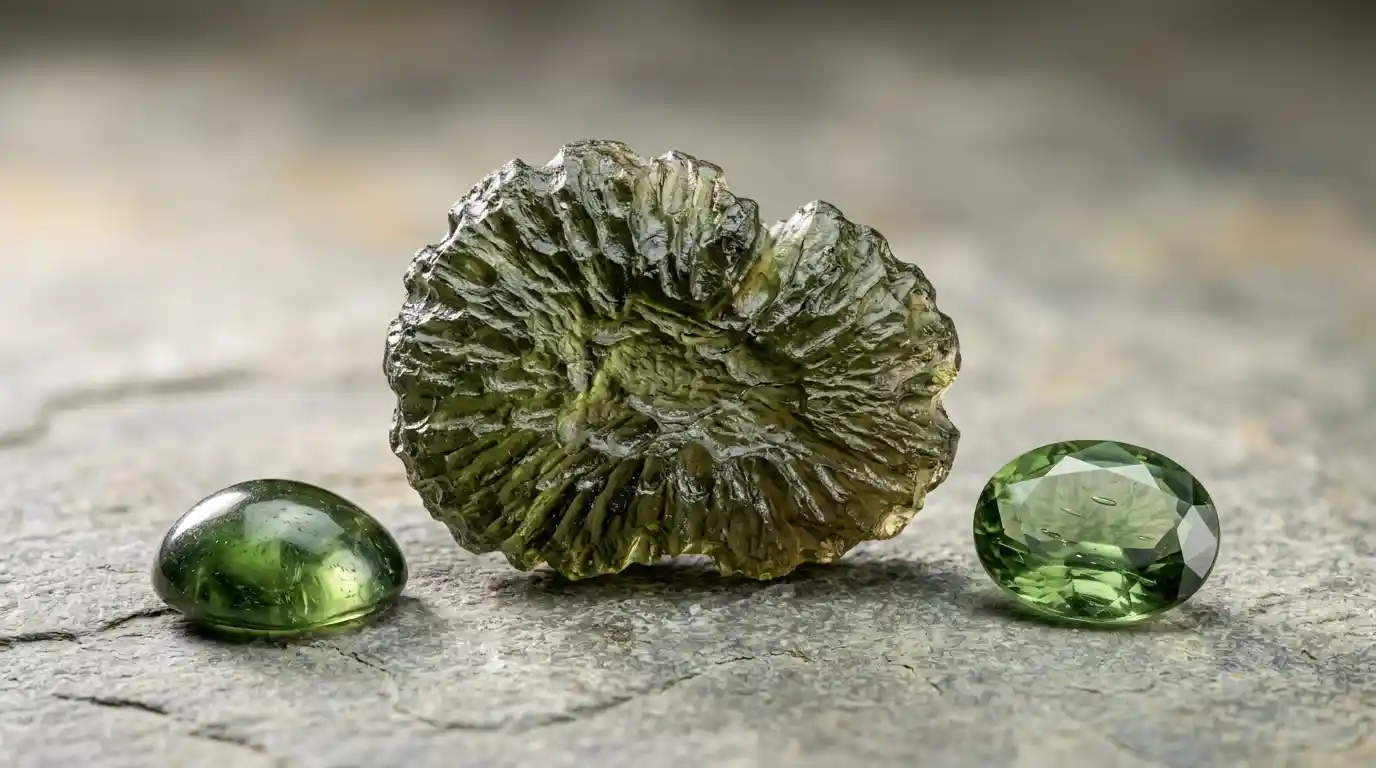
Color ranges from pale yellow-green and olive through bottle green, forest green, and brownish green. Fine transparent pieces can look brighter when backlit, while thicker specimens may appear dark.
Hardness is generally around Mohs 5 to 5.5. Moldavite lacks mineral cleavage because it is glass, but it is brittle and breaks with conchoidal fracture. Fresh chips can therefore develop sharp edges.
Ries Impact and Moldavite History
The Ries impact occurred approximately 14.7 million years ago in what is now Bavaria, Germany. Geological evidence links Moldavite directly with this event. Molten ejecta traveled hundreds of kilometers from the crater before falling across the Moldavite strewn field.
Natural sculpturing developed later. Many rough pieces show pits, furrows, grooves, spikes, and deeply etched surfaces created by weathering and chemical corrosion after burial and transport. These textures can be visually dramatic and contribute substantially to collector appeal.
Moldavite was first scientifically described in the late eighteenth century, and the name was introduced in the nineteenth century after the Moldau River, the German name for the Vltava River in southern Bohemia. The name is therefore geographic rather than spiritual.
Evidence also indicates that prehistoric people collected and traded Moldavite, while later Czech jewelry makers used faceted stones extensively. Moldavite jewelry became especially fashionable during the nineteenth century, sometimes appearing alongside Bohemian garnets and pearls.
This genuine human history does not establish today’s intense metaphysical reputation. Modern claims about rapid transformation, extraterrestrial consciousness, chakra activation, and the so-called “Moldavite flush” belong to contemporary spiritual culture rather than to impact geology.
Transformation and Intuition
Transformation Through Action
Moldavite is perhaps most famous as a stone of rapid transformation. The impact origin makes that symbolism understandable because a catastrophic geological event produced an entirely new glass. The tektite itself cannot force life changes, end relationships, attract events, or accelerate personal development. A useful ritual is to identify one change that is already necessary and define the first action that would make it real.
Intuition With Evidence
Moldavite is also associated with intuition and sudden insight. It does not transmit extraterrestrial knowledge or improve extrasensory perception. A grounded practice is to record the first instinctive response to a decision, then compare it with evidence, likely consequences, uncertainty, and reversibility. Intuition can contribute to judgment without becoming unquestioned certainty.
Emotional Release and Confidence
Emotional Release Through Reflection
Some users report intense emotions while handling Moldavite and interpret the experience as stored emotions leaving the body. There is no evidence that tektite glass extracts trauma, grief, resentment, or anxiety. Expectation, symbolism, focused attention, and the significance attached to the stone can all influence subjective experience. A practical approach is to journal about what emotion appeared, what triggered it, and what concrete action might help.
Confidence During Change
Moldavite is frequently used when someone is entering a new job, relationship stage, location, or personal routine. The stone cannot biologically produce courage or confidence. It can serve as a marker of intentional change. Identify what is prepared, what remains uncertain, and what first action is still controllable.
Adaptability and Resilience
Adaptability When Plans Shift
The violent geological event behind Moldavite makes change an obvious metaphor. A tektite cannot make the brain more adaptable. When circumstances change, use the stone as a reminder to distinguish the underlying goal from the original method. A failed route does not always mean the goal itself should be abandoned.
Resilience After Disruption
Moldavite is also linked with rebuilding after upheaval. It cannot heal emotional trauma through mineral energy. After disruption, identify what has ended, what remains stable, what support is available, and which routines need rebuilding first. Resilience develops through adaptation and support rather than through the glass.
Meditation and Spiritual Reflection
Meditation and Focused Awareness
Natural Moldavite has unusual shapes, etched surfaces, bubbles, and internal flow structures that can make it visually absorbing. A person can use the stone during meditation by focusing on its texture or transparency and returning attention to the object whenever the mind wanders. That is a valid concentration practice without demonstrating altered consciousness caused by the tektite.
Spiritual Reflection and Meaning
Modern metaphysical practice often describes Moldavite as cosmic, extraterrestrial, or spiritually accelerating. The impact event certainly began with an extraterrestrial object, but the resulting Moldavite glass formed from Earth rock. A person may still use the stone to reflect on scale, chance, geological time, or personal meaning without treating these ideas as evidence of alien information.
Purposeful Renewal
The ninth major claim involves new beginnings, personal direction, and renewal. A useful ritual can mark an intentional transition: write down what is ending, what lesson should be retained, and what specific action will define the next stage.
The symbolic power comes from assigning meaning to a tangible object with an extraordinary geological history. The renewal itself comes from decisions, behavior, and time.
Moldavite Chakra Meaning
Moldavite is commonly associated with the heart, third-eye, and crown chakras in modern crystal systems. Green color encourages the heart connection, while its unusual impact origin and modern spiritual reputation lead practitioners to connect it with intuition, awareness, and higher consciousness.
Chakras are a spiritual framework rather than anatomical structures. Moldavite has not been demonstrated to affect the physical heart, brain, pineal gland, nervous system, endocrine glands, or other organs through chakra placement.
Reports of warmth, tingling, dizziness, emotional intensity, or a racing heart are sometimes labeled the “Moldavite flush.” These sensations should not automatically be attributed to a special tektite energy. Expectation, anxiety, attention, environmental heat, posture, or other ordinary factors can contribute to subjective sensations. Persistent or concerning physical symptoms deserve ordinary health evaluation rather than metaphysical interpretation.
Moldavite Care
Moldavite is a natural glass, so its physical care is similar in many respects to other brittle glasses. At roughly Mohs 5 to 5.5, it can be scratched by quartz, feldspar, topaz, sapphire, ruby, diamond, and many everyday abrasive particles.
Its brittle structure makes impact important. Natural etched pieces can have thin ridges, projections, and sharp sculptured areas that break more easily than a rounded polished cabochon. Store rough Moldavite in a padded compartment rather than loose with harder crystals.
Brief washing with lukewarm water is generally safe for genuine untreated Moldavite. Mild soap and a soft brush or cloth can remove ordinary dirt. Do not scrub aggressively across delicate natural sculpturing.
Long soaking is unnecessary. Steam cleaning is also unnecessary because rapid thermal change adds risk to natural glass. Ultrasonic cleaning should be avoided for rough, highly sculptured, fractured, or valuable specimens because vibration may extend existing cracks or chip fragile surface features.
Strong chemicals and abrasive cleaners should be avoided. Hydrofluoric acid attacks silica-rich glass and is extremely hazardous. Household cleaning never requires such treatment.
Broken Moldavite can have sharp conchoidal edges, so chipped specimens should be handled carefully. Lapidary cutting produces glass fragments and silica-bearing dust, requiring wet cutting, eye protection, extraction, and suitable respiratory controls.
Moldavite Authenticity and Imitations
Moldavite’s popularity and price have produced a large imitation market. Manufactured green glass can resemble genuine tektite, particularly when molded or chemically altered to imitate natural surface texture.
Authentic Moldavite may contain gas bubbles, characteristic internal flow structure, and small lechatelierite inclusions, while natural surface sculpturing can provide additional clues. No single visual feature should be treated as infallible, especially in faceted stones where much of the original surface has been removed.
Artificial glass may show repetitive textures, overly smooth worm-like patterns, uniform color, or bubble characteristics inconsistent with genuine Moldavite. Sophisticated imitations can still require professional testing.
The workbook-verified buy Moldavite topic is especially important because authenticity has far greater practical significance than claims about energetic strength.
Safe Ritual Cleansing
Moldavite does not require aggressive cleansing to remain meaningful in a personal practice. There is no scientifically demonstrated negative energy that must be removed from the glass.
Sound, intentional breathing, meditation, dry placement, or brief gentle physical cleaning are suitable low-risk methods. A transformation-themed ritual can involve choosing one specific behavior that will change rather than expecting the stone to initiate unpredictable events.
Avoid flame, extreme heat, abrasive salt, harsh chemicals, prolonged saltwater exposure, and rough handling of deeply sculptured pieces. Preserving an authentic surface is more important than performing a dramatic cleansing ritual.
Conclusion
Moldavite already has one of the most extraordinary verified origins in the gem world. A meteorite impact at the Ries crater melted terrestrial rock, ejected it hundreds of kilometers, and produced green natural glass that survived for roughly 14.7 million years. Its nine healing claims can still support reflection on change, resilience, intuition, meditation, and purposeful renewal, but its geological origin does not prove medical, psychic, or extraterrestrial powers.
FAQs
What are the main Moldavite healing properties?
Common claims include transformation, intuition, emotional release, confidence, adaptability, resilience, meditation, spiritual awareness, and renewal. These are contemporary spiritual beliefs rather than scientifically proven therapeutic effects.
Is Moldavite a crystal?
No. Moldavite is amorphous natural impact glass and has no crystal lattice or crystal system.
Is Moldavite a meteorite?
No. It is a tektite formed mainly from terrestrial rock melted and ejected during the Ries meteorite impact.
How old is Moldavite?
Moldavite formed approximately 14.7 million years ago during the Ries impact event in southern Germany.
Where is genuine Moldavite found?
Most Moldavite occurs in the Czech Republic, especially southern Bohemia and Moravia, with much smaller occurrences around the wider strewn field.
What causes Moldavite’s green color?
Its green appearance results from its natural glass chemistry, particularly the proportions and oxidation states of iron and other components within the impact melt.
What is the Moldavite flush?
The term describes subjective reports of warmth, tingling, emotional intensity, dizziness, or similar sensations. No verified Moldavite-specific biological mechanism has been established for these experiences.
Which chakras are associated with Moldavite?
Modern crystal systems often associate it with the heart, third-eye, and crown chakras. These are spiritual correspondences rather than anatomical effects.
Can Moldavite go in water?
Brief cleaning with lukewarm water is generally safe for genuine Moldavite. Protect fragile natural surface features and avoid unnecessary prolonged soaking.
How can I tell if Moldavite is real?
Authenticity can involve evaluating internal flow features, bubbles, lechatelierite inclusions, natural sculpturing, provenance, and professional gemological testing. Manufactured green-glass imitations are common.
Crystal healing claims are traditional or personal beliefs and should not replace qualified medical or mental health care.