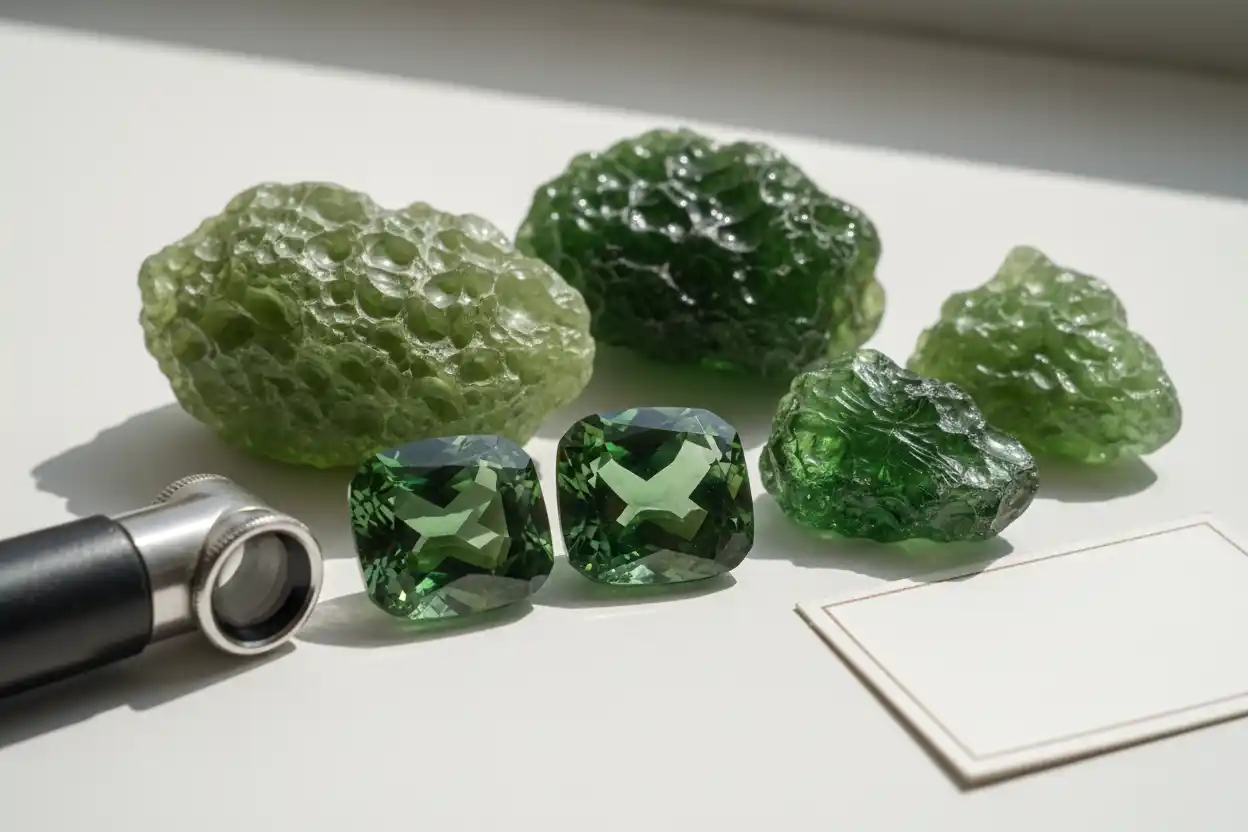
Buy Moldavite: Smart Buying Tips & Red Flags
If you want to buy moldavite intelligently, begin with natural impact-glass identity rather than color, spiritual claims, or an unusually dramatic surface. Moldavite is a green natural tektite associated with a major impact event in Central Europe, and genuine pieces can range from relatively smooth olive-green fragments to deeply sculpted specimens with grooves, pits, ridges, channels, thin projections, bubbles, internal flow structures, and microscopic high-temperature silica-glass inclusions. That natural variability is exactly what makes Moldavite interesting, but it also makes simple authenticity rules unreliable.
Manufactured green glass is the principal buying risk. Low-quality imitations may look obviously artificial because they are glossy, uniformly bright green, or filled with simple bubbles, while better imitations can be molded, carved, sandblasted, mechanically textured, or chemically etched until they reproduce many of the surface features collectors associate with natural Moldavite. Genuine pieces can also be polished, tumbled, faceted, repaired, glued, resin filled, coated, or altered after collection, so confirming natural origin does not automatically answer whether the present surface is original.
The strongest methodology when you buy moldavite is therefore natural tektite identity first, specimen form second, surface authenticity third, internal structure fourth, color and translucency fifth, condition sixth, modification and repair disclosure seventh, provenance eighth, laboratory evidence ninth, jewelry suitability tenth, and price last. Following that order prevents one bubble, one white thread, one seller certificate, one locality name, or one dramatic “hedgehog” appearance from becoming an authentication shortcut.
The broader Moldavite properties guide explains its formation, composition, physical properties, geological context, and traditional symbolism. This page stays focused on how to buy moldavite as natural rough, collector material, faceted glass, a pendant, another jewelry form, or a provenance-driven specimen without paying genuine-material prices for manufactured glass or damaged pieces.
What to Judge First When You Buy Moldavite
Moldavite belongs to the wider tektite family. Tektites are natural glasses produced when a high-energy impact melts terrestrial surface material and ejects part of that melt away from the crater, where it cools rapidly into glass. Moldavite is particularly recognizable because it commonly occurs in green shades rather than the dark brown or black colors associated with many other tektite groups.
When you buy moldavite, use this hierarchy:
| Priority | What to evaluate | Why it matters |
|---|---|---|
| 1 | Natural Moldavite identity | Manufactured green glass can imitate color, bubbles, and surface texture |
| 2 | Rough, polished, faceted, or repaired form | Different forms have different collector and jewelry value |
| 3 | Surface authenticity | Artificial etching can imitate natural sculpture |
| 4 | Internal structure | Bubbles, flow features, and lechatelierite can support identification when interpreted correctly |
| 5 | Color and translucency | Attractive green and visible internal depth affect aesthetic value |
| 6 | Condition | Chips and fresh breaks can remove important natural sculpture |
| 7 | Modification | Polishing, coating, filling, gluing, drilling, and artificial texturing should be disclosed |
| 8 | Provenance | Locality premiums require credible collecting history |
| 9 | Laboratory evidence | Valuable or suspicious specimens justify stronger verification |
| 10 | Jewelry construction | Natural glass is brittle and thin sculpted edges need protection |
| 11 | Price | Price should follow the verified specimen rather than a spiritual or rarity claim |
When you buy moldavite through this hierarchy, every premium has to correspond to something that can actually be observed, documented, or tested.
Moldavite Is Natural Glass, Not a Crystal Mineral
Retail language often calls Moldavite a crystal, but technically it is amorphous natural glass rather than a crystalline mineral.
Its atoms do not form the long-range repeating lattice expected in a mineral crystal because the molten material cooled too rapidly.
That distinction matters when you buy moldavite because sharp-looking ridges and points on rough specimens are not crystal faces. They reflect a combination of original glass form, breakage, sediment transport, burial, weathering, and chemical corrosion.
The broader tektite guide explains why impact glass belongs to a different material category from crystalline gemstones.
When you buy moldavite, do not let the word crystal become evidence for or against authenticity.
Moldavite Is Not a Meteorite Fragment
A meteorite is surviving extraterrestrial material that reaches Earth’s surface.
Moldavite consists primarily of terrestrial material melted and ejected during an impact.
When you buy moldavite, descriptions such as green meteorite, alien stone, asteroid crystal, or extraterrestrial glass should be treated as marketing language unless the seller explains the actual impact-glass distinction correctly.
The impactor supplied the energy.
The glass itself came principally from Earth material.
A seller who cannot explain that distinction may also be unreliable about authenticity, treatment, or provenance.
Color Is Useful but Never Conclusive
Genuine Moldavite can occur in olive green, bottle green, yellow-green, brownish green, forest-like green, and related tones. Thick pieces can appear dark or almost brown until illuminated from behind, while thinner areas may transmit a much brighter green.
When you buy moldavite, do not expect every authentic specimen to have the same bright emerald-green appearance.
In fact, an unnaturally consistent bright green across a seller’s entire inventory deserves scrutiny.
Manufactured bottle glass and intentionally colored glass can reproduce green very easily.
The real Moldavite profile explains why genuine material varies substantially in color, shape, internal structure, and surface character.
Extremely Bright Green Needs More Evidence
A transparent neon-green specimen can be visually attractive, but color alone should never earn a premium.
When you buy moldavite that looks unusually bright and clean, raise the evidence threshold instead of assuming you found exceptional quality.
Request:
actual-item photographs, transmitted-light images, magnified internal views, weight, dimensions, surface close-ups, provenance, and independent identification when the price warrants it.
Beautiful glass is easy to manufacture.
Beautiful genuine Moldavite is valuable because the glass has the correct natural impact origin.
Very Dark Moldavite Is Not Automatically Poor Quality
The opposite mistake is rejecting a specimen simply because it looks dark.
A thick piece can absorb enough light to appear brown-green or nearly black in reflected illumination while still showing attractive green transparency along thinner edges.
When you buy moldavite in a darker range, ask for transmitted-light photographs and inspect whether the material still reveals internal depth.
Darkness becomes a quality problem when it prevents you from appreciating the color or structure you want, not simply because the stone is darker than typical product photography.
Surface Sculpture Is a Major Collector Quality Factor
Natural Moldavite can develop remarkable surface sculpture including grooves, channels, pits, ridges, irregular depressions, wrinkles, and sharp projections.
When you buy moldavite as a collector specimen, these features can contribute substantially to value.
However, surface sculpture is also one of the most dangerous authenticity shortcuts because manufactured glass can be artificially etched.
The strongest specimen should have a convincing combination of irregular natural texture, internal structure, correct glass properties, credible provenance, and appropriate condition.
Surface appearance is part of the evidence.
It is not the entire evidence.
Natural Moldavite Does Not Need a Spiky Surface
Some genuine specimens are comparatively smooth because of transport, abrasion, depositional environment, or different weathering history.
When you buy moldavite, do not reject smooth material automatically.
A naturally worn piece can be completely genuine.
Likewise, a fake can be made deliberately rough.
The market’s fascination with deeply sculpted specimens has encouraged imitators to focus heavily on reproducing precisely that feature.
A buyer who believes “rough equals real” is therefore easier to mislead.
Deep Sculpture Can Increase Value
Strong natural surface relief can be visually dramatic, especially when grooves and ridges remain intact.
When you buy moldavite with exceptional sculpture, examine whether the texture is coherent across the complete specimen rather than impressive only on one photographed face.
Check:
both broad faces, every edge, tips, recessed channels, old weathered surfaces, and any fresh-looking breaks.
The more intricate the original sculpture, the more value a large chip can remove.
Sharp Points Are Also a Durability Liability
The same thin projections that can make a specimen desirable are mechanically fragile.
When you buy moldavite with needle-like ridges or hedgehog-style sculpture, assume those points require careful handling.
A specimen that has already lost many tips may still be genuine and attractive, but its condition should not be compared directly with a similarly sculpted intact piece.
Collectors should value form and preservation together.
“Hedgehog” Is a Form Description, Not a Universal Grade
The word hedgehog is commonly associated with highly sculpted Moldavite, especially material linked with the Besednice area.
When you buy moldavite under that description, determine what you are actually purchasing.
Does the specimen have:
fine projecting sculpture, strong natural etching, documented locality, limited damage, useful translucency, and believable provenance?
A seller should not turn hedgehog into a magic quality label for any rough green piece containing points.
Besednice Claims Need Provenance
Besednice is one of the best-known names in Moldavite collecting because strongly sculpted material from that locality has attracted substantial collector demand.
When you buy moldavite represented specifically as Besednice, do not establish locality from the surface alone.
A piece can resemble a locality style without being collected there.
Useful provenance can include:
original miner or collector records, old specimen labels, dealer documentation, acquisition history, photographs from the source chain, or a longstanding collection record.
The specimen should earn its locality premium through evidence.
Not Every Besednice Piece Is Exceptional
A locality does not remove normal quality differences.
When you buy moldavite with documented Besednice provenance, still evaluate:
form, sculpture, color, translucency, condition, size, repair, and completeness.
A heavily damaged specimen from a famous locality may be less desirable than an exceptional intact piece from another South Bohemian occurrence.
Buy the specimen first.
Buy the locality second.
South Bohemian Moldavite Covers Many Styles
South Bohemian Moldavite can occur in diverse shapes and textures, ranging from relatively smooth fragments to deeply sculpted pieces.
When you buy moldavite from this broader region, avoid assuming that one color or surface pattern proves a particular village or field.
Local sediment, transport, burial, and chemical environment can influence surface appearance substantially.
A fine unattributed South Bohemian specimen can provide excellent value when its natural identity and condition are strong.
Moravian Moldavite Can Look Different
Moravian material is often encountered in darker olive, brown-green, thicker, or somewhat smoother forms compared with the most aggressively sculpted examples associated with parts of South Bohemia.
These are tendencies, not absolute diagnostic rules.
When you buy moldavite represented as Moravian, use provenance rather than appearance alone.
A brown-green rounded specimen does not automatically become Moravian because it fits a common description.
Country-Level Provenance Is Not Field-Level Provenance
“Czech Moldavite” and “Besednice Moldavite” are not equivalent claims.
The first identifies the broad commercial source associated with most material.
The second identifies a specific collecting locality carrying stronger collector implications.
When you buy moldavite at a locality premium, the documentation should become more precise as the geographic claim becomes more precise.
Bubbles Are Useful but Not Proof
Genuine Moldavite frequently contains gas bubbles trapped while the glass was molten and cooling.
These bubbles may appear round, elongated, stretched, flattened, or irregular.
When you buy moldavite, do not accept the popular rule that round bubbles always mean fake glass.
Natural material can contain rounded bubbles.
Likewise, manufactured glass can contain elongated or distorted bubbles.
Bubble shape must be interpreted together with flow structure, lechatelierite, glass properties, surface history, and provenance.
The detailed side-by-side process belongs to Real vs Fake Moldavite.
One Bubble Cannot Authenticate a Specimen
If a seller magnifies one elongated cavity and says “this proves it is real,” the conclusion is too strong.
When you buy moldavite, ask to see several areas rather than one selected inclusion.
A genuine specimen normally presents an internally coherent combination of features.
A manufactured imitation can be deliberately designed to contain convincing-looking bubbles.
Authentication becomes stronger when several independent characteristics agree.
Flow Lines Can Support the Identification
Rapid movement of the glass melt can produce internal flow structures, schlieren, compositional streaks, and irregular bands.
When you buy moldavite, these features can appear particularly clearly in thin or faceted pieces.
However, ordinary manufactured glass can also develop flow structures.
The useful question is not whether flow exists.
It is whether the complete internal scene is consistent with verified Moldavite.
Lechatelierite Is an Important Microscopic Feature
Lechatelierite is high-temperature silica glass that can occur within genuine Moldavite as fine threads, wires, particles, or irregular inclusions.
When you buy moldavite at serious collector value, identifying convincing lechatelierite can strengthen the natural-impact interpretation substantially.
GIA research has documented characteristic natural Moldavite containing bubbles and lechatelierite, helping establish useful differences from known glass imitations.
Still, a photograph of one pale thread is not enough.
Fibers, scratches, fractures, dust, and manufactured inclusions can be mislabeled as lechatelierite by inexperienced sellers.
Absence of Visible Lechatelierite Does Not Prove a Fake
Microscopic inclusions are not guaranteed to be obvious in every specimen or every field of view.
When you buy moldavite, do not reject a piece merely because you cannot locate a white thread with a handheld loupe.
The specimen may be thick.
The inclusion may be outside the visible area.
The lighting may be poor.
The glass may contain fewer obvious inclusions.
Authentication should not be reduced to a treasure hunt for one feature.
Natural Internal Structure Should Be Evaluated as a Combination
A strong internal examination considers:
bubbles, bubble shapes, flow structures, compositional variation, lechatelierite, transparency, fracture behavior, and the relationship between internal features and external surface.
When you buy moldavite, the more of these characteristics support each other, the stronger the identification becomes.
When they conflict, independent testing becomes more appropriate.
Surface Texture Can Be Artificially Etched
This is one of the most important red flags when you buy moldavite.
Manufactured glass can be exposed to chemicals that roughen and pit the surface, producing a texture intended to resemble naturally weathered Moldavite.
Mechanical engraving, sandblasting, molding, and carving can create additional imitation surfaces.
The dedicated treated Moldavite guide covers these alterations in depth.
When you buy moldavite, never treat etched-looking roughness as proof of natural origin.
Artificial Etching Often Looks Too Uniform
Low-quality artificial texture can show:
evenly sized pits, repeated circular depressions, uniformly distributed roughness, suspiciously similar patterns among multiple pieces, or an acid-frosted appearance without convincing natural complexity.
However, high-quality imitation is more difficult.
When you buy moldavite, a sophisticated fake may not display one obvious artificial pattern.
This is why the complete evidence matters.
Molded Fakes Can Repeat Surface Patterns
A molded imitation can reproduce one convincing specimen surface multiple times.
When you buy moldavite from a seller offering numerous pieces, compare them carefully.
Natural specimens can share a general locality style.
They should not reproduce the same major pit, ridge, channel, and silhouette exactly.
Repeated geometry is a powerful warning sign for molded material.
Perfectly Identical Pieces Are Especially Suspicious
If two supposed natural specimens have the same outline and surface sculpture in the same places, investigate immediately.
When you buy moldavite, remember that each natural fragment has an individual history of flight, breakage, burial, transport, and weathering.
Exact duplication belongs much more naturally to a manufacturing process.
Smooth Glossy Fakes Are Easier but Still Common
Some low-cost imitations are simply shaped green glass with little effort to reproduce natural surface sculpture.
They may look:
very glossy, highly transparent, uniformly bright green, rounded, and decorative.
When you buy moldavite, these pieces can be easy to reject when compared with verified examples.
The danger is assuming all fakes remain this obvious.
Better counterfeits exist.
Bottle Glass Can Be Surprisingly Convincing
Ordinary green glass can overlap strongly with Moldavite in color and broad glassy appearance.
When you buy moldavite, especially faceted or polished material where most natural surface evidence has been removed, authentication becomes more difficult.
A faceted green glass stone can resemble Moldavite extremely closely with the unaided eye.
That is one reason laboratory evidence becomes more valuable for expensive faceted pieces.
Refractive Index Can Help
Natural Moldavite occupies a relatively low refractive-index range compared with many common manufactured glasses.
Professional gemological testing can use refractive behavior as part of the identification.
When you buy moldavite, do not assume a home refractometer reading alone proves authenticity.
Surface condition, curved rough, mounting, calibration, and overlapping glass values can complicate interpretation.
Measurements are strongest when combined.
Specific Gravity Is Supporting Evidence
Moldavite’s density is also relatively low compared with several common imitation glasses.
When you buy moldavite loose, specific-gravity measurement can contribute useful information.
However, home tests can be distorted by:
internal bubbles, trapped surface air, inaccurate scales, thread weight, water tension, and measurement technique.
One density result should not override contradictory evidence.
UV Reaction Can Be Useful but Limited
Some documented manufactured imitations have shown different ultraviolet behavior from natural Moldavite.
When you buy moldavite, this can support a professional comparison.
It should not become a simple consumer rule such as “no fluorescence means real.”
Manufactured glasses vary greatly.
Use ultraviolet response as one observation rather than a final verdict.
Chemical Composition Provides Stronger Evidence
Professional laboratories can compare elemental composition with known Moldavite and manufactured-glass reference material.
When you buy moldavite at a value where being wrong would be expensive, chemistry can provide much stronger support than appearance alone.
A sophisticated imitation designed around texture and bubble shape remains ordinary manufactured glass chemically.
A Laboratory Report Is Worth More as the Premium Rises
A very small inexpensive fragment may not justify advanced testing.
When you buy moldavite at a substantial collector price, the calculation changes.
A report becomes particularly useful when the piece is:
large, faceted, unusually clean, exceptionally bright green, represented as premium locality material, sold with weak provenance, suspected of artificial etching, or priced far above common commercial specimens.
The gemstone certification guide explains why independent testing carries more weight than a seller’s own certificate.
The Report Should Identify the Material Clearly
When you buy moldavite with laboratory documentation, look for clear identification as Moldavite or natural tektite glass consistent with Moldavite rather than a vague conclusion such as green glass.
Depending on the laboratory and service, testing may include:
microscopy, refractive properties, density, spectroscopy, chemical analysis, and other observations.
Read the report itself.
Do not rely solely on the retailer’s summary.
A Report May Not Prove the Exact Collecting Locality
Laboratory testing can establish natural Moldavite identity much more confidently than it can establish the exact field where one loose specimen was collected.
When you buy moldavite from a prestigious locality, scientific identification and provenance should therefore be treated as complementary evidence.
A laboratory can answer what the material is.
A collection history may answer where it was found.
Do not ask one type of evidence to perform the other’s job.
Seller Certificates Have Limited Independent Value
A printed card stating “100% authentic Czech Moldavite” records what the seller claims.
It does not necessarily mean independent testing occurred.
When you buy moldavite at meaningful value, ask:
Who issued the certificate?
Is the issuer independent?
What tests were performed?
Does the certificate identify the exact specimen?
Does it include weight or dimensions?
Can the report number be verified?
A laminated card is not a gemological instrument.
Provenance Becomes More Important as the Specimen Becomes More Expensive
For a small commercial piece, broad Czech dealer provenance may be sufficient.
When you buy moldavite at collector-level pricing, stronger ownership history becomes increasingly valuable.
Useful records can include:
original collection labels, field information, miner documentation, earlier invoices, dealer history, photographs, and collection transfers.
Good provenance does not substitute for natural-glass identification.
It strengthens confidence in source and history.
“Direct From a Miner” Is Not Complete Evidence
A seller can say direct from miner without naming the miner, locality, acquisition route, or supporting records.
When you buy moldavite based on that story, ask for enough detail to understand what the phrase actually means.
It may be completely legitimate.
It may also be generic sales language.
The stronger the locality premium, the more documentation should exist.
Natural Rough and Faceted Moldavite Are Different Markets
When you buy moldavite as a collector specimen, preserving the original external surface is often a major part of the value.
Faceting removes that surface.
This does not make faceted Moldavite fake.
It simply transfers the quality hierarchy toward:
natural-glass identity, color, transparency, internal structures, cut, dimensions, polish, and documentation.
Compare rough with rough.
Compare faceted stones with faceted stones.
Faceting Can Reveal Beautiful Internal Features
A well-cut Moldavite can show attractive green transparency, flow structures, bubbles, and internal depth that are much harder to appreciate in thick rough.
When you buy moldavite as a faceted gem, examine the stone under both reflected and transmitted light.
A good cut should create brightness without hiding the internal character completely.
The goal is not diamond-like brilliance.
Moldavite remains natural glass.
Windowing Can Weaken Faceted Moldavite
A shallow pavilion can create a broad transparent central area where the background remains visible.
When you buy moldavite in faceted form, inspect whether the center returns useful light or simply acts like a green window.
A smaller well-proportioned gem can look much more attractive than a heavier shallow stone.
Deep Cutting Can Hide Weight
The opposite problem is excessive depth.
When you buy moldavite faceted, compare carat or gram weight with millimeter dimensions.
A stone can carry substantial mass below the girdle while presenting relatively little face-up area.
Because Moldavite is usually valued differently from standardized transparent gems, visible appearance and natural identity matter more than chasing a particular carat threshold.
Fresh Chips Need to Be Separated From Natural Pits
Moldavite’s natural surface can be irregular enough that inexperienced buyers struggle to distinguish original weathering from recent damage.
When you buy moldavite rough, inspect break surfaces carefully.
Fresh chips often look smoother, brighter, and more glassy than older naturally weathered exterior surfaces.
A fresh conchoidal break may cut directly across previous sculpture.
Natural pits and grooves usually integrate more coherently into the weathered surface.
Small Chips Are Common
Natural glass is brittle, and Moldavite may experience breakage during collection, sorting, transport, handling, or mounting.
When you buy moldavite, a tiny edge chip does not make the specimen worthless.
Judge:
how much original form was lost, whether an important point disappeared, whether the chip is visually prominent, and whether the price reflects the condition.
Large Breaks Can Remove Major Collector Value
A specimen whose most distinctive sculpted side has broken away belongs to a different quality tier from an intact counterpart.
When you buy moldavite, request photographs of every edge rather than assuming the seller’s chosen front view shows the complete condition.
Collector pricing should consider preservation.
Glue Repairs Need Disclosure
A broken fragment can be reattached.
When you buy moldavite, inspect suspicious lines for adhesive, mismatched fracture edges, glossy residue, bubbles, or a seam running through what should be one continuous piece.
A repaired specimen can still display well.
It should be sold as repaired.
Resin Filling Can Hide Chips and Fractures
Transparent resin can fill cavities or repair damage.
When you buy moldavite, inspect whether a suspiciously smooth area bridges a crack or fills a natural-looking pit.
Possible clues include:
bubbles, different surface luster, shrinkage gaps, fluorescence differences, or material extending across a fracture.
Again, non-destructive professional testing is preferable to scratching or solvent experiments.
Polished Moldavite Should Be Described as Polished
Polishing can produce a smooth glassy surface and reveal color cleanly.
When you buy moldavite that has been polished or tumbled, the seller should say so clearly.
A polished genuine piece remains genuine Moldavite.
It no longer preserves an untouched natural surface.
This distinction matters particularly for collectors paying for natural sculpture.
Drilled Moldavite Has Been Permanently Modified
A hole makes it easier to string the glass as a pendant or bead, but drilling removes material and can introduce fractures.
When you buy moldavite that has been drilled, inspect:
hole edges, chips, radiating cracks, filler, and the thickness of glass remaining around the opening.
A drilled piece may be excellent jewelry material.
It should not be priced as an untouched collector specimen merely because the rest of the surface is natural.
Wire Wrapping Preserves More Surface but Can Still Damage It
Wire wrapping is popular because it allows natural rough to be worn without drilling.
When you buy moldavite in a wire wrap, inspect whether the wire presses against thin points or narrow ridges.
Over-tightened wire can chip the specimen.
Loose wire can allow it to move and strike metal repeatedly.
A good design secures the glass without using fragile sculpture as a pressure point.
Closed Settings Can Hide Condition
A bezel or closed-back mounting can protect Moldavite physically, but it can also conceal repairs, missing areas, glue, backing, or heavily damaged surfaces.
When you buy moldavite jewelry at a premium, ask whether the stone can be inspected sufficiently to confirm condition and identity.
The setting should not become a reason that basic information remains unavailable.
Rings Require the Most Caution
Moldavite is glass and is much more vulnerable to chipping and scratching than sapphire, ruby, or diamond.
When you buy moldavite for a ring, prioritize protection over a dramatic exposed design.
A low setting with protected edges is generally more practical than an elevated rough fragment whose thin points project beyond the metal.
The gemstone hardness chart provides useful scratch-resistance context, but brittleness and edge thickness are equally important for Moldavite.
Pendants Are Usually More Practical
A pendant exposes the glass to less impact than a ring or bracelet.
When you buy moldavite for wearable rough, a pendant can preserve more of the natural form while still allowing the specimen to be appreciated.
Inspect:
bail strength, wire tension, prongs, glue, sharp edges, and whether the stone can strike hard metal repeatedly.
Earrings Need Pair Matching and Security
If you buy moldavite as earrings, matching becomes complicated because natural pieces vary in color, translucency, shape, weight, and surface sculpture.
A good pair does not need to be identical.
It should feel intentionally related.
Also inspect whether thin fragments are held securely without excessive prong pressure.
Extremely Spiky Specimens May Be Better Left Unmounted
One of the most important value trade-offs when you buy moldavite is deciding whether a collector specimen should become jewelry at all.
A delicate deeply sculpted piece may lose substantial value if:
points are ground away, a hole is drilled, glue is applied, or pressure from a setting breaks the original surface.
Sometimes the best use of exceptional Moldavite is simply preservation.
Moldavite Beads Deserve Extra Authenticity Scrutiny
Perfectly round polished green beads remove most of the natural external features collectors commonly use when evaluating rough.
When you buy moldavite beads, laboratory evidence and reliable provenance become more important because ordinary green glass can be manufactured into beads extremely easily.
Look for internal structure rather than relying on external shape.
Identical Beads Are Not Proof of Fake Material
A bead strand will naturally be cut to standardized dimensions, so external uniformity is expected.
When you buy moldavite beads, the concern is internal repetition and unsupported identity rather than perfect roundness itself.
Each bead may show different flow structure, bubbles, and internal character even when the diameters match.
Carved Moldavite Should Be Identified as Carved
Carving removes natural surface material and can create texture that inexperienced buyers mistake for geological sculpture.
When you buy moldavite carvings, ask which surfaces are original and which were intentionally shaped.
A carving can be artistically valuable.
It should not be represented as naturally formed sculpture.
“Natural Surface” Needs a Precise Meaning
A specimen can be natural Moldavite while having only part of its original surface preserved.
When you buy moldavite, distinguish:
fully natural-surface rough, naturally broken fragment, partially polished piece, tumbled piece, faceted stone, drilled piece, carved specimen, repaired specimen, and artificially etched imitation.
These categories should not be blended together.
Artificially Etched Genuine Moldavite Is Also Possible
Artificial etching is often discussed in connection with fake glass, but a genuine Moldavite surface could also be modified after collection.
When you buy moldavite, this creates a two-part question:
Is the underlying glass genuine?
Is the current surface entirely natural?
Collector value depends on both.
Routine Color Treatment Is Not the Main Moldavite Issue
Unlike many transparent colored gemstones, Moldavite does not have a large routine enhancement market based on heat treatment or conventional color improvement.
The major treatment and misrepresentation risks are more often:
artificial surface etching, polishing, coating, repair, filling, gluing, carving, drilling, and manufactured green glass substitution.
When you buy moldavite, focus your treatment questions accordingly.
Coatings Can Modify Surface Appearance
A coating could alter gloss, apparent color, or surface texture.
When you buy moldavite, inspect high-contact areas and edges for peeling, different luster, unusually smooth film, or scratches revealing a different surface beneath.
Do not scrape the specimen to test it.
Professional examination protects both value and condition.
Moldavite Versus Ordinary Tektite
All Moldavite is tektite, but not every tektite is Moldavite.
Other tektites may be black, brown, dark olive, or otherwise colored and come from different strewn fields.
When you buy moldavite, do not accept an ordinary dark tektite simply because a seller calls it rare black Moldavite.
The broader seller and provenance framework for impact glass appears in where to buy real tektite.
Moldavite Versus Libyan Desert Glass
Libyan Desert Glass is another impact-related natural glass, typically pale yellow to yellow-green and associated with a completely different geographic environment.
When you buy moldavite, do not treat these materials as color variants of one gemstone.
Both are natural glasses associated with impact processes.
Their source, chemistry, appearance, distribution, and market identity differ.
Moldavite Versus Obsidian
Obsidian is natural volcanic glass formed from rapidly cooled lava, whereas Moldavite is impact-generated natural glass.
The two are both amorphous and can break conchoidally, but their formation histories and chemistry differ.
When you buy moldavite, a seller should not describe it as green obsidian simply because both materials are glass.
Color Should Not Establish Czech Origin
Green impact-like glass is not automatically Czech Moldavite.
When you buy moldavite, country-level provenance should come from a credible supply chain or laboratory-supported material identity combined with seller history.
A bottle-green color is not a passport.
Famous Locality Names Need Even Stronger Evidence
Besednice, Chlum, Slavče, and other locality names can affect collector demand.
When you buy moldavite under a specific locality label, ask how the seller knows.
Surface style may support the story.
It does not prove the story by itself.
A high-value locality specimen should ideally arrive with documentation that survives beyond the seller’s product page.
Old Collection Labels Can Add Value
A genuine historic label may provide evidence of ownership and locality history.
When you buy moldavite from an established collection, retain every original label even if it looks informal or worn.
A handwritten card can become important provenance when it forms part of a traceable ownership chain.
Do not discard it simply because a newer glossy certificate looks more impressive.
Weight Matters, but Not in a Straight Line
Moldavite is often traded by grams, particularly as rough specimens.
When you buy moldavite, do not assume a ten-gram specimen should cost exactly twice as much as a five-gram specimen.
Large intact pieces are more difficult to obtain than small fragments, so size can create a nonlinear premium when surface quality, form, color, and condition remain strong.
The dedicated Moldavite price guide explains the relationship among weight, locality, sculpture, translucency, condition, and collector demand.
Bigger Is Valuable Only When the Specimen Stays Good
A large Moldavite with weak surface character, several fresh breaks, poor translucency, and uncertain provenance can cost less than a much smaller intensely sculpted specimen in excellent condition.
When you buy moldavite, size should amplify quality rather than substitute for it.
Small Moldavite Can Offer Strong Value
A small genuine fragment with excellent internal structure or attractive natural sculpture can provide a good entry point into the material without paying for a large-specimen premium.
When you buy moldavite primarily for geological interest rather than display size, a small documented piece may be a particularly rational choice.
Authentication still matters.
Price Per Gram Is Only a Starting Metric
Comparing weight-normalized price can help identify extreme outliers, but it is not enough to judge collector Moldavite.
When you buy moldavite, compare:
surface quality, completeness, locality evidence, translucency, color, condition, form, modification, and provenance alongside weight.
Two specimens weighing exactly the same can occupy very different quality tiers.
Extremely Low Prices Deserve Scrutiny
Genuine Moldavite does not need to be prohibitively expensive, especially in small or damaged fragments.
However, when you buy moldavite at a surprisingly low price and the seller simultaneously claims:
large size, deep natural sculpture, premium locality, intense bright green color, flawless condition, and unquestioned authenticity, the combination deserves verification.
One attractive bargain is possible.
Large quantities of identical extraordinary bargains are less convincing.
Extremely High Prices Need Evidence Too
High price does not prove authenticity.
When you buy moldavite at a premium, ask exactly what creates the price difference.
Legitimate reasons can include:
rare intact size, exceptional natural sculpture, desirable locality, documented provenance, fine color, unusual form, historical collection importance, or artistic jewelry craftsmanship.
“Very powerful energy” is not a gemological value factor.
Spiritual Sensations Do Not Authenticate Moldavite
Some people report warmth, tingling, emotional intensity, light-headedness, or other sensations while holding Moldavite.
These experiences are not reliable tests of material identity.
When you buy moldavite, never accept a seller’s claim that a physical sensation proves the piece is genuine.
Expectation, attention, anxiety, temperature, suggestion, and ordinary physiological responses can all influence how an object feels.
Authentication should remain material-based.
Spiritual Power Should Not Determine Price
A seller may claim that one specimen is stronger because it comes from a certain locality, has a specific shape, or creates a more intense energetic response.
When you buy moldavite, those metaphysical descriptions should remain personal interpretation rather than objective grading factors.
Pay for physical specimen quality.
“Investment Moldavite” Requires Caution
Fine documented Moldavite can have collector demand, particularly when natural supply, locality, condition, and provenance align.
That does not make price appreciation guaranteed.
The broader gemstone resale guide explains why dealer margins, market demand, condition, documentation, and liquidity affect resale.
When you buy moldavite, purchase it because the specimen itself is worth owning to you, not because a seller promises certain financial returns.
Repairs Can Affect Resale More Than the Buyer Expects
A repaired collector specimen may display beautifully, but advanced collectors often care strongly about original condition.
When you buy moldavite, ask whether any part has been:
reattached, glued, filled, ground, reshaped, polished, coated, or artificially etched.
Retain that information for future ownership.
A buyer later discovering hidden repair may value the piece very differently.
Photographs Should Show the Exact Specimen
Moldavite is highly individual.
When you buy moldavite at more than nominal cost, stock photographs are particularly weak evidence.
Ask for images of the exact piece from:
front, back, both sides, every edge, and transmitted light where the thickness allows.
A product image of another specimen cannot tell you the condition or internal structure of yours.
Use Neutral Reflected-Light Photography
The seller should show the specimen in ordinary neutral light without excessive green saturation.
When you buy moldavite, inspect whether:
skin tones, white paper, rulers, labels, and backgrounds look natural.
If everything in the image has a green cast, the specimen’s color may also have been shifted.
Request Transmitted-Light Images
Backlighting can be useful for Moldavite because it reveals internal color, bubbles, flow structures, thickness, and fractures.
When you buy moldavite, treat transmitted light as an inspection tool rather than the only beauty photograph.
A very dark specimen may become brilliant green when backlit but appear almost opaque under normal reflected light.
You should know both appearances.
Magnified Photos Should Show More Than One Area
One microscopic field can be cherry-picked.
When you buy moldavite at premium value, request several internal views if the seller uses inclusions as proof of authenticity.
A good sequence might show:
one bubble-rich area, one flow-structure area, one apparently clean area, and any claimed lechatelierite.
The purpose is to understand the whole specimen, not to locate one convenient authentication clue.
Exact Dimensions Matter With Irregular Rough
Weight alone does not tell you whether a specimen is long and thin, compact and thick, or mostly narrow projections.
When you buy moldavite, ask for length, width, thickness, and weight.
These measurements help you judge:
display presence, fragility, jewelry fit, and whether the specimen’s apparent size in photographs is realistic.
Include a Scale in Photographs
Macro images make tiny Moldavite pieces look enormous.
When you buy moldavite online, request a ruler, caliper reading, coin-sized neutral reference, or dimensions supplied in writing.
Do not estimate physical size from a full-screen photograph.
Compare the Listing With the Report
If a laboratory report accompanies the specimen, compare:
weight, dimensions, shape, photograph, identifying surface features, and major inclusions.
When you buy moldavite, a genuine report paired with the wrong object provides no meaningful protection.
Return Rights Are Part of Authentication
A meaningful inspection period lets you compare the specimen with its listing and obtain professional non-destructive examination when appropriate.
When you buy moldavite online, confirm that ordinary inspection does not void the return.
Do not:
scratch it, acid-etch it, heat it, grind it, chip it, repolish it, or expose it to aggressive solvents.
Verification should preserve the specimen.
Never Use Acid to Test Moldavite
Artificial acid etching is itself one of the alteration risks in the Moldavite market.
When you buy moldavite, deliberately placing acid on the specimen to see how it reacts can destroy valuable natural surface evidence.
It also tells you far less than professional testing.
Do not transform an authentication question into permanent damage.
Never Scratch Moldavite to Test It
Moldavite is glass and scratches more readily than many common jewelry gemstones.
When you buy moldavite, a deliberate scratch test can permanently mark genuine material while failing to distinguish sophisticated manufactured glasses reliably.
Preserve the surface.
Never Use a Flame Test
Heat can crack glass through thermal stress and can damage glue, filler, coating, wire finishes, or jewelry settings.
When you buy moldavite, flame testing is unnecessary.
Professional gemological methods are much safer.
Do Not Break the Specimen to Inspect the Interior
A fresh fracture can reveal glass characteristics, but intentionally breaking an intact piece destroys collector value.
When you buy moldavite, use transmitted light, magnification, spectroscopy, density, refractive measurements, and chemistry where needed.
The specimen itself should not become consumable test material.
Cleaning Should Preserve Natural Sculpture
Moldavite should be treated like valuable natural glass.
For a stable untreated piece, lukewarm water, mild soap, and a soft cloth or gentle brush are generally sufficient.
Avoid hard scrubbing around fragile projections.
When you buy moldavite with deep natural sculpture, support the specimen from its thicker body rather than gripping a thin ridge.
Avoid Ultrasonic Cleaning for Fragile Rough
Even when glass itself can tolerate certain cleaning methods in theory, deep sculpture, hidden fractures, repairs, glue, and thin projections change the practical risk.
When you buy moldavite rough, conservative hand cleaning is the safer default.
Avoid Steam
Sudden concentrated heat is unnecessary for Moldavite.
When you buy moldavite jewelry, especially a repaired or glued piece, steam introduces additional risk without offering an important benefit.
Store Moldavite Separately
Harder gemstones, exposed metal edges, and other rough specimens can scratch or chip Moldavite.
When you buy moldavite, plan to store collector pieces in padded individual boxes or compartments.
A fine sculpted specimen should not rattle loosely beside quartz or sapphire.
Sharp Broken Moldavite Needs Careful Handling
Fresh glass fractures can produce sharp edges.
When you buy moldavite with visible fresh breaks, inspect whether any edge can cut skin or catch fabric.
Do not use a dangerously sharp fragment as loose pocket jewelry.
Major Red Flags When You Buy Moldavite
| Red flag | Why it matters |
|---|---|
| Seller says bright green color proves authenticity | Manufactured glass can reproduce Moldavite color easily |
| Seller says every real piece must be deeply etched | Genuine material can be naturally smooth or abraded |
| Rough texture is used as the only evidence | Manufactured glass can be molded or artificially etched |
| Multiple specimens have identical surface patterns | Molded copies should be investigated |
| Every piece is the same bright green | Natural material normally shows broader variation |
| One elongated bubble is presented as complete proof | Manufactured glass can contain bubbles too |
| Every round bubble is described as fake | Genuine Moldavite can contain rounded bubbles |
| Seller points to one white thread and declares lechatelierite | Microscopic features require proper interpretation |
| No exact-item photographs are provided | Condition, structure, and surface cannot be evaluated |
| Only the best surface is shown | Chips, repairs, or artificial areas may be concealed |
| No transmitted-light image is available for a transparent specimen | Internal structure remains difficult to assess |
| Spiky surface is automatically called Besednice | Locality requires provenance |
| “Hedgehog” is used as a universal top grade | Form and condition still need evaluation |
| Fresh shiny breaks are hidden from the listing | Original sculpture and value may be reduced |
| Glue seams or repaired areas are undisclosed | Condition category changes |
| Polished material is sold as untouched rough | Surface history is misrepresented |
| Artificially etched genuine glass is called natural-surface Moldavite | Underlying identity and surface authenticity are separate questions |
| Green tektite is called a meteorite fragment | Moldavite is mainly melted terrestrial material |
| Ordinary black tektite is called black Moldavite | Tektite variety is being misidentified |
| Seller certificate is presented as independent laboratory proof | The seller may simply be certifying its own claim |
| Report does not match specimen dimensions | Documentation may belong to another piece |
| Huge premium depends on locality but no collecting history exists | Provenance claim is weak |
| Very low price accompanies many identical premium specimens | Manufactured supply deserves consideration |
| Spiritual sensations are promoted as an authenticity test | Subjective experience cannot identify glass |
| Guaranteed appreciation is promised | Collector prices are not guaranteed |
| Seller recommends acid, scratching, flame, or breakage tests | Destructive methods can permanently damage Moldavite |
| Final-sale terms accompany uncertain authenticity | Independent verification becomes difficult |
Several of these warning signs together are a strong reason not to buy moldavite until the evidence becomes stronger.
A Practical Buy Moldavite Decision Matrix
Strong entry purchase: The specimen is modest in size, natural identity is credible, color is attractive, internal features are consistent, surface condition is honestly represented, and the price does not depend heavily on a famous locality.
Strong collector purchase: The Moldavite combines convincing natural identity, desirable surface sculpture, good translucency, attractive form, limited fresh damage, and traceable provenance.
Premium locality purchase: A specific collecting locality materially increases the price, and that locality is supported by records rather than inferred solely from surface style.
Hedgehog-style purchase: Deep projections and intricate sculpture are genuinely natural, the specimen is largely intact, and the premium reflects both form and preservation.
Smooth natural purchase: The specimen lacks dramatic sculpture but has believable natural origin, attractive color, useful internal structure, and a price below top sculpted collector material.
Faceted purchase: External sculpture has been intentionally removed, while natural Moldavite identity, transparency, color, internal character, competent cutting, dimensions, and documentation justify the purchase.
Jewelry purchase: The specimen or faceted stone is genuine, the setting avoids unnecessary stress, modifications such as drilling or glue are disclosed, and the design protects brittle edges.
Repaired purchase: A genuine specimen contains a disclosed glue repair or resin-filled area and is priced below a comparable intact piece.
Polished purchase: The stone is accurately described as genuine polished or tumbled Moldavite rather than natural-surface rough.
Documentation-dependent purchase: The specimen is unusually expensive, very large, exceptionally bright, heavily faceted, or supported by a prestigious locality claim. Independent laboratory evidence and provenance are proportionate to the risk.
Poor purchase: The glass may be genuine Moldavite but has extensive fresh damage, weak form, severe polishing, hidden repair, poor jewelry construction, or excessive pricing.
Walk away: Material identity is uncertain, surface texture appears manufactured, identical pieces repeat across inventory, provenance changes when questioned, laboratory paperwork does not match, or the seller refuses realistic inspection.
Where the Best Value Often Appears
The strongest value when you buy moldavite often appears below the most famous locality and sculpture premiums.
A naturally shaped Czech specimen with good translucency, convincing internal structure, moderate surface etching, and honest provenance can provide essentially the same geological material experience as a much more expensive highly sculpted locality piece.
A small specimen can also offer excellent value when its surface and interior are educationally interesting.
If you want Moldavite primarily because of its impact-glass origin, you do not need the largest hedgehog available.
Buy Moldavite for Authenticity Before Sculpture
A plain genuine piece is better than a spectacular manufactured fake.
When you buy moldavite, this principle should override every aesthetic preference.
Once natural identity is credible, then compare surface quality.
Buy Moldavite for Condition Before Famous Locality
A documented but badly damaged locality piece can be less desirable than a beautiful intact specimen from a less fashionable source.
When you buy moldavite, provenance adds value after physical quality rather than replacing it.
Buy Moldavite for Provenance Before a Story
A detailed seller narrative can sound convincing without being verifiable.
When you buy moldavite, a modest old label or traceable invoice can provide more practical provenance than an elaborate claim about a secret mine.
Buy Moldavite for Natural Surface Before Artificial Perfection
Natural sculpture can be irregular, asymmetrical, interrupted, and locally smooth.
When you buy moldavite, do not demand a perfectly dramatic surface.
That expectation can push you toward manufactured material designed specifically to satisfy a stereotype.
Buy Moldavite for the Form You Actually Want
Collectors and jewelry buyers may prefer completely different material.
A collector may value an untouched rough specimen most strongly.
A jewelry buyer may prefer a faceted or securely mounted piece.
When you buy moldavite, determine which category you want before comparing prices.
Buy Moldavite With a Low Laboratory Threshold When the Price Is High
Counterfeiting changes the economics of testing.
A report may seem unnecessary for a small ordinary specimen, but when you buy moldavite at a substantial premium, the cost of professional verification can become small relative to the cost of being wrong.
Do not wait until after the return period to discover that the glass cannot be authenticated confidently.
Buy Moldavite With Conservative Resale Expectations
Fine Moldavite can appeal strongly to collectors, but no specimen comes with guaranteed liquidity.
When you buy moldavite because you hope to resell it, favor:
natural identity, strong condition, credible provenance, recognizable locality where documented, unusual natural form, and original labels.
Those qualities improve collector appeal.
They do not guarantee profit.
Final Buying Method
The smartest way to buy moldavite is to treat natural glass identity, surface history, internal structure, condition, and provenance as separate questions.
First establish that the specimen is genuine natural Moldavite rather than manufactured green glass. Use the complete evidence: color, refractive behavior, density, internal flow, bubbles, lechatelierite where visible, chemical properties, natural surface context, and professional testing when necessary. Do not authenticate from one bubble or one rough-looking surface.
Next, determine exactly what form you are buying. Is it untouched natural rough, a naturally broken fragment, a polished stone, a tumbled piece, a faceted gem, a drilled pendant, a carved object, an artificially altered specimen, or a repaired piece? Natural Moldavite can exist in all of these forms, but collector value changes substantially depending on what surface history remains.
Then evaluate physical quality. Look at color, translucency, sculpture, shape, completeness, fresh chips, thin projections, fractures, repair, resin, glue, and every edge rather than only the photographed front.
After that, investigate provenance. Country-level Czech sourcing and a specific Besednice field claim require different evidence standards. Pay locality premiums only when the documentation supports the locality.
Next, determine whether laboratory verification is proportionate to the price. A high-value specimen deserves stronger evidence than a low-cost fragment, particularly when the surface is unusually perfect, the glass is faceted, the color is exceptionally bright, or the seller carries many nearly identical pieces.
Finally, evaluate jewelry construction, return rights, and price. Moldavite is brittle natural glass, so a beautiful piece can become a poor wearable choice if thin points are crushed by prongs, drill holes are fractured, or the mounting leaves sharp edges exposed.
When you buy moldavite through this hierarchy, the strongest purchase is not simply the greenest, spikiest, biggest, or most spiritually marketed specimen. It is the piece whose natural impact-glass identity, surface history, internal structure, condition, provenance, documentation, construction, and price all support the same credible story.
The wider Buying & Value section connects these principles with additional gemstone authentication, treatment, pricing, certification, and purchasing guidance.
Frequently Asked Questions
What should I check first when I buy moldavite?
Confirm natural Moldavite identity before judging surface sculpture, locality, or price. Manufactured green glass can reproduce many visual features associated with genuine specimens.
What is Moldavite?
Moldavite is a green natural tektite glass formed from terrestrial material melted and ejected during a major impact event associated with Central Europe.
Is Moldavite a meteorite?
No. The impactor came from space, but Moldavite consists principally of terrestrial material melted and ejected by the impact.
Is Moldavite a crystal?
Not technically. Moldavite is amorphous natural glass rather than a crystalline mineral, although crystal is widely used as an informal retail term.
Where does genuine Moldavite come from?
Most commercial material is associated with the Czech Republic, particularly Bohemian and Moravian parts of the Central European strewn field, with much smaller related occurrences elsewhere in the region.
Does all real Moldavite come from Besednice?
No. Besednice is one famous Moldavite locality, but genuine material occurs across multiple Bohemian and Moravian areas.
Is Besednice Moldavite better?
Fine Besednice specimens can command strong premiums for deep sculpting, but locality does not make every piece exceptional. Condition, form, color, and provenance still matter.
What is hedgehog Moldavite?
The term describes deeply sculpted Moldavite with sharp ridges or projections, often associated commercially with Besednice material.
Does a spiky surface prove Moldavite is real?
No. Manufactured glass can be molded, carved, sandblasted, or chemically etched to imitate rough natural sculpture.
Can genuine Moldavite be smooth?
Yes. Natural transport, abrasion, weathering environment, and breakage can produce comparatively smooth authentic pieces.
What color is real Moldavite?
Natural colors include olive green, bottle green, yellow-green, brownish green, forest-like green, and related shades. Thickness and lighting affect the apparent color strongly.
Is bright emerald-green Moldavite always fake?
Not automatically, but unusually bright uniform color deserves closer verification because manufactured glass can reproduce it easily.
Can Moldavite look brown?
Yes. Thick or darker material can look brown-green or nearly black under reflected light while transmitting greener light through thin areas.
Do bubbles prove Moldavite is real?
No. Genuine Moldavite commonly contains bubbles, but manufactured glass can also contain them. Bubble type, flow structure, composition, and other evidence must be considered together.
Do round bubbles mean Moldavite is fake?
No. Genuine Moldavite can contain rounded bubbles as well as elongated or irregular cavities.
Are elongated bubbles proof of genuine Moldavite?
No. They support the interpretation when they occur in an appropriate internal context, but manufactured glass can also contain distorted bubbles.
What are flow lines in Moldavite?
They are internal structures created as molten glass with small compositional or viscosity differences moved before cooling. Manufactured glass can also show flow, so the feature is not conclusive alone.
What is lechatelierite in Moldavite?
Lechatelierite is high-temperature silica glass that can occur as small particles, threads, wires, or irregular inclusions within genuine Moldavite.
Does lechatelierite prove Moldavite is real?
Convincingly identified lechatelierite provides strong supporting evidence, particularly when combined with other natural features, but a photograph of one white thread should not be accepted without proper interpretation.
Does every genuine Moldavite contain visible lechatelierite?
No. It may not be obvious within the area available for examination, particularly in thick or strongly textured specimens.
Can fake Moldavite be acid etched?
Yes. Manufactured glass can be chemically etched to imitate the pits, grooves, and roughness associated with naturally weathered Moldavite.
Can real Moldavite be artificially etched?
Yes. A genuine piece could also have its surface modified after collection. Natural-glass identity and natural-surface authenticity therefore need separate evaluation.
Can Moldavite be polished?
Yes. Polishing or tumbling changes the surface but does not change genuine Moldavite into fake material. The alteration should be disclosed because natural-surface collector value is different.
Can Moldavite be faceted?
Yes. Faceted Moldavite can produce an attractive transparent green gem, although most external natural surface sculpture is removed during cutting.
Is faceted Moldavite harder to authenticate?
It can be because much of the natural external surface evidence is gone. Internal examination and laboratory properties therefore become more important.
Can Moldavite be repaired?
Yes. Broken pieces can be glued or filled, but repair should be disclosed because it affects condition and collector value.
Can Moldavite be resin filled?
Yes. Resin can potentially fill chips, cracks, or cavities and should be treated as an alteration when present.
Can Moldavite be coated?
Surface coatings are possible and should be disclosed. Peeling, unusual surface luster, or scratches exposing another appearance can justify closer examination.
Is drilled Moldavite still real?
Yes. Drilling changes the specimen physically but does not change its geological origin. A drilled piece belongs to a modified rather than untouched-rough category.
Is wire-wrapped Moldavite safer than drilled Moldavite?
Wire wrapping avoids drilling, but excessive pressure can still damage thin ridges or sharp sculpted projections. Good construction matters.
Is Moldavite suitable for a ring?
It can be worn in a protective ring, but natural glass is brittle and scratches more easily than harder jewelry gemstones. Pendants and earrings generally expose it to less impact.
Should premium rough Moldavite be made into jewelry?
Not always. Deeply sculpted collector specimens may lose value if drilled, ground, polished, glued, or damaged during setting.
How is Moldavite different from other tektites?
Moldavite belongs to the Central European tektite field and is particularly recognized for its green color. Other tektites commonly occur in dark brown, black, and related shades from different impact fields.
Is Moldavite the same as Libyan Desert Glass?
No. Both are impact-related natural glasses, but they have different geographic sources, chemistry, typical colors, and geological contexts.
Is Moldavite green obsidian?
No. Obsidian is volcanic glass, while Moldavite is impact-generated tektite glass.
Can color prove Czech origin?
No. Manufactured glass can copy the same green shades, and exact collecting localities cannot be established reliably from color alone.
How important is provenance when I buy moldavite?
Provenance becomes increasingly important as the specimen’s price and locality premium rise. Old labels, dealer history, miner documentation, invoices, and collection records can all add confidence.
Does a certificate prove Moldavite is real?
Not automatically. A seller-issued authenticity card records the seller’s claim. Independent laboratory testing carries more weight for expensive or suspicious material.
Does Moldavite need a laboratory report?
Not every small commercial specimen does, but independent testing is sensible when you buy moldavite at high value or when authenticity, treatment, faceting, unusual color, or weak provenance creates significant uncertainty.
What can a laboratory test?
Depending on the service, laboratories can examine refractive behavior, density, inclusions, spectroscopy, chemistry, and other properties that help separate natural Moldavite from manufactured glass.
Can a laboratory prove Besednice origin?
Exact collecting locality is often better supported by provenance records than by ordinary gemological identification alone. Natural Moldavite identity and precise field provenance are separate questions.
Is big Moldavite always more valuable?
No. Large intact specimens can receive strong premiums, but surface sculpture, color, condition, provenance, and form remain important. A damaged large piece can be less desirable than a smaller exceptional specimen.
Why is Moldavite usually priced by gram?
Natural rough specimens are irregular objects rather than standardized faceted gemstones, making gram-based comparison practical. Quality and provenance still prevent price from scaling linearly with weight.
Is cheap Moldavite always fake?
No. Small, smooth, chipped, or ordinary genuine fragments can cost less than premium collector material. Extremely low prices become more suspicious when paired with extraordinary size, perfect sculpture, and large identical inventory.
Is expensive Moldavite always genuine?
No. Price itself proves nothing. High-value specimens deserve stronger authentication, provenance, and condition disclosure.
Is Moldavite a good investment?
Fine documented specimens can have collector demand, but appreciation and resale are not guaranteed. Buy moldavite primarily because the material and specimen quality justify ownership.
Can spiritual sensations prove Moldavite is authentic?
No. Warmth, tingling, emotional reactions, or other subjective sensations cannot identify natural impact glass.
Should I scratch Moldavite to test it?
No. Scratch testing can permanently damage genuine glass and does not provide enough information to justify the loss of condition.
Should I use acid on Moldavite?
No. Acid can alter the surface and destroy natural sculpture, making it inappropriate as a consumer authenticity test.
Can I use heat or flame to test Moldavite?
No. Heat can fracture glass and damage coatings, resin, glue, jewelry finishes, or repairs.
How should Moldavite be cleaned?
Use gentle hand cleaning with lukewarm water, mild soap, and a soft cloth or brush for a stable untreated piece. Avoid strong chemicals, abrasives, sudden heat, and rough scrubbing around sculpted points.
How should Moldavite be stored?
Store it separately in a padded container so harder gemstones, metal edges, and other specimens do not scratch or chip the glass.
What is the safest way to buy moldavite online?
Request exact-item photographs from every side, transmitted-light views, weight, dimensions, magnified internal images where useful, treatment and repair disclosure, provenance, meaningful return rights, and independent verification when the price warrants it.
What is the biggest mistake when you buy moldavite?
The biggest mistake is authenticating the specimen from one stereotype such as bubbles, green color, or a rough surface. When you buy moldavite, evaluate natural-glass identity, surface history, internal features, condition, modification, provenance, laboratory evidence, and price as a complete decision rather than searching for one magic proof.