10 Popular Mother of Pearl Benefits: Deep Traditions, Verified Facts, Safe Limits
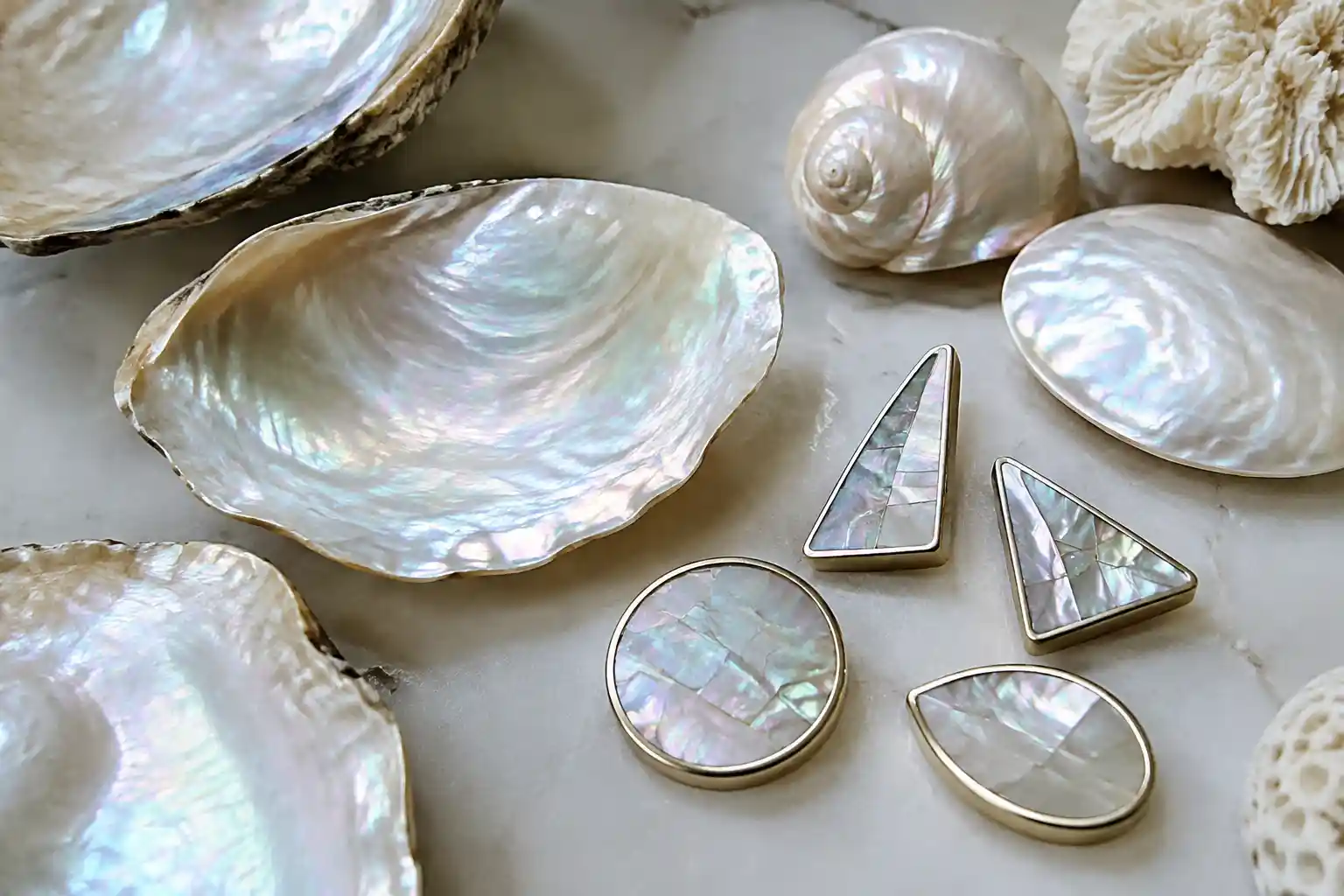
Mother of Pearl benefits begin with a biological structure rather than a conventional mineral crystal. Mother of Pearl, also called nacre, is the smooth iridescent substance lining the inner shell of certain mollusks. It is built from extremely thin calcium carbonate platelets, commonly aragonite in nacreous shells, combined with an organic matrix. The way these layers are stacked gives the surface its soft luster and shifting flashes of white, cream, silver, pink, green, blue, and other spectral colors.
That layered construction distinguishes Mother of Pearl from a pearl even though both can contain nacre. Mother of Pearl forms as part of the shell itself, while a natural or cultured pearl develops as a separate body inside a mollusk. This relationship explains their similar luster, softness, and sensitivity to acids and harsh treatment, but the two should not be treated as interchangeable gemstone categories.
Mother of Pearl benefits extend through jewelry, buttons, decorative inlay, musical instruments, boxes, furniture details, carved ornaments, watch dials, handles, and artistic objects. Its biological origin, iridescent appearance, and long decorative history have also encouraged symbolism involving protection, family, nurturing, calmness, purity, resilience, and connection with the sea. Those themes can carry cultural or personal meaning without implying that nacre medically affects emotions, hormones, digestion, fertility, or other bodily systems.
10 Mother of Pearl Benefits at a Glance
- Iridescent nacre creates shifting colors that change with lighting and viewing angle.
- Thin pieces can be shaped into jewelry, inlays, buttons, mosaics, and decorative details.
- Biological shell structure provides educational value for understanding biomineralization.
- Nacre connects naturally with pearl formation while remaining a distinct shell substance.
- White, cream, pink, silver, gray, and darker varieties support many design styles.
- Historical decorative use gives Mother of Pearl important artistic and cultural value.
- Lightweight shell sections can create large visual surfaces without the weight of many stone gems.
- Modern symbolism can connect Mother of Pearl with protection, family, patience, nurturing, and adaptability.
- Personal keepsakes can acquire meaning through relationships, travel, heirlooms, or maritime memories.
- Gentle care can preserve luster for years when the surface is protected from scratching, acids, heat, and harsh chemicals.
Iridescence Is the Most Visible Mother of Pearl Benefit
The most immediate Mother of Pearl benefit is its shifting optical appearance. A polished shell surface may look white or cream from one position and then reveal pink, green, blue, silver, or golden flashes when moved under light. This effect gives even a thin piece of nacre considerable visual complexity.
The color play comes from structure rather than pigment alone. Nacre is built from microscopic layers of calcium carbonate separated and bound by organic components. Light reflects from multiple internal boundaries, and interference between those reflections produces the characteristic iridescent appearance.
Because layer thickness and orientation vary, different shell species and even different areas of one shell can display different optical effects. Some pieces show soft silvery orient, while others reveal strong pink, green, or blue flashes.
This makes Mother of Pearl especially effective in jewelry and decorative art where movement is frequent. Earrings, pendants, watch dials, buttons, and inlays can look subtly different throughout the day as light changes.
Biological Nacre Makes Mother of Pearl Scientifically Interesting
Another important Mother of Pearl benefit is educational. Unlike quartz, corundum, or beryl, nacre is produced biologically by a mollusk. The animal’s mantle tissue secretes the substances that form the inner shell layers, creating a highly organized composite structure.
The calcium carbonate component provides hardness and rigidity, while organic components help bind the microscopic layers together. This combination creates a biological composite whose strength and optical appearance cannot be understood simply by considering calcium carbonate alone.
Mother of Pearl therefore provides a useful example of biomineralization, the process through which living organisms produce mineralized structures. Shells, teeth, bones, and several other biological structures demonstrate related principles, although their chemistry and architecture differ.
For students interested in biology, mineralogy, marine science, or materials engineering, nacre shows how living organisms can build remarkably complex structures from relatively simple chemical components.
Jewelry and Inlay Use Make Nacre Highly Versatile
Mother of Pearl has been used in jewelry and decorative work because thin shell sections can be sawn, carved, polished, drilled, and fitted into intricate designs. Pendants, earrings, brooches, rings, cufflinks, beads, buttons, watch faces, and hair ornaments can all feature nacre.
Inlay is one of its most effective uses. Thin pieces can be fitted into wood, metal, lacquer, musical instruments, boxes, furniture, knife handles, and other surfaces. The iridescence creates strong visual contrast without requiring a thick gemstone.
This design flexibility is one reason Mother of Pearl benefits artisans differently from conventional faceted gems. Its attraction comes from surface area, color play, pattern, and craftsmanship rather than brilliance from a faceted pavilion.
Pieces should still be protected from heavy impact and abrasion. Nacre is relatively soft compared with quartz, sapphire, or diamond, and a polished surface can scratch if repeatedly rubbed against harder objects.
Mother of Pearl and Pearl Share Nacre but Are Not the Same
Understanding the relationship with pearls prevents a common identification mistake. Mother of Pearl is the nacreous inner shell layer of certain mollusks. A pearl forms separately inside the animal when layers are deposited around a nucleus or other initiating structure.
Many nacreous pearls and Mother of Pearl therefore share broadly similar microscopic building components, which explains their related luster and delicate care requirements. Their form and gemological context are nevertheless different.
This relationship becomes especially useful when considering practical pearl benefits. Pearls are valued as individual rounded or irregular gems, whereas Mother of Pearl is commonly cut from shell into flat, curved, carved, or inlaid forms.
The distinction also matters when buying jewelry. A piece described as Mother of Pearl should not be represented as a pearl merely because both originate from mollusks and can contain nacre.
Color Variety Supports Many Decorative Styles
White and cream are among the most familiar Mother of Pearl colors, but nacre can show much more variation. Depending on shell species and structure, pieces may display gray, silver, pink, green, blue, gold, brown, or dark backgrounds with shifting iridescence.
Some designers prefer pale nacre because it works easily with white metals and understated jewelry. Darker shell interiors can create dramatic contrast with silver or gold, while warm cream and golden hues often suit traditional designs.
Pattern can be just as important as color. Natural growth lines, curved shell structure, patches of stronger iridescence, and slight surface differences ensure that individual pieces rarely look completely identical.
This makes Mother of Pearl especially useful for decorative objects intended to feel handcrafted rather than perfectly uniform.
Historical Craftsmanship Adds Artistic Mother of Pearl Benefits
Mother of Pearl has a long history in decorative arts across numerous regions and traditions. Craftspeople have used shell nacre in jewelry, carvings, buttons, religious objects, household items, boxes, furniture, mosaics, musical instruments, and architectural decoration.
Its usefulness came partly from availability in coastal and trading societies and partly from the visual effect achieved with thin pieces. Even a small shell section could add luminous contrast to wood, lacquer, metal, or dark backgrounds.
Historical use should still be described with cultural specificity when discussing individual societies. It is inaccurate to assume that every tradition gave nacre the same symbolic meaning merely because the substance appeared in decorative objects.
The craftsmanship itself is well established and gives Mother of Pearl benefits that do not depend on spiritual claims. Skilled cutting and inlay can transform shell into highly detailed artistic surfaces.
Lightweight Decorative Surfaces Can Create Strong Visual Impact
Another practical Mother of Pearl benefit is that nacre can cover relatively large decorative areas without requiring a thick piece. Thin shell sections can provide strong iridescence while adding comparatively little bulk.
This is useful in earrings, statement pendants, watch dials, boxes, furniture inlays, and instrument decoration. Designers can create visually prominent pieces that would be much heavier if constructed from a thick slab of dense mineral.
Thinness also creates limitations. Very thin sections need suitable backing because they may flex, crack, or chip if unsupported. Jewelry quality therefore depends not only on nacre appearance but also on construction.
A well-designed piece protects the shell while allowing enough exposed surface for the iridescence to remain visible.
Protection and Nurturing Are Common Symbolic Themes
Modern Mother of Pearl benefits frequently include symbolism involving protection, nurturing, family, patience, and emotional gentleness. The shell origin makes these themes intuitive because a shell physically protects the living mollusk within it.
The symbolism can be meaningful without assuming an energetic mechanism. A parent might give Mother of Pearl jewelry to represent care for a child. A family heirloom may symbolize continuity across generations. Someone with a strong connection to the sea may associate nacre with home or travel.
These ideas are more defensible as metaphor than as medical claims. The shell provides a real example of biological protection, while humans extend that idea into emotional symbolism.
The detailed Mother of Pearl meaning can therefore include protection as a personal or cultural theme without claiming that nacre physically shields a wearer from illness or negative energy.
Maritime Memories and Heirlooms Can Create Personal Meaning
Objects often gain importance because of where they came from or who owned them. Mother of Pearl is especially suited to this because its shell origin naturally connects it with oceans, coasts, fishing communities, maritime trade, and travel.
A pendant purchased near the sea may become a memory of a journey. Vintage buttons inherited from a relative can carry family history. An old musical instrument with nacre inlay may be valued for craftsmanship and personal associations far beyond the commercial price of the shell.
This type of meaning develops through experience rather than standardized crystal symbolism. It can therefore be highly specific and emotionally durable.
A piece may represent family to one owner, artistic craftsmanship to another, and marine biology to someone else. None of those interpretations requires a supernatural claim.
Mother of Pearl Needs Gentle Care
Mother of Pearl is beautiful but relatively soft. Harder gemstones, abrasive dust, rough cloths, and repeated friction can scratch or dull a polished surface.
Acids and strong chemicals are especially inappropriate because calcium carbonate is chemically vulnerable to acidic substances. Perfume, hairspray, cosmetics, household cleaners, and aggressive jewelry solutions should therefore be kept away from nacre whenever possible.
A soft damp cloth is usually suitable for routine cleaning. Mild soapy water can be used carefully for uncomplicated pieces, followed by gentle drying. Long soaking is unnecessary, particularly when jewelry contains adhesives, stringing, porous backing, or other components.
Steam and ultrasonic cleaners should generally be avoided. Storage in a soft pouch or separated jewelry compartment reduces contact with harder gems.
Mother of Pearl Benefits Do Not Include Proven Medical Effects
Mother of Pearl benefits do not include scientifically established treatment for anxiety, depression, digestive illness, fertility problems, hormonal conditions, pregnancy concerns, inflammation, skin disease, or other medical problems.
Calcium carbonate in nacre also does not function as a calcium supplement through ordinary skin contact. The fact that calcium is part of the shell’s composition should not be used to imply nutritional benefit.
Spiritual practices may associate Mother of Pearl with calmness, protection, feminine energy, intuition, or emotional balance. These ideas belong to symbolic or cultural traditions rather than demonstrated clinical effects.
The substance already offers substantial real value through biological structure, optical beauty, decorative versatility, historical craftsmanship, and personal symbolism.
Conclusion
Mother of Pearl benefits include natural iridescence, fascinating nacre structure, jewelry and inlay versatility, artistic history, lightweight decorative use, biological education, and strong personal symbolism. Its beauty comes from microscopic calcium carbonate layers and organic components built by mollusks rather than from a conventional mineral crystal.
Protection, family, nurturing, patience, and connection with the sea are understandable symbolic themes when presented as interpretation. Gentle care is essential because nacre is relatively soft and sensitive to acids, abrasion, heat, and harsh chemicals. Its real beauty and cultural importance do not require medical claims.
FAQs
What are the main Mother of Pearl benefits?
The strongest Mother of Pearl benefits include beautiful iridescence, decorative versatility, jewelry use, inlay potential, biological interest, historical craftsmanship, and personal symbolism. Modern traditions also associate nacre with protection, family, nurturing, patience, and emotional gentleness, but these are symbolic rather than medically established effects.
What is Mother of Pearl made of?
Mother of Pearl is nacre produced by certain mollusks. It consists mainly of microscopic calcium carbonate platelets, commonly aragonite, arranged with an organic matrix. This layered biological structure creates the characteristic luster and iridescent color seen across polished shell surfaces.
Is Mother of Pearl the same as pearl?
No. Mother of Pearl is the nacreous layer lining the inside of certain mollusk shells. A pearl is a separate rounded, irregular, or shaped body that forms within a mollusk. Both can contain nacre, which explains their similar luster, but they are different gem products.
Why does Mother of Pearl show rainbow colors?
Microscopic layers within nacre interact with light. Reflections from closely spaced layers interfere with one another, producing shifting spectral colors as the viewing angle changes. The effect depends on nacre structure, layer spacing, shell species, orientation, and lighting.
Is Mother of Pearl suitable for jewelry?
Yes, particularly in earrings, pendants, brooches, cufflinks, beads, watch dials, and protected ring designs. The surface is softer than quartz and many conventional gemstones, so jewelry should be protected from abrasion and hard impact. Good construction is especially important for thin shell sections.
Can Mother of Pearl be used for inlay?
Yes. Inlay is one of its classic decorative uses. Thin nacre pieces can be fitted into wood, lacquer, metal, musical instruments, boxes, furniture, and other objects. Its intense iridescence provides visual impact even when only a thin section is used.
Does Mother of Pearl symbolize protection?
Protection is a common symbolic interpretation because the shell physically protects a mollusk. People may extend that biological role into themes of family, care, boundaries, and nurturing. There is no scientific evidence that nacre creates an invisible protective field around a wearer.
Is Mother of Pearl easy to scratch?
Yes. Nacre is relatively soft compared with quartz, sapphire, or diamond and can become scratched or abraded through rough wear. Keeping it separate from harder jewelry and wiping the surface with a soft cloth helps preserve its luster.
How should Mother of Pearl be cleaned?
Gentle cleaning is best. A soft damp cloth and, when appropriate, a small amount of mild soap are usually sufficient. Acids, abrasive products, steam, ultrasonic cleaning, perfumes, harsh household chemicals, and prolonged soaking should be avoided.
Does Mother of Pearl have healing powers?
There is no established scientific evidence that Mother of Pearl diagnoses, treats, cures, or prevents physical or mental-health conditions. Claims involving emotional healing, fertility, digestion, hormonal balance, protection, or calming energy belong to spiritual or cultural interpretations rather than established medicine.
Mother of Pearl benefits involving healing energy, emotional balance, protection, fertility, or physical wellness reflect cultural, personal, or spiritual interpretations and should not replace qualified physical or mental-health care.