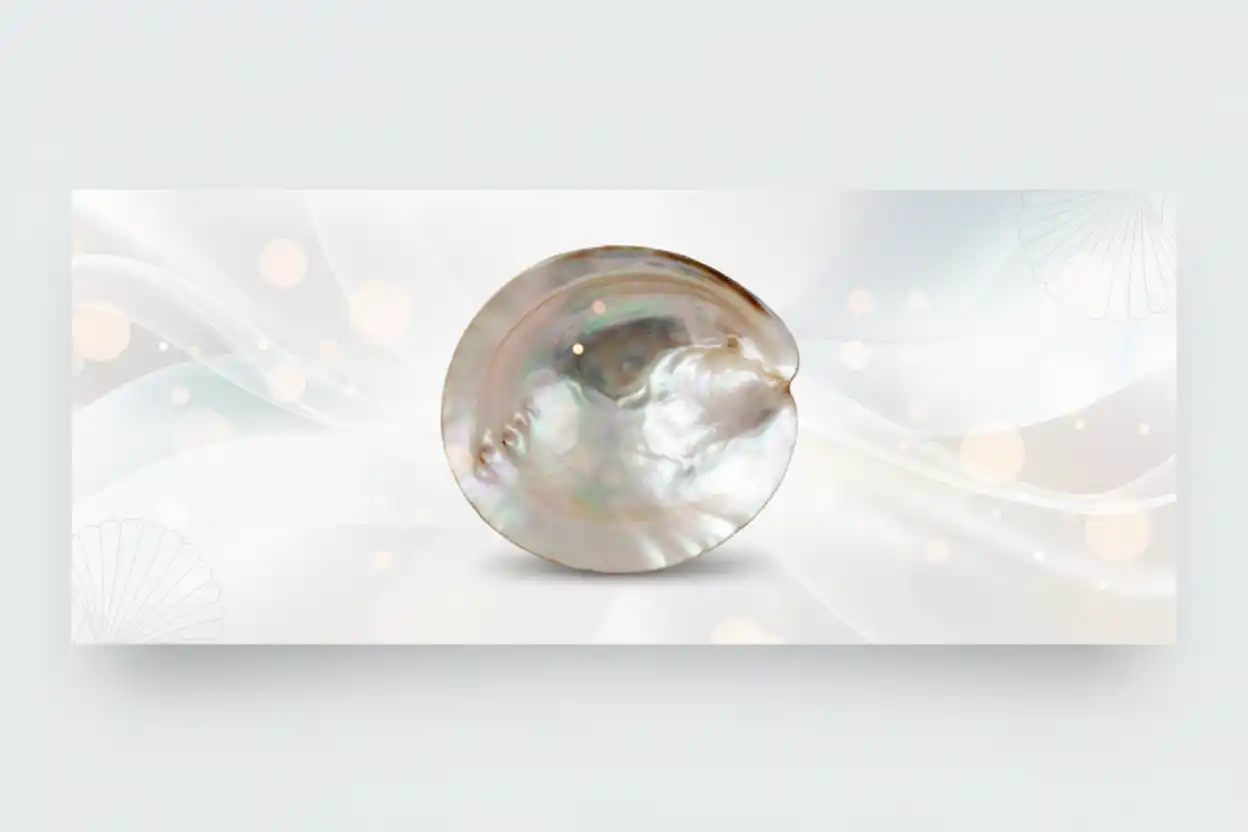
Mother of Pearl: Meaning, Properties & Symbolism
Mother of pearl is the smooth, often iridescent inner shell layer called nacre that certain mollusks produce. It appears in pearl oysters, freshwater mussels, abalone, trochus, turbo shells, nautilus, and several other nacre-forming species.
Unlike a mineral crystal, mother of pearl is a biological composite. It consists mainly of microscopic calcium-carbonate platelets bound together by an organic matrix, creating a layered material that combines luminous color with greater toughness than its brittle mineral component would have alone.
Mother of Pearl at a Glance
| Property | Mother of pearl |
|---|---|
| Material type | Biogenic organic-inorganic composite and organic gem material |
| Scientific term | Nacre |
| Main composition | Predominantly aragonite calcium carbonate with an organic protein-polysaccharide matrix; minor components vary by species |
| Common colors | White, cream, silver, pink, golden, gray, brown, green, blue, black, and multicolored |
| Crystal system | No single system applies to the composite; the principal aragonite platelets are orthorhombic |
| Structure | Thin mineral platelets arranged in layered biological architecture |
| Luster | Pearly and iridescent |
| Transparency | Translucent in thin sections to opaque |
| Mohs hardness | Variable, commonly around 2.5–4 depending on species, layer structure, and testing direction |
| Cleavage | No single cleavage for the composite; thin layers can delaminate |
| Tenacity | Comparatively tough for a shell material but vulnerable to scratching, peeling, and impact |
| Common uses | Cabochons, beads, inlay, buttons, watch dials, carvings, instrument decoration, jewelry, and decorative arts |
| Main care concern | Acids, cosmetics, perfume, heat, dryness, scratches, delamination, dye, and glued construction |
Mother of Pearl Is Nacre
Nacre is the technical name for the iridescent inner layer of certain mollusk shells. Mother of pearl is its established decorative and gem-trade name.
Not every shell produces nacre. Many mollusks create other forms of calcium-carbonate shell structure that may be porcelain-like, fibrous, crossed-lamellar, or non-iridescent.
Mother of pearl belongs to the organic and biogenic materials included in the broader types of gemstones guide. Calling it organic does not mean that most of its mass is organic matter; the term reflects its production by a living organism.
Its dominant mineral component is usually aragonite, CaCO₃. However, the finished nacre layer also contains proteins, polysaccharides, water, pigments, and trace components that vary between species.
Therefore, mother of pearl should not be assigned one false crystal system or the properties of a single aragonite crystal.
How Mollusks Form Nacre
A mollusk’s mantle tissue secretes the materials that build its shell. In nacre-forming species, the inner surface grows through repeated deposition of microscopic calcium-carbonate platelets and very thin organic layers.
The platelets overlap in a brick-and-mortar arrangement. Aragonite forms the “bricks,” while the biological matrix separates, binds, and helps organize the layers.
This architecture improves fracture resistance. A crack must change direction, cross interfaces, or pull layers apart rather than moving freely through one brittle crystal.
Growth lines record changes in the organism’s environment, health, age, and shell-building activity. Consequently, color, thickness, and surface quality can vary across one shell.
Once removed from the living mollusk, mother of pearl no longer repairs itself. Cutting and polishing must therefore preserve enough thickness to retain both structural stability and iridescence.
Why Mother of Pearl Is Iridescent
Mother of pearl’s shifting colors result primarily from the interaction of light with its layered microstructure.
Incoming light reflects from several closely spaced layers. Some reflected wavelengths reinforce one another, while others partially cancel, producing colors that change with the viewing angle.
Platelet thickness, spacing, orientation, surface curvature, pigments, and the observer’s angle all influence the effect. That is why one white cabochon can flash pink and green while another shows silver, blue, or gold.
This phenomenon is structural coloration rather than ordinary pigment alone. Surface polishing strengthens the visible effect by allowing light to enter and return cleanly.
A thick coating or poor polish can mute orient. Conversely, a very thin shell piece may appear translucent and show strong color over a dark backing.
Mother of Pearl and Pearl
Mother of pearl and pearl contain closely related material, but they form in different shapes and locations.
Mother of pearl lines part of the shell’s interior. A pearl forms as a separate body within the mollusk when tissue deposits nacre or another shell material around a nucleus, irritant, or pearl sac.
Many cultured saltwater pearls develop around a round mother-of-pearl bead nucleus. Freshwater cultured pearls are commonly tissue-nucleated, although production methods vary.
The dedicated pearl guide owns pearl formation, natural-versus-cultured terminology, pearl structure, value factors, and symbolism.
A flat or curved shell cabochon should not be sold simply as a pearl. Likewise, a round bead cut directly from shell is a mother-of-pearl bead, not a cultured pearl.
The types of pearl guide explains Akoya, South Sea, Tahitian, and freshwater categories without merging them into shell inlay.
Sources and Mother-of-Pearl Types
White and silver mother of pearl commonly comes from pearl oysters and freshwater mussels. These materials support beads, buttons, inlay, carvings, and pale cabochons.
Black-lip pearl oysters produce gray, silver, charcoal, green, and multicolored nacre. The appearance depends on shell area, thickness, polishing, and backing.
Gold-lip shells can show cream, yellow, and golden tones. However, a bright uniform gold surface may also be dyed or coated.
Freshwater mussel shell is often white to pale cream and has historically supplied buttons and bead nuclei for cultured pearls.
Abalone produces some of the strongest blue, green, purple, pink, and turquoise iridescence. Its distinctive structure and commercial forms are covered in the abalone shell guide.
Trochus and turbo shells provide white, silver, or subtly colored nacre used in buttons, mosaics, jewelry, and instrument decoration.
The detailed source and color distinctions belong on the dedicated types of mother-of-pearl guide.
Natural Colors
White mother of pearl is rarely a flat paper white. It may show cream, silver, pink, green, blue, or golden flashes under moving light.
Gray and black shell can contain green, purple, bronze, or peacock-like colors. A dark backing often intensifies these effects.
Abalone-derived material has a naturally stronger multicolor appearance, although vivid blue or green shell products may still be dyed.
Pink mother of pearl may come from naturally colored shell, surface orientation, backing, or treatment. The same caution applies to bright red, cobalt blue, purple, and neon green.
Color should be evaluated in neutral lighting from several angles. A photograph taken under one direct light can exaggerate orient or hide a flat, chalky surface.
How to Identify Mother of Pearl
Natural mother of pearl normally shows a layered or subtly rippled structure under magnification. Fine growth lines, small pits, color variation, and changes in iridescence may appear across the surface.
The back can reveal the curved shape, darker exterior layer, or internal architecture of the original shell. However, many cabochons are backed with metal, resin, stone, or another shell piece.
Mother of pearl feels comparatively light. It is softer than glass and many gemstones, although scratch testing damages the surface and should not be used on finished jewelry.
Under strong light, thin pieces may appear translucent. Their orient changes continuously rather than remaining as a printed patch.
Plastic imitations may show molding seams, uniform color, low density, scratches, or repeated patterns. Some plastics imitate nacre convincingly, so one visual clue is not conclusive.
Glass imitations are usually harder, more uniformly vitreous, and may contain round bubbles. Composite shell can contain real nacre fragments held in resin.
The same analytical tools used to examine real versus fake pearls can help with shell products, although mother-of-pearl construction requires its own interpretation.
Professional testing may use microscopy, Raman spectroscopy, X-ray diffraction, fluorescence, chemical analysis, and imaging of layered structure.
Mother of Pearl, Abalone, and Other Organic Gems
Abalone shell is a type and source of mother of pearl, not a completely unrelated gem. Its vivid blue-green-purple orient gives it a distinct retail identity.
Coral is also produced biologically, but it consists of a different skeletal material and structure. It does not have nacre’s layered iridescence.
Fossil coral has undergone mineral replacement and should not be treated as fresh organic coral or shell.
Amber is fossilized plant resin, while jet is an organic-rich fossil material derived from wood. Their chemistry, hardness, formation, and treatments differ substantially from nacre.
These comparisons matter because “organic gemstone” describes origin, not one shared composition or care method.
Jewelry Suitability
Mother of pearl works well in earrings, pendants, brooches, cufflinks, watch dials, beads, and protected inlay.
Rings and bracelets experience more scratching, impact, water, and chemical exposure. A bezel or recessed inlay offers better protection than an exposed domed piece.
Thin shell can crack when a setting is tightened unevenly. Meanwhile, layered pieces can peel if an edge remains unsupported.
A dark backing may enhance orient, but it can also conceal thin shell, glue, repairs, or assembled construction. Buyers should ask whether the item is solid shell, backed shell, doublet, mosaic, or composite.
The material’s modest position on the gemstone hardness chart explains its susceptibility to abrasion. However, its layered architecture gives it more fracture resistance than a simple hardness number suggests, as discussed in gemstone toughness versus hardness.
Mother of pearl is appropriate for frequent wear when the design protects it and the wearer keeps it away from chemicals and rough contact.
Treatments and Assembled Products
Bleaching can lighten or even out natural shell color. Properly performed bleaching may be difficult to detect without laboratory testing.
Dyeing produces pink, red, blue, green, purple, black, and other fashionable colors. Dye may collect in pores, cracks, drill holes, or growth layers.
Coatings and lacquer can intensify shine, alter color, seal the surface, or protect printed designs. Over time, a coating may scratch, yellow, peel, or separate.
Waxing and oiling can improve short-term luster. However, excess material may collect around drill holes and carved recesses.
Backing with dark resin, shell, glass, stone, or metal can strengthen thin nacre and deepen orient. This construction is not inherently deceptive when disclosed.
Composite or reconstituted mother of pearl combines shell pieces, flakes, or powder with resin. Printed or laser-patterned material may then imitate natural mosaic work.
The gemstone treatment guide explains coating, filling, dyeing, backing, and composite construction in broader context.
Pearl-specific treatments such as bleaching, dyeing, coating, irradiation, filling, and luster enhancement are covered separately in the treated-pearl guide.
Current Mother-of-Pearl Asking Prices
Mother of pearl itself is usually affordable. Finished value comes mainly from species, color, carving, thickness, matching, metal, craftsmanship, age, and maker.
| Mother-of-pearl product | Broad retail asking range |
|---|---|
| Small flat cabochon | About $2–$15 |
| Larger or strongly iridescent cabochon | About $10–$40 |
| Common bead strand | About $5–$30 |
| Carved bead or focal component | About $10–$60 |
| Simple fashion pendant or earrings | About $20–$100 |
| Sterling-silver jewelry | About $40–$250 |
| Gold jewelry | About $200–$1,500 or more |
| Small inlaid box, handle, or decorative object | About $25–$300 |
| Fine carved panel or detailed mosaic work | About $100–$1,000 or more |
| Signed antique or designer object | Highly variable |
These figures represent broad July 2026 asking prices rather than appraisals. A luxury brand, antique provenance, precious metal, or intricate inlay can raise the price far above the value of the shell alone.
Value Factors
Orient and luster create the first impression. Strong shifting color over a smooth surface usually attracts more interest than chalky or weakly reflective shell.
Thickness affects durability. Thin pieces can still be beautiful, but they require backing and careful setting.
Color rarity depends on species and natural origin. Vivid untreated abalone or dark pearl-oyster shell may command more than common white freshwater material.
Matching raises the value of earrings, cufflinks, buttons, and repeated inlay. Natural shell varies enough that close pairs require careful cutting.
Carving quality also matters. Crisp detail without chipped edges, peeling layers, or visible adhesive indicates skilled work.
Condition includes scratches, acid etching, dryness, cracks, delamination, glue failure, and coating wear. Surface damage can permanently reduce orient.
Finally, documentation may matter when the shell comes from a regulated, protected, vintage, or regionally significant source.
Buying Mother of Pearl
Ask what mollusk or shell type supplied the material. A seller may not know the exact species, but “white pearl oyster shell,” “freshwater mussel,” or “abalone” is more informative than “ocean gemstone.”
Confirm whether the piece is solid shell, backed, assembled, laminated, reconstituted, or resin-coated. Construction strongly affects price and care.
Inspect color under neutral lighting. Dye often looks unnaturally uniform, particularly around drill holes and edges.
Check for peeling, open layers, cracks, cloudy glue, and chipped corners. Thin inlay should sit flush rather than projecting above the surrounding metal or wood.
Repeated identical patterns can indicate printed composite material. Natural orient should change with viewing angle rather than remain fixed like metallic paint.
Responsible sourcing also deserves consideration. Shell species, fisheries rules, wildlife regulations, and export requirements differ by origin. A seller should not make broad “sustainable” claims without traceability.
Mother of pearl appears in both the crystals beginning with M directory and the gemstones beginning with M directory, although it is an organic composite rather than a crystal.
Cleaning and Storage
Wipe mother of pearl after wear with a soft, slightly damp cloth. This removes perfume, skin oils, cosmetics, and perspiration before they remain on the surface.
For deeper cleaning, use lukewarm water and a small amount of mild soap. Work quickly with a soft cloth or brush, then dry the item completely.
Do not soak assembled jewelry. Water can weaken glue, enter laminated layers, or become trapped behind a backing.
Avoid vinegar, lemon juice, acidic jewelry cleaner, bleach, ammonia, alcohol, hairspray, and perfume. Acids react with calcium carbonate, while solvents may affect coatings and adhesives.
Steam and ultrasonic cleaners are unsuitable. Heat, vibration, and pressure changes can crack thin shell or loosen inlay.
Store each piece in a soft pouch away from harder gemstones. Avoid airtight exposure to extreme heat and dryness for long periods, particularly with antique or delicate shell.
The broader water-safety guide provides context, but nacre’s coatings, glue, backing, and biological structure justify conservative handling.
Mother-of-Pearl Meaning and Symbolism
Mother of pearl has long been valued for luminosity, protection, craftsmanship, and its association with water and living shells.
Modern spiritual traditions often connect it with calm communication, emotional balance, adaptability, nurturing, and sensitivity to changing circumstances.
Its layered construction has also inspired symbolism involving resilience: delicate individual components can create a stronger whole when arranged together.
White material may symbolize simplicity or renewal, while multicolored abalone nacre is commonly associated with creativity, movement, and personal expression.
These meanings remain cultural, artistic, spiritual, or personal. Scientific evidence does not show that mother of pearl regulates emotions, protects against illness, or produces guaranteed energetic effects.
Frequently Asked Questions
Is mother of pearl a mineral?
No. It is a biological composite made mainly from aragonite platelets and an organic matrix produced by certain mollusks.
Is mother of pearl the same thing as a pearl?
No. Mother of pearl forms as part of the shell lining, while a pearl forms as a separate body within mollusk tissue.
Which animals produce mother of pearl?
Pearl oysters, freshwater mussels, abalone, trochus, turbo shells, nautilus, and several other mollusks produce nacre.
Why does mother of pearl change color?
Light reflects from its microscopic layers and interferes at different wavelengths, creating angle-dependent iridescence.
What colors occur naturally?
Natural nacre can be white, cream, silver, pink, gold, gray, green, blue, brown, black, or multicolored, depending on species and shell area.
Is white mother of pearl always bleached?
No. Many shells produce naturally pale nacre, although bleaching may be used to lighten or even out the color.
How can I distinguish mother of pearl from plastic?
Natural shell usually shows changing orient, fine growth structure, irregular variation, and layered edges. Plastic may show molding seams, repeated patterns, or fixed pearlescent color.
Can mother of pearl be worn in a ring?
Yes, but recessed inlay or a protective bezel is preferable. Exposed shell scratches more readily than most ring stones.
Can mother of pearl get wet?
Brief gentle washing is generally acceptable. Prolonged soaking is unsuitable for glued, backed, coated, dyed, or laminated pieces.
Why does mother of pearl scratch easily?
Its calcium-carbonate component is relatively soft. Hard dust, metal edges, and other gemstones can abrade the polished surface.
Is mother-of-pearl jewelry always ethically sourced?
No. Sustainability and legality depend on species, fishery, origin, processing, and traceability. Buyers should request credible sourcing information.
What makes mother of pearl valuable?
Strong orient, natural color, thickness, species, matching, carving, condition, treatment disclosure, craftsmanship, precious metal, and provenance all affect value.
Mother of pearl retains its best luster when cleaning remains gentle and chemical-free. Detailed instructions for glued inlay, beads, settings, and delicate antique pieces are provided in the mother-of-pearl jewelry cleaning guide.
Cutting, drilling, or grinding shell produces fine calcium-carbonate and organic dust that can irritate the eyes and respiratory system. Use wet-working methods, effective dust extraction, eye protection, and suitable respiratory protection, and verify any additional hazards associated with coatings or backing materials.