Nuummite Healing Properties: 12 Claims, Greenland Geology & Safe Use
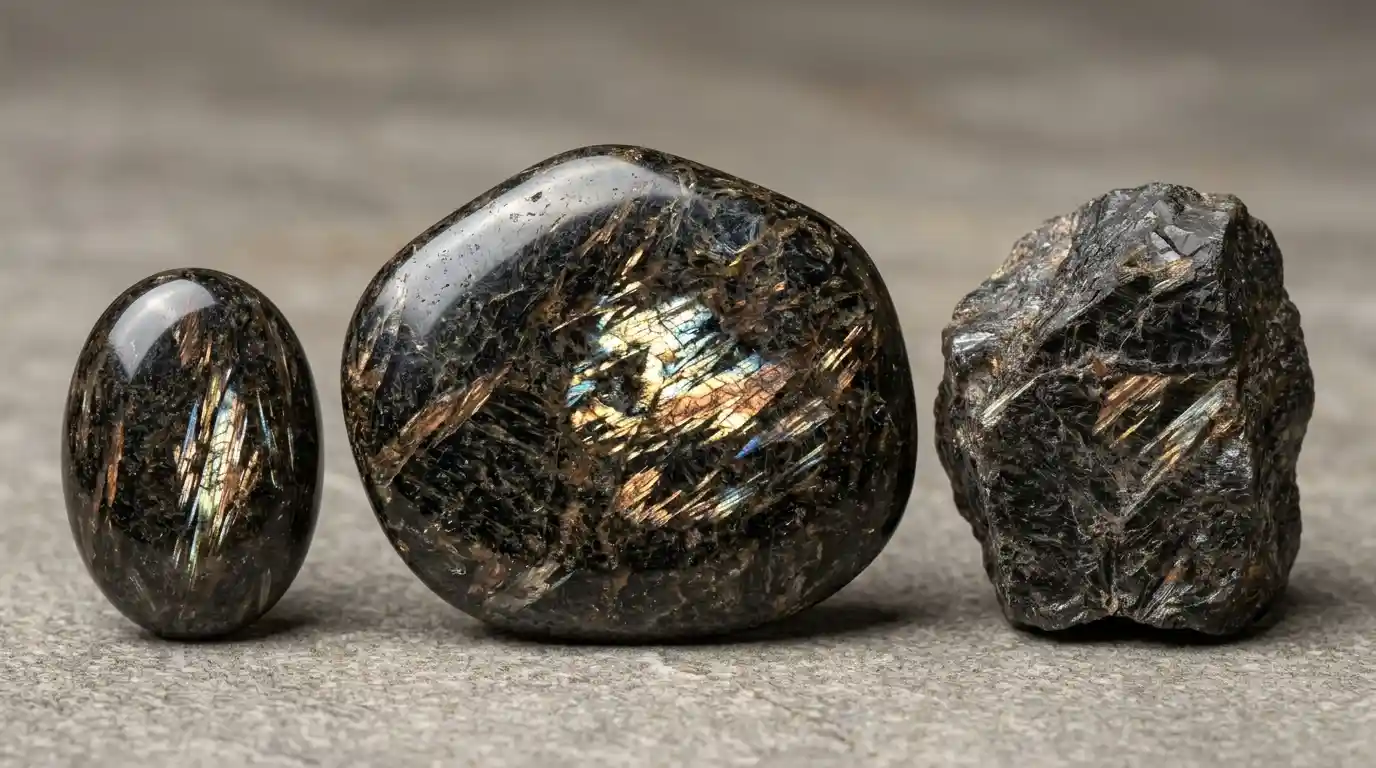
Nuummite healing properties are commonly associated with grounding, emotional protection, concentration, confidence, courage, boundaries, resilience, intuition, self-reflection, personal change, meditation, and spiritual awareness. Its dark gray to black appearance can reveal narrow flashes of gold, bronze, blue, green, or violet when polished and turned under light, creating an easy visual connection with ideas about hidden strength and inner discovery. Those optical effects do not establish a therapeutic mechanism. Nuummite has not been demonstrated to treat anxiety, depression, trauma, fatigue, pain, inflammation, neurological disease, sleep disorders, or another medical condition, and there is no evidence that its ancient geological age gives it stronger healing energy. Scientifically, Nuummite is not a single mineral species. It is an iridescent metamorphic rock from Greenland composed mainly of intergrown orthoamphiboles in the anthophyllite-gedrite series, with microscopic exsolution structures responsible for its characteristic flash.
12 Nuummite Healing Claims
- Grounding and present-moment awareness
- Emotional protection and boundaries
- Concentration and sustained focus
- Confidence during uncertainty
- Courage in difficult situations
- Resilience after setbacks
- Intuition and reflective judgment
- Self-reflection and pattern awareness
- Personal transformation and change
- Emotional steadiness under pressure
- Meditation and focused attention
- Spiritual awareness and inner direction
These twelve themes can support different personal practices without becoming twelve scientifically proven effects. Many Nuummite benefits become more useful when translated into actions such as reducing distractions, reviewing evidence before a decision, enforcing a boundary, documenting recurring patterns, or deliberately changing one behavior.
Nuummite Geology and Composition
Nuummite is a rock rather than an individual mineral species. The name is applied to dark iridescent orthoamphibole-rich rock from the Nuuk region of Greenland, especially stone containing anthophyllite and gedrite. These amphiboles occur together in elongated crystals and extremely fine internal lamellae.
The iridescence is one of Nuummite’s defining verified features. Alternating submicroscopic layers of anthophyllite and gedrite formed through exsolution within the amphibole crystals. When light strikes these internal structures at suitable angles, selected wavelengths are reflected and interfere with one another, producing metallic-looking flashes.
Golden and bronze colors are especially characteristic of Greenland Nuummite, while blue, greenish, and violet flashes can also occur. The effect is directional. A polished cabochon may look nearly black from one angle and suddenly show bright streaks when tilted.
Nuummite can also contain accessory minerals including pyrrhotite, chalcopyrite, magnetite, ilmenite, biotite, quartz, feldspar, garnet, and others depending on the occurrence. Because the stone is a rock composed of several phases, assigning it one exact chemical formula or crystal system is inaccurate.
The amphibole components themselves are orthorhombic minerals. Anthophyllite is magnesium-rich, while gedrite contains more aluminum and variable iron. Their intergrowth is responsible for much of the gemstone’s structure and optical character.
Nuummite is generally around Mohs 5.5 to 6 in practical gem use. It is therefore softer than quartz, topaz, sapphire, ruby, and diamond. Different mineral grains and directions can behave somewhat differently, so polished pieces require protection from abrasion.
Nuummite Age and Greenland Origin
Nuummite is often marketed as one of the world’s oldest gemstones, and there is real geology behind that description. The Nuummite-bearing rocks near Nuuk occur within very old Precambrian terranes, including units more than three billion years old. Detailed work on Simiuttat material places important stages of the amphibole rock’s history in the Archean.
This extraordinary age describes geological formation, not a three-billion-year history of human spiritual practice. Humans did not exist when these rocks formed.
Historical specimens from the Nuuk area were collected by Greenland explorer and mineralogist Karl Ludwig Giesecke in the early nineteenth century. The commercial gemstone identity came much later. Peter W. Uitterdijk Appel introduced the name Nuummite in the early 1980s, deriving it from Nuuk, and the iridescent rock was subsequently developed as a Greenlandic gemstone.
That timeline is important because claims that ancient civilizations practiced a specific Nuummite healing tradition are not supported by the naming and gemological history. Modern metaphysical symbolism developed after the gemstone entered contemporary trade.
The Nuummite meaning associated with protection, inner strength, ancient wisdom, and transformation can still be meaningful in personal practice, but those ideas should be presented as modern symbolism rather than archaeological fact.
Grounding and Protection
Grounding Through Sensory Focus
Nuummite is frequently described as strongly grounding because of its dark bodycolor and dense appearance. The stone does not electrically anchor the body to the Earth or regulate the nervous system through an invisible field. It can still work as a tactile focus object. Notice its weight, temperature, polished surface, changing flashes, breathing rhythm, and immediate surroundings. The useful effect comes from deliberately returning attention to present sensory information.
Emotional Protection Through Boundaries
Protection is one of Nuummite’s most common metaphysical themes. There is no evidence that amphibole-rich rock absorbs hostility or creates an energetic shield around the wearer. A more practical interpretation connects protection with boundaries: decide which requests you will decline, what behavior you will not accept, and when removing yourself from an interaction is necessary.
Focus, Confidence, and Courage
Concentration Through Routine
Nuummite is often used in work or meditation spaces for concentration. It has not been shown to increase attention span or memory through mineral contact. A useful routine is to place the stone beside one active task, remove unrelated notifications, and work for a defined period before switching activities.
Confidence During Uncertainty
The sudden flash that appears within an otherwise dark stone has encouraged symbolism around hidden ability or confidence. Nuummite cannot biologically increase self-esteem. Before entering an uncertain situation, use it as a reminder to identify what has already been prepared, what remains unknown, and what first action can still be taken.
Courage in Difficult Situations
Some crystal traditions connect Nuummite with courage and personal power. A stone cannot eliminate fear or make a genuinely unsafe situation harmless. A practical courage ritual involves identifying the actual risk, reducing what can reasonably be reduced, and taking the necessary next step when the action remains appropriate.
Resilience, Intuition, and Reflection
Resilience After Setbacks
Nuummite’s survival through immense geological time naturally encourages themes of endurance. The rock cannot make someone psychologically resilient through contact. After disappointment, use it as a cue to separate what cannot be changed from what remains possible, identify one useful lesson, and decide how the next attempt should differ.
Intuition With Evidence
Nuummite is sometimes described as enhancing intuition or revealing hidden truths. There is no evidence that it provides extrasensory information. A grounded practice is to record an initial instinct about a choice and then compare it with evidence, realistic consequences, uncertainty, and reversibility. Intuition becomes one source of information rather than unquestioned certainty.
Self-Reflection and Pattern Awareness
Dark stones are often used for introspective practices, and Nuummite is no exception. The rock cannot uncover subconscious information automatically. Keeping it beside a journal can still create a repeatable cue to track triggers, reactions, assumptions, and repeated behavior. Patterns become visible through observation.
Change and Emotional Steadiness
Personal Transformation Through Action
Nuummite is frequently marketed as a transformation stone because of its ancient geology and dramatic hidden iridescence. It cannot force relationships, careers, beliefs, or identities to change. A useful ritual is to choose one behavior that no longer produces the desired result and replace it with one specific action that can be repeated.
Emotional Steadiness Under Pressure
Some users describe Nuummite as stabilizing intense emotions. It has not been shown to regulate cortisol, neurotransmitters, or heart rate through mineral contact. It can instead serve as a reminder to delay an immediate reaction, slow the breathing, and separate known facts from interpretations before responding.
Meditation and Spiritual Awareness
Meditation With Iridescence
Nuummite’s directional flash can make it an engaging meditation object. A practitioner can slowly tilt the stone, observe how iridescence appears and disappears, notice when attention wanders, and return to the visual effect or the breath. This is a valid focus exercise without demonstrating that the stone alters consciousness through a special frequency.
Spiritual Awareness and Direction
Modern metaphysical traditions often connect Nuummite with deep spiritual insight, ancestral themes, or ancient wisdom. Geological age does not mean a rock stores human knowledge. Someone can still use it while reflecting on personal values, responsibilities, long-term direction, or the scale of geological time without turning those reflections into claims of supernatural communication.
Nuummite Chakra Meaning
Nuummite is most commonly associated with the root chakra in contemporary crystal practice because of its dark color and grounding reputation. Some practitioners also connect its golden and blue flashes with solar plexus, third-eye, or crown themes involving confidence, insight, and spiritual awareness.
Chakras are a spiritual framework rather than anatomical structures. Nuummite has not been demonstrated to affect the spine, adrenal glands, brain, pineal gland, nervous system, endocrine function, or another physiological system through chakra placement.
The gemstone’s ancient geological age may strengthen its symbolism for some users, but age does not create a measurable chakra effect.
Nuummite Care and Safety
Nuummite is moderately durable but should not be treated like quartz or sapphire. With practical hardness around Mohs 5.5 to 6, its polished surface can be scratched by quartz, topaz, corundum, diamond, and abrasive particles containing harder minerals.
Store Nuummite separately from harder gemstones, preferably in a padded compartment. Cabochons, pendants, and earrings are generally less exposed to impact and abrasion than everyday rings or bracelets.
Brief cleaning with lukewarm water and mild soap is appropriate for many sound polished pieces. Use a soft cloth rather than an abrasive brush. Long soaking is unnecessary, particularly when the stone has open fractures, surface treatments, glue, or attached metal components.
Steam and ultrasonic cleaning are poor defaults. Nuummite is an intergrowth of several minerals, and internal grain boundaries or fractures may respond differently to heat and vibration. Gentle hand cleaning provides more control.
Strong acids, harsh alkaline cleaners, bleach, abrasive powders, and aggressive jewelry dips should be avoided. They can affect individual mineral phases or degrade the polish.
Lapidary cutting and grinding create mixed silicate and amphibole dust. Wet cutting, effective extraction, eye protection, and appropriate respiratory controls are important. Nuummite should not be intentionally powdered, inhaled, or ingested for wellness purposes.
Safe Ritual Cleansing
Nuummite does not require salt, heat, chemicals, or prolonged water exposure for ritual cleansing. There is no scientifically demonstrated negative energy that must be removed from the rock.
Sound, intentional breathing, meditation, dry placement, or gently wiping the polished surface are low-risk approaches. A grounding ritual can be made practical by choosing one boundary, one task, or one decision that needs consistent action.
Avoid flame, steam, abrasive salt, aggressive chemicals, and prolonged immersion. Simple symbolic practices preserve the polished iridescence and keep spiritual use separate from unsupported physical claims.
Conclusion
Nuummite is already remarkable without assigning it an ancient healing system. It is an iridescent Greenland metamorphic rock dominated by anthophyllite-gedrite intergrowths whose submicroscopic exsolution structures produce striking golden, blue, and bronze flashes. Its twelve healing themes can support grounding, boundaries, reflection, resilience, and meditation when the useful effect comes from deliberate attention and behavior rather than an unproven therapeutic property.
FAQs
What are the main Nuummite healing properties?
Common claims include grounding, protection, concentration, confidence, courage, resilience, intuition, self-reflection, transformation, emotional steadiness, meditation, and spiritual awareness. These are contemporary wellness or spiritual beliefs rather than proven therapeutic effects.
Is Nuummite a mineral?
No. Nuummite is an iridescent metamorphic rock composed mainly of intergrown anthophyllite and gedrite amphiboles.
What causes Nuummite’s golden flash?
The iridescence comes from extremely fine alternating exsolution lamellae of anthophyllite and gedrite that interact with light.
How old is Nuummite?
The Greenland rocks containing Nuummite are Archean and can be more than three billion years old. That geological age does not imply equally ancient human healing traditions.
Where does genuine Nuummite come from?
The defining gemstone occurs around Nuuk in western Greenland, including several localities containing iridescent orthoamphibole-rich rock.
How hard is Nuummite?
Nuummite is commonly around Mohs 5.5 to 6 in gem use. It should be protected from quartz and harder stones that can scratch its polish.
Does Nuummite have ancient healing traditions?
A specific ancient Nuummite healing system is not documented. Its modern gemstone identity and trade name developed in the twentieth century.
Which chakra is Nuummite associated with?
Modern crystal practice most commonly connects Nuummite with the root chakra and sometimes with the solar plexus, third-eye, or crown chakras. These are spiritual correspondences rather than anatomical effects.
Can Nuummite go in water?
Brief cleaning with lukewarm water is generally appropriate for sound polished Nuummite. Prolonged soaking is unnecessary, especially when fractures, treatments, glue, or metal components are present.
How should Nuummite be cleaned?
Use mild soap, lukewarm water, and a soft cloth. Avoid abrasive cleaners, steam, ultrasonics, strong chemicals, and hard scrubbing.
Crystal healing claims are traditional or personal beliefs and should not replace qualified medical or mental health care.