Nuummite Meaning, Properties, Identification & Value
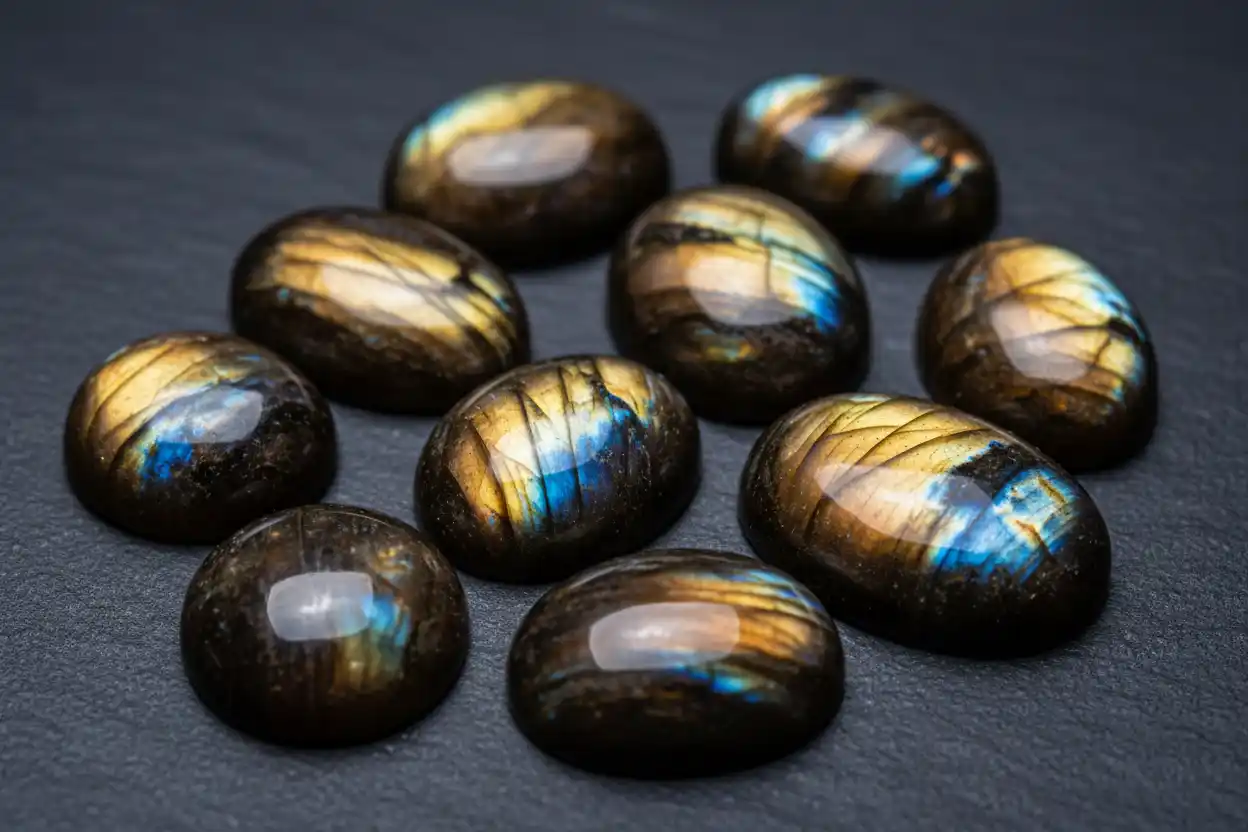
Nuummite is a dark, iridescent metamorphic rock best known from the Nuuk region of southwestern Greenland. Polished pieces can display elongated flashes of gold, bronze, copper, blue, green, violet, or reddish light across a brown-black to nearly black background.
The material consists principally of intergrown orthoamphibole minerals, especially anthophyllite and gedrite. Therefore, Nuummite is a rock and trade material rather than one mineral species with a single formula or crystal system.
Nuummite at a Glance
| Property | Nuummite |
|---|---|
| Material type | Iridescent metamorphic amphibole rock and lapidary trade material |
| Principal minerals | Anthophyllite and gedrite, with variable accessory minerals |
| Composition | Variable magnesium-iron aluminosilicate amphibole mixture |
| Common body colors | Black, brown-black, charcoal gray, dark brown, and gray-green |
| Iridescent colors | Gold, bronze, copper, yellow, blue, green, violet, and reddish |
| Crystal system | No single crystal system applies to the rock; principal orthoamphiboles are orthorhombic |
| Texture | Interlocking elongated amphibole crystals, commonly foliated or aligned |
| Luster | Vitreous to subvitreous; flashing areas may appear metallic |
| Transparency | Opaque |
| Mohs hardness | Commonly about 5.5–6, with variation between components and altered zones |
| Cleavage | Variable at rock scale; constituent amphiboles possess strong prismatic cleavage |
| Tenacity | Brittle, with possible weakness along crystal alignment and fractures |
| Common uses | Cabochons, pendants, beads, rings, spheres, palm stones, carvings, and display slabs |
| Main care concern | Misidentification, poor flash orientation, fractures, resin, impact, and amphibole-bearing cutting dust |
Nuummite Is an Iridescent Rock
Nuummite is not an approved mineral species. The name belongs to an iridescent orthoamphibole rock originally marketed from the Nuuk area.
Its principal components are anthophyllite and gedrite. Both belong to the amphibole group, but their compositions vary in magnesium, iron, aluminum, and related substitutions.
Other minerals may occur in the rock, including pyrite, pyrrhotite, chalcopyrite, quartz, feldspar, mica, and alteration products. Consequently, not every gold-colored point or streak represents the same optical effect.
The classification principles in types of gemstones help distinguish an ornamental rock from a single crystal species.
A seller who assigns one fixed chemical formula or one universal refractive index to an entire Nuummite cabochon oversimplifies the material.
The Origin of the Name
Nuummite means “from Nuuk” in Greenlandic. The modern gem material was recognized during geological work near Nuuk in the early 1980s and introduced commercially soon afterward.
The mineralogist Karl Ludwig Giesecke had collected comparable iridescent amphibole material in Greenland in the early nineteenth century. For this reason, modern accounts sometimes describe Nuummite as rediscovered rather than discovered in 1982.
The name was adopted for local cutting and jewelry production. It has since become internationally associated with dark Greenland material displaying golden or blue iridescence.
Because the word refers directly to Nuuk, geographic origin remains central to its commercial identity. Similar iridescent orthoamphibole rocks occur elsewhere, but sellers should disclose those origins rather than implying every dark flashing stone came from Greenland.
An Archean Metamorphic Material
Nuummite’s Greenland host rocks are Archean and approximately three billion years old. This makes the geological material ancient, although modern polishing and jewelry production are obviously recent.
Geological descriptions indicate that an original igneous or volcanic rock underwent intense metamorphism. Heat, pressure, deformation, and chemical re-equilibration produced the aligned orthoamphibole assemblage.
More than one metamorphic event affected parts of the Nuuk region. Recrystallization and exsolution within the amphiboles created the microscopic structures responsible for the optical flash.
The final rock records a long sequence: original crystallization, deep metamorphism, deformation, uplift, erosion, discovery, and lapidary orientation.
A marketing claim that every Nuummite stone is exactly three billion years old should therefore be interpreted as a broad age for the geological formation, not a precise date for each visible flash or fracture.
What Creates Nuummite’s Iridescence?
Nuummite’s color effect is not ordinary metallic glitter and does not come solely from reflective sulfide grains.
Anthophyllite and gedrite can separate into extremely fine alternating lamellae during cooling and metamorphic re-equilibration. These nanoscale layers interact with light.
Reflections from adjacent lamellae reinforce particular wavelengths through optical interference. Their spacing and orientation determine whether the flash appears gold, yellow, blue, violet, or another color.
The effect becomes strongest when the stone is cut across the elongated amphibole grains at a favorable angle. A poorly oriented cabochon can contain authentic material yet display little visible flash.
Golden streaks from sulfides may occur separately. Under magnification, pyrite or chalcopyrite generally looks like localized metallic particles, whereas true Nuummite iridescence moves across elongated internal structures.
This distinction is important because low-grade dark amphibole rock containing only scattered sulfide glitter may not show the optical quality expected from fine Nuummite.
Color and Pattern
The body is commonly dark brown, charcoal, or black. Greenish or gray areas may appear where mineral proportions, weathering, or alteration differ.
Gold and bronze flashes dominate much Greenland material. Blue and violet iridescence occurs less consistently and may command additional interest when it is strong.
Some stones contain broad elongated flashes, while others show fine needle-like streaks, broken flames, feathers, or scattered patches.
The number of flashes does not determine quality by itself. A single wide, sharply defined golden-blue area can be more compelling than numerous weak streaks.
The effect should shift as the stone rotates beneath a fixed light. Static metallic specks that remain unchanged may be sulfides rather than interference color.
A dark surface without visible flash may still be the correct amphibole rock, but it generally carries less lapidary value.
Greenland Sources
The best-documented Nuummite occurs at several localities around Nuuk in southwestern Greenland. Simiuttat and other sites in the Nuuk district have produced studied golden and blue-violet material.
Mining and collecting conditions can be difficult because exposures lie in rugged Arctic terrain with a short field season. Supply is therefore less continuous than for many widely quarried decorative rocks.
A specific Greenland claim should ideally include the Nuuk district or another documented source, not merely a Nordic-themed product description.
Similar iridescent orthoamphibole material has been reported from Mauritania and Wyoming. These occurrences are geologically interesting, but they should not be passed off as Nuuk material.
Some commercial sources use names such as Mauritanian Nuummite, Jenakite, or Nuummite-type rock. The correct approach is to state both the material and locality clearly.
How to Identify Genuine Nuummite
Rotate the stone beneath a concentrated light. Authentic iridescence should emerge from within elongated crystal structures and move as the viewing angle changes.
Inspect the surface with magnification. Look for aligned brown-black amphibole grains, internal golden or blue flashes, natural fractures, pits, and any resin.
The stone should feel like a dense rock rather than lightweight plastic. However, density varies with mineral proportions and cannot confirm identity alone.
Typical hardness falls around 5.5–6. Quartz can scratch it, while steel may leave marks on some areas. Destructive testing is inappropriate for finished jewelry.
A laboratory may use petrographic microscopy, Raman spectroscopy, X-ray diffraction, infrared spectroscopy, and chemical analysis to identify anthophyllite, gedrite, and accessory minerals.
The methods in how to identify crystals explain why appearance, hardness, density, and origin must support one another.
A retail “certificate of authenticity” has limited value unless the issuing party can distinguish an amphibole rock from feldspar, pyroxene, glass, or another dark ornamental material.
Nuummite and Labradorite
Labradorite is a plagioclase feldspar, not an amphibole rock. Its labradorescence usually appears as broader blue, green, gold, orange, or multicolored sheets across cleavage-related internal layers.
Nuummite’s flashes more commonly follow elongated rods, feathers, flames, or fiber-like amphibole crystals.
Labradorite is generally lighter in body color and can display gray, transparent, or translucent areas. Nuummite is usually opaque and distinctly dark brown-black.
Both effects change with viewing angle, so a photograph alone can create confusion. A gemologist can separate them through refractive index, density, structure, and spectroscopy.
Nuummite and Larvikite
Larvikite is an igneous rock dominated by feldspar. Polished pieces show silver, blue, or steel-colored flashes from feldspar crystals.
Its pattern is commonly coarse and granular, with blocky reflective areas. Nuummite instead shows more elongated amphibole flashes in a dark metamorphic host.
Larvikite is widely available and generally cheaper. Some products sold as Nuummite are actually dark larvikite selected for strong blue schiller.
Neither material is inherently inferior, but the invoice should identify the correct rock. Detailed seller checks for the feldspar material belong on the dedicated larvikite buying guide.
Other Dark Flashing Lookalikes
Hypersthene is a pyroxene mineral or pyroxene-rich material that can display bronze, silver, or coppery schiller. Its reflections often appear smoother and more sheet-like than Nuummite’s elongated flames.
Astrophyllite commonly contains radiating bronze-gold blades in a dark matrix. The crystals look more sharply metallic and starburst-like rather than producing interference within dark amphibole grains.
Arfvedsonite is a dark sodium amphibole that may show blue reflections, fibrous texture, or associated feldspar. It lacks Nuummite’s specific anthophyllite-gedrite identity.
Obsidian is volcanic glass. Golden or silver sheen obsidian can flash under light, but it has a glassy amorphous texture rather than interlocking amphibole crystals.
These comparisons explain why the dedicated Nuummite buying guide should own detailed seller authentication and geographic-origin checks.
Lapidary Orientation
Nuummite rough can look unremarkable until it is wet, ground, and examined from several angles. The cutter must locate the direction that produces maximum iridescence.
A cabochon cut parallel to the wrong plane may show only dark amphibole. Reorienting the dome can transform the same rough into a strongly flashing stone.
Curved surfaces generally display the effect better than flat slabs because the dome presents several angles to the light.
Fractures and small cavities complicate cutting. Resin stabilization may be necessary when parallel amphibole grains separate or when the matrix contains open pits.
Overheating can damage resin and may create new fractures. Controlled wet cutting also limits hazardous amphibole-bearing dust.
Jewelry Suitability
Nuummite works well in pendants, earrings, brooches, beads, and carefully protected rings.
Its moderate hardness means quartz dust, topaz, sapphire, and harder stones can scratch the polish. The gemstone hardness chart provides the practical comparison.
The rock is brittle and may break along aligned grains or fractures. The difference between scratching and structural breakage is explained in gemstone toughness versus hardness.
A bezel setting protects the edges and maintains the stone’s viewing orientation. Prongs can work, although pressure should not be concentrated on a fractured girdle.
A ring should remain low and protected because repeated knocks can chip the dome. Pendants allow larger stones to show their iridescence with less impact risk.
Bracelet beads need smooth drill holes and sufficient wall thickness. Cracks radiating from a hole can enlarge under string tension.
Treatments and Imitations
Polishing is the principal accepted enhancement. However, resin impregnation or fracture filling may stabilize porous or cracked material.
Wax and oil can darken the host and temporarily intensify contrast. Clear coatings may increase gloss but can scratch, peel, or yellow.
Dyeing can make gray or brown material appear blacker. Color concentrated in cracks or around drill holes suggests treatment.
Resin and glass imitations can contain metallic flakes arranged to resemble golden streaks. Repeated patterns, mold seams, round bubbles, or low weight provide warning signs.
Dark larvikite, labradorite, hypersthene, astrophyllite-bearing rock, arfvedsonite, and ordinary amphibolite may be relabeled as Nuummite.
The broad fraud indicators in how to spot fake crystals remain useful, while resin, coating, filling, and dyeing are covered in gemstone treatments explained.
Current Nuummite Asking Prices
Nuummite pricing depends strongly on verified origin, iridescence, size, orientation, fracture condition, and craftsmanship.
| Nuummite product | Broad retail asking range |
|---|---|
| Small tumbled or pocket stone | About $8–$35 |
| Small commercial cabochon | About $10–$40 |
| Strongly flashing Greenland cabochon | About $40–$200 |
| Large or multicolored premium cabochon | About $100–$400 or more |
| Bead strand | About $20–$100 |
| Simple silver pendant | About $75–$350 |
| Designer Greenland Nuummite jewelry | About $250–$1,000 or more |
| Palm stone or polished freeform | About $30–$200 |
| Sphere or substantial polished piece | About $150–$1,000 or more |
| Large documented Greenland rough or collector specimen | Individually priced |
These are broad current asking prices, not appraisals or guaranteed resale values.
Very cheap cabochons may be genuine low-grade material, incorrectly labeled dark rock, or stones without verified Greenland origin. Conversely, a high price does not prove that the flash is Nuummite iridescence.
Value Factors
Iridescence drives value. Broad, bright, mobile gold, blue, green, or violet flashes generally command more than faint bronze specks.
Orientation matters because the cutter controls whether the effect appears face-up. A large badly oriented cabochon may have less visual value than a smaller well-cut stone.
Body color should provide clean contrast without appearing artificially blackened. Dark brown-black is typical, but natural variation is expected.
Fractures, pits, resin, and edge chips reduce value unless the pattern or provenance is exceptional.
Greenland origin carries additional market interest because Nuuk defines the traditional material. However, the claim should come from a credible supplier rather than an unsupported product title.
Craftsmanship can dominate the finished price. A secure handmade silver or gold setting may cost far more than the loose stone.
Buying Nuummite
Ask whether the seller guarantees Greenland origin and how that conclusion was established. A wholesale statement copied through several vendors is not the same as direct sourcing.
Request a video under one moving light. The flash should shift internally rather than remain as fixed surface glitter.
Inspect the sides and back for resin, paint, black dye, open fractures, and pattern continuity.
Compare the material with labradorite, larvikite, hypersthene, and astrophyllite before paying a rarity premium.
Avoid claims that every dark stone with one gold fleck is three-billion-year-old premium Nuummite. The age belongs to the geological host, while quality depends on mineralogy, flash, cutting, and condition.
Nuummite appears in both the crystals beginning with N directory and the gemstones beginning with N directory.
Cleaning and Storage
Clean Nuummite briefly with lukewarm water, mild soap, and a soft cloth or brush. Rinse and dry it immediately.
Avoid prolonged soaking when the stone contains fractures, resin, glue, or a porous matrix. The general crystal water-safety guide provides additional context.
Steam and ultrasonic equipment are unnecessary and may enlarge fractures or weaken fillings.
Do not use acids, bleach, abrasive powder, or solvent-based cleaners. These substances can affect resin, metal settings, sulfide inclusions, and polished surfaces.
Store Nuummite separately from quartz and harder stones. A fabric pouch also protects its dome and maintains the polished surface needed for strong iridescence.
Nuummite Meaning and Symbolism
Modern crystal traditions often associate Nuummite with self-knowledge, personal authority, resilience, protection, and examining concealed motives.
Its flashes emerging from a nearly black background inspire symbolism involving insight appearing within uncertainty.
The stone’s great geological age supports themes of patience, deep time, inherited experience, and long-term transformation.
Because Nuummite entered the international gem market only in the late twentieth century, elaborate claims of one continuous ancient Nuummite-healing tradition should be treated cautiously.
These meanings remain personal, cultural, artistic, or spiritual interpretations. Scientific evidence does not show that Nuummite blocks harmful energy, removes curses, treats illness, or guarantees psychological change.
Frequently Asked Questions
Is Nuummite a mineral?
No. It is an iridescent metamorphic rock composed principally of the amphibole minerals anthophyllite and gedrite.
What does the name Nuummite mean?
It means “from Nuuk,” referring to Greenland’s capital and the surrounding district where the gem material became commercially recognized.
Is Nuummite really three billion years old?
The Greenland host rocks are Archean and broadly around three billion years old. The number describes geological formation history rather than a precise date for every visible feature.
What causes Nuummite’s golden flash?
Nanoscale intergrowths or exsolution lamellae within orthoamphibole crystals interfere with light, producing mobile gold, bronze, blue, or violet colors.
Is every golden streak caused by iridescence?
No. Pyrite, pyrrhotite, or chalcopyrite can create metallic particles. True Nuummite flash moves across elongated amphibole structures as the viewing angle changes.
Does genuine Nuummite come only from Greenland?
Greenland is the traditional and defining source. Similar iridescent orthoamphibole rocks occur elsewhere and should be sold with their correct locality.
How can I distinguish Nuummite from labradorite?
Labradorite is feldspar with broad sheet-like labradorescence. Nuummite is a dark amphibole rock with elongated internal flashes.
Why is larvikite sold as Nuummite?
Dark larvikite can show blue or silver feldspar reflections and is generally more available. Inaccurate or opportunistic labeling creates confusion.
Is Nuummite suitable for a ring?
Yes, with a low protective setting and careful wear. Its moderate hardness, fractures, and aligned grains make pendants less risky.
Is Nuummite usually treated?
Some pieces are only polished, while resin stabilization, fracture filling, wax, oil, coating, or dark dye may occur.
Can Nuummite be placed in water?
Brief gentle washing is usually manageable for a sound untreated stone. Avoid soaking fractured, filled, glued, or sulfide-rich pieces.
What makes Nuummite valuable?
Strong mobile iridescence, rare blue or multicolored flashes, correct orientation, verified Greenland origin, structural condition, size, and workmanship determine value.
Nuummite’s dark body hides its strongest feature until the cutter finds the correct orientation. That relationship between internal structure and polished shape is central to the guide to gemstones for cabochons and carving.
Finished polished Nuummite is generally suitable for normal external wear, but cutting or grinding can release respirable amphibole and silica-bearing dust. Use wet methods, effective local extraction, eye protection, and appropriate respiratory protection; do not ingest the material or use it in drinking-water preparations.