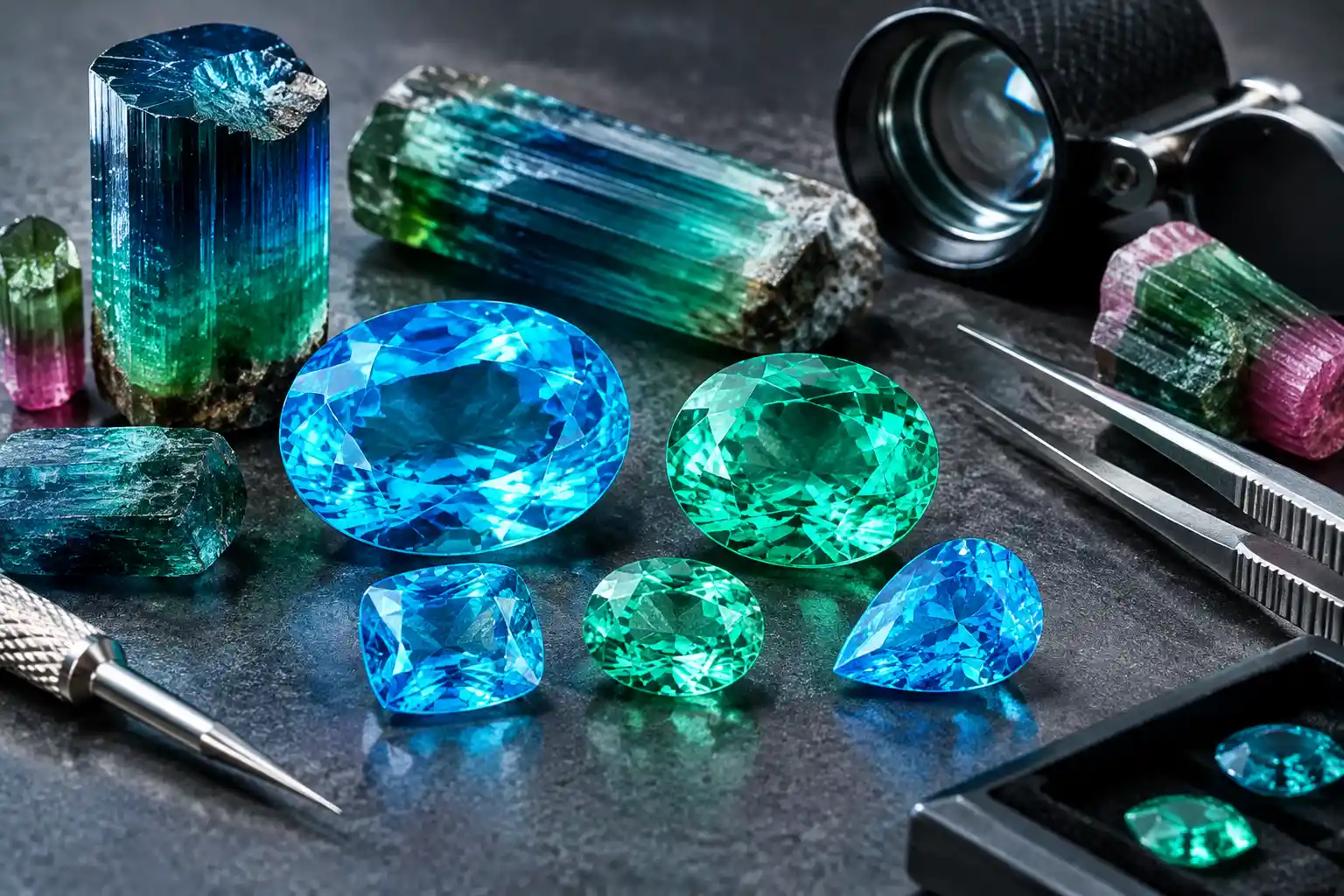
11 Real Paraiba Tourmaline Benefits: Deep Traditions, Evidence, Safe Use & Clear Limits
Paraiba Tourmaline benefits begin with an extraordinarily vivid color produced by unusual trace-element chemistry. In modern gemological use, Paraíba refers to copper-bearing tourmaline displaying highly saturated blue, electric blue, violet-blue, bluish green, greenish blue, green, or related colors in which copper is a principal cause of the appearance, commonly interacting with manganese. The trade name began with discoveries in Brazil’s Paraíba State during the late 1980s and later expanded to qualifying copper-bearing stones from Nigeria and Mozambique.
This history is important because Paraiba Tourmaline benefits cannot be reduced to color alone. The stone combines tourmaline’s useful Mohs hardness of approximately 7 to 7.5 with striking optical intensity, strong collector demand, geological rarity, sophisticated laboratory identification, and a fascinating story of the same unusual copper-bearing gem chemistry appearing on two continents. Origin can significantly influence market value, but current gemological usage does not restrict the Paraíba designation exclusively to Brazilian material.
The strongest Paraiba Tourmaline benefits are practical and gemological. These include vivid color, jewelry suitability, collector appeal, educational value, geographic-origin research, and the design possibilities created by small stones with exceptional visual presence. Modern spiritual traditions may add symbolism involving communication, individuality, confidence, or creative expression, but copper and manganese within the crystal do not provide nutritional or medical benefits through ordinary skin contact.
11 Paraiba Tourmaline Benefits at a Glance
- Copper creates vivid blue-to-green colors that can appear unusually bright even in relatively small gemstones.
- Tourmaline hardness around 7 to 7.5 supports many forms of carefully worn jewelry.
- Brazilian discovery history gives Paraíba Tourmaline a distinctive place in modern gemology.
- Copper-bearing tourmalines from Brazil, Nigeria, and Mozambique provide valuable geological and chemical comparisons.
- Strong saturation gives small stones considerable visual impact in fine jewelry.
- Laboratory chemistry can help distinguish geographic origin when standard gemological testing is insufficient.
- Collector appeal comes from color, rarity, locality, size, clarity, cutting, treatment, and documentation.
- Heat treatment may improve some stones, making accurate disclosure important when evaluating value.
- Professional identification helps separate Paraíba Tourmaline from ordinary blue or green tourmaline and imitations.
- Modern symbolism can connect the gem with individuality, communication, optimism, and creative expression.
- Sensible cleaning and setting choices allow owners to enjoy Paraiba Tourmaline benefits without unnecessary damage or unsupported wellness claims.
Copper-Bearing Color Is the Most Distinctive Paraiba Tourmaline Benefit
Color is the defining feature behind Paraiba Tourmaline benefits. Fine stones can display an intense electric or neon-like blue, turquoise, blue-green, greenish blue, violet-blue, or green appearance that looks unusually luminous compared with many ordinary tourmalines.
Copper is the key trace element responsible for these characteristic colors. Manganese can interact with the copper-related absorption and influence purple, violet, pinkish, or related components, while iron can complicate the final appearance in some stones.
The visual result can be so strong that a small Paraíba Tourmaline may command attention alongside much larger gems. This intensity is one reason the stones became famous quickly after the Brazilian discoveries.
“Neon” is a descriptive trade term rather than a claim that the stone generates light. Paraíba Tourmaline does not glow independently in darkness. Its vivid appearance comes from the way the gem absorbs and transmits visible light.
Brazilian Discovery History Gives Paraíba Tourmaline a Unique Identity
The Paraíba name originated with extraordinary copper-bearing tourmalines discovered in northeastern Brazil during the late 1980s. Stones from Paraíba State and neighboring Rio Grande do Norte became famous for vivid blue-to-green colors unlike the appearance most buyers associated with traditional tourmaline.
This discovery transformed the colored-stone market and encouraged gemologists to investigate the chemistry responsible for the unusual hues.
Later, similar copper-bearing tourmalines were discovered in Nigeria and Mozambique. Their appearance and many standard gemological properties can overlap so strongly with Brazilian stones that geographic origin may require advanced quantitative chemical analysis.
That history gives Paraiba Tourmaline benefits significant educational value. The gemstone demonstrates how a trade name can begin with one locality and later become a gemological variety designation applied more widely according to chemistry and color.
Brazil, Nigeria, and Mozambique Create an Important Gemological Comparison
Copper-bearing tourmalines qualifying for the Paraíba designation are known from Brazil, Nigeria, and Mozambique. These occurrences became especially interesting because the stones can overlap substantially in color and routine gemological properties.
An experienced gemologist cannot reliably determine geographic source simply by deciding that one stone “looks Brazilian.” Standard refractive index, specific gravity, inclusions, and color may not provide a definitive answer.
Advanced laboratories use quantitative trace-element chemistry to help separate geographic origins. Elements such as copper, manganese, gallium, lead, zinc, strontium, tin, and others can form chemical patterns useful in origin determination.
This adds another layer to Paraiba Tourmaline benefits for collectors. A gemstone can be appreciated both for its beauty and for the analytical science required to establish where it formed.
Tourmaline Hardness Supports Fine Jewelry Use
Durability is one of the most practical Paraiba Tourmaline benefits. Tourmaline generally has a Mohs hardness around 7 to 7.5, providing respectable resistance to ordinary scratching.
The stone works well in earrings, pendants, necklaces, rings, brooches, and other jewelry when set appropriately. Earrings and pendants offer especially protected environments, while rings should account for the possibility of impact.
Tourmaline can be brittle under severe stress, and long prismatic crystal structure can sometimes influence fracture behavior. Thin girdles, sharp corners, heavily included areas, and exposed points deserve protection.
Because fine Paraíba Tourmaline can be exceptionally valuable, setting design should focus on security as much as appearance. A protective halo, bezel, or well-designed prong arrangement can reduce unnecessary risk without hiding the color.
Small Paraíba Tourmalines Can Have Exceptional Visual Presence
One unusual Paraiba Tourmaline benefit is that size is not the only route to visual impact. Strong copper-bearing color can make relatively small stones appear remarkably vivid.
This creates interesting possibilities for jewelry design. A modest center stone with exceptional color can outperform a much larger dull gem visually, while several small matched stones can create an intense line of blue or green across earrings or a ring.
Cutting is crucial. Poor proportions can create extinction, windows, or loss of saturation, while skilled orientation can preserve both color and brightness.
Tourmaline’s pleochroism also means color may vary with viewing direction. Cutters must balance crystal orientation with weight retention and appearance, especially when valuable rough is scarce.
Anyone preparing to buy Paraiba Tourmaline should therefore evaluate face-up color and cutting together rather than assuming that carat weight alone determines beauty.
Rarity Creates Strong Collector Demand
Fine Paraíba Tourmaline remains one of the most sought-after categories within colored tourmaline. Strong demand reflects vivid color, scarcity, discovery history, locality differences, and limited availability of high-quality transparent stones.
Brazilian specimens can receive particularly strong premiums, especially when color is exceptional and origin is supported by a reputable laboratory. African stones from Mozambique and Nigeria can also achieve impressive quality and substantial value.
Collector appeal extends beyond transparent faceted gems. Crystals showing characteristic color, unusual inclusions, cat’s-eye effects, or strong locality documentation may be desirable for different reasons.
The drivers behind Paraiba Tourmaline price therefore include color saturation, hue, tone, size, clarity, cutting, treatment, geographic origin, laboratory documentation, and overall visual impact.
Rarity should still be considered alongside quality. A poorly cut or unattractive stone does not become exceptional merely because copper is present.
Paraíba Origin Determination Shows the Value of Advanced Laboratory Testing
Geographic origin is unusually important for Paraíba Tourmaline because Brazilian stones often occupy a different market position from African material.
The challenge is that stones from Brazil, Nigeria, and Mozambique can look remarkably similar. Routine testing may confirm tourmaline and establish copper-bearing chemistry without providing enough information to identify the source confidently.
Advanced laboratories can use highly precise quantitative trace-element measurements to compare unknown stones with databases of samples from known deposits.
This analytical work is one of the most interesting Paraiba Tourmaline benefits from an educational perspective. It demonstrates that modern gemology extends far beyond looking through a loupe.
A credible report can therefore add significant information to an expensive stone, particularly when origin contributes directly to price.
Heat Treatment Requires Accurate Disclosure
Heat treatment may be used on Paraíba Tourmaline to modify color, often by reducing undesirable purple, violet, or other components and emphasizing brighter blue-to-green appearances.
Heating does not automatically make the gem synthetic or artificial. A naturally mined tourmaline remains natural even when its color has been modified through treatment.
Disclosure still matters because untreated stones may attract premiums in certain circumstances, and buyers deserve to know what can be determined about a gemstone’s treatment history.
Treatment detection can sometimes be difficult, and laboratories may have limitations in determining whether every tourmaline has been heated. A report should therefore be read for exactly what it states rather than what a buyer hopes it implies.
Paraíba Tourmaline Needs Correct Identification, Not Color Guessing
Vivid blue or green color alone does not prove that a gem qualifies as Paraíba Tourmaline. Ordinary indicolite and other blue-green tourmalines can overlap partially in hue, while glass, synthetic products, or other gemstones may imitate the appearance.
Accepted Paraíba classification considers copper-bearing chemistry together with an appropriate color range. Simply calling any bright turquoise tourmaline “Paraíba” is therefore insufficient.
This makes laboratory testing especially valuable when significant money is involved. Gem identification can establish whether the stone is tourmaline and whether its chemistry fits the copper-bearing variety.
Documentation also protects future owners. A stone accompanied by a respected laboratory report is easier to evaluate, insure, resell, or pass between collectors than one supported only by a seller’s verbal description.
Paraíba Tourmaline Gives Collectors a Modern Gemological Story
Unlike gems with thousands of years of recorded use, Paraíba Tourmaline became famous only recently. Its story centers on modern discovery, mineral chemistry, global sourcing, rapidly developing market demand, and sophisticated origin analysis.
This makes modernity one of the most interesting Paraiba Tourmaline benefits.
Collectors can trace the development from the original Brazilian finds to later discoveries in Nigeria and Mozambique, then follow how laboratories refined terminology and origin-determination methods as the market evolved.
The stone demonstrates that gemstone history is still being created. Important gem categories do not all belong to antiquity.
For someone interested in contemporary gemology, Paraíba Tourmaline can therefore represent discovery and changing scientific understanding as much as visual beauty.
Modern Symbolism Can Reflect Individuality and Expression
The vivid appearance of Paraíba Tourmaline naturally encourages symbolism involving communication, individuality, creativity, confidence, optimism, or expressive personality.
A bright blue-green stone can stand out dramatically even within a restrained jewelry design, making individuality an intuitive modern theme.
Someone may choose a Paraíba pendant to commemorate creative work or select a ring because the color reminds them of tropical water, travel, or a particular place. Another owner may associate the gemstone with confidence simply because wearing an unusual color feels expressive.
The detailed Paraiba Tourmaline meaning can develop these themes further, but none should be presented as an automatic biological effect of the stone.
Copper Content Does Not Provide a Health Benefit Through Wear
Copper is genuinely responsible for much of Paraíba Tourmaline’s extraordinary color, but chemical composition should not be converted into a medical claim.
Wearing copper-bearing tourmaline does not provide a controlled nutritional dose of copper through the skin. The copper is present within the mineral’s crystal chemistry rather than functioning as a supplement.
Likewise, manganese within the stone does not regulate nerves, hormones, metabolism, or mood through ordinary jewelry contact.
This distinction is especially important because factual gem chemistry can sound medically suggestive when presented carelessly. Paraiba Tourmaline benefits should remain centered on color, mineralogy, jewelry, collecting, and symbolism rather than supposed mineral delivery to the body.
Paraíba Tourmaline Care Is Manageable With Sensible Precautions
Tourmaline’s hardness of approximately 7 to 7.5 makes routine care relatively straightforward. Mild soap, lukewarm water, and a soft brush are appropriate for many uncomplicated stones.
Ultrasonic cleaning deserves caution, particularly when a gemstone is heavily included or contains significant fractures. Steam and abrupt temperature changes are also unnecessary risks for valuable stones.
Storage should prevent contact with harder gems such as sapphire and diamond. A lined compartment or separate pouch reduces scratching and accidental impacts.
High-value rings should be inspected periodically to ensure prongs remain secure. Preventing a loose stone from falling out is far easier than replacing a fine Paraíba Tourmaline of comparable color and origin.
What Paraiba Tourmaline Benefits Do Not Include
Paraiba Tourmaline benefits do not include scientifically established treatment for physical or mental-health conditions. There is no reliable evidence that wearing the gemstone treats anxiety, depression, thyroid disorders, hormonal problems, circulation conditions, neurological illness, pain, fertility concerns, or other medical issues.
Its copper and manganese content should not be interpreted as therapeutic nutrient delivery.
Meditation, personal symbolism, and spiritual practices can still use the gemstone as a visual focus, but these experiences should remain separate from medical treatment.
Conclusion
Paraiba Tourmaline benefits combine exceptional copper-bearing blue-to-green color, tourmaline durability, jewelry versatility, collector scarcity, modern discovery history, and sophisticated gemological science. Stones from Brazil, Nigeria, and Mozambique demonstrate how closely similar gems can require advanced chemical testing when geographic origin matters.
Color quality, cutting, treatment, origin, documentation, and authenticity are more important than dramatic marketing language. Individuality, optimism, communication, and creativity can remain meaningful modern symbolism, while the gemstone’s copper and manganese chemistry should never be confused with medical benefit.
FAQs
What are the main Paraiba Tourmaline benefits?
The strongest Paraiba Tourmaline benefits include vivid copper-bearing color, jewelry durability, collector rarity, strong visual impact, modern gemological importance, geographic-origin research, and distinctive personal symbolism. Claims involving healing or medical effects are not scientifically established.
What makes Paraiba Tourmaline different from ordinary tourmaline?
Paraíba Tourmaline is distinguished by copper-bearing chemistry combined with an accepted vivid blue-to-green or related color range. Copper is a major cause of the characteristic electric or neon-like appearance, often interacting with manganese.
Does Paraiba Tourmaline only come from Brazil?
No. The name began with discoveries in Brazil’s Paraíba State, but qualifying copper-bearing tourmalines are also known from Nigeria and Mozambique. Modern gemological usage can apply the Paraíba designation regardless of geographic origin when the stone meets accepted chemistry and color criteria.
How hard is Paraiba Tourmaline?
Tourmaline generally measures about 7 to 7.5 on the Mohs scale. This provides good resistance to everyday scratching and supports many jewelry uses. Severe impact can still chip or fracture a stone, especially around exposed edges.
Why is Brazilian Paraiba Tourmaline often more expensive?
Brazilian stones can command strong premiums because of historical importance, limited production, market reputation, and the exceptional color seen in some specimens. Quality still matters, and African material from Mozambique or Nigeria can also be exceptionally attractive and valuable.
Is Paraiba Tourmaline usually treated?
Some Paraíba Tourmaline is heat treated to improve or modify color. Heating can reduce less desirable color components and produce a more attractive appearance. Treatment disclosure matters, although determining heat history can sometimes be difficult.
How can a laboratory determine where Paraiba Tourmaline came from?
Standard gemological tests may not separate Brazil, Nigeria, and Mozambique reliably. Advanced laboratories can use quantitative trace-element chemistry and compare elemental patterns with reference stones of known origin.
Is every neon-blue tourmaline Paraiba?
No. Vivid appearance alone is insufficient. Accepted Paraíba classification involves copper-bearing tourmaline in an appropriate blue, green, violet-blue, or related color range. Laboratory analysis may be needed when the designation affects value.
Is Paraiba Tourmaline suitable for an engagement ring?
Yes, with sensible design. Its hardness around 7 to 7.5 makes it suitable for jewelry, but a protective setting is beneficial because tourmaline can still suffer impact damage. Valuable stones should be mounted securely and removed during demanding manual activities.
Does copper in Paraiba Tourmaline benefit the body?
There is no established evidence that wearing copper-bearing tourmaline supplies useful nutritional copper to the body. Copper is incorporated into the gemstone’s chemistry and is important for color, not as a therapeutic supplement delivered through skin contact.
Does Paraiba Tourmaline have healing powers?
There is no established scientific evidence that Paraíba Tourmaline diagnoses, treats, cures, or prevents physical or mental-health conditions. Claims involving emotional healing, energy, hormones, circulation, thyroid function, or other medical effects belong to spiritual interpretation rather than established medicine.
Paraiba Tourmaline benefits involving healing energy, emotional treatment, mineral supplementation, or physical wellness reflect modern spiritual and personal interpretation and should not replace qualified physical or mental-health care.