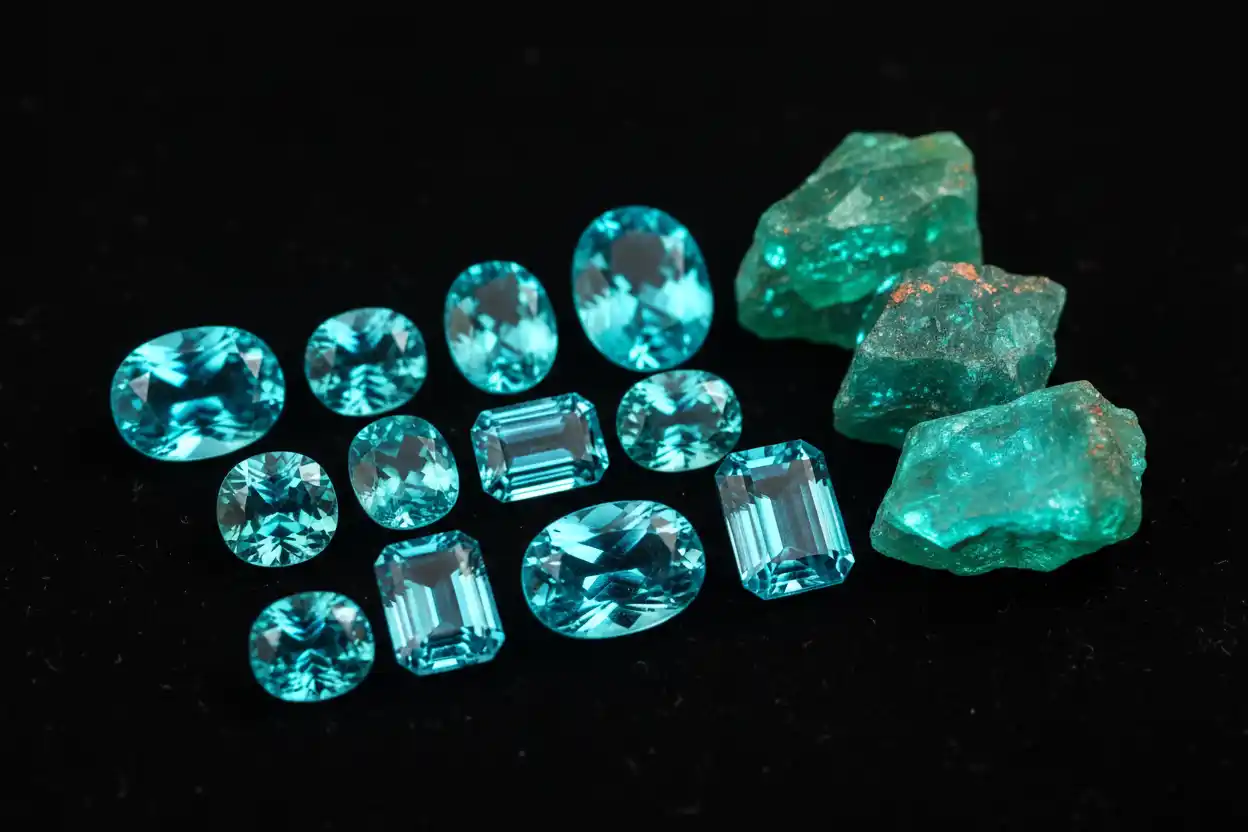
Paraiba Tourmaline Meaning, Properties, Color & Value
Paraiba Tourmaline is the gem-trade name for vivid blue, greenish blue, bluish green, green, or yellowish-green tourmaline whose distinctive color is produced mainly by copper, commonly with manganese. The material first became famous through discoveries in Brazil’s Paraíba State and is now also known from Rio Grande do Norte, Nigeria, and Mozambique.
The name identifies a copper-bearing color variety rather than one geographic origin or a separate mineral species. Most examples are elbaite tourmaline, although copper-bearing liddicoatite-group material has also been documented.
Paraiba Tourmaline at a Glance
| Property | Paraiba Tourmaline |
|---|---|
| Material type | Copper- and manganese-bearing gem tourmaline variety |
| Principal mineral species | Usually elbaite; some liddicoatite-group examples occur |
| General tourmaline composition | Complex borosilicate with sodium, lithium, aluminum, copper, manganese, and other variable elements |
| Recognized colors | Electric blue, neon blue, violet-blue, greenish blue, bluish green, green, and yellowish green |
| Color cause | Primarily Cu²⁺ absorption, modified by Mn, Fe, oxidation state, heat treatment, and other compositional factors |
| Crystal system | Trigonal |
| Typical habit | Elongated striated prisms, broken crystals, alluvial grains, and faceted gemstones |
| Luster | Vitreous |
| Transparency | Transparent to translucent |
| Mohs hardness | Approximately 7–7.5 |
| Cleavage | Indistinct |
| Tenacity | Brittle |
| Specific gravity | Commonly around 3.0–3.1, with compositional variation |
| Common uses | Fine faceted jewelry, melee, cabochons, cat’s-eye gems, collector crystals, and high-jewelry center stones |
| Main care concern | Fractures, heat treatment, origin claims, clarity enhancement, edge chipping, and extreme replacement cost |
Paraiba within the Tourmaline Family
Paraiba belongs to the diverse mineral group introduced in the tourmaline guide.
Tourmaline is not one chemically fixed mineral. The group includes numerous species whose structures can accommodate sodium, calcium, lithium, magnesium, iron, aluminum, copper, manganese, chromium, vanadium, fluorine, hydroxyl, and other components.
Most faceted Paraiba Tourmaline has been identified as elbaite, a lithium- and sodium-bearing tourmaline common in granitic pegmatites.
However, analytical work has confirmed some copper-bearing liddicoatite-group stones. Consequently, a laboratory report may list a specific mineral species or simply tourmaline when species determination is outside the requested service.
Paraiba should not be described as a type of sapphire, apatite, beryl, or glass merely because those materials can imitate its color.
The broader color and species framework belongs on types of tourmaline, while this page remains focused on copper-bearing blue-to-green material.
How the Name Developed
Prospector Heitor Dimas Barbosa spent years searching pegmatites in northeastern Brazil for an unusual blue-green gem.
During the late 1980s, vividly colored copper-bearing tourmalines emerged from the Mina da Batalha area in Paraíba State.
Their bright turquoise, blue, and green appearance differed from conventional blue tourmaline and quickly attracted international attention.
Related copper-bearing material was subsequently identified in neighboring Rio Grande do Norte State.
During the following decade, copper-bearing tourmalines also reached the market from Nigeria. Large-scale discoveries near Mavuco in Mozambique followed in the early twenty-first century.
The trade gradually adopted Paraiba for qualifying copper-bearing blue-to-green tourmaline regardless of origin. Major laboratories now separate the variety description from a distinct geographic-origin conclusion.
Therefore, a stone can be described as Paraiba Tourmaline with an origin of Brazil, Nigeria, Mozambique, another locality, or undetermined.
What Qualifies as Paraiba Tourmaline?
Professional laboratory nomenclature applies Paraiba to tourmaline with a blue-to-green color range, suitable saturation and tone, and color produced mainly by copper and manganese.
The accepted range includes electric blue, neon blue, violet-blue, bluish green, greenish blue, green, and yellowish green.
The mere detection of copper does not necessarily qualify a weak gray, brown, pink, or very pale stone for the trade variety.
Likewise, an iron-rich copper-bearing tourmaline whose absorption is dominated by iron may fall outside laboratory Paraiba criteria.
Retail usage is less consistent. Sellers may apply the name to any turquoise tourmaline, any copper-bearing stone, or even glass and laboratory-created substitutes.
For a high-value purchase, the variety should be confirmed by a respected gemological laboratory rather than inferred from the listing title.
Why Copper Creates Neon Color
Copper occurs mainly as Cu²⁺ within the tourmaline structure. Its visible-light absorption can create vivid blue and green transmission.
Manganese adds or modifies pink, purple, red, and yellow components depending on oxidation state and concentration.
Iron may contribute green, blue-green, gray, or dark absorption. Too much iron can suppress the luminous appearance associated with fine material.
The celebrated neon effect does not mean that the stone produces light. Instead, strong selective absorption and transmission create unusually vivid color even in modest illumination.
A fine stone can remain visibly saturated in lower light where a conventional blue-green gem appears darker or grayer.
Color terminology remains subjective. Electric, swimming-pool blue, lagoon, neon turquoise, and Windex blue are market descriptions rather than standardized grades.
The wider relationship between bodycolor and symbolism appears in tourmaline color meaning.
Brazilian Paraiba Tourmaline
Brazilian stones come principally from Paraíba and Rio Grande do Norte States.
Mina da Batalha material established the original market identity and is associated with intense blue, turquoise, violet-blue, and green colors.
Brazilian rough is commonly small and fractured. Fine faceted gems above one carat are correspondingly scarce, while clean stones of several carats are exceptional.
The original Brazilian deposits produced relatively limited quantities compared with later African sources.
Brazilian provenance can add a substantial premium when the color, clarity, cut, and laboratory evidence support the claim.
Nevertheless, not every Brazilian stone has top neon color. Origin should enhance a fine gem rather than substitute for visible quality.
Nigerian Paraiba Tourmaline
Copper-bearing tourmaline entered the market from Nigeria during the late 1990s.
Nigerian stones can show blue, greenish blue, bluish green, green, violet, and purple tones.
The deposits produced much less material than Mozambique, and Nigerian stones are consequently less visible in current retail markets.
Their gemological properties can overlap both Brazilian and Mozambican material. Standard instruments and visual inspection cannot establish origin reliably.
A laboratory requires quantitative trace-element data and comparison with documented reference samples before offering a Nigerian origin conclusion.
Mozambican Paraiba Tourmaline
Mozambique became the largest modern source of copper-bearing tourmaline after discoveries near Mavuco in the Alto Ligonha pegmatite region.
The deposits have produced a broad color range, including violet, purple, blue, greenish blue, bluish green, green, and yellow-green.
Mozambican crystals can yield larger faceted stones than the original Brazilian deposits. However, fractures, tubes, liquid inclusions, and color zoning remain common.
Heat treatment converts much purplish, pinkish, or violet material into brighter blue-to-green colors by changing manganese-related absorption.
Fine Mozambican stones can show exceptional saturation and clarity. They should not be dismissed automatically as inferior because of African origin.
Brazilian premiums reflect history, scarcity, and market preference, but visible color and beauty overlap substantially among the three major source countries.
Paraiba and Indicolite
Indicolite is the trade name for blue tourmaline.
An indicolite may be colored largely by iron and contain little or no copper. It can show navy, teal, greenish blue, or blue-gray tones.
Paraiba Tourmaline is defined by copper-related color and a recognized blue-to-green appearance.
Some stones qualify visually as blue tourmaline but not as Paraiba because copper is absent or not primarily responsible for the color.
Conversely, every qualifying blue Paraiba is a form of blue tourmaline in a broad visual sense, but its copper chemistry and market require the more specific name.
Instrument testing is essential because color overlap can be substantial.
Paraiba and Rubellite
Rubellite is strongly saturated pink-to-red tourmaline.
Copper-bearing crystals from Mozambique and Brazil can begin with purple, violet, pinkish, or reddish tones before heat treatment.
These stones may contain both copper and manganese, yet color determines whether the final gem falls within Paraiba’s recognized blue-green range.
A pink copper-bearing tourmaline is not automatically called Paraiba by every laboratory.
This distinction prevents chemistry from replacing the necessary color criteria.
Heating Paraiba Tourmaline
Heat treatment is common and widely accepted in the Paraiba market.
Heating can reduce manganese-related pink, red, purple, or brown absorption, revealing a stronger blue or green color associated with copper.
The treatment may transform violet or purplish rough into vivid blue-green material without adding foreign colorants.
Some naturally blue or green gems remain unheated. However, proving the absence of heating can be difficult, and laboratories may not always determine treatment conclusively.
Heat does not make a stone synthetic. It modifies the color of an existing natural tourmaline.
Sellers should disclose known treatment, while buyers should not assume “natural Paraiba” means unheated.
The wider difference among heating, diffusion, filling, coating, and laboratory growth is covered in gemstone treatments explained.
Clarity and Inclusions
Paraiba Tourmaline frequently contains liquid inclusions, partially healed fractures, growth tubes, needles, fingerprints, color zoning, and internal stress features.
The market tolerates more inclusion than it would in many pale tourmalines because intense neon color is the principal attraction.
Nevertheless, major surface-reaching fractures reduce durability and may produce haziness or loss of brilliance.
A clean gem with vivid color commands a strong premium. Eye-clean Brazilian stones of useful size are particularly scarce.
Copper particles can occasionally create metallic inclusions or chatoyancy. Cat’s-eye Paraiba Tourmaline represents a specialist phenomenal category rather than the standard faceted market.
Clarity enhancement through oil or resin is possible and requires disclosure.
How Laboratories Identify Paraiba
Routine gemological tests first establish that the stone is tourmaline.
Refractive index, birefringence, optic character, pleochroism, specific gravity, spectroscopy, and inclusions provide the initial framework.
Chemical analysis must then detect copper and evaluate other elements contributing to color.
Laboratories may use laser-ablation inductively coupled plasma mass spectrometry, quantitative X-ray fluorescence, ultraviolet-visible-near-infrared spectroscopy, and related methods.
Copper detection alone is not the full conclusion. Color, saturation, iron absorption, manganese, and laboratory nomenclature also matter.
Geographic origin requires a separate analysis. Brazilian, Nigerian, and Mozambican stones can look almost identical and overlap in routine measurements.
Quantitative trace elements such as copper, zinc, gallium, tin, strontium, lead, and others are compared with reference databases.
Even advanced laboratories may report an inconclusive or undetermined origin when the chemistry falls outside established source fields.
The principles behind multi-method testing appear in how to identify crystals.
Common Imitations and Mislabeling
Apatite can display bright blue-green color but is softer and has different optical properties.
Blue zircon has strong brilliance and dispersion, while Paraiba Tourmaline generally shows less rainbow fire.
Aquamarine, blue topaz, sapphire, synthetic spinel, glass, cubic zirconia, YAG, and coated gems can imitate part of the color range.
Ordinary iron-bearing tourmaline may receive a Paraiba label despite lacking significant copper.
Laboratory-grown stones and simulants may be marketed through vague phrases such as Paraiba color, Paraiba created, or neon Paraiba gemstone.
“Paraiba color” describes appearance, not mineral identity. The invoice should identify whether the object is tourmaline, glass, cubic zirconia, synthetic sapphire, or another substance.
General warning signs of false reports, renamed stones, and coatings appear in how to spot fake crystals.
Durability and Jewelry Suitability
Tourmaline has a Mohs hardness of approximately 7–7.5, giving Paraiba useful resistance to ordinary wear.
Its position can be compared on the gemstone hardness chart.
However, tourmaline is brittle and can contain numerous fractures. Its toughness is only fair, as explained in gemstone toughness versus hardness.
A well-cut sound stone can be used in rings, pendants, earrings, necklaces, bracelets, and brooches.
High rings require more caution because the stone can strike hard surfaces. Protective halos, bezels, or closely fitted prongs reduce edge exposure.
Elongated emerald cuts, pears, and marquises need additional protection at corners and points.
A surface-reaching fracture under a prong can expand during setting or later repair.
Current Paraiba Tourmaline Asking Prices
The market is too variable for one dependable price per carat. Color, origin, size, clarity, treatment, cut, and laboratory documentation interact sharply.
| Paraiba Tourmaline product | Broad retail asking context |
|---|---|
| Tiny melee or heavily included pale stones | From hundreds of dollars per stone, depending on confirmation and color |
| Commercial African stones below 0.50 ct | Often about $1,000–$8,000 per carat |
| Bright African stones around 0.50–2 ct | Often about $5,000–$25,000 per carat |
| Fine larger Mozambican stones | Commonly about $10,000–$40,000 per carat or more |
| Fine Brazilian stones around 1 ct | Frequently promoted around $20,000–$100,000 per carat |
| Exceptional Brazilian or large neon gems | Individually priced and capable of substantially exceeding those ranges |
These figures represent broad July 2026 asking contexts rather than appraisals or guaranteed transaction prices.
Included small stones provide an entry point into the market, while large neon gems occupy high jewelry and auction channels.
The dedicated Paraiba Tourmaline price guide should own detailed size, origin, and quality segmentation.
What Gives Paraiba Tourmaline Value?
Color is the dominant factor. Fine material displays vivid blue, turquoise, greenish blue, or bluish green without excessive gray, darkness, or yellow.
Saturation should remain visible in ordinary light rather than appearing neon only under an intense display lamp.
Origin influences price. Brazilian stones commonly command the strongest premium, followed by exceptional Nigerian or Mozambican material according to market preference.
Clarity matters, but vivid color can compensate for inclusions to a point. Eye-clean stones receive a major premium.
Size increases value nonlinearly because fine crystals large enough to produce clean gems are scarce.
Cut determines brilliance, windowing, extinction, face-up color, apparent size, and protection of fragile areas.
A respected laboratory report supports both variety identity and, when possible, geographic origin.
Treatment, fracture filling, chips, and weak durability reduce value. However, ordinary heat treatment is widely accepted when represented accurately.
Buying Paraiba Tourmaline
A major purchase should have an independent laboratory report identifying natural tourmaline and the Paraiba variety.
The report should state geographic origin when tested. “Brazilian Paraiba” requires more evidence than a dealer’s verbal statement.
Confirm whether the stone has been heated and whether any clarity enhancement, filling, or coating was detected.
Inspect videos in daylight-equivalent, warm indoor, and lower light. Fine color should remain lively rather than becoming gray or dark immediately.
Look closely at the girdle, points, corners, and setting contact areas for fractures and chips.
Compare face-up dimensions rather than carat weight alone. A deep pavilion can retain weight while producing a small visible gem.
Detailed laboratory, seller, return-policy, and transaction checks belong on the Paraiba Tourmaline buying guide.
Paraiba is indexed through the crystals beginning with P directory and the gemstones beginning with P directory.
Paraiba Tourmaline Jewelry
Paraiba’s color makes even small stones effective in jewelry. Melee can create vivid halos, pavé fields, and accents around diamonds or colored gems.
A Paraiba Tourmaline ring requires structural protection because the hand experiences repeated impact.
Paraiba earrings reduce abrasion and allow closely matched pairs or graduated layouts.
Paraiba necklaces and pendants accommodate larger center stones with less direct contact than rings.
A Paraiba bracelet places more stress on the gems and settings, particularly in flexible tennis-style construction.
Fine jewelry should remain accompanied by its laboratory reports and insurance documentation.
Cleaning and Storage
Clean Paraiba Tourmaline with lukewarm water, mild soap, and a soft brush.
Avoid steam. Rapid heat changes can extend fractures and may affect filling or other treatment.
Ultrasonic cleaning is unsuitable when a stone contains significant inclusions, surface-reaching fractures, oil, resin, or a fragile setting.
Remove rings and bracelets before exercise, gardening, household cleaning, or work around hard surfaces.
Store the gem separately from sapphire, ruby, topaz, diamond, and other hard stones that can scratch it.
Have frequently worn jewelry inspected for loose prongs or weakened settings.
Complete setting-specific instructions appear in how to clean Paraiba Tourmaline jewelry.
Paraiba Tourmaline Meaning and Symbolism
Paraiba Tourmaline entered the international market only in the late twentieth century, so claims of ancient traditions specific to the variety are historically implausible.
Modern symbolism commonly connects its vivid blue-green color with original thinking, confident communication, creativity, and expressing an idea visibly.
Its copper-bearing chemistry inspires associations with conductivity, connection, and the transfer of energy or information.
The gem’s discovery after years of determined prospecting also supports themes of persistence and trusting a carefully developed vision.
These meanings remain personal, artistic, spiritual, or cultural interpretations. Scientific evidence does not show that Paraiba Tourmaline treats illness, changes the nervous system, or guarantees confidence and communication.
Frequently Asked Questions
Is Paraiba Tourmaline a separate mineral species?
No. It is a copper- and manganese-bearing gem variety of tourmaline, usually elbaite and occasionally another closely related tourmaline species.
Does Paraiba Tourmaline have to come from Brazil?
No. Professional laboratories use the variety name for qualifying copper-bearing blue-to-green tourmaline regardless of origin and report Brazil, Nigeria, Mozambique, or another conclusion separately.
What creates the neon blue-green color?
Copper produces most of the characteristic blue-to-green absorption, while manganese, iron, oxidation state, and heat treatment modify the final hue.
Is every copper-bearing tourmaline Paraiba?
No. The stone must also fall within an accepted blue-to-green color range and display suitable saturation and tone.
Is Paraiba Tourmaline commonly heated?
Yes. Heating commonly reduces purple, pink, red, or brown manganese-related absorption and reveals brighter blue or green color.
Can a laboratory always detect heating?
No. Heat treatment can be difficult or impossible to determine conclusively in some stones.
Why does Brazilian Paraiba cost more?
Original-deposit history, limited production, small typical crystal size, strong market demand, and scarcity of fine stones create an origin premium.
Is Mozambican Paraiba genuine Paraiba Tourmaline?
Yes, when it meets laboratory variety criteria. It should be identified as Paraiba Tourmaline with Mozambique origin rather than represented as Brazilian.
How do laboratories determine geographic origin?
They compare quantitative trace-element chemistry and spectroscopy with reference samples from known deposits.
Is Paraiba Tourmaline suitable for an engagement ring?
A sound gem can be worn in a protective setting, but fractures, brittleness, rarity, and replacement cost require careful daily habits.
Why are very cheap large Paraiba listings suspicious?
Large vivid copper-bearing tourmalines are valuable. Extremely low prices commonly indicate glass, synthetic material, ordinary tourmaline, misleading certificates, or undisclosed quality problems.
What gives Paraiba Tourmaline the highest value?
Vivid neon color, strong saturation, favorable origin, clarity, size, precision cutting, treatment disclosure, condition, and a respected laboratory report determine value.
Paraiba’s identity depends on both copper-related color and defensible gemological testing. Buyers comparing it with ordinary blue tourmaline should begin with the dedicated indicolite guide rather than assuming every turquoise tourmaline belongs to the same premium category.