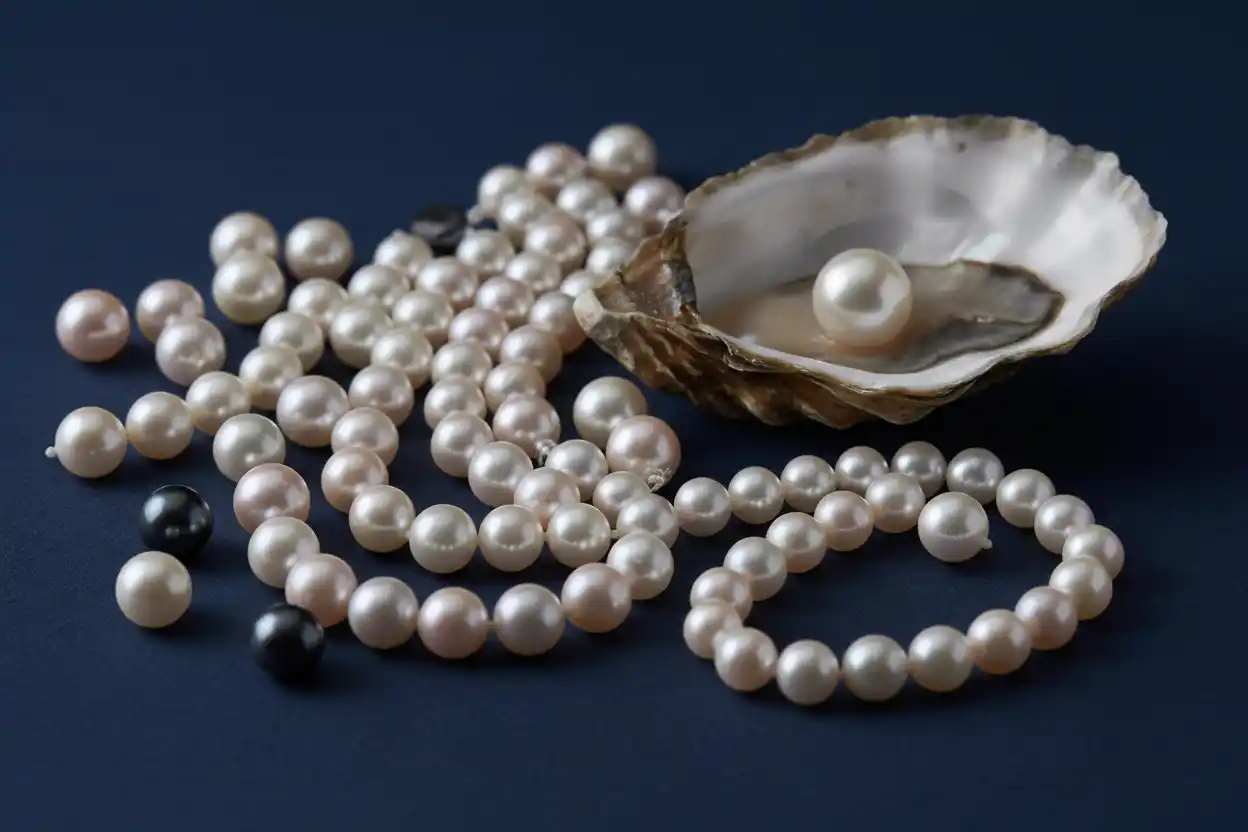
Pearl Meaning, Properties, Types & Symbolism
Pearl is a biological gemstone produced inside the soft tissue of certain saltwater and freshwater mollusks. Rather than crystallizing inside rock, it grows as the animal deposits calcium-carbonate layers and an organic binding material around a developing pearl sac.
Natural pearls form without deliberate human intervention, whereas cultured pearls result from a carefully managed process initiated by a pearl farmer. Both are genuine pearl products; cultured pearls are not synthetic imitations.
Pearl at a Glance
| Property | Pearl |
|---|---|
| Material type | Organic gem product formed by mollusks |
| Principal composition | Calcium carbonate, usually aragonite in nacreous pearls, with an organic matrix and water |
| Common colors | White, cream, silver, gold, yellow, peach, pink, lavender, gray, green, blue, and black |
| Crystal system | No single system applies to the complete pearl; aragonite platelets are orthorhombic |
| Internal structure | Concentric or overlapping calcium-carbonate layers bound by organic material |
| Luster | Pearly, ranging from dull to mirror-bright |
| Transparency | Opaque to translucent at thin edges |
| Mohs hardness | Approximately 2.5–3 |
| Cleavage | None as a biological composite |
| Tenacity | Usually good for its low hardness, but aging, dehydration, thin nacre, or treatment can increase fragility |
| Specific gravity | Commonly approximately 2.60–2.85 |
| Common uses | Necklaces, earrings, rings, bracelets, brooches, pendants, buttons, embroidery, and collectible natural pearls |
| Main care concern | Abrasion, acids, perfume, cosmetics, perspiration, dehydration, excessive heat, weak stringing, and thin nacre |
Pearl Is an Organic Gem, Not a Crystal
Pearls belong to the organic and biogenic category described in types of gemstones. They are created by living animals, although most of a finished nacreous pearl consists of mineral calcium carbonate.
The individual aragonite platelets within nacre are crystalline. However, the complete pearl also contains conchiolin-like organic material, water, pores, growth boundaries, and layered biological structures.
For that reason, a pearl should not be assigned one crystal system as though it were a single mineral crystal.
Its structure is better described as a natural composite engineered by the mollusk. Extremely thin mineral tablets overlap like microscopic tiles, while organic layers bind the structure together.
That arrangement produces a material that is soft enough to scratch easily but often more resistant to sudden breakage than its low Mohs hardness suggests.
How a Pearl Forms
A pearl begins when mantle cells form a pearl sac within the mollusk’s soft tissue.
The familiar story that every pearl grows around a grain of sand is an oversimplification. Natural pearls may begin after microscopic parasites, tissue damage, displaced mantle cells, shell fragments, or other biological disturbances.
Once the pearl sac develops, it secretes calcium carbonate and organic material in repeated layers.
Nacreous mollusks deposit aragonite tablets in an organized structure similar to the interior of their shells. As the pearl grows, small changes in secretion, animal health, water conditions, and sac shape influence its surface and final form.
Growth can continue for months or years. Longer periods may build thicker nacre, although extended cultivation also exposes the mollusk to disease, storms, temperature changes, pollution, and other risks.
Natural and Cultured Pearls
A natural pearl forms without deliberate human intervention. The event begins within a wild mollusk through a naturally occurring biological process.
A cultured pearl forms after a technician initiates pearl-sac development. The mollusk then performs the actual mineral deposition.
Bead-nucleated culturing usually places a rounded shell bead and a small piece of donor mantle tissue inside the host mollusk. The tissue develops into a sac that coats the bead with nacre.
Tissue-nucleated culturing places mantle tissue without a large bead into the host. The resulting pearl can consist almost entirely of nacre and organic material.
Modern freshwater pearl production includes both tissue-nucleated and bead-nucleated techniques. Saltwater Akoya, Tahitian, and South Sea cultured pearls are commonly bead nucleated.
The word cultured must remain in the description because it explains human involvement. However, it does not mean artificial, fake, or laboratory-grown.
Artificial products made from glass, plastic, shell powder, ceramic, or coated beads are imitation pearls rather than cultured pearls.
The Main Cultured Pearl Categories
Freshwater cultured pearls grow mainly in freshwater mussels. They occur in white, cream, peach, pink, lavender, and treated colors, with round, near-round, oval, button, drop, ringed, and highly baroque shapes.
Akoya cultured pearls are produced primarily by small saltwater pearl oysters. They are known for relatively modest size, roundness, white-to-cream bodycolor, and sharp reflective luster.
Tahitian cultured pearls grow in black-lipped pearl oysters. Their natural bodycolors include gray, charcoal, green, blue-green, silver, and nearly black, often with peacock, rose, aubergine, or blue overtones.
South Sea cultured pearls grow in large silver- or gold-lipped oysters. They are commonly white, silver, cream, or gold and can reach larger sizes than most Akoya and freshwater pearls.
The complete distinctions among these products, along with keshi, blister, mabe, and non-nacreous pearls, belong on the dedicated guide to types of pearl.
Nacreous and Non-Nacreous Pearls
Most familiar jewelry pearls are nacreous. Their surfaces contain overlapping aragonite tablets that produce the depth and orient associated with traditional pearl luster.
Not every biologically produced pearl has this structure.
Conch pearls form in queen conchs and may show a flame-like pattern rather than nacreous iridescence. Their colors commonly include pink, peach, cream, and white.
Melo pearls can occur in orange, yellow, brown, or cream and may also display flame structures.
Quahog, scallop, clam, and other mollusks can produce calcareous concretions that qualify as natural pearls under appropriate biological and gemological definitions.
These non-nacreous pearls have different internal structures, appearances, durability concerns, and markets. They should not be evaluated solely through the same nacre criteria applied to Akoya or South Sea cultured pearls.
Pearl and Mother of Pearl
Pearl and mother of pearl can come from the same mollusk, but they are not the same object.
Mother of pearl, also called nacre, lines the inside of many shells. It forms as relatively flat or curved shell layers and is cut into inlay, buttons, cabochons, watch dials, and decorative components.
A pearl develops as a separate rounded, baroque, drop-shaped, or irregular formation within the mollusk’s tissue or against the shell.
The dedicated Mother of Pearl guide explains shell-layer structure, cutting behavior, and identification without treating shell inlay as a pearl.
A bead nucleus used in pearl culturing may itself be cut from nacreous freshwater shell. Nevertheless, the finished cultured pearl includes the new biological layers deposited around that bead.
What Creates Pearl Luster?
Luster describes the quality and quantity of light reflected from the pearl’s surface and near-surface layers.
Fine pearls produce bright, sharp reflections. A viewer may see the outline of a window, lamp, or facial features on the surface rather than a diffuse white patch.
The effect depends on smoothness, nacre structure, layer thickness, transparency, and the consistency of microscopic mineral tablets.
Light can reflect from the exterior and penetrate slightly into the nacre before returning. Interference among these reflections creates visual depth.
Thin, poorly organized, dehydrated, damaged, or chalky nacre produces weaker, hazier luster.
A heavily polished surface can look shiny while lacking the depth of naturally fine nacre. Therefore, surface gloss alone does not define pearl quality.
Orient and Overtone
Bodycolor is the pearl’s dominant overall color. Overtone is a secondary translucent color visible across the body, such as rose over white or peacock over dark gray.
Orient is a shifting iridescent effect created by interference within fine surface and near-surface structures. It can display pink, green, blue, and violet colors that move as the pearl turns.
Fine orient is especially prized in translucent nacre and certain natural pearls. However, not every pearl displays a dramatic rainbow effect.
Bodycolor can be natural or treated. Freshwater cultured pearls are often dyed into black, blue, green, red, and other colors that do not correspond to their original appearance.
Akoya pearls may undergo routine bleaching and controlled processing to improve consistency. Tahitian and South Sea pearls are valued strongly for naturally produced dark, white, silver, and golden colors.
Treatment details belong on treated-pearl identification.
Pearl Shapes
Perfectly round pearls receive strong demand because they are difficult to produce and easy to match into traditional strands.
Near-round pearls look round during normal wear but reveal slight asymmetry when rolled or measured.
Oval, button, drop, pear, and teardrop shapes suit earrings and pendants. A well-balanced drop can be more desirable than a poorly surfaced round pearl.
Baroque pearls have irregular outlines. Their ridges, curves, points, flat sections, and asymmetrical forms make every piece visually distinct.
Circled pearls show one or more grooves around their circumference. This pattern is common in some Tahitian and South Sea cultured pearls.
Keshi cultured pearls are non-beaded by-products or intentional tissue-grown products associated with pearl culturing. They often have irregular shapes and high nacre content, although the term should be qualified accurately.
Matching becomes increasingly difficult as pearl size, color complexity, luster, and roundness improve. A fine strand therefore represents both individual pearl quality and the labor required to assemble a harmonious set.
Pearl Quality Factors
Pearls require a different quality system from faceted gemstones.
Size measures the pearl’s dimensions, usually in millimeters. Price can increase rapidly as size rises because large pearls require suitable mollusks and longer or more difficult cultivation.
Shape ranges from round to highly baroque. Roundness carries a premium in traditional strands, while distinctive baroque shapes can command strong designer demand.
Color includes bodycolor, overtone, and orient. Preferences depend on pearl type, market, fashion, and how the color complements the wearer or design.
Luster is often the most important visible quality factor. Bright, sharp reflections make a pearl appear lively even when minor surface features remain.
Surface quality considers pits, bumps, wrinkles, scratches, cracks, flat spots, discoloration, and other growth features.
Nacre quality evaluates the appearance and, where relevant, thickness or condition of the deposited pearl layers. Thin nacre can reveal the bead beneath and reduce long-term durability.
Matching measures how consistently pearls in a strand, pair, or suite correspond in size, shape, color, luster, surface, and overall appearance.
These seven factors should be assessed together rather than reduced to an unregulated AAA label.
How Laboratories Identify Pearls
A gemologist begins with magnification, surface appearance, luster, drill-hole structure, weight, ultraviolet response, spectroscopy, and other non-destructive observations.
Natural and cultured pearls can look identical externally. Internal analysis is therefore essential when origin materially affects value.
X-radiography reveals differences in growth structure. A bead-nucleated cultured pearl commonly shows a large central nucleus surrounded by nacre.
Tissue-nucleated freshwater cultured pearls may contain irregular internal cavities, organic structures, or growth features without a shell bead.
Natural pearls can show concentric internal growth, small cavities, or complex structures that differ from common cultured products.
X-ray computed microtomography can provide three-dimensional views of a pearl’s interior. This method helps laboratories identify nuclei, cavities, drilled channels, filling, and natural growth structures.
Raman spectroscopy, X-ray fluorescence, radiography, and chemical analysis may also help determine mollusk environment, treatment, or whether a product is an imitation.
Home tests cannot reliably separate every natural, cultured, and imitation pearl. The dedicated guide to real versus fake pearl owns detailed authentication intent.
Common Pearl Imitations
Coated glass beads are among the most familiar imitations. Their surfaces may feel smooth and display uniform color without the fine layered texture of nacre.
Plastic pearls are lighter and may show mold lines, peeling coating, or visible seams around drill holes.
Shell pearls commonly use a bead made from crushed or shaped shell material covered with an artificial coating. They contain shell-derived components but are not cultured pearls.
Majorca and similar branded imitation pearls use manufactured cores and coatings designed to reproduce pearl appearance. The brand name should not conceal their imitation status.
Cheap imitations may look convincing in photographs. Magnification around drill holes often reveals chipped coating, exposed glass or plastic, pooled paint, or glue.
A tooth-rubbing test is widely promoted but can scratch the pearl, contaminate it, and provide ambiguous results. Professional testing is preferable for meaningful purchases.
Pearl Treatments
Bleaching is widely used to reduce unwanted organic staining and improve color consistency.
Dye can create black, blue, green, pink, gold, or other hues. Pigment may become visible inside drill holes or surface defects.
Irradiation can darken some pearls or their nuclei. The response depends on freshwater or saltwater origin, internal material, and treatment conditions.
Luster enhancement may alter surface appearance through polishing, coating, or proprietary processing.
Wax, oil, polymer impregnation, and filling can improve apparent smoothness or conceal damage.
Working may include peeling, grinding, polishing, cutting, or modifying a natural or cultured pearl. Significant alteration should be disclosed because it affects structure and value.
Treatments are not automatically unacceptable, but the description must not imply untreated natural color or an intact pearl when that is inaccurate.
Pearl Durability
Pearl ranks only about 2.5–3 on the Mohs scale. Quartz dust, metal edges, gemstones, and ordinary abrasive particles can scratch its surface.
The gemstone hardness chart places pearl among the softest commonly worn gems.
Its layered composite structure can provide useful toughness, yet aging, dehydration, thin nacre, bleaching, drilling, and impact may create cracks or peeling.
The distinction between scratching and structural failure is explained in gemstone toughness versus hardness.
Pearl earrings and necklaces generally survive better than rings and bracelets because they receive less direct abrasion.
The pearl earrings guide covers stud, drop, hoop, and matched-pair considerations without duplicating pearl formation.
Rings require a protected setting and should be reserved for careful wear. Repeated contact with desks, doors, household chemicals, and handwashing can damage nacre.
Current Pearl Asking Prices
Pearl prices vary by type, size, luster, surface, shape, nacre, matching, treatment, jewelry metal, and brand.
| Pearl product | Broad July 2026 retail asking range |
|---|---|
| Simple freshwater cultured-pearl earrings or pendant | About $30–$250 |
| Commercial freshwater cultured-pearl strand | About $100–$300 |
| Fine freshwater cultured-pearl strand | About $300–$800 or more |
| Commercial Akoya cultured-pearl strand | About $300–$800 |
| Fine Akoya cultured-pearl strand | About $800–$5,000 or more |
| Commercial Tahitian cultured-pearl strand | About $500–$1,500 |
| Fine Tahitian cultured-pearl strand | About $1,500–$5,000 or more |
| Commercial South Sea cultured-pearl strand | About $1,000–$3,000 |
| Fine South Sea cultured-pearl strand | About $3,000–$10,000 or more |
| Luxury-brand, exceptional matched, or very large strand | About $10,000–$50,000 or more |
| Laboratory-confirmed natural pearl | Individually valued; fine examples may reach thousands, tens of thousands, or substantially more |
These ranges are broad asking-price context rather than formal appraisals or resale guarantees.
The dedicated pearl price guide should own detailed comparisons among pearl types, millimeter sizes, grading claims, jewelry formats, and natural-pearl premiums.
What Gives Pearl Value?
Pearl type establishes the market context. A freshwater cultured pearl, Akoya pearl, Tahitian pearl, South Sea pearl, conch pearl, and natural saltwater pearl cannot be valued through one universal table.
Luster usually has the strongest immediate effect. Bright, crisp reflections make a pearl appear more alive and can compensate for a few minor surface features.
Size raises value when other qualities remain equal. The increase can be nonlinear because large fine pearls are harder to cultivate.
Roundness receives a premium, although well-shaped drops and unusual baroque pearls have independent designer markets.
Color should be attractive, even, and appropriately disclosed. Natural peacock, silver, gold, rose, lavender, and overtone combinations may command strong demand.
Surface quality matters, but completely flawless pearls are rare. The position and visibility of marks are often more important than their total number.
Nacre must appear healthy and durable. Chalkiness, exposed nuclei, peeling, or thin layers reduce value.
Matching can add substantial cost to a pair or strand because the seller may need to sort through thousands of pearls.
Finally, laboratory documentation becomes essential when a seller claims natural origin, unusual mollusk species, exceptional treatment status, or a rare geographic source.
Buying Pearls
Ask whether the product is a natural pearl, cultured pearl, composite pearl product, or imitation.
The word real is insufficient because both natural and cultured pearls are genuine, while an imitation may also contain shell material.
Identify the pearl type, approximate size, bodycolor, treatment, surface grade, luster description, and metal used in the jewelry.
Do not rely on AAA, AAAA, Hanadama-style, gem grade, or top quality without understanding the seller’s grading system. Most commercial letter grades are not standardized across retailers.
Inspect photographs that show reflections clearly. Overexposed white backgrounds can conceal poor luster and surface defects.
For strands, check matching, knotting, clasp quality, string condition, and whether each pearl is individually knotted.
A laboratory report is appropriate for a valuable natural pearl or major matched collection. It may be unnecessary for an inexpensive cultured strand sold with full disclosure.
The dedicated pearl buying guide owns seller comparisons, laboratory reports, return policies, and transaction safeguards.
Pearl appears in the crystals beginning with P directory and the gemstones beginning with P directory, although it is a biological gem rather than a mineral crystal.
Cleaning and Storage
Put pearl jewelry on after cosmetics, perfume, hairspray, lotion, and other personal products have dried.
Remove it before swimming, bathing, exercising, cooking, cleaning, or sleeping.
After wear, wipe each pearl gently with a clean, soft, slightly damp cloth to remove perspiration and cosmetic residue.
For occasional deeper cleaning, use lukewarm water with a small amount of mild soap. Avoid prolonged soaking, particularly when the pearls are strung.
Never use steam or ultrasonic cleaning. Heat, vibration, weak string, drill holes, treatment, and delicate nacre create unnecessary risks.
Allow a washed strand to dry flat before wearing or storing it. Wet silk or thread can stretch and attract dirt inside drill holes.
Store pearls separately in a soft fabric pouch. Plastic bags can trap unsuitable conditions, while harder gemstones will scratch the nacre.
Do not store pearls for years in an excessively hot, dry safe. Moderate environmental humidity helps reduce dehydration risk, although deliberate water immersion is not appropriate.
A frequently worn strand should be restrung when its cord stretches, discolors, frays, or leaves visible gaps between knots.
The complete process appears in how to clean pearl jewelry.
Pearl Meaning and Symbolism
Pearls have held symbolic importance across Asian, Middle Eastern, European, African, Pacific, and Indigenous cultures.
Their formation inside water-dwelling mollusks has supported associations with the sea, rain, the moon, fertility, prosperity, status, protection, mourning, purity, and wisdom.
No single meaning belongs to every society. White-pearl bridal symbolism, Gulf natural-pearl heritage, Chinese dragon-pearl imagery, and Pacific shell traditions developed within distinct cultural contexts.
Modern interpretations commonly connect pearl with composure, integrity, maturity, patience, and lessons developed gradually through experience.
Its layered formation provides a natural metaphor for growth: small deposits accumulate over time until they create a finished structure.
Pearl is also one of June’s recognized birthstones, alongside moonstone and alexandrite, as explained in the June birthstone guide.
Belief-based wellness claims belong on the dedicated pearl healing-properties guide. Scientific evidence does not show that wearing pearls treats illness, balances hormones, or guarantees emotional outcomes.
Frequently Asked Questions
Are cultured pearls real pearls?
Yes. Cultured pearls are genuine biological pearl products whose growth was initiated through human intervention and completed by a living mollusk.
What is the difference between natural and cultured pearls?
Natural pearls begin without deliberate human help. Cultured pearls develop after a technician inserts mantle tissue, usually with or without a bead nucleus.
Do pearls really form around grains of sand?
Occasionally, but the familiar sand-grain story is not the usual explanation. Natural pearls more often begin after microscopic biological irritation, tissue displacement, parasites, or injury.
What are pearls made from?
Most familiar nacreous pearls consist mainly of microscopic aragonite calcium-carbonate tablets bound by organic material and containing some water.
What is the difference between freshwater and saltwater pearls?
They grow in different mollusks and environments and commonly differ in nucleation, size, shape, color, nacre structure, production volume, and price.
Is mother of pearl the same as pearl?
No. Mother of pearl is the nacreous lining of a shell, while a pearl forms as a separate growth within tissue or against the shell.
Why do fine pearls look as though they glow?
Light reflects from the surface and near-surface nacre layers. Fine, orderly mineral tablets create sharp luster and visual depth.
Are black, pink, and golden pearls naturally colored?
Natural colors occur, especially in Tahitian, South Sea, and freshwater pearls. Dye, irradiation, coating, and other treatments can also create or modify color.
How can I tell whether a pearl is natural, cultured, or imitation?
External inspection can reveal some imitations, but X-radiography and other laboratory tests are often necessary to distinguish natural and cultured growth structures.
Are pearls suitable for everyday jewelry?
Earrings and necklaces can be worn regularly with good care. Rings and bracelets receive greater abrasion and chemical exposure.
Can pearls get wet?
Brief gentle washing is acceptable, but soaking is not recommended. Strands must dry completely before wear or storage.
What makes a pearl valuable?
Pearl type, size, shape, color, luster, surface, nacre, matching, treatment, provenance, condition, and jewelry craftsmanship determine value.
Pearl’s appearance becomes much easier to evaluate once luster, nacre, shape, and matching are considered separately. Readers choosing their first strand can apply those factors to the construction and length decisions discussed in the pearl necklace guide.