11 Real Rainbow Obsidian Benefits: Grief Healing & Volcanic Glass Cautions
Rainbow obsidian benefits begin with the distinctive properties of natural volcanic glass. Rainbow obsidian is not a crystalline mineral with a fixed chemical formula. It is a silica-rich volcanic rock, usually rhyolitic in composition, that cooled rapidly enough for most of the melt to solidify as glass instead of developing an extensive crystalline structure.
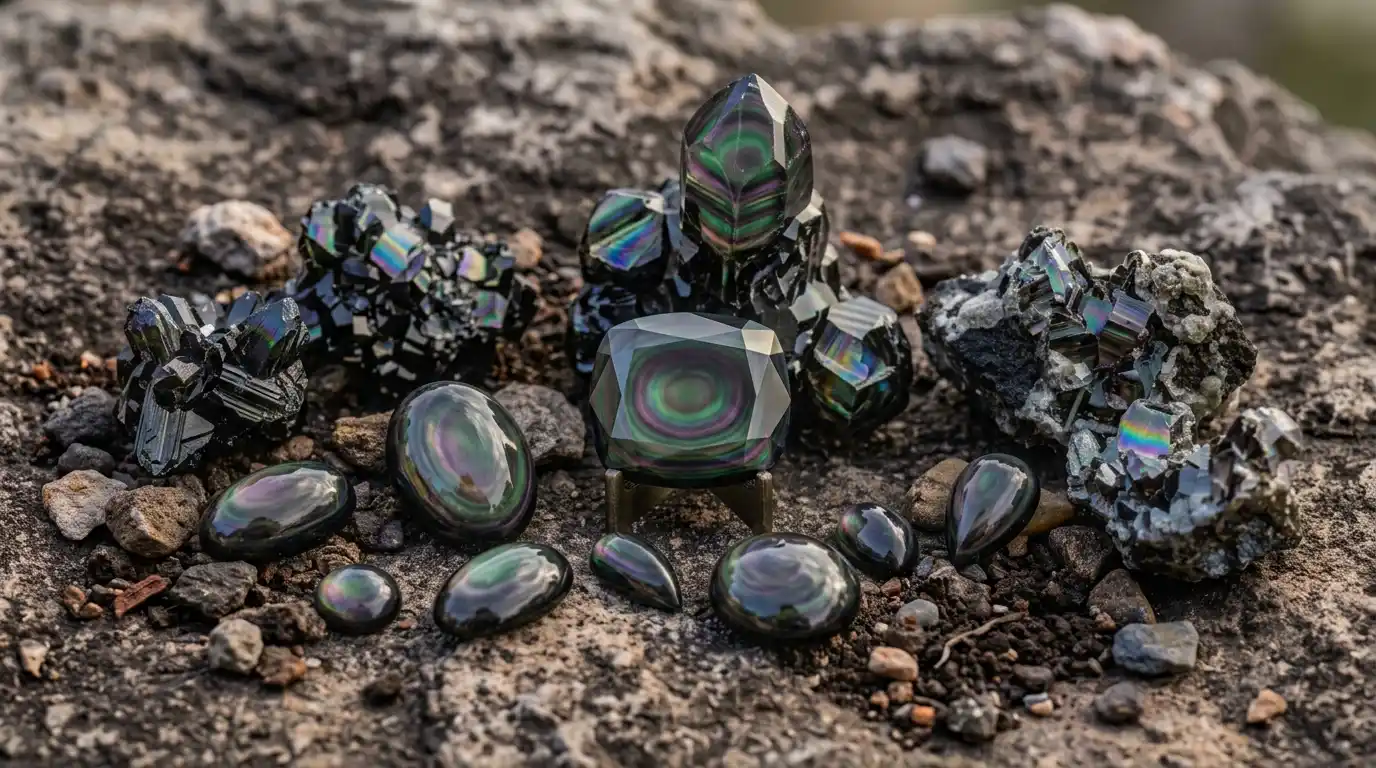
Its dark body can reveal green, violet, blue, gold, reddish, or multicolored sheen when a polished surface is viewed at the correct angle. In well-studied Mexican rainbow obsidian, especially specimens from Jalisco, this iridescence has been linked to extremely small oriented mineral inclusions within the glass. That optical structure gives rainbow obsidian practical value for lapidary work, collecting, geology education, and identification.
Modern crystal traditions also associate rainbow obsidian benefits with grief reflection, emotional processing, protection, grounding, and personal transformation. These practices may give someone a meaningful focus during meditation or journaling, but rainbow obsidian has not been shown to treat grief, depression, trauma, anxiety, or another psychological or medical condition.
11 Rainbow Obsidian Benefits at a Glance
- Iridescent green, violet, blue, gold, and multicolored sheen gives polished rainbow obsidian distinctive visual appeal.
- Its volcanic-glass structure provides a useful example of rapid cooling and inhibited crystallization.
- Conchoidal fracture demonstrates how noncrystalline glass can break into smooth curved surfaces and exceptionally sharp edges.
- Rainbow obsidian is well suited to cabochons, carvings, spheres, polished freeforms, beads, and display pieces.
- Microscopic inclusions responsible for some rainbow effects make the stone valuable for optical and petrographic study.
- Geological provenance can add collector interest, especially for documented Mexican rainbow obsidian.
- Its approximately Mohs 5 to 5.5 hardness provides moderate scratch resistance but does not eliminate brittle fracture risk.
- Archaeological obsidian demonstrates the long practical importance of volcanic glass for cutting tools and exchange networks.
- Modern grief symbolism can make the stone a personal reminder for reflection, remembrance, or journaling.
- Grounding and protective themes can support intentional spiritual practice without being treated as measurable physical effects.
- Understanding sharp fracture edges, impact sensitivity, temperature change, and careful cleaning improves safe ownership.
Rainbow Obsidian Benefits Start With Volcanic Glass Formation
One of the most important rainbow obsidian benefits is its geological value. Obsidian develops when silica-rich lava cools rapidly and crystallization is strongly inhibited. The result is volcanic glass rather than a rock composed mainly of visible interlocking mineral crystals.
High-silica magma is extremely viscous, which slows atomic movement and makes crystal growth more difficult during rapid cooling. Obsidian is therefore commonly associated with rhyolitic volcanic systems, lava flows, domes, and other silica-rich volcanic activity.
Because it is glass, obsidian is amorphous on a large structural scale rather than belonging to a crystal system such as cubic, trigonal, or monoclinic. Calling rainbow obsidian a “crystal” may be common in spiritual commerce, but “volcanic glass” is the more accurate geological description.
This distinction is not merely technical. It explains rainbow obsidian’s fracture behavior, vitreous luster, lack of cleavage, and the way inclusions or flow structures can become visible after polishing.
Why Rainbow Obsidian Shows Iridescent Colors
The optical sheen is one of the most recognizable rainbow obsidian benefits. Most pieces look black or very dark until polished and tilted under directional light, when curved bands of green, purple, gold, blue, or other colors can appear beneath the surface.
The effect is caused by microscopic structures that reflect and interfere with light. In notable rainbow obsidian from Jalisco, Mexico, research has identified oriented nanocrystals of hedenbergite, a pyroxene-group mineral, as an important source of the colored iridescence.
This does not mean every iridescent obsidian deposit must contain precisely the same inclusion population. Sheen in obsidian can also be influenced by microscopic mineral inclusions, bubbles, flow structures, and related features, so identification should consider the actual specimen rather than applying one explanation universally.
The color is structural and optical rather than a luminous energy produced by the rock. That scientific explanation makes the phenomenon more interesting because a dark volcanic glass can produce vivid color through structures that may be microscopic.
Lapidary and Jewelry Value
Rainbow obsidian benefits lapidaries because polishing can reveal optical features that are difficult to see on an unworked surface. Cutters commonly fashion it into cabochons, spheres, palm stones, carvings, beads, pendants, polished slabs, and decorative freeforms.
Orientation matters greatly. A piece can contain attractive rainbow bands yet appear almost completely black if the surface is cut at the wrong angle relative to the internal layers responsible for the sheen.
Experienced cutters therefore inspect rough carefully and may test-polish a surface before committing to the final shape. Curved cabochons and spheres can be particularly effective because changing viewing angles allow different parts of the sheen to appear as the piece moves.
Rainbow obsidian can also be used in rings and bracelets, but these settings expose it to more frequent impacts. Pendants, earrings, carvings, and display specimens are generally easier environments for preserving polished glass.
Hardness Does Not Prevent Conchoidal Fracture
Rainbow obsidian is commonly around Mohs 5 to 5.5, giving it moderate resistance to scratching. That number should not be confused with high resistance to breakage because obsidian remains brittle.
Unlike feldspar or fluorite, obsidian does not possess mineral cleavage planes in the conventional crystallographic sense. Instead, it characteristically breaks by conchoidal fracture, producing smooth curved surfaces that can terminate in extremely sharp edges.
The difference between gemstone toughness and hardness is therefore especially useful when evaluating rainbow obsidian. Hardness concerns scratching, while toughness describes resistance to chipping, cracking, and breaking under mechanical stress.
A polished piece may tolerate ordinary handling for years but still chip if dropped onto tile or struck against metal. The newly broken edges can be sharp enough to cut skin, so damaged pieces should be handled cautiously.
Archaeological and Educational Benefits of Obsidian
The sharpness produced by conchoidal fracture gave obsidian major technological importance long before it became popular as polished jewelry. People in many parts of the world fashioned volcanic glass into blades, projectile points, scrapers, and other cutting tools.
Obsidian is particularly useful for controlled flaking because fracture can propagate through the glass in relatively predictable curved patterns. Skilled toolmakers could remove flakes with acute edges far sharper than ordinary broken rock.
Archaeologists also analyze the chemical composition of obsidian artifacts to compare them with geological sources. This can reveal how raw volcanic glass moved between communities and provide evidence for ancient exchange, travel, and social connections.
These practical and archaeological uses are among the strongest real rainbow obsidian benefits because they arise directly from the physical behavior and geological provenance of obsidian.
Geological Provenance and Collector Appeal
Knowing where rainbow obsidian is found can significantly increase the scientific and collector value of a specimen. Rainbow obsidian is especially associated in the gem and mineral trade with deposits in Jalisco, Mexico, including material from the Magdalena region.
A documented locality can help explain the rock’s flow banding, inclusion structures, optical sheen, and relationship to a particular volcanic province. Provenance also helps distinguish a geologically documented specimen from generic black glass marketed only under an attractive trade name.
Collectors often evaluate rainbow obsidian according to intensity of sheen, number of visible colors, pattern, polish quality, size, geological provenance, and absence of distracting fractures. Strong iridescence that appears from a useful viewing angle generally has greater decorative appeal than weak color visible only under highly specific lighting.
Natural variation is expected. Two pieces cut from the same rough block may display different patterns because their polished surfaces intersect internal layers at different orientations.
Rainbow Obsidian Benefits for Grief Reflection
Grief healing is a common phrase in discussions of rainbow obsidian benefits, but it requires careful interpretation. Modern spiritual practices sometimes use the dark glass and hidden rainbow sheen as symbols of finding hope, color, or meaning during periods of sadness and loss.
That metaphor can be emotionally resonant without requiring a medical claim. Someone might hold rainbow obsidian while journaling about a loss, place it beside a photograph during remembrance, or use it as a tactile focus during quiet reflection.
The stone itself does not process grief for the person or shorten a normal grieving process. Persistent or overwhelming grief may require support from qualified mental-health professionals, healthcare providers, grief counselors, trusted community members, or other appropriate resources.
Claims about rainbow obsidian healing properties are therefore best treated as spiritual traditions and personal practices rather than clinical effects. Reflection with a meaningful object can coexist with professional support when needed.
Grounding, Protection, and Personal Ritual
Grounding is another frequently mentioned theme among rainbow obsidian benefits. The dark appearance of obsidian has led many contemporary crystal traditions to associate it with stability, boundaries, protection, and attention to difficult emotions.
These ideas are symbolic. Scientific testing has not demonstrated that rainbow obsidian creates an invisible protective field, removes negative energy from the body, or blocks harmful intentions from other people.
A practical interpretation is more defensible. A person can intentionally associate the stone with pausing before reacting, maintaining personal boundaries, or returning attention to immediate tasks during stressful moments.
The object then functions as a cue within a chosen routine. The action, reflection, or boundary-setting comes from the individual rather than from a measurable energy emitted by volcanic glass.
Water, Temperature, and Cleaning Safety
Rainbow obsidian is generally more tolerant of brief clean-water contact than many porous or water-reactive collector specimens. However, the question of whether rainbow obsidian is safe in water should still distinguish gentle washing from prolonged soaking, rapid temperature change, jewelry immersion, or repeated ritual exposure.
The greater physical concern is often thermal shock or mechanical impact. Glass can crack when subjected to abrupt temperature differences, especially when fractures, inclusions, or internal stresses are already present.
A soft cloth with mild soap and lukewarm water is sufficient for most polished pieces. Avoid boiling water, freezing treatments, harsh abrasives, strong household chemicals, and aggressive impacts during cleaning.
Broken or chipped obsidian requires special care because conchoidal fracture can create extremely sharp edges. A damaged piece should not continue to be carried loosely in a pocket or used in massage until the edge has been professionally smoothed or the specimen has been retired from handling.
How to Identify Genuine Rainbow Obsidian
Authentic rainbow obsidian should retain the fundamental characteristics of natural volcanic glass. It typically shows a vitreous luster, dark bodycolor, conchoidal fracture, and optical sheen arising from internal structures rather than paint or a superficial metallic coating.
The rainbow effect may appear only when the stone is tilted under directional light. This is normal and differs from synthetic decorative glass containing evenly distributed glitter, metallic foil, obvious bubbles, or artificial color patterns.
Visual inspection alone cannot authenticate every specimen. Artificial glass is widely available and can be sold under misleading gemstone names, so provenance and reputable disclosure become increasingly important when an expensive or unusually transparent piece is offered.
A strong rainbow effect does not automatically prove natural origin. The most convincing assessment combines appearance, microscopic examination, physical properties, provenance, and professional gemological or petrographic testing when value justifies it.
Conclusion
Rainbow obsidian benefits include iridescent beauty, lapidary potential, geological education, archaeological significance, collector value, and useful lessons about volcanic glass and conchoidal fracture. Grief healing, grounding, and protection are best understood as symbolic practices that may support reflection without replacing mental-health care or scientific evidence.
FAQs
What are the main rainbow obsidian benefits?
The most defensible rainbow obsidian benefits include attractive iridescence, usefulness for lapidary work, collector appeal, volcanic-geology education, archaeological significance, and distinctive conchoidal fracture. Spiritual traditions also associate it with grief reflection, grounding, and protection, but these are belief-based uses.
Is rainbow obsidian a crystal?
No. Rainbow obsidian is natural volcanic glass rather than a crystalline mineral. It forms when silica-rich lava cools rapidly enough to inhibit extensive crystal growth.
What causes the rainbow colors in rainbow obsidian?
The colors result from light interacting with microscopic internal structures. In well-studied Mexican rainbow obsidian, oriented nanocrystals of hedenbergite have been identified as an important cause of the multicolored iridescence.
Does rainbow obsidian really heal grief?
There is no scientific evidence that rainbow obsidian treats grief or another psychological condition. It may serve as a meaningful object during meditation, remembrance, journaling, or reflection, while significant or persistent grief may require professional or community support.
How hard is rainbow obsidian?
Rainbow obsidian is generally around Mohs 5 to 5.5. It has moderate scratch resistance but remains brittle and can break with sharp conchoidal fracture.
Does rainbow obsidian have cleavage?
Obsidian does not have mineral cleavage because it is amorphous volcanic glass rather than a crystalline mineral. It characteristically breaks by conchoidal fracture.
Can rainbow obsidian be worn every day?
It can be worn with reasonable care, but rings and bracelets face greater impact risk than earrings or pendants. Hard knocks, drops, and contact with harder gemstones can scratch or chip polished obsidian.
Is rainbow obsidian safe in water?
Brief washing in clean lukewarm water is generally different from prolonged soaking. Avoid severe temperature changes, harsh chemicals, and repeated unnecessary immersion, especially when the piece contains fractures, adhesives, or delicate metal settings.
Disclaimer: Grief-healing, grounding, protective, emotional, and energetic descriptions of rainbow obsidian reflect spiritual traditions and personal practices. Rainbow obsidian is not a medical or psychological treatment and should not replace professional healthcare.