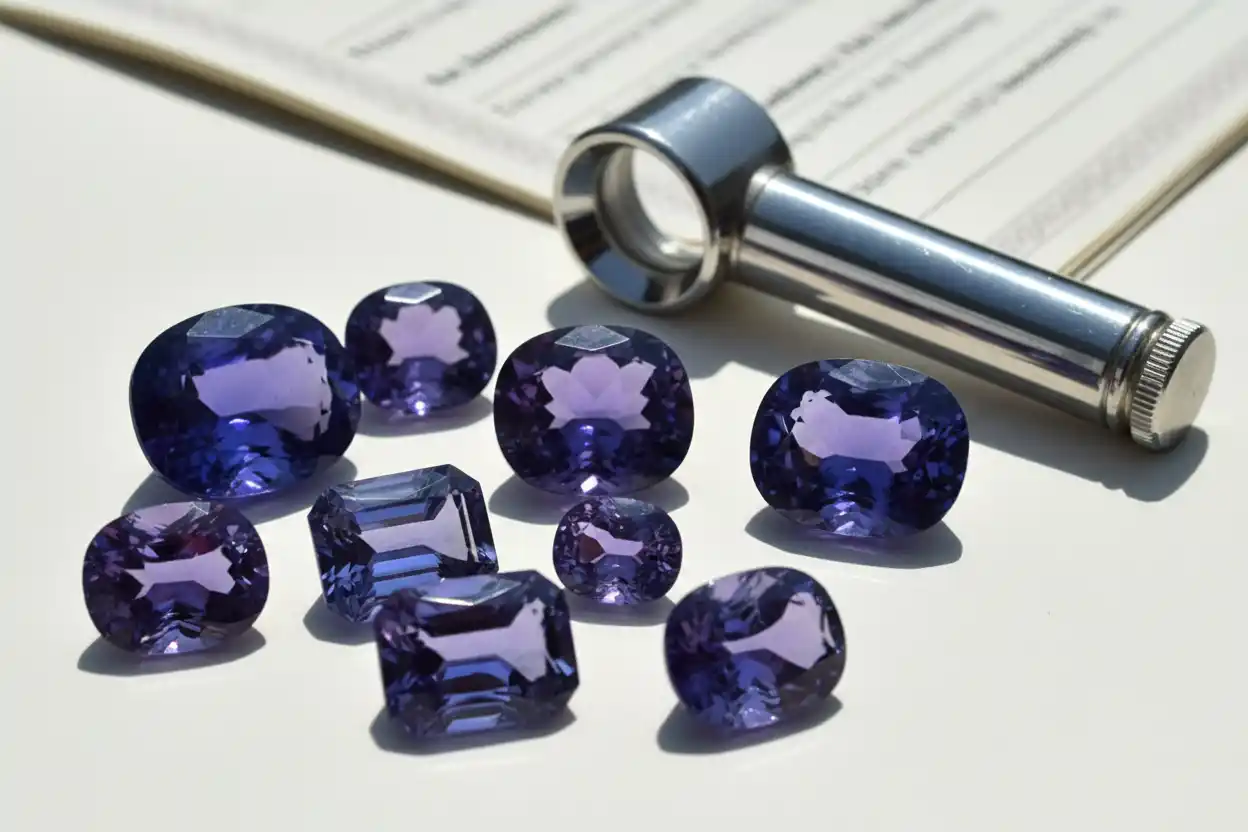
Buy Tanzanite: Smart Buying Tips & Red Flags
When you buy tanzanite, color is usually the first feature you notice, but it should not be the first claim you trust. Fine tanzanite can display saturated violet-blue, blue-violet, purple-blue, and related hues, while strong pleochroism means the same gemstone can reveal noticeably different colors as its orientation changes. Cutting, lighting, depth, heat treatment, and camera settings can therefore make two stones with similar rough characteristics look dramatically different in a listing.
A disciplined way to buy tanzanite begins by confirming that the stone is natural tanzanite rather than iolite, synthetic spinel, synthetic sapphire, synthetic forsterite, glass, cubic zirconia, or another blue-violet substitute. Once identity is secure, evaluate face-up color, pleochroic balance, transparency, clarity, cut, dimensions, structural condition, treatment disclosure, documentation, setting design, and return rights.
Treatment also needs proper context. Most blue-violet tanzanite offered in jewelry has been heated to reduce brownish, yellowish, or greenish components and emphasize the blue and violet directions already present in the crystal. This accepted treatment does not turn natural zoisite into a synthetic gemstone, but coating, fracture filling, misleading untreated claims, and poorly documented simulants belong to different commercial categories.
The strongest way to buy tanzanite is therefore to pay for the finished gemstone you can evaluate rather than for a seller-created grade, an impressive carat number, or a provenance phrase used as a substitute for quality.
What Should You Judge First When You Buy Tanzanite?
When you buy tanzanite, prioritize identity first, followed by face-up color, transparency, clarity, cutting, dimensions, condition, treatment disclosure, documentation, and jewelry suitability. Source terminology and retailer grades should come later because neither can rescue an unattractive or damaged gemstone.
Tanzanite is the transparent blue-to-violet gem variety of zoisite, a calcium aluminum silicate mineral. Its color behavior is strongly directional, which is one reason cutting orientation has an unusually important influence on the finished appearance. The broader mineralogical background is explained in tanzanite meaning, while the host mineral and its related varieties are covered in zoisite.
| Priority | What to evaluate | Stronger choice | Main red flag |
|---|---|---|---|
| 1 | Identity | Natural tanzanite established appropriately | Blue-violet color used as proof |
| 2 | Face-up color | Attractive blue-violet or violet-blue with useful saturation | Gray, brown, overly pale, or nearly black appearance |
| 3 | Pleochroism | Appealing directional colors through normal movement | Seller shows only one ideal viewing angle |
| 4 | Transparency | Open, transparent faceting quality | Cloudiness priced as fine material |
| 5 | Clarity | Eye-clean or minimally distracting inclusions | Large open fractures or cleavage-related damage |
| 6 | Cut | Balanced brightness, color, and face-up spread | Large window, heavy extinction, excessive depth |
| 7 | Treatment | Routine heat and other enhancements disclosed accurately | “Natural” used as though it means untreated |
| 8 | Dimensions | Good visible size for stated weight | Hidden pavilion weight |
| 9 | Documentation | Report appropriate to value and claims | Seller card treated as independent proof |
| 10 | Setting | Protection appropriate to cleavage and moderate hardness | Exposed mounting promoted for unrestricted wear |
Use this hierarchy each time you buy tanzanite and the most common marketing distractions become much easier to identify.
Color Is Usually the Biggest Value Factor
After identity, color normally has the greatest visible influence when you buy tanzanite. Fine stones tend to show an attractive balance of blue and violet with sufficient saturation to look rich while remaining bright enough for the internal color to remain open.
There is no requirement that every fine stone be pure blue. Some buyers prefer a stronger blue face-up appearance, while others deliberately buy tanzanite with more obvious violet because that color combination is part of the gemstone’s distinctive identity.
The important question is whether the color looks attractive across normal viewing conditions.
A stone that is intensely blue under concentrated lighting but becomes pale gray-violet indoors should not be evaluated solely from its best photograph.
Blue-Violet and Violet-Blue Are Not the Same Visual Experience
The wording can sound trivial, but it becomes useful when you buy tanzanite because the dominant color changes how the gemstone reads in jewelry.
Blue-violet generally suggests that blue is visually dominant with violet as the modifying hue. Violet-blue suggests the reverse balance.
Both can be beautiful.
The stronger buy tanzanite choice is the stone whose actual appearance matches your preference rather than whichever listing uses the more prestigious sounding adjective.
Ask for rotating video because a pleochroic stone may move between these impressions as the viewing direction changes.
Do Not Assume the Bluest Tanzanite Is Automatically Best
Strong blue material frequently attracts high demand, yet color quality cannot be reduced to maximum blueness.
When you buy tanzanite, a vivid violet-blue stone with excellent transparency and cut can be considerably more attractive than a darker blue stone whose center suffers from extinction.
A slightly more violet gemstone may also show stronger brightness because the cutter oriented it differently or retained less depth.
If a seller tells you that violet automatically means lower grade, evaluate the actual gemstone rather than accepting a simplified hierarchy.
Tanzanite is naturally pleochroic. Violet is part of its legitimate optical character.
Saturation Matters More Than a Fancy Color Name
Descriptions such as royal blue, electric blue, velvet blue, peacock, AAA blue, exceptional blue, or investment color are not universal tanzanite grades.
When you buy tanzanite, translate every marketing phrase into observable characteristics.
Is the hue attractive?
Is the tone too dark?
Is saturation genuinely strong?
Does the stone retain brightness?
Does the color remain appealing when the lighting changes?
If those questions produce weak answers, the trade term adds little value.
Tone Can Make Fine Color Look Too Dark
A tanzanite can possess strong blue-violet saturation yet still look disappointing if the tone is excessively dark.
When you buy tanzanite, rotate the stone under ordinary reflected light and check whether large areas remain nearly black. Deep material can look luxurious beneath strong showcase lamps while losing much of its visible color in less concentrated illumination.
Some darkness is useful because it creates contrast and helps saturation appear richer. The problem begins when darkness dominates the face.
A slightly lighter gemstone with stronger brightness can provide a better buy tanzanite result than a heavier stone whose color closes up.
Pale Tanzanite Can Still Be Attractive
Small or lightly saturated stones may appear lavender, lilac-blue, violet, or pale blue rather than richly saturated.
When you buy tanzanite on a moderate budget, pale material can still be appealing when it is transparent, well cut, and honestly priced.
The mistake is paying fine saturated-stone prices for weak color because the listing uses an aggressive grade.
A bright pale tanzanite can be preferable to a badly cut dark gem when your objective is a lively piece of jewelry rather than maximum saturation.
Larger Stones Often Show Color More Strongly
Color path length affects how strongly a gemstone appears saturated. As the material becomes larger or deeper, light travels through more colored crystal before returning to the viewer.
When you buy tanzanite, this helps explain why small gems can appear lighter than substantial stones even when the rough has related color characteristics.
However, larger does not automatically mean better. Excessive pavilion depth can intensify color while creating hidden weight, extinction, and smaller-than-expected face-up dimensions.
Judge size and color together rather than paying for one at the expense of the other.
Pleochroism Is Central to How Tanzanite Looks
Tanzanite is strongly pleochroic, meaning different crystallographic directions can show different colors.
When you buy tanzanite, this directional behavior should be treated as one of the gemstone’s defining quality factors rather than as a flaw.
Untreated zoisite rough can reveal combinations including blue, violet, brown, greenish, yellowish, or burgundy-related directions. Heating generally reduces the less commercially desired brown, green, and yellow components, leaving blue and violet more visually dominant.
The finished gemstone still changes subtly as it rotates.
That movement is part of what makes tanzanite visually distinctive.
Cutting Orientation Controls Blue Versus Violet
A cutter can orient tanzanite so the dominant face-up direction emphasizes either more blue or more violet, depending on the rough.
When you buy tanzanite, understand that maximizing the bluest orientation may require greater rough loss. A cutter can sometimes preserve more weight by choosing another orientation that produces a more violet face-up result.
This creates a real value trade-off.
One gemstone may weigh more because the cutter retained rough. Another may weigh less but show the stronger blue color buyers often seek.
Compare what you see rather than assuming the heavier finished gem came from better rough.
Rotating Video Is Essential
Few gemstone categories benefit from video as much as tanzanite.
When you buy tanzanite online, request continuous rotation rather than a collection of disconnected still photographs. The video reveals pleochroism, extinction, windowing, color shifts, inclusion visibility, and overall brightness through movement.
A seller can photograph a pleochroic stone at the single angle where it looks deepest blue.
Video makes that selective presentation harder.
The strongest buy tanzanite listing should help you understand the complete stone, not merely its most flattering orientation.
Neutral Lighting Matters
Lighting can dramatically alter a blue-violet gemstone.
When you buy tanzanite, request at least one image or video under neutral-looking white illumination. Warm light can strengthen violet and purple components, while cooler illumination may emphasize blue.
A dark background can make saturation look deeper. Heavy exposure can make a dark gemstone appear brighter.
Look at neutral objects in the frame. White card should remain reasonably white, and the metal or tweezers should not carry a strong unexplained blue or purple cast.
Color evaluation becomes much more reliable when the surrounding scene looks believable.
Compare Ordinary Indoor Light With Stronger Illumination
Jewelry-counter lighting is designed to make gemstones sparkle. It is useful, but it should not be the only environment used when you buy tanzanite.
Ask how the stone looks under normal indoor illumination. Does the color remain clearly blue-violet? Does it become heavily gray? Does the center darken?
Then examine it under stronger directional light to evaluate brilliance and pleochroism.
A strong gemstone should remain attractive in both situations even though its exact appearance changes.
Heat Treatment Is Routine
One of the most important facts to understand when you buy tanzanite is that heating is normal within the market.
Most blue and violet jewelry-quality tanzanite has been heated to reduce brownish, yellowish, or greenish components and make blue and violet more dominant. The gemstone remains natural zoisite because the crystal formed geologically before treatment.
This distinction matters because some sellers use “natural tanzanite” as though natural automatically means unheated.
It does not.
Natural versus manufactured origin and heat treatment are separate characteristics.
Heated Tanzanite Is Not Fake Tanzanite
A heated natural tanzanite is still tanzanite.
When you buy tanzanite, do not automatically reject routine heating simply because another gemstone category places a large premium on untreated material.
The finished color, transparency, cutting, and condition usually matter more to most jewelry buyers than proving that the stone avoided routine heat.
A strong heated gem can offer considerably more beauty than a weak supposedly untreated stone.
Treatment becomes problematic when disclosure is misleading or when the seller invents an unsupported rarity premium around an untreated claim.
Be Cautious With “Completely Untreated” Premiums
Unheated naturally attractive tanzanite can exist, but proving the exact thermal history of a blue-violet stone is not always straightforward.
When you buy tanzanite at a premium because it is supposedly unheated, read the laboratory report carefully and determine what the laboratory actually concluded. Do not assume that the presence of a report automatically proves an untreated claim.
Ask whether treatment determination for tanzanite is within that laboratory’s service and whether the report explicitly addresses heating.
If the document does not state the claimed characteristic, the seller should not use the document as though it does.
Coated Tanzanite Is a Different Treatment Category
Surface coatings can be applied to pale tanzanite or other gemstones to deepen or modify apparent blue-violet color.
When you buy tanzanite, coating matters far more commercially than routine heat because the color enhancement exists at the surface rather than throughout the natural crystal structure.
A coating can wear, scratch, chip, or respond differently during cleaning and repair.
Possible clues include color concentrations near facet junctions, unusual iridescence, inconsistent color around chipped areas, or a surface film visible under magnification.
These clues justify professional examination rather than destructive testing.
Never Scratch a Stone to Test for Coating
A scratch could permanently damage tanzanite while still providing an ambiguous result.
When you buy tanzanite with suspicious surface color, do not scrape a facet edge, apply solvent, heat the stone, or use an abrasive in an attempt to expose the underlying material.
Professional microscopy and analytical techniques are safer.
The gemstone’s moderate hardness and cleavage make destructive experimentation particularly inappropriate.
Fracture Filling Can Improve Apparent Clarity
Fracture filling is much less characteristic of the tanzanite market than routine heating, but surface-reaching fissures can contain filler.
When you buy tanzanite with obvious fractures, ask whether resin, polymer, oil, or another filling material has been introduced.
Filler can reduce the visibility of a fissure and make the gemstone look cleaner. It can also alter care requirements because chemicals, heat, and mechanical cleaning can affect the filling differently from the zoisite.
Filled material can still be wearable when disclosed and priced appropriately.
“Enhanced” Is Too Vague
When you buy tanzanite, a seller should be able to distinguish ordinary heat treatment from coating, filling, dye, assembly, or another intervention.
The single word enhanced does not tell you enough.
Ask:
What treatment was performed?
Does it affect only color or also clarity?
Is anything present at the surface?
Does the treatment create special cleaning restrictions?
Is the disclosure recorded on the invoice?
A routine heated gemstone and a coated pale gemstone should not be treated as the same product category.
Natural Tanzanite Versus Synthetic Tanzanite
Commercial laboratory-grown tanzanite matching natural blue-violet zoisite is not a dominant mainstream jewelry product.
That does not mean every product marketed as synthetic tanzanite is harmless terminology.
When you buy tanzanite, sellers may use synthetic tanzanite loosely for synthetic forsterite, synthetic spinel, synthetic sapphire, glass, or another manufactured material chosen to imitate the color.
The central question should therefore be what the material actually is.
The wider authentication process appears in real vs fake tanzanite.
Synthetic Forsterite Is an Important Tanzanite Simulant
Synthetic forsterite can be produced with a blue-violet appearance and pleochroic behavior that creates a convincing visual resemblance.
When you buy tanzanite, this simulant deserves attention because the presence of directional color alone does not establish natural zoisite.
Refractive properties, birefringence, spectroscopy, inclusions, and other gemological evidence can distinguish the materials.
Do not pay a tanzanite premium simply because the stone changes between blue and violet as it moves.
Iolite Can Look Surprisingly Similar
Iolite is another naturally pleochroic blue-violet gemstone and one of the more important natural lookalikes.
When you buy tanzanite, iolite can be confused with it because both can show strong directional color. However, their optical properties, density, mineral composition, typical colors, and luster differ.
Iolite often displays a pale, gray, yellowish, or nearly colorless direction that can be quite distinctive, although visual observation alone remains insufficient for an expensive transaction.
The full comparison is covered in iolite vs tanzanite.
A genuine iolite can be beautiful. The issue is paying tanzanite prices for it.
Sapphire Can Also Overlap Visually
Blue and violet sapphire can occupy part of tanzanite’s color range, especially in photographs.
Sapphire is corundum and considerably harder, while tanzanite is zoisite with strong cleavage and a different optical profile.
When you buy tanzanite, the tanzanite vs sapphire comparison is particularly useful if you are deciding between color character and greater durability rather than trying only to identify an unknown stone.
A sapphire can provide stronger resistance to frequent ring wear, while tanzanite offers a highly distinctive blue-violet pleochroic appearance.
Glass and Cubic Zirconia Can Imitate Color Cheaply
Glass can be manufactured in almost any blue-violet shade, while cubic zirconia can provide strong brilliance in similarly colored products.
When you buy tanzanite, bubbles or flow structures may suggest glass, while excessive dispersion or an unusually heavy feel may raise questions about cubic zirconia. These observations are screening clues rather than definitive tests.
Do not use scratch tests.
A polished imitation can still be damaged, while destructive testing provides weaker evidence than proper gemological measurements.
Fine Tanzanite Is Usually Expected to Be Eye-Clean
Transparent faceted tanzanite can occur with excellent clarity, so visible inclusions should be judged more strictly than they are in inherently included gems such as emerald.
When you buy tanzanite, an eye-clean stone is generally desirable, particularly in ordinary jewelry sizes.
Natural inclusions can include mineral crystals, needles, fluid-related features, growth structures, healed fissures, and fractures. Their significance depends on location and visibility.
A small enclosed crystal near the edge may matter very little.
A bright fissure beneath the table is much more distracting.
Inclusions Do Not Prove Natural Origin
One of the most persistent gemstone myths is that included automatically means natural.
When you buy tanzanite, remember that natural material can be extremely clean, while imitations or manufactured substitutes can contain internal features of their own.
One inclusion pattern should never replace complete identification.
Microscopy becomes most useful when its observations agree with refractive properties, optical character, spectroscopy, and the rest of the evidence.
Surface-Reaching Fractures Need Serious Attention
Tanzanite’s cleavage makes fractures particularly important.
When you buy tanzanite, inspect any crack reaching the crown, table, girdle, pavilion, culet, or pointed corners. A fissure near a prong position can create a vulnerability during setting or impact.
A fracture can also contain filler.
Ask for side and pavilion photographs when an internal line appears suspicious.
A high saturation grade does not compensate for a structurally weak stone.
Cut Quality Controls Color as Much as Brilliance
Tanzanite cutting is not simply about maximizing sparkle. The cutter must balance pleochroic orientation, color saturation, face-up dimensions, inclusion placement, cleavage risk, and weight retention.
When you buy tanzanite, evaluate whether the finished stone presents an attractive combination of blue and violet while returning light across most of its face.
A technically symmetrical cut can still be weak if it faces up pale or dark.
An unconventional cut can be excellent if it presents the color beautifully.
Windowing Is Common Enough to Check Carefully
A window is a pale or transparent face-up area where light passes through the pavilion rather than returning toward the viewer.
When you buy tanzanite, place the gemstone against a neutral background and inspect the center.
If a broad central area allows you to see the background clearly, the pavilion may be too shallow.
Windowing weakens color intensity and brilliance, which is particularly damaging in lightly saturated material.
A small amount of leakage at changing angles is normal. A large stationary window should reduce the price.
Extinction Can Make Tanzanite Look Nearly Black
Extinction is the opposite optical problem.
When you buy tanzanite, large dark areas can appear when body color, orientation, and cutting combine to prevent useful light return.
Rotate the stone. Healthy contrast should move as the facet pattern changes. If a large central region remains almost black, the stone may be too dark or poorly proportioned.
A smaller or lighter gemstone with stronger brilliance can look substantially better once set.
Bow Ties Matter in Ovals and Elongated Shapes
Oval, pear, marquise, and elongated cushion tanzanites can show a bow-tie-shaped dark area across the center.
When you buy tanzanite in one of these shapes, request continuous video and inspect whether the bow tie breaks up during movement.
A moderate amount of central contrast can be attractive.
A severe stationary black band can divide the stone visually and suppress otherwise desirable color.
Do not judge bow ties from one photograph because the seller can choose an angle where the effect is minimized.
Compare Carat Weight With Millimeter Dimensions
Carat weight tells you mass rather than visible size.
When you buy tanzanite, always request length, width, and depth. Cutters often retain deeper pavilions because larger weight and stronger color can both be commercially valuable.
That does not make deep cutting automatically wrong.
The question is whether the depth creates a benefit.
If one stone weighs substantially more than another but both have nearly identical face-up dimensions, determine whether the heavier gem has superior color or simply contains hidden weight.
Large Fine Tanzanite Belongs to a Stronger Value Tier
Large tanzanite is available, yet fine quality becomes more demanding as size rises.
When you buy tanzanite in substantial dimensions, evaluate whether strong color, transparency, eye-clean clarity, efficient cutting, and sound condition all survive.
A large pale or heavily windowed gem should not receive the same premium as a saturated, well-cut stone.
The material-specific relationship among color, size, treatment, and market value is covered in tanzanite price.
Carat weight becomes meaningful only after quality is established.
Seller Grades Such as AAA and AAAA Are Not Universal
AAA, AAAA, premium, investment grade, heirloom, top gem, and similar labels do not belong to one globally standardized tanzanite grading system.
When you buy tanzanite, ask exactly what the seller’s grade measures.
Is it color saturation?
Is blue weighted more strongly than violet?
Does the grade include clarity?
Does cut quality matter?
Does treatment change the grade?
Two retailers can use AAA for completely different stones.
Compare the gemstone rather than the letters.
“D Block” Should Not Be Used as an Automatic Quality Grade
The Merelani mining area has been divided into mining blocks, and Block D has developed a strong reputation in tanzanite marketing.
When you buy tanzanite described as D Block, separate provenance from quality.
A mine block is a source claim, not a universal color grade. Not every stone from one block will have identical saturation, clarity, or cutting potential.
Likewise, a fine gemstone should not be dismissed merely because the seller cannot attach a fashionable block label.
If D Block provenance creates a substantial premium, ask what documentation actually connects the stone to that source.
Tanzanite Has an Unusually Concentrated Geographic Source
Unlike gems that occur across numerous countries, commercial tanzanite is associated with the Merelani mining area near Mount Kilimanjaro in northern Tanzania.
When you buy tanzanite, this concentrated source is part of its rarity story.
However, source scarcity should not become a guaranteed investment claim.
A pale commercial stone and an exceptional saturated gemstone come from the same limited geographic region but belong to very different quality tiers.
Geographic scarcity explains part of the market. It does not replace grading of the individual stone.
Mine Scarcity Does Not Guarantee Price Appreciation
Sellers sometimes use the limited deposit to argue that anyone who buys tanzanite is automatically purchasing a rapidly appreciating asset.
That conclusion is too strong.
Resale depends on color, clarity, size, cut, documentation, condition, jewelry design, buyer demand, dealer margins, and the venue through which the stone is sold.
A low-quality stone does not become highly liquid simply because the deposit is geographically restricted.
Buy tanzanite for its beauty and rarity first rather than for guaranteed financial returns.
A Laboratory Report Is Useful When the Stakes Are High
Not every modest commercial stone requires an individual laboratory report.
A report becomes more useful when you buy tanzanite of substantial value, when natural-versus-imitation identity is uncertain, when an unusual untreated claim creates a premium, when coating or filling is suspected, or when the gemstone is especially large.
The report should identify the material and record the stone’s measurements, weight, shape, cutting style, and other relevant characteristics within the laboratory’s service.
Do not assume that every report comments on heating.
Read the actual conclusion.
Ask What the Laboratory Can Establish
When you buy tanzanite because of a specific treatment claim, determine whether the laboratory offers an opinion on that characteristic.
The phrase laboratory certified can create false confidence when the report merely identifies natural tanzanite but says nothing about an untreated claim promoted by the retailer.
Similarly, an identification report does not automatically establish D Block provenance.
The evidence should match the claim that creates the premium.
A Report Is Not an Appraisal
A gemological report addresses identity and supported characteristics. An appraisal estimates monetary value for a defined purpose.
When you buy tanzanite, a high insurance appraisal does not prove that the stone is unheated, untreated, D Block material, or even exceptionally well cut.
Likewise, a respected identification report does not tell you whether the seller’s price is competitive.
Use the report to determine what the stone is.
Use market comparison and quality analysis to determine what it is worth.
Match the Report to the Exact Tanzanite
When you buy tanzanite with documentation, compare the report with the exact gemstone.
Check:
- Carat weight.
- Length.
- Width.
- Depth.
- Shape.
- Cutting style.
- Color description.
- Report number.
- Photograph where supplied.
A report belonging to another gemstone from the same parcel does not identify yours.
If the stone was recut after testing, its measurements and weight may have changed, which should be explained.
Seller Certificates Are Not Independent Laboratory Reports
A retailer can create an authenticity card, appraisal, quality certificate, or AAA document.
When you buy tanzanite, ask who performed the identification and whether the organization is independent from the sale.
A laminated card stating natural AAA tanzanite is not equivalent to a laboratory report merely because it contains technical-looking language.
The value lies in the testing behind the document.
Actual-Stone Photos Are Essential
Tanzanite varies too much in color, pleochroism, cutting, and clarity for stock photographs to represent a premium individual gem accurately.
When you buy tanzanite online, request actual-stone photographs face-up, from the side, and from the pavilion where practical.
A face-up image shows color, windowing, extinction, and inclusions.
A profile shows pavilion depth.
The rear view can reveal chips, fractures, coating irregularities, and hidden inclusions.
The stronger the price, the more complete the visual evidence should become.
Side Views Expose Hidden Weight
A face-up photograph can make a deep tanzanite look excellent because the extra pavilion depth remains invisible.
When you buy tanzanite, inspect the side profile and compare depth with length and width.
A deep pavilion may help preserve color or avoid inclusions. It may also retain unnecessary weight that increases the carat figure without increasing visible size.
Ask what benefit the depth provides.
Pavilion Views Can Reveal Color Concentration and Damage
A rear view is particularly useful when you buy tanzanite with unusually strong color or suspected treatment.
Inspect whether the color appears distributed naturally through the stone, whether facet junctions show suspicious surface concentrations, and whether the pavilion contains chips or fractures.
A single unusual feature does not prove coating or filling.
It tells you where professional examination should focus.
Return Rights Are Part of Online Inspection
Screens cannot reproduce pleochroic color perfectly.
When you buy tanzanite remotely, a meaningful return policy gives you the opportunity to inspect the stone under your own lighting before committing fully.
Check whether tags must remain attached, whether independent testing is permitted, whether setting a loose gemstone ends return eligibility, and who pays insured shipping.
A high-value stone with strong treatment or quality claims should not come with conditions that make reasonable verification impossible.
Put Treatment and Identity Claims in Writing
When you buy tanzanite, important commercial characteristics should appear in the invoice or detailed sales description.
Useful wording can identify the stone as natural tanzanite, disclose routine heat when known or assumed by the seller, mention coating or filling when present, record weight and dimensions, and reference a laboratory report.
If an untreated or specific mine-block claim materially affects the price, preserve that claim in writing as well.
Documentation does not replace testing, but it defines what the seller represented.
Tanzanite Is Less Durable Than Sapphire
Tanzanite has moderate scratch resistance, commonly around Mohs 6–7, but its cleavage and relatively limited toughness make it more vulnerable to hard impact than sapphire.
When you buy tanzanite for a ring, the comparison with sapphire is therefore more than a color question.
Sapphire ranks much higher for abrasion resistance and frequent-wear durability. Tanzanite can still work beautifully in rings when the wearer understands the limitations and the setting protects the stone.
The decision should match the expected wear.
Cleavage Is the Main Durability Risk
Zoisite has pronounced cleavage, meaning the crystal can split more readily along particular structural directions.
When you buy tanzanite, inspect existing fissures, thin girdles, sharp corners, and pointed shapes because a hard impact or setting pressure can exploit those weaknesses.
A high Mohs number would not solve this problem even if tanzanite were harder. Hardness measures scratch resistance, whereas cleavage describes a different type of structural vulnerability.
That distinction should influence both purchase and setting.
Rings Require Protective Design
When you buy tanzanite for a ring, low-profile protective settings are generally preferable to tall exposed designs.
A halo can provide surrounding protection. A bezel or partial bezel can shield portions of the girdle, although the setter must avoid excessive pressure. Substantial prongs can also work when positioned away from fractures.
The exact design should follow the individual stone rather than one universal setting rule.
The broader style and protection trade-offs appear in tanzanite rings.
Pointed Shapes Need Extra Care
Pear, marquise, trillion, and other pointed cuts can be beautiful in tanzanite, but their corners concentrate stress.
When you buy tanzanite in a pointed shape, inspect each tip closely for chips, fractures, and excessive thinness.
Protective V-prongs or equivalent design features can reduce direct impact.
A visually perfect point is valuable only if the setting protects it properly.
Earrings and Pendants Are Lower-Risk Choices
If you buy tanzanite primarily for strong color and larger visible size, earrings and pendants often provide a more forgiving setting environment than rings or bracelets.
These pieces encounter fewer hard surfaces and generally require less direct contact during normal wear.
That can make them especially suitable for larger gems, strong pleochroic stones, or pieces with minor inclusions that would create more concern on the hand.
Avoid Ultrasonic Cleaning
Tanzanite should not be treated as an ultrasonic-friendly gemstone by default.
When you buy tanzanite, plan on gentle manual cleaning because vibration can aggravate fractures and cleavage-related weaknesses, particularly when filler or structural damage is present.
There is little reason to accept that risk when mild soap and careful hand cleaning are effective.
Avoid Steam and Sudden Heat
Steam cleaning combines heat with rapid temperature change, which is inappropriate for a cleavage-sensitive gemstone.
When you buy tanzanite jewelry, also inform the jeweler about the center stone before soldering, resizing, retipping, or another repair involving concentrated heat.
Routine heat treatment performed under controlled gem-processing conditions does not mean a finished gemstone should be exposed casually to a jeweler’s torch.
Those are entirely different thermal situations.
Gentle Cleaning Is the Better Long-Term Approach
For a sound tanzanite, lukewarm water, a small amount of mild soap, and a very soft brush or cloth provide the safer general approach.
When you buy tanzanite with fractures, filler, coating, antique settings, glue, or delicate companion stones, become even more conservative.
Avoid aggressive chemicals, abrasives, extreme temperatures, and prolonged soaking when condition is uncertain.
Value Trade-Off: Blue Versus Violet
Suppose one gemstone is strongly blue but slightly darker, while another is brighter with a more obvious violet component.
Which should you buy tanzanite?
If maximum blue appearance is your priority, the first stone may justify the premium.
If you prefer brightness and the characteristic blue-violet identity of the material, the second may provide greater visual satisfaction.
There is no universal answer.
Pay for the appearance you genuinely prefer rather than the color hierarchy someone else tells you to prefer.
Value Trade-Off: Better Color Versus Better Clarity
Fine tanzanite is often expected to be eye-clean, but a small inclusion can still be a sensible compromise when the color is exceptional.
When you buy tanzanite, compare whether the inclusion is visible during normal wear and whether it creates structural risk.
A vivid blue-violet stone with a tiny enclosed crystal may be much more desirable than a perfectly clean gemstone whose color is weak and gray.
A large surface-reaching fracture creates a different trade-off and should receive far more weight.
Value Trade-Off: Smaller Fine Stone Versus Larger Pale Stone
A larger gemstone can be visually impressive, but size cannot compensate for weak color indefinitely.
When you buy tanzanite on a fixed budget, a smaller saturated stone with strong cut and clarity can often look more valuable than a much larger pale gem.
This is particularly true in rings, where the center stone is viewed from relatively close range and color quality remains obvious.
If additional finger coverage is desired, setting design can sometimes provide it without sacrificing gemstone quality.
Value Trade-Off: Better Cut Versus More Carats
A deep tanzanite can retain substantial weight while appearing relatively small face-up.
When you buy tanzanite, compare dimensions with carat weight and inspect video for windowing and extinction.
A lighter gem with more efficient proportions can look larger, brighter, and more balanced.
The heavier stone should win only when its additional depth creates a visible advantage such as stronger color or superior face-up performance.
Value Trade-Off: Routine Heated Versus Supposedly Unheated
For most buyers, a beautifully saturated routinely heated natural gemstone provides a stronger practical purchase than a weak stone carrying a speculative untreated premium.
When you buy tanzanite because untreated status matters specifically to your collection, require evidence appropriate to that claim.
If your primary goal is jewelry beauty, compare the actual stones first.
Treatment history should modify value rather than override visible quality.
Value Trade-Off: Tanzanite Versus Sapphire
If you want a blue center stone for frequent ring wear, sapphire provides substantially greater durability.
If you value strong violet-blue pleochroism, geographic scarcity, and tanzanite’s distinctive color character, you may prefer tanzanite despite its greater care requirements.
When you buy tanzanite instead of sapphire, make that decision knowingly rather than treating the two gems as interchangeable blue stones.
Realistic Resale Expectations
Fine tanzanite has an established collector and jewelry market, particularly for saturated larger stones with excellent clarity, competent cutting, good documentation, and attractive color orientation.
That does not guarantee easy resale.
When you buy tanzanite at retail, the price can include dealer margin, cutting, jewelry manufacturing, metal, diamonds, branding, laboratory costs, and other expenses that a secondary buyer may not reimburse fully.
Limited geographic supply can support long-term interest, but it should not be converted into a guaranteed appreciation promise.
Do Not Buy Tanzanite as a Guaranteed Investment
A salesperson may emphasize that the gemstone comes from one restricted mining area and suggest that supply scarcity makes future profit inevitable.
When you buy tanzanite, separate scarcity from investment performance.
Price depends on demand as well as supply. Resale also depends on the quality of your individual stone, documentation, condition, and transaction venue.
A beautiful rare gemstone can be a satisfying collectible without functioning like a predictable financial asset.
Practical Buy Tanzanite Decision Matrix
| Factor | Strong candidate | Reasonable compromise | Serious concern |
|---|---|---|---|
| Identity | Natural tanzanite established appropriately | Modest purchase with clear disclosure and returns | Blue-violet appearance used as proof |
| Color | Saturated blue-violet or violet-blue with brightness | Attractive lighter color priced appropriately | Gray, brown, nearly black, or heavily manipulated appearance |
| Pleochroism | Appealing directional color through movement | More violet orientation at fair price | One ideal angle used to represent entire stone |
| Clarity | Eye-clean or minimally included | Small harmless inclusion with fine color | Large central or surface-reaching fissure |
| Cut | Bright, balanced, limited windowing | Minor asymmetry preserving fine rough | Broad window, severe extinction |
| Weight | Dimensions appropriate to carat figure | Some depth supporting stronger color | Excessive hidden pavilion mass |
| Heat | Routine treatment clearly understood | Treatment assumed where disclosure is limited | “Natural” sold as proof of no heat |
| Coating | None or specifically disclosed | Treated product priced accordingly | Coated material sold as fine natural color |
| Filling | None or clearly disclosed | Minor filling reflected in price | Fracture enhancement concealed |
| Lab report | Appropriate to value and claim | No report for modest straightforward stone | Report used to prove claims it does not address |
| Mine-block claim | Credible provenance if premium applies | No block claim | D Block used as automatic quality grade |
| Photos | Exact stone in neutral and ordinary light | Clear actual-stone imagery | Stock images or extreme color editing |
| Setting | Protective design appropriate to cleavage | Careful occasional-wear ring | Exposed mounting promoted for unrestricted use |
| Returns | Meaningful inspection opportunity | Reasonable disclosed limitations | Expensive final sale with little recourse |
This matrix is not a universal grading system. It is a way to make every buy tanzanite trade-off explicit before you pay for it.
Stone-Specific Red Flags When You Buy Tanzanite
A major red flag is a seller using natural tanzanite as though the phrase automatically proves untreated color. Most blue-violet market material is routinely heated, and geological origin is a separate question from treatment.
Another warning is an unusually saturated stone shown only against black backgrounds or under intense blue-biased lighting. Ask for neutral and ordinary-light video before paying a premium.
Be cautious with AAAA or investment grades that are not defined, as well as D Block terminology presented as though it were a laboratory color grade.
A report also deserves scrutiny when the seller claims it proves unheated status even though the document merely identifies tanzanite.
Other red flags include strong blue-violet color paired with suspicious surface film, color concentrations around facet edges, open fractures with no filling disclosure, large carat weight with small face-up dimensions, severe extinction described as deep saturation, and stock photography for an individually priced gemstone.
A final warning is durability advice that treats tanzanite like sapphire. Cleavage and moderate hardness make the two stones very different choices for frequent ring wear.
A Better Way to Buy Tanzanite
Begin your buy tanzanite comparison with several stones of similar budget and approximate size rather than choosing one gemstone from a heavily edited hero photograph.
First, verify that the material is natural tanzanite or otherwise correctly represented.
Next, compare face-up color under similar neutral lighting. Decide whether you prefer blue-dominant, violet-dominant, or more balanced material, then remove candidates that appear muddy, overly gray, excessively dark, or unattractively pale for their price.
Rotate the remaining stones to evaluate pleochroism. Check whether the attractive color survives movement rather than appearing only from one direction.
Then inspect clarity and structural condition. Prioritize eye-clean stones where practical, but treat fractures near the girdle or corners far more seriously than small enclosed inclusions.
Study cutting afterward. Look for brightness, manageable extinction, limited windowing, sensible symmetry, and face-up dimensions appropriate to the carat weight.
Then review treatment disclosure. Routine heat should be understood rather than sensationalized, while coating and filling deserve much stronger value and care adjustments.
For expensive stones, examine what the laboratory report actually establishes. Do not let the seller extend its conclusion beyond the words on the document.
Finally, assess setting protection, actual-stone imagery, invoice wording, return conditions, and realistic resale expectations.
The wider Buying & Value collection applies similar evidence-first principles across many gemstones, but the best way to buy tanzanite is particularly dependent on understanding pleochroism, routine heating, cutting orientation, and cleavage.
Frequently Asked Questions
What should I check first when I buy tanzanite?
When you buy tanzanite, confirm the gemstone’s identity first, then evaluate face-up color, pleochroism, transparency, clarity, cut, dimensions, treatment, condition, and documentation.
What is the best tanzanite color?
Fine tanzanite commonly shows saturated blue-violet or violet-blue with enough brightness to remain lively. When you buy tanzanite, personal preference between blue-dominant and violet-dominant material should also influence the choice.
Is blue tanzanite more valuable than violet tanzanite?
Blue-dominant material often receives strong market demand, but color quality depends on saturation, tone, brilliance, and cutting as well. When you buy tanzanite, a bright violet-blue stone can be superior to a dark poorly cut blue gem.
Why does tanzanite change color when I move it?
Tanzanite is strongly pleochroic, so different crystal directions can show different colors. When you buy tanzanite, rotating video helps you judge how those directional colors work together.
Is all tanzanite heat treated?
Most blue-violet jewelry-quality material has been heated, but not every individual stone necessarily has the same thermal history. When you buy tanzanite, do not assume natural means unheated.
Is heated tanzanite fake?
No. Heated natural tanzanite remains naturally formed zoisite. When you buy tanzanite, routine heat should be distinguished from synthetic material, coatings, and fracture filling.
Does heat treatment lower tanzanite value?
Routine heating is widely accepted in the market and usually does not create the same stigma associated with some more invasive treatments. When you buy tanzanite, finished color, clarity, cut, size, and condition usually remain more important.
Is unheated tanzanite worth more?
A credible untreated claim may interest collectors, but it should be supported appropriately and does not compensate for weak color or cutting. When you buy tanzanite, judge the gemstone before paying for treatment rarity.
Can tanzanite be coated?
Yes. Surface coatings can deepen or modify color. When you buy tanzanite with unusually intense appearance, coating should be considered if other evidence raises concern.
Can tanzanite be fracture filled?
Fracture filling can occur, although it is much less routine than heating. When you buy tanzanite with surface-reaching fissures, ask specifically about filler.
Does synthetic tanzanite exist?
Laboratory-grown material directly matching natural tanzanite is not a dominant mainstream jewelry category. When you buy tanzanite, products called synthetic tanzanite may instead be synthetic forsterite, synthetic spinel, synthetic sapphire, glass, or another simulant.
What gemstones can look like tanzanite?
Iolite, sapphire, synthetic sapphire, synthetic spinel, synthetic forsterite, glass, and cubic zirconia can create similar blue-violet appearances.
Can I identify tanzanite from pleochroism alone?
No. When you buy tanzanite, pleochroism is a useful clue but other materials such as iolite and synthetic forsterite can also show directional color.
Should tanzanite be eye-clean?
Fine faceted tanzanite is commonly expected to look eye-clean. When you buy tanzanite with visible inclusions, evaluate whether they distract from transparency or create structural weakness.
Are inclusions proof that tanzanite is natural?
No. When you buy tanzanite, identity should rely on multiple gemological characteristics rather than the presence or absence of inclusions alone.
What is windowing in tanzanite?
Windowing is a pale transparent face-up area caused by weak pavilion light return. When you buy tanzanite, a large window should generally reduce the price.
What is extinction in tanzanite?
Extinction appears as dark or black-looking regions where little light returns. When you buy tanzanite, excessive extinction can make otherwise saturated material look lifeless.
Why are some tanzanites cut very deep?
Cutters may preserve weight, strengthen face-up color, work around inclusions, or select a desirable pleochroic orientation. When you buy tanzanite, compare depth with face-up dimensions to determine whether the compromise benefits the stone.
Should I buy tanzanite based on carat weight?
No. When you buy tanzanite, compare carat weight with millimeter dimensions, color, clarity, and cutting. A heavy deep stone may face up smaller than a lighter efficient cut.
Are larger tanzanites more valuable?
Fine larger stones can command stronger premiums when saturation, clarity, cutting, and condition remain excellent. When you buy tanzanite, large pale or badly windowed material belongs to a different quality tier.
What does AAA tanzanite mean?
AAA is generally a seller-defined commercial grade rather than one universal standard. When you buy tanzanite, ask what the retailer actually means by the grade.
What is D Block tanzanite?
D Block refers to part of the Merelani mining area and is sometimes used commercially as a quality-associated provenance term. When you buy tanzanite, do not treat the block name as an automatic color or quality grade.
Does all tanzanite come from Tanzania?
Commercial tanzanite is associated with the Merelani mining area in northern Tanzania. When you buy tanzanite, the geographically concentrated source is important, but individual stone quality still determines value.
Is tanzanite rarer than sapphire?
Tanzanite has a far more geographically restricted commercial source, while sapphire occurs in numerous regions. Market value, however, depends on quality and demand rather than geographic scarcity alone.
Do I need a laboratory report when I buy tanzanite?
Not every modest stone requires one. When you buy tanzanite of substantial value or with unusual identity, treatment, or untreated claims, independent documentation becomes more useful.
Does a laboratory report prove tanzanite is unheated?
Not automatically. When you buy tanzanite, read exactly what the report states and confirm whether treatment determination is part of that laboratory’s conclusion.
Is an appraisal proof that tanzanite is genuine?
No. An appraisal estimates monetary value. When you buy tanzanite, gemstone identity should be supported through appropriate gemological examination.
Is tanzanite good for rings?
Tanzanite can be worn in rings, but its moderate hardness and cleavage require greater care than sapphire. When you buy tanzanite for a ring, use a protective setting and avoid hard impact.
Is tanzanite good for an engagement ring?
It can work for a carefully worn engagement ring, but it is less forgiving than sapphire, spinel, or diamond. When you buy tanzanite for this purpose, durability should be part of the decision rather than an afterthought.
What jewelry is safest for tanzanite?
Earrings and pendants generally expose the gemstone to less impact than rings and bracelets, making them strong choices when you buy tanzanite in larger sizes.
Can tanzanite go in an ultrasonic cleaner?
Ultrasonic cleaning is best avoided because vibration can affect fractures and cleavage-related weaknesses.
Can tanzanite be steam cleaned?
Steam should be avoided. Heat and rapid temperature change create unnecessary risk for tanzanite and any associated fractures or fillers.
How should tanzanite be cleaned?
Use lukewarm water, mild soap, and gentle manual cleaning for a sound gemstone. When you buy tanzanite with filling, coating, fractures, or an antique setting, use even more conservative care.
Does tanzanite hold its value?
Fine stones can attract collector and jewelry demand, particularly when color, size, clarity, cutting, and documentation are strong. When you buy tanzanite, however, resale value and appreciation are not guaranteed.
What is the biggest red flag when I buy tanzanite?
A major warning is a large premium based on an unsupported claim—such as unheated color, AAAA quality, D Block provenance, or exceptional blue saturation—combined with weak documentation, heavily manipulated photography, poor cut, or restrictive return terms.
Final Buy Tanzanite Checklist
Before you buy tanzanite, confirm that the stone is natural tanzanite or otherwise represented accurately rather than relying on blue-violet color alone. Iolite, synthetic forsterite, synthetic spinel, synthetic sapphire, glass, cubic zirconia, and other materials can imitate portions of its appearance.
Judge face-up color under neutral lighting and ordinary indoor conditions. When you buy tanzanite, decide whether you prefer blue-dominant, violet-dominant, or balanced material rather than allowing a seller-created grade to make that decision for you. Look for useful saturation, controlled tone, and enough brightness to keep the gemstone open.
Evaluate pleochroism through continuous rotation. A strong stone should remain attractive as blue and violet proportions change rather than looking exceptional only from one carefully selected angle.
Inspect transparency and clarity next. Eye-clean material is generally desirable, but a small enclosed inclusion can be acceptable. Surface-reaching fissures, cleavage-related cracks, and fractures near pointed corners deserve much greater concern.
Study the cut from several directions. When you buy tanzanite, look for balanced brightness, limited windowing, manageable extinction, controlled bow ties in elongated shapes, and face-up dimensions that make sense for the carat weight. Extra pavilion depth should provide a visible benefit rather than simply preserve mass.
Understand treatment correctly. Routine heat is common and accepted, whereas coatings and fracture filling belong to different disclosure categories. Do not assume the word natural means untreated, and do not assume the presence of a laboratory report proves a claim the report does not actually discuss.
Treat AAA, AAAA, investment grade, royal blue, and D Block as commercial descriptions that require interpretation rather than universal scientific grades. The gemstone should demonstrate its quality independently of the terminology.
For higher-value purchases, match any laboratory report to the exact stone through weight, dimensions, shape, color, and report number. Distinguish gemological identification from monetary appraisal and preserve important treatment or provenance claims in writing.
When you buy tanzanite online, request actual-stone images, neutral-light video, ordinary-light video, side and pavilion views, clear measurements, treatment disclosure, and return rights that allow meaningful inspection.
Finally, consider how the gemstone will be worn. Tanzanite’s blue-violet color and pleochroism make it distinctive, but moderate hardness and pronounced cleavage require more thoughtful handling than harder ring stones.
The strongest way to buy tanzanite is to pay first for correctly represented identity, compelling face-up color, attractive pleochroism, strong transparency, sensible clarity, efficient cutting, sound structural condition, and clear treatment disclosure. Large carat weight, intense blue terminology, mine-block claims, proprietary grades, and scarcity stories should increase the price only after the individual gemstone has shown that it genuinely deserves the premium.