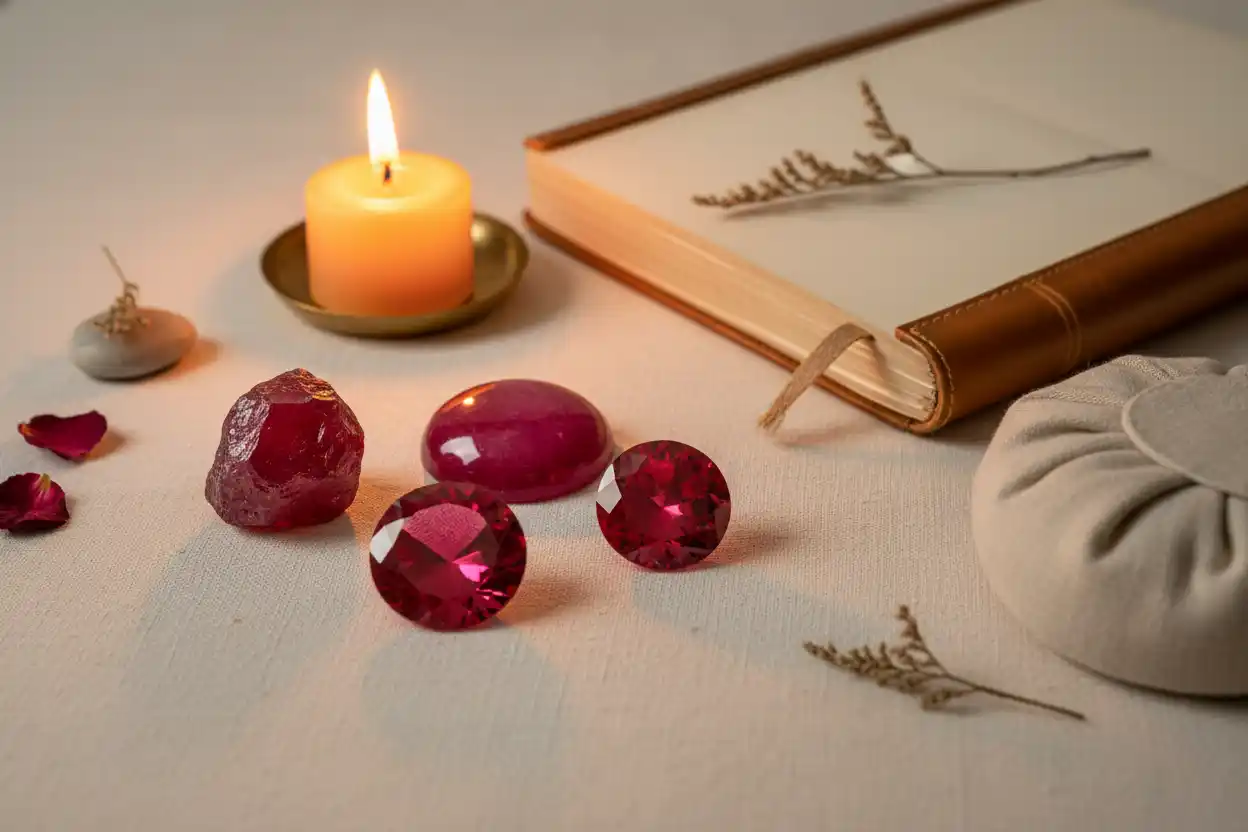
Ruby Healing Properties: 12 Traditional Beliefs, Corundum Science & Safe Use
Ruby healing properties are traditionally associated with courage, passion, confidence, resilience, motivation, protection, relationship commitment, concentration, generosity, leadership, emotional strength, and spiritual vitality. Ruby has a genuine cultural history extending across South Asia, Southeast Asia, Europe, and the ancient Mediterranean, so some of these associations have deeper historical roots than the modern metaphysical identities attached to recently discovered gemstones. Historical belief, however, is not clinical evidence. Ruby healing properties have not been scientifically demonstrated to treat anemia, heart disease, circulation problems, infertility, inflammation, fatigue, depression, anxiety, blood disorders, or another medical condition. Scientifically, Ruby is the red gem variety of corundum, Al₂O₃, colored mainly by chromium substituting for aluminum within the crystal structure. Corundum crystallizes in the trigonal system, measures Mohs 9, has no cleavage, and possesses excellent practical durability when it is not weakened by fractures or unstable treatments.
12 Ruby Healing Properties Traditions
- Courage during difficult situations
- Passion directed toward meaningful goals
- Confidence through preparation and experience
- Resilience after setbacks
- Motivation and purposeful action
- Protection as a traditional symbolic theme
- Commitment and relationship awareness
- Concentration and determination
- Generosity and responsible prosperity
- Leadership with accountability
- Emotional strength under pressure
- Spiritual vitality and devotion
These twelve ruby healing properties are most useful when historical symbolism becomes a prompt for deliberate behavior instead of a promise that the gemstone automatically changes the body or mind. Courage can mean acting after assessing risk, passion can mean investing sustained effort in a worthwhile goal, and protection can mean making safer choices. The separate Ruby benefits page can address practical uses, while this article keeps ruby healing properties centered on traditional beliefs, evidence limits, gemology, history, treatments, and safe handling.
Ruby Is Red Corundum
Understanding ruby healing properties begins with the stone’s mineral identity. Ruby is corundum, aluminum oxide with the formula Al₂O₃. Pure corundum is colorless, but trace chromium replacing aluminum creates the characteristic red coloration associated with Ruby.
Ruby belongs to the trigonal crystal system and measures Mohs 9, making it one of the hardest natural gemstones used regularly in jewelry. Diamond is harder, but Ruby is substantially more scratch resistant than quartz, feldspar, opal, fluorite, calcite, and many other familiar gems.
Corundum also has no cleavage, which contributes to Ruby’s excellent toughness. That combination explains why high-quality Ruby can survive frequent wear in rings, bracelets, and other exposed settings.
Ruby healing properties do not become stronger when a stone has more intense color, greater transparency, or fewer inclusions. Those characteristics can influence beauty and value, but they do not establish therapeutic potency.
The workbook-verified Ruby quality grading topic addresses color, clarity, cut, treatment, size, and value separately from ruby healing properties.
What Makes Ruby Red?
Chromium is central to Ruby’s appearance. Small amounts of Cr³⁺ substitute for aluminum within corundum and absorb selected wavelengths of visible light, leaving the red color that reaches the eye.
Chromium can also contribute to Ruby’s red fluorescence under ultraviolet or even strong visible illumination. Fine stones can therefore appear to possess an internal glow, particularly under light rich in wavelengths that excite chromium fluorescence.
This optical response helps explain why ruby healing properties have historically become associated with fire, life, blood, warmth, and vitality. The visible glow is genuine gemological behavior, but it is not biological energy entering the wearer.
Iron can modify Ruby’s appearance by suppressing fluorescence or changing overall color character. This is one reason stones from different geological environments can look noticeably different even when all are chromium-bearing corundum.
Ruby Has Genuine Historical Traditions
Ruby healing properties have stronger historical foundations as beliefs than many crystal-healing topics because Ruby has been treasured for centuries. Sanskrit tradition called Ruby ratnaraj, often translated as “king of precious stones,” and historical Indian beliefs connected fine Rubies with status, protection, rebirth, and divine favor.
Historical accounts from Myanmar describe Ruby as a stone of protection and invincibility. Some traditions went far beyond simply wearing the gemstone, reflecting how strongly Ruby became associated with bodily courage and warfare.
Roman writers described red gemstones that were valued for hardness and color, although ancient terminology did not always distinguish Ruby from spinel and other red gems as precisely as modern gemology does.
Medieval European traditions connected Ruby with health, wealth, wisdom, love, and protection. These historical records justify discussing ruby healing properties as genuine traditions, but they do not prove that Ruby actually produced the medical outcomes people attributed to it.
The Ruby meaning page can explore those cultural symbols more deeply, while ruby healing properties remain focused on how such beliefs can be interpreted responsibly today.
Courage, Passion, and Confidence
Courage With Realistic Risk Assessment
Courage is one of the oldest ruby healing properties. The gemstone cannot remove fear or make a dangerous situation safe. A practical interpretation is to distinguish actual danger from ordinary discomfort, reduce avoidable risk, and take the next appropriate step when fear rather than danger is the main obstacle.
A Ruby ring or loose stone can become a personal cue for that process without being treated as a protective force.
Passion Directed Toward a Real Goal
Ruby healing properties frequently include passion because red is culturally associated with love, fire, desire, and intensity. Passion becomes useful when it is directed rather than simply amplified.
Choose one goal that deserves sustained effort, identify the next measurable action, and give it consistent attention. Ruby can symbolize commitment, but the repeated work creates progress.
Confidence Through Preparation
Confidence is another familiar part of ruby healing properties. Corundum does not raise self-esteem through skin contact.
Before a presentation, negotiation, difficult conversation, or unfamiliar task, review what has already been prepared, identify what remains uncertain, and decide which first action is under personal control. Confidence grows more reliably from preparation than from reassurance alone.
Resilience, Motivation, and Protection
Resilience After Setbacks
Ruby healing properties commonly include strength and endurance. The gemstone cannot transfer psychological resilience, even though its high hardness makes strength an understandable metaphor.
After a setback, identify what failed, what remains usable, what lesson matters, and how the next attempt should change. Resilience develops through adaptation.
Motivation Through Action
Motivation appears frequently among ruby healing properties because of Ruby’s intense color and historical associations with vitality.
Ruby does not increase metabolic energy, dopamine, or physical stamina through ordinary contact. It can, however, serve as a cue to begin one delayed task instead of waiting for motivation to appear first.
Protection as Historical Symbolism
Protection has a genuine place in the history of ruby healing properties. Indian, Burmese, and European traditions all contain protective beliefs associated with red gems and Ruby.
There is no evidence that Ruby forms an invisible protective shield. A modern practical interpretation connects protection with boundaries, safer decisions, secure environments, documented agreements, and responsible risk management.
Commitment, Concentration, and Generosity
Commitment in Relationships
Ruby healing properties are often connected with romantic passion and commitment. The stone cannot create loyalty, compatibility, or affection in another person.
A relationship-oriented Ruby practice can focus instead on repeated behavior: Are promises kept? Is communication honest? Are boundaries respected? Is responsibility taken after conflict? Those patterns matter more than gemstone symbolism.
Concentration and Determination
Focus is another theme within ruby healing properties. Corundum has not been shown to improve memory or attention span biologically.
Use the gemstone as a visual cue for one focused interval. Remove unnecessary notifications, define the task clearly, and avoid switching until a planned stopping point.
Generosity and Responsible Prosperity
Historical Ruby symbolism often connects the gemstone with wealth, nobility, and status. Modern ruby healing properties sometimes extend this into abundance or prosperity.
Ruby cannot attract money or guarantee financial success. A practical version connects prosperity with budgeting, saving, fair compensation, generosity within one’s means, and attention to long-term financial decisions.
Leadership, Emotional Strength, and Spiritual Vitality
Leadership With Accountability
Leadership appears naturally among ruby healing properties because Ruby was historically associated with rulers, nobility, and status.
A gemstone cannot create leadership ability. A more useful interpretation emphasizes clear decisions, responsibility for consequences, listening to relevant expertise, and giving credit appropriately.
Emotional Strength Under Pressure
Ruby healing properties are sometimes described as emotionally strengthening. No evidence shows that chromium-bearing corundum regulates stress hormones or removes emotional pain.
During pressure, separate facts from assumptions, identify whether an immediate response is necessary, and avoid turning one difficult event into a permanent conclusion.
Spiritual Vitality and Devotion
The final theme within ruby healing properties concerns spiritual fire, devotion, life force, or sacred passion. Historical traditions give Ruby unusually rich symbolic context for such ideas.
A person can use Ruby during prayer, meditation, or reflection on courage and commitment without claiming that the gemstone transmits measurable spiritual power.
Ruby Chakra Associations
Ruby healing properties are most commonly linked with the root chakra in modern crystal practice because of the gemstone’s deep red color. Some systems also connect Ruby with the heart because of love and devotion symbolism or with the sacral chakra because of passion.
Chakras are spiritual frameworks rather than anatomical structures. Ruby healing properties have not been demonstrated to affect blood, the heart, reproductive organs, adrenal glands, circulation, nervous system, or endocrine function through chakra placement.
Claims that Ruby can treat anemia because it is red or improve blood because it contains chromium confuse symbolic color with physiology.
Ruby Heat Treatment and Filling
Treatment is important when discussing ruby healing properties because a stone’s durability and care can depend more on treatment than on its spiritual use.
Heating is extremely common in natural Ruby. Controlled heat can improve color, dissolve some microscopic inclusions, and modify clarity. A heated Ruby remains natural corundum, although treatment disclosure matters for value.
Some lower-quality Rubies contain numerous fractures filled with lead-rich glass or other fillers to improve apparent transparency. These stones require much more cautious handling because the filler can be damaged by heat, chemicals, or even relatively mild acids.
Synthetic Ruby also exists and has the same essential Al₂O₃ chemistry and chromium-related red color as natural Ruby. Laboratory origin changes geological provenance and value, not whether the substance is chemically corundum.
Anyone buying the gemstone should use buy Ruby checks based on natural versus laboratory origin, treatment disclosure, color, clarity, cut, and independent laboratory evidence rather than evaluating a stone by ruby healing properties.
Ruby Care and Cleaning
Ruby healing properties do not change the fact that untreated and conventionally heat-treated corundum is extremely durable. Mohs hardness 9, excellent toughness, and absence of cleavage make Ruby suitable for frequent jewelry wear.
Warm soapy water is a safe routine cleaning method. A soft brush can remove dirt from underneath a setting, followed by thorough rinsing and drying.
Ultrasonic and steam cleaning are usually acceptable for untreated and simply heat-treated Ruby, but treatment history matters. Glass-filled, cavity-filled, dyed, or extensively fractured stones need gentler care and are better cleaned with a damp cloth.
Strong acids should be avoided around treated stones. Even mild acidic substances can damage some lead-glass fillers. Boric acid can also etch corundum surfaces under appropriate conditions.
Ruby healing properties never require flame, extreme heat, acids, saltwater, or chemical “activation.”
Safe Ritual Cleansing
Ruby healing properties can be incorporated into symbolic rituals without exposing the gemstone to unnecessary risks. There is no scientifically demonstrated unwanted energy that must be physically extracted from Ruby.
Sound, quiet reflection, intentional breathing, prayer, dry placement, or ordinary gentle cleaning are sufficient for personal ritual use. A courage-focused practice might involve defining one difficult but worthwhile action and completing it immediately afterward.
If a Ruby is fracture filled or its treatment history is unknown, avoid heat, steam, chemicals, and aggressive cleaning. Protecting the gemstone is more useful than performing elaborate cleansing methods.
Conclusion
Ruby healing properties combine genuine historical traditions with one of gemology’s most important minerals. Ruby is chromium-bearing red corundum, Al₂O₃, with Mohs hardness 9, no cleavage, strong durability, and a history that connects it with courage, royalty, protection, passion, and devotion. Those traditions can support meaningful reflection on confidence, resilience, relationships, leadership, and commitment when cultural symbolism remains separate from medical evidence.
FAQs
What are ruby healing properties?
Ruby healing properties commonly refer to beliefs involving courage, passion, confidence, resilience, motivation, protection, commitment, concentration, generosity, leadership, emotional strength, and spiritual vitality.
What is Ruby made of?
Ruby is the red variety of corundum, aluminum oxide with the formula Al₂O₃.
What gives Ruby its red color?
Chromium replacing small amounts of aluminum in the corundum structure creates Ruby’s characteristic red color and can also produce red fluorescence.
How hard is Ruby?
Ruby has Mohs hardness 9 and excellent toughness with no cleavage, making it one of the most durable colored gemstones.
Are ruby healing properties historically documented?
Many protective, vitality, wealth, courage, and love beliefs around Ruby are genuinely historical. Historical belief does not prove the medical effectiveness of ruby healing properties.
Does Ruby improve blood or treat anemia?
No. Ruby healing properties have not been demonstrated to treat anemia, circulation problems, or blood disorders. Red color is not evidence of a medical effect on blood.
Which chakra is Ruby associated with?
Modern crystal practice most commonly links Ruby with the root chakra and sometimes the heart or sacral chakra. These are spiritual rather than anatomical associations.
Is heat-treated Ruby still real Ruby?
Yes. A heated natural Ruby remains natural corundum. Treatment should still be disclosed because it affects rarity and value.
Can Ruby go in water?
Yes. Warm soapy water is safe for most untreated and heat-treated Ruby. Glass-filled or otherwise heavily treated stones need more cautious cleaning.
Can synthetic Ruby have the same ruby healing properties beliefs?
Laboratory-grown Ruby has the same essential corundum chemistry, but ruby healing properties are spiritual or personal beliefs rather than measurable mineral effects, so science does not establish different healing potency for natural or synthetic stones.
Ruby healing properties come from historical, spiritual, and personal belief systems and should not replace qualified medical or mental health care.