Rhodochrosite vs Rhodonite: Differences, Tests and Identification
Rhodochrosite and rhodonite are manganese-bearing pink-to-red gemstones whose similar names create frequent confusion.
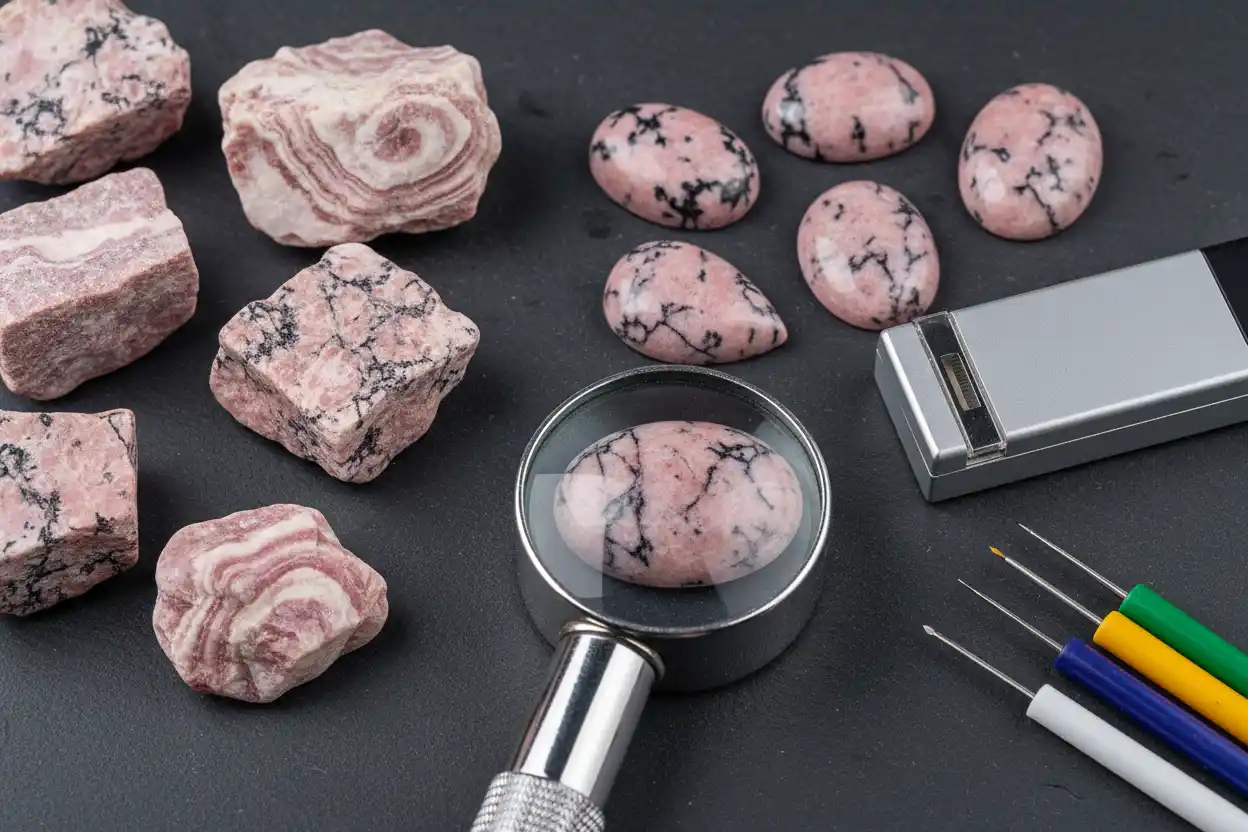
The easiest visual distinction is pattern. Rhodochrosite commonly displays white, cream or pale-pink bands. Rhodonite more commonly displays black or dark-brown manganese-oxide veins.
That rule is useful but not universal. Rhodochrosite can be unbanded, transparent or nearly solid red. Rhodonite can lack black veining and occur as transparent rose-red crystals.
The mineral difference is definitive: rhodochrosite is manganese carbonate, while rhodonite is a manganese-rich silicate in the pyroxenoid group. Their hardness, cleavage, density, optical properties and chemical behavior therefore differ.
Rhodochrosite vs Rhodonite at a Glance
| Feature | Rhodochrosite | Rhodonite |
|---|---|---|
| Mineral class | Carbonate | Silicate; pyroxenoid group |
| Simplified composition | MnCO₃ | Manganese-rich chain silicate |
| Crystal system | Trigonal | Triclinic |
| Common appearance | Pink, red or coral with white and cream bands | Pink to rose-red with black or brown oxide veins |
| Other forms | Transparent crystals, stalactites, botryoidal and massive material | Massive aggregates, granular material and rare transparent crystals |
| Mohs hardness | Approximately 3.5–4 | Commonly about 5.5–6 |
| Cleavage | Perfect rhombohedral cleavage in three directions | Perfect cleavage in two directions |
| Tenacity | Brittle | Brittle |
| Specific gravity | Commonly around 3.5–3.7 | Commonly around 3.4–3.7 |
| Refractive behavior | Very strong birefringence; spot reading often near 1.60 | Higher spot readings commonly around the low 1.70s |
| Luster | Vitreous to pearly | Vitreous to pearly |
| Acid response | Carbonate reacts with suitable acids | Generally resistant to ordinary acids |
| Common dark inclusions | Manganese oxides may occur but are less characteristic | Black manganese oxides are common |
| Typical jewelry use | Pendants, earrings and protected collector jewelry | Cabochons, beads, carvings and protected rings |
| Main identification test | Carbonate properties, pattern, RI, Raman and XRD | Silicate properties, hardness, Raman and XRD |
The table gives broad tendencies. Mixed rocks and related manganese minerals can produce intermediate-looking specimens.
The Fundamental Mineral Difference
Rhodochrosite is a carbonate mineral.
Its structure contains carbonate groups combined principally with manganese. It belongs to the calcite group and forms rhombohedral crystals, scalenohedrons, stalactites and banded masses.
Rhodonite is a manganese-rich silicate.
Its structure consists of silicate chains associated with manganese, calcium, iron and magnesium. It belongs to the pyroxenoid group and crystallizes in the triclinic system.
This chemical distinction explains why rhodochrosite is softer and acid-sensitive while rhodonite is harder and more chemically resistant.
The complete symbolic and geological profiles remain in Rhodochrosite Meaning and Rhodonite Meaning.
Color Differences
Rhodochrosite commonly appears pale pink, rose, raspberry, coral, red or orange-red.
Its finest transparent crystals can display intense red, while ordinary ornamental material is often medium pink with white bands.
Rhodonite generally appears pink, rose-red, reddish brown or purplish pink.
Weathering can darken rhodonite as manganese oxidizes. The resulting black or brown material commonly forms veins, patches or surface coatings.
Neither hue is exclusive. A solid-pink cabochon cannot be identified through color alone.
Lighting can also change the apparent balance between pink, purple, orange and brown.
Pattern Differences
Pattern provides the quickest initial clue.
Rhodochrosite often develops curved, concentric, lace-like or parallel white bands. These layers commonly form through repeated mineral deposition in veins and stalactites.
Rhodonite more often contains irregular black or dark-brown networks caused by manganese oxides. The dark material may follow fractures, grain boundaries and weathered zones.
A useful summary is:
White bands suggest rhodochrosite. Black veins suggest rhodonite.
However, this is a screening rule. Dyed calcite, resin and pressed mineral powder can imitate rhodochrosite bands. Painted or mixed stones can imitate rhodonite’s black matrix.
Rhodochrosite Banding
Banded rhodochrosite commonly forms through successive carbonate layers.
A stalactite cut across its growth direction can show concentric circles, sweeping arcs and irregular lace-like zones.
The white component may be calcite-rich, while the pink sections contain more manganese.
Natural bands often change thickness, merge, split and continue beneath the polished face.
Manufactured imitations may show simpler stripes, repeated patterns or granular material bonded with resin.
A flat printed-looking design should be examined from the edge and back.
Rhodonite’s Black Veins
Rhodonite’s dark veins commonly consist of manganese oxides formed through alteration.
They may appear jet black, dark brown or gray.
The network can be sparse or dominate much of the stone. Fine pink bodycolor with balanced black veining is popular for beads and cabochons.
Dark lines should have mineral texture and depth. Painted surfaces may stop at an edge or collect in scratches.
Not every rhodonite contains black veins. Transparent crystals and some compact massive material can be nearly pure pink or red.
Transparency
Most commercial rhodochrosite is translucent to opaque, although rare crystals can be transparent.
Most commercial rhodonite is also translucent to opaque. Transparent rhodonite is uncommon and usually appears as small crystals or faceted collector gems.
Transparency therefore does not separate them automatically.
A transparent red or pink specimen deserves closer examination because it can also be spinel, garnet, tourmaline, red beryl, synthetic material or glass.
Refractive index, density and spectroscopy are more reliable than appearance.
Crystal Habit
Rhodochrosite can form rhombohedrons, scalenohedrons and curved or saddle-shaped crystals.
Transparent Sweet Home Mine material commonly occurs as sharply formed rhombohedral crystals associated with quartz and sulfide minerals.
Rhodonite crystals may be tabular, bladed or prismatic, although massive material is far more common in the jewelry trade.
Crystal form can support identification when natural faces are intact.
Broken fragments and polished objects lose much of this evidence, so laboratory testing becomes more important.
Hardness
Rhodochrosite has a Mohs hardness of approximately 3.5–4.
Rhodonite is harder, commonly around 5.5–6.
Therefore, rhodonite generally resists scratching better.
Do not test that difference by scratching a finished object. Steel, quartz and other tools can damage the surface, while mixed minerals or coatings can create misleading results.
The completed gemstone-hardness chart provides comparative context.
Hardness does not measure resistance to cleavage or impact.
Cleavage
Both minerals have important cleavage.
Rhodochrosite has perfect rhombohedral cleavage in three directions. It can split along smooth flat planes characteristic of carbonate structure.
Rhodonite has perfect cleavage in two directions. Cutting transparent crystals is difficult because pressure can open one of those planes.
The completed gemstone-cleavage guide explains why cleavage remains relevant even when a stone appears compact.
Neither mineral should be struck, dropped or pried as a home test.
Toughness and Jewelry Durability
Rhodochrosite is softer and generally less suitable for frequent-wear jewelry.
Rhodonite is harder and can perform better in cabochons and beads, but cleavage and internal fractures still require protection.
A rhodochrosite pendant or pair of earrings usually survives better than a ring. Rhodonite can be used in rings, although a bezel and selective wear are advisable.
The gemstone toughness-versus-hardness guide explains why rhodonite’s higher hardness does not make it unbreakable.
Specific Gravity
The two minerals overlap substantially in density.
Rhodochrosite commonly falls around 3.5–3.7. Rhodonite frequently occupies a similar broad range depending on calcium, iron, magnesium and associated minerals.
Consequently, hand heft is a poor separator.
Hydrostatic measurement can support a conclusion when combined with refractive index and microscopy.
A mounted stone, porous specimen or composite object can produce an inaccurate result.
Refractive Index
Rhodochrosite has unusually strong birefringence.
Its ordinary and extraordinary refractive indices differ substantially, although curved banded cabochons commonly provide a spot reading near 1.60.
Rhodonite generally has higher refractive indices in the low-to-mid 1.70 range, depending on composition.
This distinction can be useful for polished stones.
White calcite bands, mixed minerals and curved surfaces may complicate the rhodochrosite reading.
A professional refractometer or Raman instrument provides more dependable information than visual comparison.
Double Refraction
Transparent rhodochrosite can display strong double refraction.
When viewed through a clear cleavage fragment, lines or objects may appear doubled.
Most ornamental cabochons are too cloudy or curved for an obvious home observation.
Rhodonite is also doubly refractive but does not normally create the same extreme carbonate doubling.
Do not split a specimen to create a viewing surface.
Acid Reaction
Rhodochrosite is a carbonate and reacts with suitable acids, especially when powdered or warmed.
Rhodonite is a silicate and is substantially more resistant.
Although this difference is diagnostic in controlled mineralogy, acid testing should not be used on jewelry or polished specimens.
Vinegar, hydrochloric acid and other chemicals can etch rhodochrosite permanently. They may also damage dye, filler, glue, metal and associated calcite.
Raman spectroscopy provides the same mineral distinction without destroying the object.
Surface Weathering
Rhodochrosite may develop brown or black manganese-oxide alteration on exposed surfaces.
Rhodonite commonly alters to manganese oxides even more visibly, producing characteristic black networks and crusts.
Therefore, black alteration is a tendency rather than an absolute distinction.
Freshly broken interiors can look much pinker than weathered surfaces.
Do not remove dark material with acid or abrasive polishing. It may be part of the specimen’s natural history.
Common Rhodochrosite Imitations
Pressed gibbsite-and-calcite composites can reproduce pink-and-white banding.
Dyed calcite, dyed magnesite, resin, ceramic and glass also occur.
Imitations may show simplified repeated stripes, granular pressed texture, resin bubbles and lower density.
Some contain real calcite in the white bands, making one spot test misleading.
The planned Where to Buy Real Rhodochrosite owns detailed seller and imitation checks.
Common Rhodonite Imitations
Dyed howlite, magnesite, calcite, resin, ceramic and painted stone can imitate pink rhodonite with black veins.
Some products use a pink polymer body with black pigment poured through it.
Repeating patterns, mold seams, casting bubbles and low weight provide warning signs.
Rose quartz may also be mislabeled as rhodonite, especially when dark inclusions are present.
The complete Rose Quartz vs Rhodonite page owns that distinction.
The planned Where to Buy Real Rhodonite retains the seller workflow.
Rhodonite and Pyroxmangite
Rhodonite has a closely related polymorph called pyroxmangite.
Both are manganese silicates with similar color, hardness and appearance.
Their silicate-chain structures differ, but that distinction is not visible in most massive or polished material.
Some specimens historically sold as rhodonite may consist partly or mainly of pyroxmangite or other rhodonite-group minerals.
X-ray diffraction, Raman spectroscopy and chemical analysis may be necessary for precise classification.
For ordinary jewelry, rhodonite-group may be a reasonable commercial description when exact species analysis is unavailable. A high-value crystal claim deserves more precision.
Rhodochrosite and Calcite
Rhodochrosite belongs to the calcite group and commonly forms with calcite.
White bands in ornamental material can contain calcium-rich carbonate.
Mangano calcite occupies another pink manganese-bearing carbonate category and can overlap visually.
The broad calcite guide explains carbonate properties.
This relationship is why one white band should not be tested as though it represents the entire pink stone.
Rhodonite and Manganese Oxides
Black areas in rhodonite commonly consist of secondary manganese oxides.
These alteration products develop as manganese-bearing material reacts with oxygen and water.
Their exact mineral identities may include more than one oxide phase.
A polished cabochon can therefore be a natural mixed-mineral object rather than pure rhodonite throughout.
This is normal for ornamental material, provided the seller does not claim a chemically pure single crystal.
Which Stone Is More Valuable?
Value depends on the exact form.
Fine transparent red rhodochrosite crystals and faceted gems can be highly collectible because good rough is rare and difficult to cut.
Large attractive banded rhodochrosite is valued for color, pattern and workmanship, although ordinary material remains accessible.
Transparent gem-quality rhodonite is also rare and collectible. Massive pink-and-black rhodonite is more common and generally valued by pattern, color, compactness and polish.
One name is not universally more expensive than the other. A specimen’s quality, provenance, treatment and construction determine the comparison.
Which Is Better for Jewelry?
Rhodonite is generally the more practical choice.
Its higher hardness gives it better resistance to surface scratches, especially in beads and cabochons.
Rhodochrosite is better reserved for protected pendants, earrings and occasional-wear pieces.
Neither stone is ideal for an exposed daily ring.
Transparent faceted material from either species should receive especially protective mounting because cleavage and rarity increase the consequences of damage.
Meaning and Symbolism Differences
Rhodochrosite is traditionally associated with self-compassion, emotional healing, joy and receiving care.
Rhodonite is commonly associated with compassion combined with boundaries, reconciliation and calm response after conflict.
The themes overlap because both stones are pink manganese minerals.
Their symbolic difference can be summarized as inward compassion versus compassion expressed through relationships and boundaries.
These meanings are not mineral-identification criteria.
Both appear in Pink Crystals, Pink Gemstones, Red Crystals and Red Gemstones according to their exact bodycolor.
Water and Cleaning
Neither stone should be soaked routinely.
Rhodochrosite is especially vulnerable because it is a soft carbonate and reacts with acids.
Rhodonite tolerates brief water contact better, but fractures, black alteration, dye, filler and glue can still be affected.
Use a soft cloth and minimal moisture, then dry immediately.
The crystal water-safety guide explains why mineral identity and treatment both matter.
Avoid steam, ultrasonic cleaners, saltwater, vinegar, citrus and household chemicals.
A Safe Home Identification Sequence
First, examine the pattern.
White or cream curved bands favor rhodochrosite. Black manganese-oxide veins favor rhodonite.
Next, observe translucency and surface texture. Rhodochrosite may show pearly carbonate luster and delicate banding, while rhodonite often appears denser and more silicate-like.
Inspect edges and drill holes for dye, resin, printed pattern and a different interior.
Do not scratch or acid-test the object.
When the distinction affects value, use the general crystal-identification guide and request professional refractive-index or Raman testing.
Laboratory Identification
Raman spectroscopy distinguishes carbonate rhodochrosite from silicate rhodonite quickly.
X-ray diffraction can confirm crystal phases and separate rhodonite from pyroxmangite or related minerals.
Chemical analysis shows manganese associated with carbonate in rhodochrosite or silicate structure in rhodonite.
FTIR can reveal resin and organic filler.
For a valuable object, the completed gemstone-certification guide explains report options. Use how to read a gem-lab report to check whether the entire object or only one surface area was tested.
For online purchases, follow how to buy gemstones online and retain a sufficient return period.
Frequently Asked Questions
1. What is the easiest visual difference between rhodochrosite and rhodonite?
Rhodochrosite commonly has white or cream bands, while rhodonite commonly has black or brown manganese-oxide veins.
2. Are rhodochrosite and rhodonite related minerals?
Both are manganese-bearing, but rhodochrosite is a carbonate and rhodonite is a silicate.
3. Which stone is harder?
Rhodonite is harder at about 5.5–6, while rhodochrosite is approximately 3.5–4.
4. Which stone has white bands?
Rhodochrosite commonly displays white calcite-rich or pale carbonate bands.
5. Which stone has black veins?
Rhodonite commonly contains black manganese-oxide veins and patches.
6. Can rhodochrosite occur without bands?
Yes. Transparent crystals and massive material may be solid pink or red.
7. Can rhodonite occur without black matrix?
Yes. Fine transparent crystals and selected massive material may show little dark oxide.
8. Which is better for a ring?
Rhodonite is generally more durable, but both need protective settings and selective wear.
9. Can an acid test separate them?
It can in controlled mineral testing because rhodochrosite is a carbonate, but acid permanently damages polished stones and should not be used at home.
10. Can hardness testing separate them?
The hardness ranges differ, but deliberate scratching is destructive and mixed or treated material can give misleading results.
11. Why is some “rhodonite” actually pyroxmangite?
The minerals are structurally related and visually similar, so X-ray or Raman testing may be required for exact classification.
12. Which laboratory test gives the clearest identification?
Raman spectroscopy distinguishes carbonate rhodochrosite from silicate rhodonite, while X-ray diffraction resolves related structural species.
Rhodochrosite and rhodonite are indexed in Crystals That Start With R and Gemstones That Start With R.
The visual rule remains helpful: pale bands point toward rhodochrosite, while dark oxide veins point toward rhodonite. Yet the final distinction is chemical and structural. Rhodochrosite is a soft acid-sensitive carbonate; rhodonite is a harder manganese silicate whose own related species can require laboratory separation. Pattern starts the identification, but mineral testing completes it.