Rhodonite Healing Properties: 9 Wellness Beliefs, Mineral Facts & Safe Use
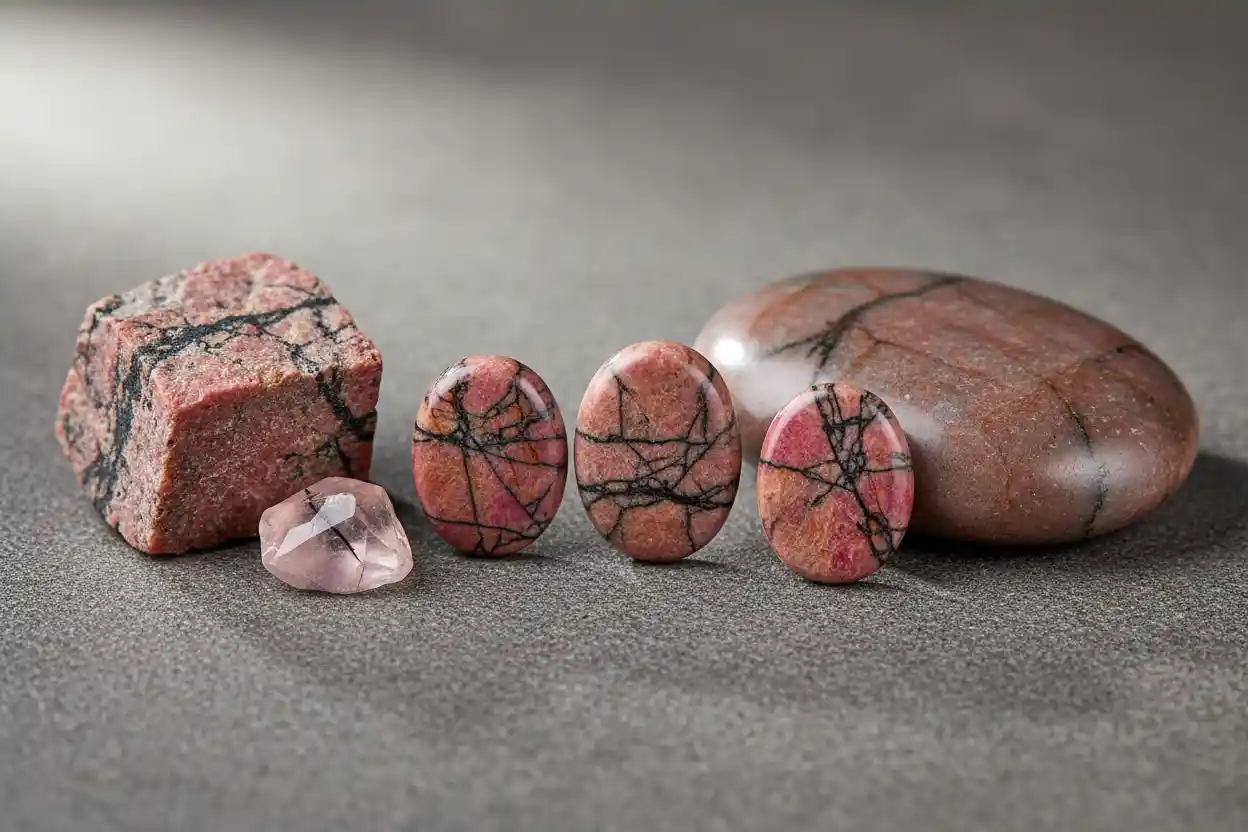
Rhodonite healing properties are commonly associated with compassion, emotional steadiness, self-respect, relationship awareness, forgiveness, resilience, boundaries, confidence, and reflective meditation. The stone’s pink to red color, often crossed by dramatic black manganese-oxide veins, naturally encourages themes involving the heart, emotional strength, and recovery after difficult experiences. Those visual associations do not establish a therapeutic mechanism. Rhodonite healing properties have not been scientifically demonstrated to treat anxiety, depression, trauma, heart disease, blood pressure problems, inflammation, pain, hormonal disorders, or another medical condition. Mineralogically, Rhodonite is a manganese-rich pyroxenoid that crystallizes in the triclinic system. Its chemistry is often simplified as MnSiO₃, although natural Rhodonite contains calcium, magnesium, iron, and other substitutions, and modern mineral classification recognizes greater structural complexity than the simplified formula suggests.
9 Rhodonite Healing Properties Beliefs
- Compassion with realistic boundaries
- Emotional steadiness during conflict
- Self-respect and fairer self-evaluation
- Relationship awareness and communication
- Forgiveness without forced reconciliation
- Resilience after disappointment
- Stronger personal boundaries
- Confidence during emotional uncertainty
- Meditation and reflective awareness
These nine rhodonite healing properties become more useful when they are translated into deliberate behavior rather than treated as automatic effects. Compassion can involve understanding another person’s perspective without excusing harmful conduct, forgiveness can mean reducing resentment while preserving a necessary boundary, and resilience can mean rebuilding routines after disappointment. The separate Rhodonite benefits page can address practical uses, while this article keeps rhodonite healing properties focused on wellness beliefs, mineral science, evidence limits, and safe handling.
Rhodonite Mineral Facts
Understanding rhodonite healing properties begins with the mineral itself. Rhodonite is a manganese-rich member of the pyroxenoid family and belongs to the triclinic crystal system. Older gemological descriptions often write its chemistry as MnSiO₃, but natural specimens rarely match that simplified composition exactly. Calcium, iron, magnesium, and other cations substitute for manganese in the crystal structure, and modern rhodonite-group classification reflects this complexity.
Rhodonite commonly appears pink, rose red, brownish red, grayish pink, or nearly reddish brown. Transparent crystals can show vivid pink-red color, while most lapidary material is translucent to opaque and contains black or brown manganese-oxide veins and patches.
Rhodonite generally measures about Mohs 5.5 to 6.5. That is enough hardness for cabochons, beads, carvings, and carefully worn jewelry, but Rhodonite is not especially tough. Perfect cleavage in two directions and brittle behavior can make transparent crystals difficult to facet and vulnerable to impact.
These physical facts matter because rhodonite healing properties are sometimes discussed without acknowledging that the stone can chip or split even when it appears dense and substantial.
Why Rhodonite Is Pink With Black Veins
The appearance behind many rhodonite healing properties comes from manganese chemistry. Manganese within the silicate structure produces the characteristic pink to red color, while weathering and oxidation can create dark manganese-oxide coatings, veins, or replacement zones.
Black markings are therefore not evidence that Rhodonite has “absorbed negativity.” They are natural mineral features produced by chemical alteration.
In some specimens, black manganese oxides follow fractures or irregular networks through the pink stone. This striking contrast is highly valued in carvings and cabochons because each piece develops a different pattern.
Rhodonite healing properties are often symbolically linked with balancing tenderness and strength, and the pink-black color contrast makes that metaphor easy to understand. Geologically, however, the colors record manganese mineral chemistry rather than emotional energy.
Rhodonite Formation and Important Sources
Rhodonite forms in manganese-rich metamorphic deposits, hydrothermal settings, and altered manganese ores. It can occur with minerals such as spessartine garnet, bustamite, tephroite, calcite, quartz, and manganese oxides.
Russia’s Ural region became historically famous for Rhodonite, including large decorative masses used for architectural objects, carvings, columns, bowls, and ornamental works associated with imperial Russia.
Fine transparent crystals have also come from localities in Australia, Brazil, Japan, Sweden, South Africa, and the United States. Broken Hill in Australia is particularly known for attractive red crystalline material, while New Jersey and Massachusetts have produced important American specimens.
Rhodonite healing properties do not vary medically by locality. Differences in color, transparency, inclusions, chemistry, and quality can affect appearance and collectibility, but they do not establish stronger or weaker therapeutic action.
Rhodonite History and Name
Rhodonite was recognized as a distinct mineral around the transition from the eighteenth to nineteenth century and was named from the Greek word associated with rose color. The name refers directly to its characteristic pink appearance.
Russian deposits gave the stone major decorative importance. Large pieces were carved into elaborate objects, and Rhodonite became closely associated with Russian ornamental stonework.
That history is genuine, but modern rhodonite healing properties involving emotional repair, heart-chakra work, trauma release, or relationship healing should not automatically be described as ancient traditions. Most of those interpretations belong to contemporary crystal culture.
Historical use provides cultural context. It does not turn rhodonite healing properties into scientifically verified therapeutic effects.
Compassion, Emotional Steadiness, and Self-Respect
Compassion Without Overlooking Harm
Compassion is one of the most repeated rhodonite healing properties. The stone cannot biologically increase empathy or alter another person’s behavior. A more practical interpretation asks whether you can understand someone’s circumstances while still judging their actions accurately.
Compassion does not require accepting repeated disrespect, manipulation, or unsafe behavior. Rhodonite can become a cue to combine empathy with clear limits.
Emotional Steadiness During Conflict
Rhodonite healing properties are also associated with emotional balance during arguments or stressful interactions. Manganese silicate has not been shown to regulate cortisol, adrenaline, or neurotransmitters through skin contact.
A useful routine is to delay a non-urgent response until emotional intensity decreases, identify the central issue, and avoid expanding one disagreement into unrelated accusations.
Self-Respect Through Fairer Evaluation
Self-worth appears frequently among rhodonite healing properties. The stone cannot create self-esteem automatically.
Use it as a reminder to replace broad judgments such as “I always fail” with a specific description of what happened, what went well, and what should improve. Accurate self-evaluation supports responsibility without turning one mistake into a permanent identity.
Relationships, Forgiveness, and Resilience
Relationship Awareness Through Repeated Behavior
Rhodonite healing properties are strongly linked with relationships. A gemstone cannot make another person loyal, honest, affectionate, or compatible.
A better relationship review looks at repeated evidence: Are boundaries respected? Do actions match promises? Is responsibility taken after conflict? Are important concerns dismissed or addressed? Patterns provide more useful information than symbolic reassurance.
Forgiveness Without Forced Reconciliation
Forgiveness is another familiar theme within rhodonite healing properties. The stone cannot erase painful memories or decide whether reconciliation is appropriate.
Someone can reduce resentment while still maintaining distance from a person whose behavior remains harmful. Forgiveness and restored access are separate decisions.
Resilience After Disappointment
Rhodonite healing properties often include emotional recovery. The mineral cannot heal grief or trauma through an invisible field.
After a setback, identify what cannot be changed, what support remains available, which routine has been disrupted, and what first constructive action can be restarted. The gemstone can symbolize recovery, but the rebuilding process produces resilience.
Boundaries and Confidence
Boundaries as Practical Protection
Stronger boundaries are especially compatible with rhodonite healing properties because compassion without boundaries can become exhausting or unsafe.
Decide which behavior is unacceptable, communicate the limit clearly, and determine what action will follow if it continues. This turns a vague protection idea into something observable and controllable.
Confidence During Emotional Uncertainty
Confidence appears among rhodonite healing properties when people use the stone during difficult conversations, transitions, or relationship decisions.
Rhodonite cannot biologically increase confidence. Before acting, identify what has already been prepared, what remains uncertain, and which part of the outcome remains under your control. Confidence grows more reliably from preparation and repeated experience.
Meditation and Reflective Awareness
The ninth of the rhodonite healing properties concerns reflective awareness. A polished Rhodonite cabochon can provide a useful visual focus because pink areas, black manganese veins, fractures, and color transitions offer stable details for attention.
During meditation, observe one vein or color boundary and return attention to it or the breath whenever the mind wanders. This is a genuine concentration practice without proving that Rhodonite alters consciousness through mineral energy.
Rhodonite healing properties are also sometimes connected with reviewing emotional triggers. Journaling can make that practice more concrete by recording the situation, reaction, interpretation, and consequence. Patterns become visible because they are documented repeatedly.
Rhodonite Chakra Associations
Rhodonite healing properties are most commonly associated with the heart chakra in contemporary crystal practice. Pink coloration encourages themes involving compassion, relationships, forgiveness, self-respect, emotional recovery, and connection.
The black manganese-oxide areas sometimes lead practitioners to add root-chakra symbolism involving boundaries, security, and grounding.
Chakras are spiritual frameworks rather than anatomical structures. Rhodonite healing properties have not been demonstrated to affect the physical heart, lungs, blood pressure, adrenal glands, nervous system, or endocrine system through chakra placement.
Rhodonite Care and Cleavage
Physical care is important because rhodonite healing properties do not change the mineral’s moderate hardness or brittleness. Rhodonite generally falls around Mohs 5.5 to 6.5 and can be scratched by quartz, topaz, sapphire, ruby, diamond, and other harder gemstones.
Perfect cleavage makes hard impacts especially risky. Fine crystals and transparent faceted Rhodonite can split along structural planes, so rings should receive more protection than pendants, earrings, or display specimens.
Warm water, mild soap, and a soft cloth are appropriate for careful routine cleaning of sound untreated Rhodonite. Avoid aggressive scrubbing around fractures or black altered zones.
Steam and ultrasonic cleaning should not be default choices. Heat, vibration, cleavage, and pre-existing fractures can combine to cause damage.
Strong acids and harsh household chemicals should also be avoided. Some manganese-bearing alteration products may react differently from the primary Rhodonite host, making gentle hand cleaning the safer approach.
Safe Ritual Cleansing
Rhodonite healing properties do not require saltwater, vinegar, flame, steam, or prolonged soaking. There is no scientifically demonstrated negative emotional energy that must be physically removed from the stone.
Sound, dry placement, intentional breathing, quiet reflection, or gentle cleaning are lower-risk practices. A boundary-focused ritual can be made practical by writing one limit that needs to be communicated and the action that will follow if it is ignored.
Avoid abrasive salt, aggressive chemicals, rapid temperature changes, and rough handling that could exploit Rhodonite’s cleavage.
Conclusion
Rhodonite healing properties are contemporary wellness beliefs attached to a genuine manganese-rich pyroxenoid with pink coloration, black manganese-oxide veining, triclinic structure, moderate hardness, and significant cleavage. Compassion, emotional steadiness, forgiveness, resilience, boundaries, confidence, and reflection can all become useful practices when the stone remains a symbolic cue rather than a substitute for evidence-based care.
FAQs
What are rhodonite healing properties?
Rhodonite healing properties commonly refer to beliefs involving compassion, emotional steadiness, self-respect, relationships, forgiveness, resilience, boundaries, confidence, and reflective meditation.
What is Rhodonite made of?
Rhodonite is a manganese-rich silicate pyroxenoid. Its composition is often simplified as MnSiO₃, although natural stones contain calcium, iron, magnesium, and other substitutions.
Why does Rhodonite have black veins?
Black areas are commonly manganese oxides produced through oxidation or alteration. They are natural geological features rather than evidence that the stone absorbed negative energy.
How hard is Rhodonite?
Rhodonite generally measures about Mohs 5.5 to 6.5 and has perfect cleavage, so it can scratch or split more easily than quartz.
Do rhodonite healing properties help emotional trauma?
No scientifically demonstrated Rhodonite effect has been shown to treat trauma. Personal reflection with the stone can be meaningful but should not replace appropriate mental health care.
Which chakra is associated with Rhodonite?
Modern crystal practice most commonly links Rhodonite with the heart chakra and sometimes the root chakra. These are spiritual correspondences rather than anatomical effects.
Can Rhodonite go in water?
Brief gentle cleaning with lukewarm water and mild soap is generally suitable for sound specimens. Avoid prolonged soaking when fractures, treatments, or unstable alteration zones are present.
Is Rhodonite the same as Rhodochrosite?
No. Rhodonite is a manganese silicate, while Rhodochrosite is manganese carbonate. They can share pink coloration but have different chemistry, hardness, cleavage, and geological identities.
Are rhodonite healing properties ancient?
Rhodonite has a genuine decorative and mineralogical history, particularly in Russia, but most modern rhodonite healing properties belong to contemporary crystal practice rather than a documented ancient healing system.
Is Rhodonite safe to wear?
Yes, with reasonable care. Its moderate hardness and cleavage make protected settings preferable for jewelry exposed to frequent knocks.
Rhodonite healing properties are spiritual or personal wellness beliefs and should not replace qualified medical or mental health care.