9 Real Rhodonite Benefits: Emotional First Aid & Manganese Silicate Care
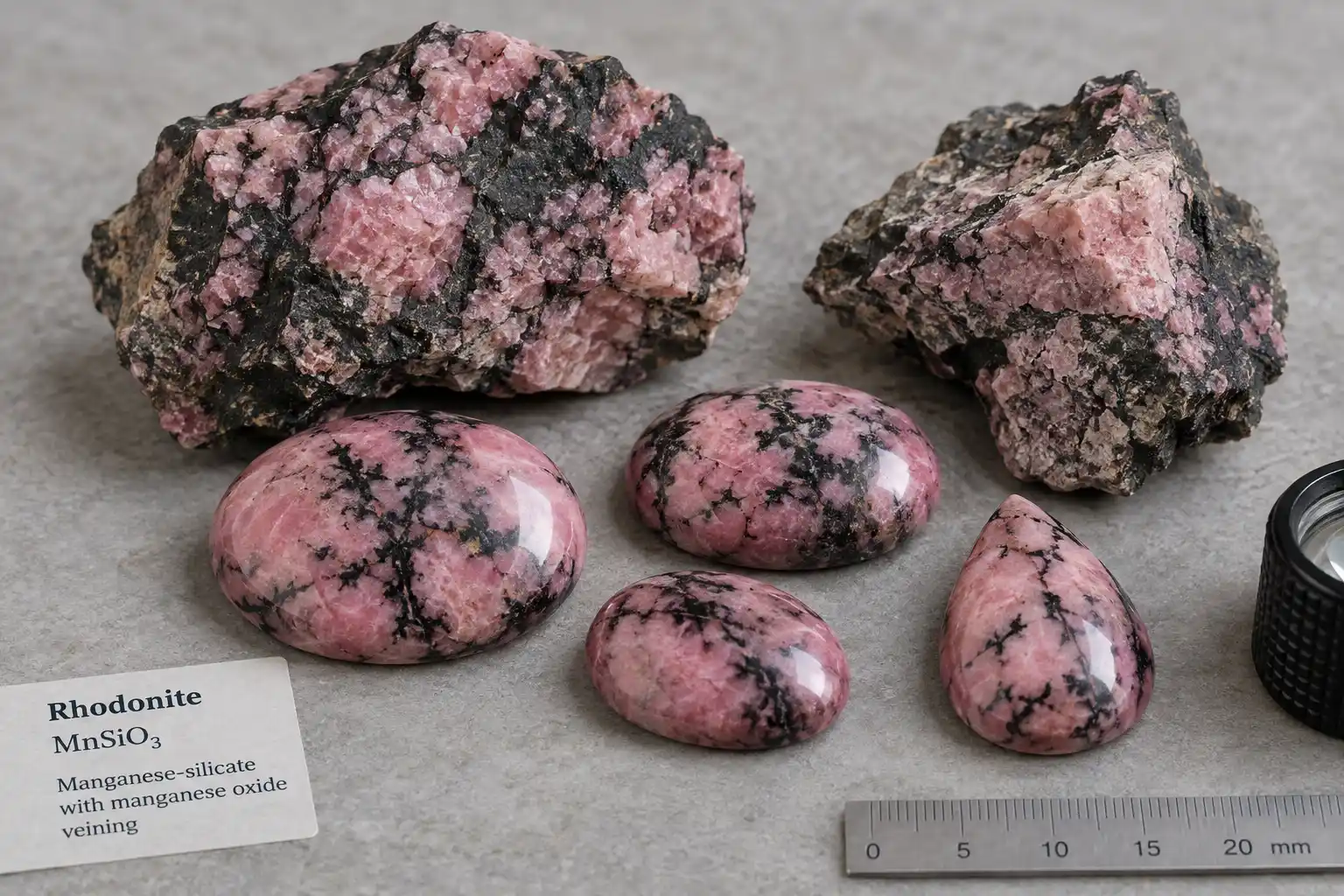
Rhodonite benefits begin with the real properties of a manganese-rich silicate mineral known for rose-pink, reddish-pink, brownish-red, and occasionally vivid red colors. Rhodonite belongs to the pyroxenoid group and crystallizes in the triclinic system. Its chemistry is often simplified as MnSiO3, although natural rhodonite commonly contains calcium, magnesium, iron, and other substitutions within its structure.
For jewelry and collecting, important rhodonite benefits include attractive pink coloration, strong contrast with black manganese oxide veining, useful polishability, geological interest, ornamental carving potential, and uncommon transparent crystals that can be faceted. Rhodonite usually measures about 5.5 to 6.5 on the Mohs scale, but strong cleavage means hardness alone should never be mistaken for excellent resistance to breaking.
Modern spiritual traditions add emotional first aid, compassion, forgiveness, relationship reflection, and heart chakra symbolism to rhodonite benefits. A polished stone may serve as a meaningful reminder during journaling, meditation, or a difficult conversation, but rhodonite does not medically treat trauma, depression, anxiety, heart disease, or other physical or psychological conditions.
9 Rhodonite Benefits at a Glance
- Rose-pink to deep red coloration gives rhodonite strong jewelry, carving, and collection appeal.
- Black manganese oxide veining can create dramatic natural patterns in polished cabochons and decorative pieces.
- Mohs hardness around 5.5 to 6.5 provides moderate scratch resistance when jewelry is worn carefully.
- Massive rhodonite can take a smooth polish for beads, cabochons, carvings, spheres, and ornamental objects.
- Rare transparent crystals offer unusual faceting and mineral-collection value.
- Manganese-rich geological occurrences make rhodonite useful for studying silicate chemistry, metamorphism, and ore-forming processes.
- Its pink color and dark veining provide useful identification clues when combined with hardness, cleavage, density, and professional testing.
- Modern emotional first-aid and heart chakra practices use rhodonite symbolically for reflection, compassion, and relationship intentions.
- Understanding cleavage, manganese-bearing dust, treatments, water exposure, and cleaning limits allows safer ownership and lapidary work.
Rhodonite Benefits Begin With Manganese Silicate Mineralogy
One of the most useful rhodonite benefits is its mineralogical character. Rhodonite is a manganese-rich pyroxenoid built from silicate chains, and its natural chemistry can include meaningful amounts of calcium, iron, magnesium, and other elements replacing manganese within the crystal structure.
The mineral crystallizes in the triclinic system and commonly occurs as massive, granular, compact, or coarse crystalline stone. Well-formed transparent crystals are much less common, which is one reason fine faceted rhodonite attracts specialist collectors.
Color generally ranges from pink and rose-red to reddish brown. Fresh surfaces can show beautiful saturated pink tones, while exposure and alteration may produce dark brown or black manganese oxide coatings and veins.
These features give rhodonite benefits that are easy to appreciate without relying on metaphysical claims. Chemistry, color, crystal structure, geological occurrence, and cutting behavior already make it an unusually interesting gem and collector mineral.
Pink Color and Black Veining Create Distinctive Lapidary Appeal
The combination of pink stone and dark manganese oxide veining is one of the most recognizable rhodonite benefits. Polished cabochons may display irregular black lines, branching patterns, patches, or matrix-like areas against rose-pink backgrounds.
These dark zones are not automatically impurities that reduce beauty. In decorative rhodonite, strong contrast can become the main visual feature, and cutters often orient slabs so the black patterns become part of the finished design.
Fine transparent crystals are evaluated differently. A collector may prefer vivid pink or red color, good transparency, attractive crystal form, minimal damage, and strong provenance rather than the black veining prized in ornamental rough.
The variety of appearances means rhodonite benefits both lapidary artists and mineral collectors. One specimen may be ideal for a large carved object, while another is better preserved as a natural crystal.
Rhodonite Benefits for Jewelry and Carving
Rhodonite can be fashioned into cabochons, beads, pendants, earrings, bracelets, carvings, spheres, small boxes, and polished decorative objects. Its moderate hardness allows it to take a good polish while remaining workable for experienced lapidaries.
Cleavage is the main limitation. Rhodonite has perfect cleavage in two directions and good cleavage in another, so a strong blow can split or chip the stone even when the polished surface has resisted ordinary scratching.
This makes pendants, earrings, and protected jewelry easier choices than high-profile everyday rings. Rings are still possible, but lower settings and sensible wear reduce the chance of impact against hard surfaces.
Rare transparent rhodonite can be faceted, although cutting requires particular care. Cleavage, relatively modest hardness, and valuable rough make faceted stones more suitable for collectors and occasional jewelry than for demanding daily wear.
Geological Occurrence Adds Scientific Value
The question of where rhodonite is found matters because locality can influence color, chemistry, crystal size, associated minerals, transparency, and the type of rough available for cutting. Rhodonite develops in manganese-rich rocks and ore deposits, including metamorphosed manganese formations and several types of hydrothermal or metasomatic mineral assemblages.
Important occurrences include Broken Hill in New South Wales, the Ural Mountains, Franklin in New Jersey, Peru, Brazil, Sweden, Japan, Canada, and other manganese-rich districts. Some localities are famous for ornamental pink stone, while others have produced exceptional transparent or well-formed crystals.
Broken Hill is particularly important to gem collectors because high-quality transparent rhodonite crystals have come from its manganese-rich ore system. Russian rhodonite, meanwhile, became famous for large ornamental pieces and decorative carving.
These geological differences are part of the real rhodonite benefits for collectors. A known locality turns a polished or natural specimen into a physical record of a particular manganese deposit and its geological history.
Rhodonite Helps Explain Mineral Identification
Rhodonite benefits gemological education because its pink color can overlap with several other stones. Rhodochrosite, pink calcite, rose quartz, thulite, dyed stones, and artificial products may all create confusion when identification is based on color alone.
Collectors comparing rhodochrosite and rhodonite can use mineral chemistry as one of the clearest distinctions. Rhodonite is a manganese silicate, while rhodochrosite is manganese carbonate and is considerably softer.
Rhodonite also differs from rose quartz in hardness, density, cleavage, crystal structure, and chemical composition. Black manganese oxide veining can support an identification, but it should not be treated as proof because appearance varies and other stones can contain dark inclusions.
Professional testing may consider refractive properties, specific gravity, microscopic features, spectroscopy, and other measurements. Valuable transparent stones deserve more than a visual guess.
Emotional First Aid as a Personal Practice
The phrase emotional first aid is frequently attached to rhodonite benefits. Used carefully, it can describe a simple personal routine such as pausing after an upsetting event, writing down what happened, identifying what can be controlled, contacting someone trustworthy, or choosing a calmer time for an important conversation.
A rhodonite stone may become a tactile reminder for that pause. Its value in the routine comes from personal association, attention, and the actions that follow rather than from a measurable force emitted by the mineral.
This distinction matters because emotional first aid is not the same as treatment for trauma, depression, panic disorder, self-harm, or another serious psychological concern. A gemstone should never be presented as a substitute for qualified mental-health support.
Rhodonite benefits can therefore remain meaningful without exaggerated healing claims. The stone can symbolize compassion or emotional steadiness while evidence-based care addresses genuine health needs.
Heart Chakra Traditions and Relationship Symbolism
Modern rhodonite chakra practices commonly connect the stone with the heart chakra because of its pink and red coloration. Themes may include affection, forgiveness, relationship boundaries, empathy, reconciliation, and compassion toward oneself or other people.
Chakras are spiritual frameworks rather than anatomical structures. Wearing rhodonite near the chest does not physically change heart function, blood circulation, hormones, or the nervous system.
A person may still use rhodonite during reflection on a relationship. The stone can provide a consistent visual cue while someone thinks about communication, boundaries, responsibility, or whether forgiveness is appropriate in a particular situation.
This is a more realistic interpretation of spiritual rhodonite benefits. Symbolism can support thought and intention without being confused with medical treatment or guaranteed emotional change.
Rhodonite Benefits Through Personal Meaning
Personal symbolism does not need a universal spiritual rule. Rhodonite can represent a relationship, reconciliation, creative achievement, family memory, personal boundary, gift, journey, or a period of emotional growth.
A pendant received from a close friend may carry one meaning, while a specimen collected from a known locality may represent geological interest. Another owner may simply appreciate the contrast between pink stone and black manganese oxide veining.
These meanings are personal rather than mineralogical, but that does not make them unimportant. Objects often gain significance through the experiences, people, and events attached to them.
Rhodonite benefits in this sense come from the relationship between the owner and the object. The mineral provides the physical reminder while the meaning develops through human experience.
Manganese Content Does Not Mean Nutritional Manganese
Manganese is essential to rhodonite’s identity, but its presence creates a common misunderstanding. Wearing rhodonite does not supply the body with a useful dose of manganese, and manganese within the mineral does not pass beneficially through normal skin contact.
Ordinary handling of a polished stone is very different from cutting, drilling, grinding, or crushing manganese-bearing rock. Lapidary operations can create fine airborne particles, making appropriate dust control important.
Wet cutting methods, effective extraction, ventilation, and suitable respiratory protection reduce unnecessary exposure during repeated lapidary work. The same principle applies to many gemstones because mineral dust is not something people should intentionally inhale.
Rhodonite should never be powdered, swallowed, or intentionally dissolved for supposed wellness benefits. Its manganese chemistry is relevant to mineralogy, not a reason to use the stone as a dietary supplement.
Water, Oxidation, and Safe Rhodonite Care
Rhodonite is not among the most water-sensitive ornamental stones, but prolonged soaking is unnecessary. Fractures, polished surfaces, manganese oxide coatings, dyes, adhesives, and jewelry settings can all influence how a particular piece responds to repeated immersion.
For routine cleaning, use a soft cloth with lukewarm water and a small amount of mild soap when needed. Avoid strong acids, aggressive household chemicals, steam, abrupt temperature changes, and unnecessary ultrasonic cleaning when cleavage fractures or unknown treatments are present.
Dry jewelry after washing and store it away from harder gemstones. Quartz, topaz, corundum, and diamond can all abrade rhodonite’s polished surface.
These care habits preserve the real rhodonite benefits of color, polish, pattern, and craftsmanship without relying on elaborate cleansing rituals.
How to Evaluate Rhodonite Quality
Rhodonite quality depends on whether the stone is being evaluated as a carving rough, cabochon, bead, transparent faceted gem, or natural mineral specimen. Ornamental pieces may be prized for even pink color or dramatic black veining, while transparent crystals are judged more heavily on clarity, saturation, crystal form, damage, and rarity.
Good polishing matters because surface scratches can dull the stone’s appearance. Large fractures and poorly bonded zones deserve attention when buying carvings, rings, or thin decorative pieces.
Color treatment or composite construction should be disclosed when present. An unusually bright pink stone should be judged through ordinary gemological examination rather than through spiritual descriptions or seller claims.
Ultimately, the strongest rhodonite benefits come from knowing what the individual specimen genuinely offers: mineralogical interest, geological provenance, attractive lapidary work, useful jewelry, or personal symbolism.
Conclusion
Rhodonite benefits include distinctive pink color, striking manganese oxide patterns, lapidary versatility, geological significance, mineral identification value, and uncommon transparent collector gems. Emotional first aid and heart chakra traditions can serve as personal symbolism, while manganese chemistry, strong cleavage, and lapidary dust require sensible care rather than exaggerated wellness claims.
FAQs
What are the main rhodonite benefits?
Rhodonite benefits include attractive pink coloration, decorative black manganese oxide patterns, usefulness for cabochons and carvings, moderate scratch resistance, geological interest, and rare transparent collector crystals. Modern spiritual traditions also connect it with emotional reflection, compassion, and relationship themes.
What is rhodonite made of?
Rhodonite is a manganese-rich silicate mineral in the pyroxenoid group. Its chemistry is commonly summarized around MnSiO3, but natural rhodonite normally includes calcium, iron, magnesium, and other substitutions.
Is rhodonite the same as rhodochrosite?
No. Rhodonite is a manganese silicate, while rhodochrosite is manganese carbonate. They also differ in hardness, cleavage behavior, crystal structure, geological occurrence, and reaction to acids.
Is rhodonite durable enough for jewelry?
Rhodonite has moderate hardness around 5.5 to 6.5, but its strong cleavage makes it less resistant to impact than hardness alone suggests. Pendants and earrings are generally easier to protect than exposed everyday rings.
Does rhodonite provide manganese to the body?
No. Wearing or holding rhodonite does not supply nutritional manganese through the skin. Cutting and grinding require normal mineral-dust precautions, but ordinary handling of an intact polished stone is a different type of exposure.
Can rhodonite help after an emotional event?
A person may use rhodonite as a reminder to pause, journal, contact a trusted person, or reflect before reacting. The gemstone itself does not treat trauma, anxiety, depression, or another psychological condition.
What chakra is rhodonite associated with?
Modern crystal traditions most commonly associate rhodonite with the heart chakra because of its pink coloration and themes involving relationships and compassion. This is a spiritual interpretation rather than an anatomical or scientifically measurable property.
Can rhodonite go in water?
Brief gentle cleaning with lukewarm water is generally different from prolonged soaking. Avoid unnecessary immersion, harsh chemicals, steam, and aggressive cleaning when a stone contains cleavage fractures, dyes, coatings, or delicate jewelry components.
Can rhodonite have personal meaning without spiritual beliefs?
Yes. Rhodonite can represent a friendship, relationship, personal achievement, family memory, journey, geological interest, or important life period. Personal symbolism does not require a universal metaphysical explanation.
Disclaimer: Emotional first-aid, heart chakra, compassion, relationship, and energetic descriptions of rhodonite reflect spiritual beliefs and personal practices. Rhodonite is not a medical or psychological treatment, and its manganese content does not provide nutritional benefits through normal skin contact.