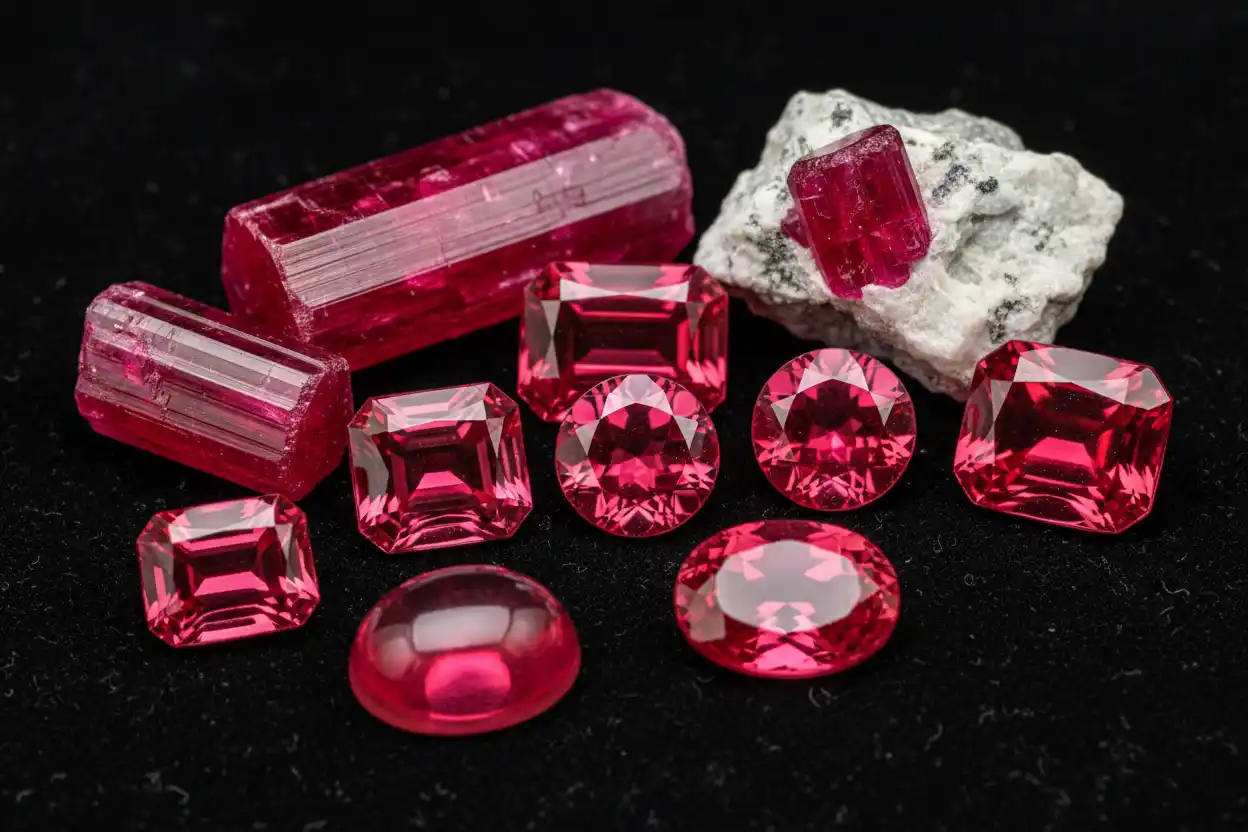
Rubellite Meaning, Properties, Identification & Value
Rubellite is the trade name for strongly saturated pink, red, purplish-red, orangey-red, or brownish-red tourmaline. Most gem material belongs to elbaite or fluor-elbaite, although red tourmaline can occur in other lithium-rich tourmaline species.
The name does not have one universally enforced color boundary. Some dealers reserve Rubellite for tourmaline that appears distinctly red under different light sources, while others include vivid dark pink stones within the category.
Rubellite at a Glance
| Property | Rubellite |
|---|---|
| Material type | Red-to-pink gem variety of lithium-rich tourmaline |
| Common mineral species | Primarily elbaite or fluor-elbaite; occasionally other tourmaline-group species |
| General composition | Complex borosilicate containing sodium, lithium, aluminum, boron, silicon, oxygen, hydroxyl or fluorine, and trace elements |
| Common colors | Raspberry red, cherry red, crimson, purplish red, pink-red, orangey red, brownish red, and deep magenta |
| Crystal system | Trigonal |
| Typical habit | Long striated prisms, short thick crystals, radiating groups, broken pegmatite crystals, faceted gems, and cabochons |
| Luster | Vitreous |
| Transparency | Transparent to opaque |
| Mohs hardness | Approximately 7–7.5 |
| Cleavage | Indistinct to absent in practical gem use |
| Tenacity | Brittle |
| Fracture | Uneven to conchoidal |
| Specific gravity | Commonly approximately 3.02–3.20, varying with chemistry |
| Optical character | Uniaxial negative and strongly pleochroic |
| Common uses | Faceted gems, cabochons, rings, earrings, necklaces, bracelets, pendants, carvings, and mineral specimens |
| Main care concern | Internal fractures, heat sensitivity, irradiation-related color instability, filling, over-dark cutting, and confusion with Ruby, Garnet, Spinel, or Pink Tourmaline |
Rubellite within the Tourmaline Family
Tourmaline is a group of related borosilicate minerals rather than one mineral with a simple fixed formula.
The parent Tourmaline guide explains the group’s shared crystal structure, electrical properties, general history, and major mineral species.
Rubellite is most commonly associated with elbaite, the lithium-rich tourmaline species that also produces pink, green, blue, colorless, and multicolored gemstones.
Fluor-elbaite can also produce Rubellite when fluorine occupies the dominant anion position in part of the structure.
Certain red crystals may belong to fluor-liddicoatite, olenite, or another tourmaline species. Therefore, color alone does not prove elbaite composition.
The complete mineral and commercial variety framework appears in types of Tourmaline.
Rubellite versus Pink Tourmaline
The boundary between Rubellite and Pink Tourmaline is commercial rather than strictly mineralogical.
Both colors commonly occur in elbaite and result primarily from manganese-related absorption and radiation-sensitive color centers.
Pink Tourmaline usually describes pale blush, bubblegum pink, rose, salmon, and moderately saturated pink material.
Rubellite generally implies a deeper, richer red, raspberry, magenta, or purplish-red appearance.
Some dealers maintain that Rubellite should remain red under daylight, fluorescent light, and incandescent light rather than becoming brownish or washed-out pink.
No international instrument-based rule defines exactly how red, saturated, or dark the stone must be. Consequently, the same gem may be sold as fine Pink Tourmaline by one supplier and Rubellite by another.
A precise description should state the visible hue and tone instead of relying entirely on the variety name.
What Creates Rubellite’s Color?
Manganese is the most important trace element associated with red and pink elbaite.
However, manganese concentration alone does not explain every shade. Its oxidation state, interaction with other elements, crystal defects, natural irradiation, and later heat exposure all influence the color.
Mn²⁺ commonly contributes pale pink and related tones, while Mn³⁺-related absorption can strengthen red, magenta, and violet-red appearances.
Natural radiation can create color centers that intensify pink or red in some stones.
Iron, titanium, copper, and other trace elements may modify the hue, especially in stones that lean brown, orange, violet, or purple.
A deep red stone can appear almost black when the bodycolor is excessively concentrated. Cutters must therefore balance saturation with sufficient light return.
Pleochroism
Rubellite is strongly pleochroic, meaning its color can change when viewed along different crystallographic directions.
One direction may appear deeper red or purple, while another looks lighter pink, orangey, or brownish.
The strongest absorption commonly occurs along the crystal’s length.
Cutters orient the table and pavilion to display the most attractive color while preventing excessive darkness.
A stone cut without regard to pleochroism can show a brownish face-up hue even when the rough contained a vivid red direction.
Elongated emerald, oval, cushion, and pear cuts often follow the crystal’s natural shape while managing color efficiently.
Geological Formation
Most Rubellite forms in lithium-rich granitic pegmatites.
Pegmatites represent the late, volatile-rich portions of granitic magma systems. Water, boron, lithium, fluorine, sodium, manganese, cesium, and other elements become concentrated as common rock-forming minerals crystallize.
Boron helps stabilize tourmaline, while lithium and aluminum support elbaite-group compositions.
Open pockets allow well-formed crystals to grow with albite, quartz, lepidolite, spodumene, muscovite, pollucite, and other pegmatite minerals.
Changing fluid chemistry can create color zoning. A crystal may have a colorless core, pink middle, and green rim, or shift from pale pink to saturated red along its length.
Later stress, pocket collapse, or cooling can fracture the crystal. As a result, large transparent rough commonly contains healed cracks and internal veils.
Important Rubellite Sources
Brazil’s Minas Gerais pegmatite districts have produced major quantities of red, pink, green, and multicolored elbaite.
The Jonas, Cruzeiro, Pederneira, Golconda, and numerous additional mines are known for collectible crystals and gem rough.
Mozambique has supplied large, deeply colored red and purplish-red tourmalines, including material suitable for substantial faceted stones and carvings.
Nigeria produces pink-to-red elbaite from several pegmatite regions, sometimes with complex color zoning.
Madagascar yields Rubellite and related tourmalines from lithium-rich pegmatites, including crystals with unusual species compositions.
Afghanistan and Pakistan produce crystals from the Hindu Kush and associated pegmatite belts. Their material ranges from pale pink to vivid red, commonly with albite or lepidolite matrix.
California’s historic Himalaya, Tourmaline Queen, Stewart, and related pegmatites supplied famous pink and red tourmaline.
Russia, Myanmar, Namibia, Zambia, and several other regions also produce red tourmaline.
Color cannot establish geographic origin. A Brazil or Mozambique claim should depend on documented supply history, inclusions, and advanced trace-element analysis rather than appearance alone.
Rubellite Inclusions
Rubellite commonly contains more visible inclusions than green or blue transparent tourmaline.
Typical features include long growth tubes, liquid-filled channels, healed fractures, fingerprints, flat films, mineral crystals, and color zoning.
Needle-like or tubular inclusions may follow the crystal’s length.
A network of fine healed fissures can scatter light while remaining structurally stable. Larger surface-reaching fractures create a greater setting risk.
The colored-stone market accepts moderate inclusions when the Rubellite has exceptional saturation and brilliance.
Nevertheless, dark, heavily fractured, or cloudy material should not receive a premium solely because the seller calls it natural and untreated.
Transparent stones with vivid color and limited distracting inclusions are significantly less common than ordinary commercial Rubellite.
Rubellite versus Watermelon Tourmaline
Watermelon Tourmaline contains contrasting pink or red and green zones in the same crystal.
A red center surrounded by green can be cut into slices, cabochons, or faceted gems.
Rubellite describes the red or strongly pink portion rather than requiring a green zone.
A uniformly red gem is Rubellite but not Watermelon Tourmaline.
Meanwhile, a multicolored slice may contain Rubellite-quality red while remaining valued primarily for its watermelon zoning.
The two markets overlap in crystal specimens, but their quality factors differ. Rubellite emphasizes face-up red color and brilliance, while Watermelon Tourmaline depends on color separation, pattern, and slice orientation.
Rubellite versus Paraíba Tourmaline
Paraíba Tourmaline is copper- and manganese-bearing tourmaline known for vivid blue, greenish blue, violet, and related neon colors.
Rubellite is generally manganese colored and red-to-pink.
Some copper-bearing tourmalines contain pink, violet, red, or multicolored zones, especially from Mozambique and Nigeria.
However, a reddish tourmaline does not receive Paraíba status merely because copper might be present.
The Paraíba trade category depends on copper-bearing chemistry and the accepted blue-to-green color range rather than general tourmaline rarity.
Rubellite versus Ruby
Rubellite and Ruby can overlap in crimson, raspberry, and purplish-red color.
Ruby is chromium-bearing corundum with a hardness of 9 and greater density.
Rubellite has lower refractive indices, stronger birefringence, pronounced dichroism, and a different inclusion suite.
Tourmaline commonly forms lengthwise-striated prisms, whereas Ruby commonly forms barrel-shaped or tabular corundum crystals.
Ruby may fluoresce strongly red beneath ultraviolet light. Rubellite is often weak or inert, although fluorescence alone is not conclusive.
Both stones require instruments when faceted and mounted.
The guide to Ruby, Garnet, and Spinel identification owns the wider red-gem comparison.
How to Identify Rubellite
Rubellite’s refractive indices commonly lie around 1.62–1.65, depending on tourmaline species and chemistry.
Birefringence can produce facet-edge doubling when the stone is viewed through the crown at an appropriate angle.
The gem is uniaxial negative and strongly pleochroic.
Specific gravity commonly falls near 3.0–3.2, below most Rubies and many red Garnets.
Natural rough often has a rounded triangular cross-section and deep parallel striations along prism faces.
Under magnification, gemologists look for growth tubes, liquid inclusions, healed fractures, pleochroism, and color zoning.
Raman spectroscopy confirms the tourmaline structure. Chemical analysis can determine whether the stone is elbaite, fluor-elbaite, liddicoatite, or another species.
The general non-destructive testing sequence appears in how to identify crystals.
Heat Treatment
Heat can lighten dark tourmaline and reduce undesirable brown, purple, or gray components.
The result depends on the stone’s starting chemistry and the defect centers responsible for its color.
Some red and pink stones become paler after heating rather than more saturated.
Excessive heat can remove radiation-related red or pink color completely.
Internal fractures create a separate danger because rapid temperature change can break the gem.
Heat treatment may be difficult to detect conclusively after it has occurred.
Therefore, untreated claims should not create a large premium unless a respected laboratory can support them.
Irradiation
Irradiation can create or strengthen pink and red color centers in pale tourmaline.
The energy source may involve electrons, gamma rays, or another controlled form of radiation.
After treatment, heating may adjust or partly remove the resulting color.
Some irradiation-related colors are stable under normal conditions, while others can fade with strong heat or prolonged bright light.
Gemological detection is not always straightforward because natural radiation can create similar centers underground.
A seller should disclose known irradiation even when a laboratory cannot determine the treatment history independently.
The broader terminology belongs on gemstone treatments explained.
Fracture Filling and Surface Treatments
Rubellite’s common surface-reaching fractures make clarity enhancement possible.
Oil or resin can reduce the visibility of fissures.
Filler may show flash colors, trapped bubbles, incomplete areas, or a different luster under magnification.
Coatings can strengthen red color, create metallic effects, or conceal surface damage.
Dye can enter fractures in pale or heavily included material, although it is less central to fine transparent Rubellite than irradiation or filling.
A significant filler can affect durability, repair, ultrasonic cleaning, and value.
Synthetic and Imitation Rubellite
Laboratory-grown tourmaline exists for research, but synthetic gem tourmaline is not a major commercial jewelry product.
The more common risks are substitutions.
Red glass, synthetic Spinel, synthetic corundum, Garnet, dyed Quartz, and assembled stones can imitate Rubellite.
Glass may contain bubbles, flow lines, low hardness, and no natural pleochroism.
Synthetic Spinel is singly refractive, while Rubellite is doubly refractive.
Dyed or coated material may show color concentrated near fractures or worn facet edges.
The distinction among synthetic, natural, and imitation gems is explained in lab-grown versus natural gemstones.
Cutting Rubellite
Cutters orient Rubellite to balance color, pleochroism, brilliance, clarity, and weight.
Dark rough often receives shallower cuts so less red material lies in the light path.
Light stones can tolerate greater depth and may benefit from brilliant-style pavilions.
Elongated crystals naturally produce emerald cuts, long cushions, pears, and ovals.
Included material is often cut into cabochons, beads, carvings, or tablets.
A cabochon should reveal attractive color without emphasizing large surface fractures.
Precision cutting can improve brightness substantially, but it cannot correct an overly dark body or unstable internal crack.
Durability and Jewelry Suitability
Rubellite’s hardness of approximately 7–7.5 makes it suitable for most jewelry.
Its position appears in the gemstone hardness chart.
The mineral lacks prominent gemological cleavage, but it remains brittle.
A sharp blow can chip facet junctions or extend an internal fracture.
The distinction between hardness and structural toughness is covered in gemstone toughness versus hardness.
Rings, earrings, pendants, bracelets, and necklaces are practical when the stone is structurally sound.
A low setting or bezel offers greater protection for heavily included stones.
Prongs should not press against a filled or surface-reaching fracture.
Heat from a jeweler’s torch can damage color or break an included Rubellite, so the stone should be removed before major repair work whenever possible.
Current Rubellite Asking Prices
Rubellite spans inexpensive included stones and high-value clean gems with vivid red color.
| Rubellite product | Broad July 2026 retail asking range |
|---|---|
| Small opaque or heavily included cabochon | About $10–$50 total |
| Translucent commercial Rubellite | About $20–$100 per carat |
| Small commercial faceted stone | About $75–$300 per carat |
| Good transparent red or purplish-red gem | About $200–$800 per carat |
| Fine vivid clean material above one carat | About $500–$2,000 per carat |
| Exceptional large, bright, minimally included gem | About $1,500–$5,000 per carat or more |
| Attractive natural crystal specimen | About $100–$1,500 |
| Major historic or highly aesthetic crystal | Several thousand dollars or more |
These figures represent broad current asking-price context rather than appraisals or guaranteed transaction values.
Translucent carvings and included gems can appear far below the usual per-carat ranges quoted for fine transparent Rubellite.
Detailed size, color, clarity, and origin segmentation belongs on the Rubellite price guide.
What Gives Rubellite Value?
Color is the principal factor.
The strongest demand centers on vivid raspberry red, cherry red, and purplish red without excessive brown, orange, gray, or black extinction.
Tone should remain rich but not so dark that the stone loses brilliance.
Clarity matters, although moderate inclusions are accepted more readily than in some other tourmaline colors.
Large clean stones carry substantial premiums because fractures and color zoning reduce faceting yield.
Cut quality controls brightness, pleochroism, windowing, extinction, symmetry, and apparent size.
Treatment affects value when irradiation, filling, coating, or another enhancement is known.
Reliable origin, an independent report, condition, and craftsmanship complete the assessment.
Buying Rubellite
Ask how the seller distinguishes Rubellite from ordinary Pink Tourmaline.
View the gem beneath daylight-equivalent, fluorescent, and warm incandescent light.
The stone should retain an attractive red or saturated pink-red appearance rather than becoming muddy brown.
Request magnified photographs and a rotating video showing inclusions, windowing, extinction, and pleochroism.
Ask specifically about heat, irradiation, oil, resin, coating, and other clarity enhancement.
A laboratory report becomes useful for expensive stones, significant treatment questions, unusual species claims, or major origins.
Detailed transaction checks belong on the Rubellite buying guide.
Rubellite is included in the pink-gemstone directory and red-gemstone directory.
It also appears in the crystals beginning with R directory and gemstones beginning with R directory.
Cleaning and Storage
Clean Rubellite with warm—not hot—water, mild soap, and a soft brush.
Rinse briefly and dry it with a lint-free cloth.
Avoid ultrasonic cleaning when the stone contains fractures, filling, coatings, or significant inclusions.
Steam is not recommended because sudden heat can damage both the color and the internal structure.
Keep the gem away from prolonged intense heat and strong display lighting when irradiation-related color stability is uncertain.
Store Rubellite separately from sapphire, Ruby, diamond, and other harder stones.
Complete setting-specific care appears in how to clean Rubellite jewelry.
Rubellite Meaning and Symbolism
Red and pink tourmalines have been incorporated into jewelry for centuries, although historic stones were often confused with Ruby, Spinel, or Garnet.
Modern crystal traditions associate Rubellite with affection, vitality, emotional honesty, creative confidence, and maintaining warmth without surrendering personal boundaries.
Its pronounced pleochroism provides a natural metaphor for one subject showing different qualities from different perspectives.
Color zoning can symbolize identity developing through several stages rather than appearing fully formed at once.
Deep red stones receive associations with commitment and courage, while raspberry and pink-red material is linked with compassion and relationship awareness.
These meanings remain personal, artistic, cultural, or spiritual interpretations. Scientific evidence does not show that Rubellite treats illness, changes hormones, improves circulation, or guarantees romantic success.
Frequently Asked Questions
Is Rubellite a mineral species?
No. It is a red-to-strong-pink tourmaline trade variety, most commonly composed of elbaite or fluor-elbaite.
Is Rubellite the same as Pink Tourmaline?
They overlap. Rubellite generally describes more saturated red, raspberry, magenta, or purplish-red material, while Pink Tourmaline usually has a lighter pink bodycolor.
What creates Rubellite’s red color?
Manganese-related absorption, radiation-created color centers, oxidation state, other trace elements, and heat history all influence the color.
Does genuine Rubellite stay red under every light?
Fine material should remain attractively red or pink-red in common lighting, but the trade has no universal rule requiring identical color under every source.
Where is Rubellite found?
Important sources include Brazil, Mozambique, Nigeria, Madagascar, Afghanistan, Pakistan, California, Russia, and several other pegmatite regions.
Is Rubellite rarer than Ruby?
Fine large clean Rubellite is genuinely uncommon, but broad rarity comparisons depend on size and quality. Ordinary included Rubellite is more available than fine Ruby.
Is Rubellite usually included?
Yes. Growth tubes, liquid inclusions, healed fractures, and internal veils are common.
Is Rubellite commonly treated?
Heat, irradiation, oil or resin filling, and occasional coatings can occur.
Can irradiation be detected in Rubellite?
Not always. Natural and laboratory radiation can produce similar color centers, making conclusive detection difficult.
Is Rubellite suitable for an engagement ring?
A sound stone can be worn in a protective setting, although heavily fractured or filled examples require more cautious use.
Can Rubellite go in water?
Brief washing with warm soapy water is generally suitable. Avoid soaking filled, coated, glued, or strongly fractured material.
What makes Rubellite valuable?
Vivid red color, balanced tone, limited brown or gray, transparency, clarity, size, cut, treatment status, condition, origin, and documentation determine value.
Rubellite earns its place within the Tourmaline family through saturated red color rather than one rigid chemical boundary. Evaluating its hue, pleochroism, clarity, treatment, and cutting separately provides more useful information than debating whether a borderline dark-pink stone qualifies for the trade name.
Cutting or grinding Rubellite can generate fine borosilicate and associated-mineral dust. Use wet lapidary methods, effective local extraction, eye protection, protective clothing, and suitable respiratory protection rather than dry processing.