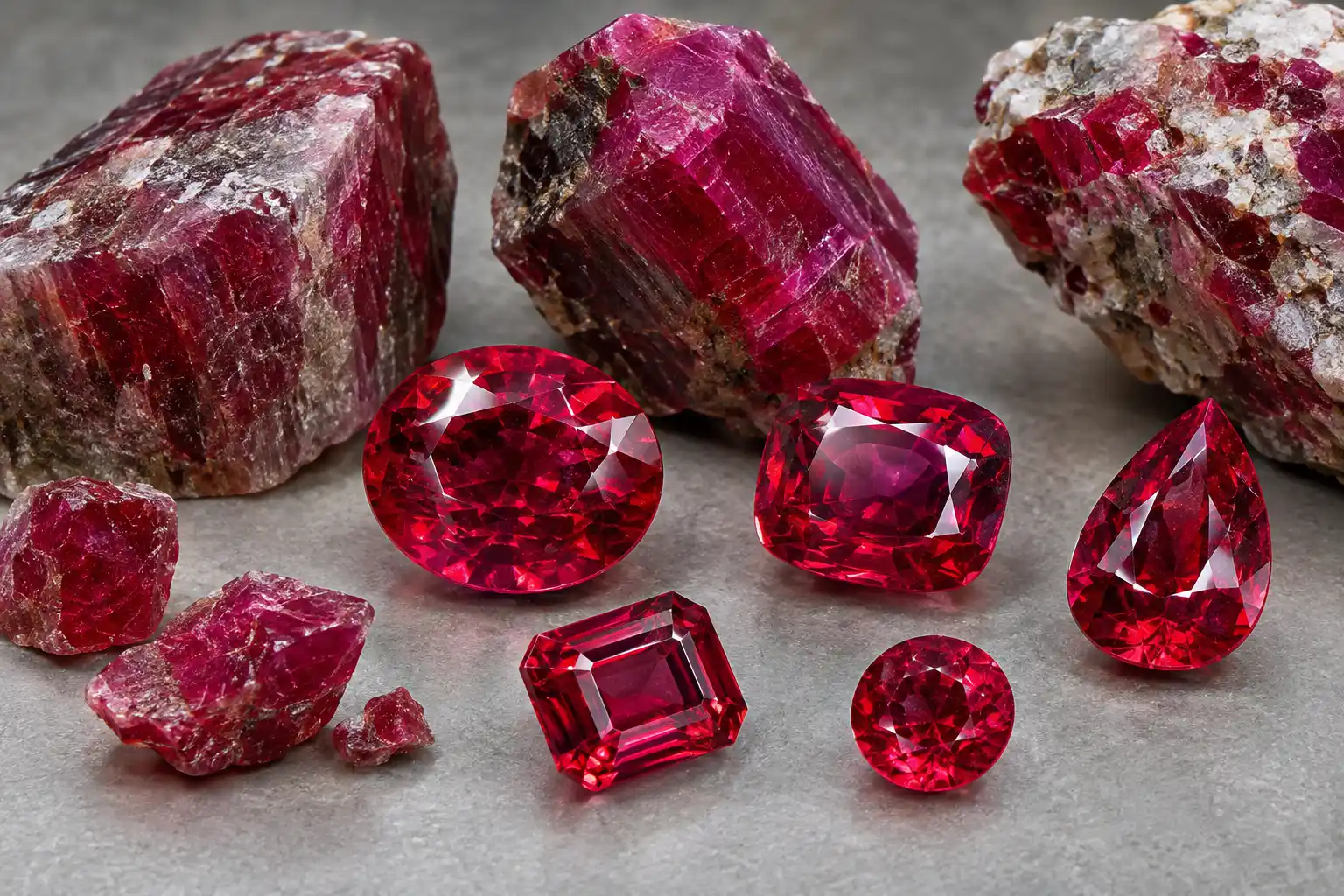
15 Ruby Benefits for Courage & Spiritual Vitality
Ruby benefits begin with the exceptional gemological properties of red corundum. Ruby is aluminum oxide, Al2O3, colored primarily by small amounts of chromium substituting for aluminum within the crystal structure. It crystallizes in the trigonal system and reaches 9 on the Mohs scale, placing it immediately below diamond in scratch resistance.
These physical properties give ruby benefits that are easy to measure. Fine ruby combines excellent hardness, strong color, useful toughness, brilliant polishing potential, fluorescence in many specimens, jewelry versatility, geological interest, and some of the highest collector appeal found among colored gemstones.
Courage and spiritual vitality belong to a different part of ruby’s story. Red color has inspired ideas about strength, passion, life, protection, and confidence across many periods and cultures, while modern spiritual practices may use ruby as a personal symbol for these qualities. Ruby does not medically increase stamina, blood flow, hormones, immunity, or physical energy.
15 Ruby Benefits at a Glance
- Mohs hardness 9 gives ruby exceptional resistance to everyday scratching.
- The absence of true cleavage makes ruby less vulnerable to splitting along fixed crystal planes than many popular gems.
- Strong red color provides enduring jewelry and collector appeal.
- Chromium can produce vivid fluorescence that makes some rubies appear especially lively in daylight.
- High polish and good transparency allow fine ruby to show strong brilliance.
- Ruby works well in rings, earrings, pendants, bracelets, and other frequently worn jewelry.
- Oriented rutile inclusions can create six-rayed asterism in star ruby.
- Natural inclusions can reveal clues about growth conditions and geographic origin.
- Marble-hosted and basalt-related rubies provide valuable lessons in metamorphic and igneous-associated geology.
- Ruby’s long jewelry history adds cultural and historical significance beyond its physical beauty.
- Its position within the corundum family helps students understand the relationship between ruby and sapphire.
- Heat treatment provides an important example of how accepted gemstone enhancement can change appearance while preserving mineral identity.
- Modern courage symbolism can make ruby a personal reminder of persistence, confidence, and deliberate action.
- Spiritual vitality traditions can support meditation or reflection when kept separate from medical claims.
- Proper cleaning and treatment awareness make high-quality ruby relatively practical to preserve for generations.
Ruby Benefits Begin With Corundum Chemistry
The most important ruby benefits come from its identity as red corundum. Pure corundum would be colorless, but chromium entering the aluminum sites of the crystal lattice creates the absorption pattern responsible for ruby’s red coloration.
Ruby shares its basic Al2O3 chemistry and crystal structure with sapphire. The distinction is largely one of color-producing trace elements and gem-trade classification, with red corundum called ruby and other gem colors generally falling within sapphire terminology.
This relationship makes ruby particularly useful for gemological study. Two gems can belong to the same mineral species yet look dramatically different because tiny quantities of trace elements alter the way their crystals absorb and transmit light.
Chromium also contributes to another ruby benefit: fluorescence. Many rubies emit strong red fluorescence under ultraviolet radiation, and sunlight contains enough ultraviolet energy to make some low-iron rubies appear especially vivid.
Mohs 9 Hardness Is a Major Practical Ruby Benefit
Scratch resistance is one of the strongest ruby benefits for jewelry. With Mohs hardness 9, corundum is significantly harder than quartz, feldspar, tourmaline, topaz, spinel, and many other colored gems.
Only a small number of natural substances commonly encountered in jewelry are harder. Diamond can scratch ruby, while another corundum gem can also abrade it under suitable conditions.
Hardness should still be separated from toughness. A fine ruby’s real-world ruby durability depends on fractures, inclusions, treatments, cutting, setting design, and the severity of any impact it receives.
Corundum has no true cleavage, which is another practical advantage. Ruby can still chip around facet junctions or fracture after a strong blow, but it lacks the pronounced cleavage planes that make gems such as fluorite, topaz, and some feldspars particularly vulnerable in specific directions.
Ruby Benefits for Rings and Everyday Jewelry
Ruby benefits jewelry wearers because the combination of hardness and good toughness makes the gem suitable for frequent use. Well-cut natural ruby can perform effectively in engagement rings, wedding jewelry, earrings, pendants, bracelets, and heirloom pieces.
Rings receive the most impact, so mounting design still matters. A valuable ruby with significant surface-reaching fractures deserves more protection than a clean stone in a robust setting.
Ruby’s ability to take and retain a high polish is equally useful. Smooth facets maintain crisp reflections, helping a well-proportioned gem preserve attractive brilliance after years of sensible wear.
This practical durability is one reason ruby has remained important in fine jewelry. The stone offers saturated color without requiring the extreme daily caution needed for softer gems such as opal, fluorite, rhodochrosite, or calcite.
Chromium, Color, and Fluorescence
Color is central to ruby benefits because fine red hues are the defining feature of the gem. Chromium absorbs portions of visible light while allowing red wavelengths to dominate, producing colors that range from pinkish red to strongly saturated red and purplish red.
Iron can also influence appearance. Higher iron content may deepen or modify color and can reduce chromium-related fluorescence, which helps explain why rubies from different geological settings may behave differently under ultraviolet light.
Fluorescence can improve face-up liveliness in suitable stones. A strongly fluorescent ruby may seem to possess additional red intensity in daylight because visible red fluorescence adds to the light already reflected and transmitted by the gem.
This effect is entirely optical. The glow does not represent spiritual energy or heat stored inside the stone.
Star Ruby and the Benefit of Natural Asterism
Some ruby benefits come from inclusions rather than perfect clarity. Fine needle-like rutile inclusions can align along crystallographic directions within corundum, and when the rough is cut as a correctly oriented cabochon, reflected light may produce a six-rayed star.
This phenomenon is called asterism. A sharp star that moves smoothly across the dome under a single light source can make star ruby especially desirable to collectors.
The effect also demonstrates why inclusions are not automatically flaws. In transparent faceted ruby, dense inclusions may reduce clarity, but in star ruby the right orientation and concentration of inclusions create the feature that gives the gem its identity.
Heat treatment can dissolve or alter rutile needles, which may weaken a natural star. Treatment history therefore matters when evaluating valuable asteriated ruby.
Geological Origin Adds Scientific Value
The question of where ruby is found matters because different geological environments influence color, inclusions, iron content, fluorescence, and crystal growth.
Some famous rubies form in metamorphosed marble. These deposits are associated with regions including Myanmar, Vietnam, Afghanistan, Tajikistan, and parts of the Himalayan geological belt. Marble-hosted ruby often contains relatively little iron, which can allow strong red fluorescence.
Other rubies occur in amphibolite, gneiss, and basalt-related environments. Mozambique has become one of the world’s most important modern ruby sources, while Madagascar, Tanzania, Sri Lanka, Thailand, Cambodia, Greenland, and several other regions also produce ruby.
Geographic origin cannot be determined reliably from color alone. Gemological laboratories study inclusions, trace-element chemistry, spectroscopy, and other characteristics when an origin opinion is required.
Ruby Quality Depends on More Than Red Color
Color normally has the greatest influence on the appearance of a fine ruby, but ruby benefits are best judged through several gemological characteristics together. Hue, tone, saturation, transparency, clarity, cut, fluorescence, size, treatment, and provenance can all matter.
The principles behind ruby quality grading also show why terms such as “pigeon blood” should be used carefully. The phrase is widely associated with exceptional vivid red ruby, but laboratories and sellers can apply specific criteria differently.
A ruby that is too dark can lose brightness even if saturation is strong. An overly shallow stone may show windowing, while a poorly oriented or deeply cut stone can retain unnecessary weight at the expense of face-up beauty.
Visible inclusions are common in natural ruby. Their effect on value depends on size, location, color, transparency, durability risk, and whether they interfere with the overall appearance.
Heat Treatment and Other Ruby Enhancements
One practical ruby benefit is that heat treatment can improve color or clarity while leaving the stone as natural corundum. Heating has a long history in the ruby trade and is widely accepted when it is accurately disclosed.
Heat can modify iron-related coloration, improve transparency, dissolve some silk-like rutile, or heal certain fractures in the presence of naturally occurring components. The exact effect depends on the ruby and the treatment conditions.
More extensive enhancement deserves separate consideration. Lead-glass-filled ruby contains glass introduced into fractures to improve transparency and apparent quality, and such stones require much more cautious care.
A treated ruby is not automatically synthetic. Natural origin, treatment history, and whether a gem was grown in a laboratory are three separate questions.
Ruby Benefits for Gem Identification
Ruby benefits gemology students because the stone can teach color origin, crystal structure, fluorescence, inclusions, treatment, spectroscopy, and the separation of natural gemstones from synthetic counterparts.
Natural ruby may contain rutile silk, mineral crystals, healed fissures, color zoning, fluid-related features, or other growth characteristics. Synthetic ruby can share the same corundum chemistry and many core physical properties but reveals a different growth history through diagnostic features.
Visual inspection alone is not enough for valuable stones. Red spinel, garnet, glass, synthetic corundum, composite stones, and other red gems can resemble ruby to an untrained observer.
The strongest identification comes from a combination of refractive properties, spectroscopy, microscopy, fluorescence, specific gravity, advanced chemical testing, and skilled interpretation.
Courage as a Symbolic Ruby Benefit
Courage is one of the oldest themes people associate with ruby benefits. The intense red color naturally evokes fire, blood, strength, danger, passion, and determination, making the gem an intuitive symbol for bravery.
Historical traditions in several regions attributed protective or strengthening qualities to ruby. These beliefs tell us how people interpreted the gemstone, but they do not establish that ruby physically changes fear responses or protects someone from injury.
A modern wearer may still use ruby as a reminder of courage. A ring could represent speaking honestly, pursuing a difficult goal, maintaining boundaries, or returning to an important task after a setback.
In this sense, the gemstone supports symbolism while courage remains a human decision and behavior.
Spiritual Vitality Without Physical-Energy Claims
Spiritual vitality is another theme associated with ruby benefits. Modern traditions may connect the gem with enthusiasm, passion for life, confidence, creativity, sexual energy, or renewed personal direction.
These ideas should remain distinct from biological energy. Ruby does not increase oxygen levels, blood production, metabolism, hormones, testosterone, fertility, or cardiovascular performance through skin contact.
The chromium and aluminum within corundum remain part of a stable crystal lattice. Wearing ruby does not deliver useful nutrients or medicinal elements into the body.
Someone can still associate ruby with vitality during meditation, prayer, exercise goal-setting, or creative work. The stone becomes a reminder of the person’s intention rather than the source of physical energy.
Ruby Chakra Traditions
Modern crystal systems frequently associate ruby with the root chakra because its intense red color fits contemporary lower-chakra color schemes. Some practices also connect ruby with the heart because of its relationship symbolism and historic association with passion.
Chakras are spiritual frameworks, not anatomical structures. Ruby cannot physically activate the spine, adrenal glands, reproductive organs, heart, circulation, or nervous system.
A chakra practice may still provide a structured form of reflection. Someone might use ruby while thinking about security, courage, relationships, or practical goals without claiming a medical effect.
These symbolic ruby benefits remain more credible when spiritual language is clearly separated from physiology.
Personal and Relationship Value
Ruby benefits can also be entirely personal. A ruby may represent an anniversary, family relationship, graduation, business achievement, birthday, engagement, or difficult period successfully completed.
This is why the gemstone has value beyond mineral chemistry. Jewelry can become connected with the person who gave it, the occasion it marked, and the experiences that followed.
Personal meaning does not need a universal spiritual rule. A ruby inherited from a relative can matter more to its owner than a larger stone with no personal history.
The gem provides durability and visual beauty, while human memory gives the object its individual significance.
Cleaning and Preserving Ruby
Good care protects ruby benefits over decades of wear. For most untreated or conventionally heat-treated stones, warm water, mild soap, and gentle brushing are appropriate.
The correct way to clean ruby jewelry changes when significant fractures or fracture filling are present. Glass-filled rubies need more conservative treatment because heat, chemicals, and repair procedures can damage the filler.
Ultrasonic and steam cleaning should never be assumed safe without knowing the gemstone’s condition and treatment history. A qualified jeweler can examine valuable ruby jewelry before aggressive cleaning or repair.
Store ruby separately from softer stones because corundum can scratch many other gems. Diamond can scratch ruby, so high-value pieces also benefit from individual compartments or soft pouches.
Conclusion
Ruby benefits include exceptional Mohs 9 hardness, excellent jewelry potential, chromium-rich color, fluorescence, asterism, geological value, and strong gemological educational interest. Courage and spiritual vitality can provide meaningful personal symbolism, but they remain separate from medical, hormonal, cardiovascular, or physical-energy claims.
FAQs
What are the main ruby benefits?
Ruby benefits include Mohs 9 hardness, strong jewelry durability, intense red color, excellent polishing potential, fluorescence in many stones, geological interest, and rare optical effects such as asterism. Modern traditions also associate ruby with courage, passion, vitality, and confidence.
What is ruby made of?
Ruby is red corundum with the basic chemical formula Al2O3. Small amounts of chromium substituting into the corundum structure are primarily responsible for its red color.
Is ruby durable enough for everyday rings?
Yes. Ruby’s Mohs hardness of 9, lack of true cleavage, and generally good toughness make it one of the better colored gemstones for rings. Fractures, extensive treatments, setting style, and strong impacts can still affect durability.
Why do some rubies glow strongly in daylight?
Chromium can cause red fluorescence when ruby is exposed to ultraviolet radiation. Low-iron rubies may display particularly strong fluorescence, which can add visible red intensity under sunlight.
What creates a star in star ruby?
Fine oriented inclusions, commonly rutile needles, reflect light along specific directions inside the crystal. When the rough is cut correctly as a cabochon, these reflections can form a moving six-rayed star.
Does ruby increase courage or physical energy?
There is no scientific evidence that ruby directly changes courage, stamina, hormones, blood flow, or metabolism. It can serve as a symbolic reminder of confidence, persistence, passion, or deliberate action.
Is heated ruby still real ruby?
Yes. A natural ruby that has been heat treated remains natural corundum, although the treatment should be disclosed. Synthetic ruby, fracture-filled ruby, and heated natural ruby are different gemological categories.
Can ruby be worn for spiritual vitality?
Ruby can be used during meditation, prayer, or personal reflection as a symbol of vitality and motivation. The practice is spiritual or personal rather than evidence that corundum produces biological energy.
Disclaimer: Courage, vitality, chakra, passion, protective, emotional, and energetic descriptions of ruby reflect spiritual beliefs and cultural traditions. Ruby is not a medical treatment and should not replace professional healthcare.