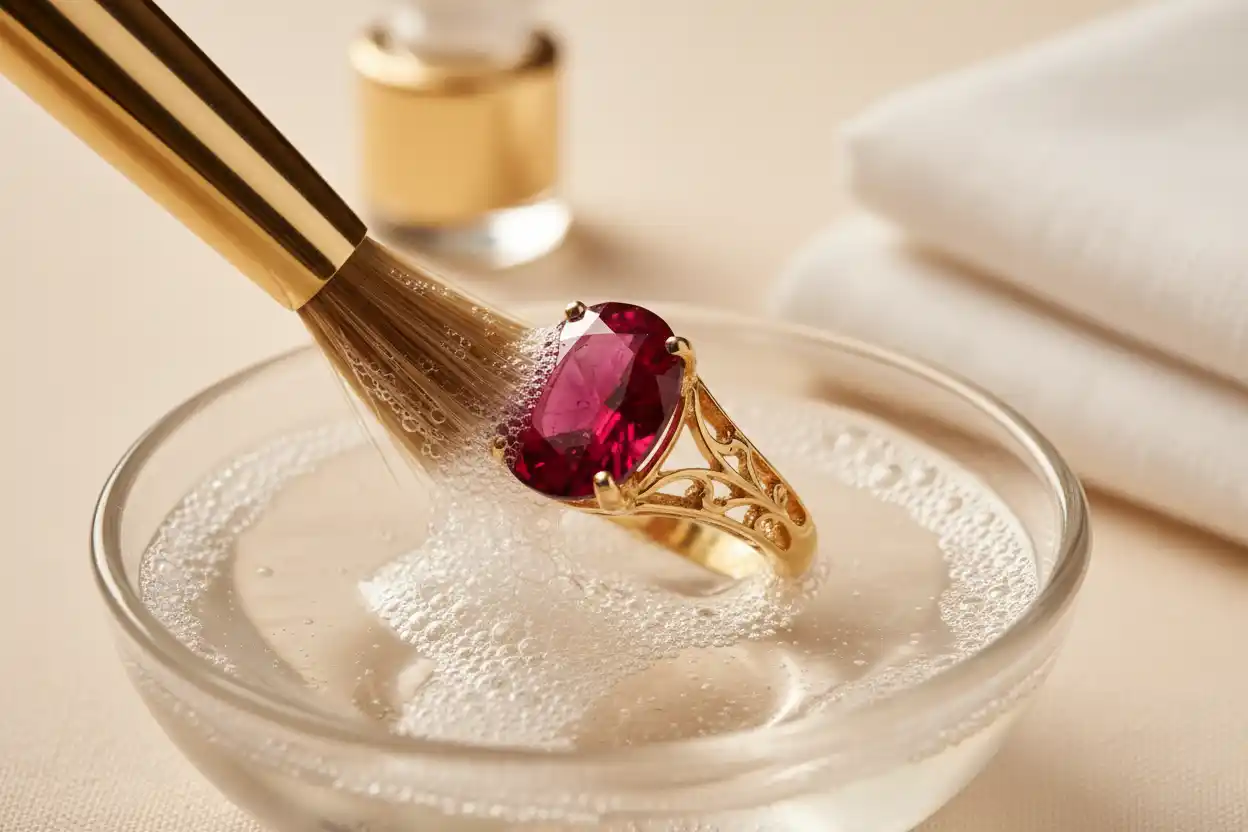
How to Clean Ruby Jewelry Safely: Rings, Lab Rubies & Care
Knowing how to clean ruby jewelry properly starts with one important fact: ruby itself is extremely durable, but not every ruby jewelry piece has the same treatment, inclusions or setting.
For most sound natural rubies, conventionally heat-treated rubies and untreated lab-grown rubies, lukewarm water, mild liquid dish soap and a soft brush provide an effective home-cleaning method. Ruby is corundum with Mohs hardness 9, so ordinary brushing does not threaten a sound polished surface.
The exceptions matter. Lead-glass-filled ruby, fracture-filled material, coated stones, heavily fractured gems, assembled products and jewelry with loose settings require more conservative care. Ultrasonic and steam cleaning may be suitable for some sound rubies, but they should never be treated as universal methods.
The safest way to learn how to clean ruby jewelry is therefore to identify the stone and its treatment before choosing the cleaning technique.
How to Clean Ruby Jewelry at a Glance
| Ruby or jewelry type | Safest routine approach | Main concern |
|---|---|---|
| Untreated natural ruby | Lukewarm water, mild soap, soft brush | Setting condition |
| Conventionally heated ruby | Lukewarm water, mild soap, soft brush | Fractures and setting |
| Lab-grown ruby | Same basic hand-cleaning method | Additional treatments or fractures |
| Flame-fusion lab ruby | Mild soap and water | Setting and any later treatment |
| Flux-grown lab ruby | Mild soap and water | Flux features, fractures, filling |
| Hydrothermal lab ruby | Mild soap and water | Fractures and later treatments |
| Lead-glass-filled ruby | Minimal gentle hand cleaning | Glass filler, acids, heat, solvents |
| Fracture-filled ruby | Gentle manual cleaning | Filler stability |
| Coated ruby | Damp cloth or very gentle cleaning | Coating abrasion |
| Star ruby | Gentle hand cleaning when treatment is uncertain | Silk, fractures, filling |
| Antique ruby jewelry | Conservative cleaning after inspection | Repairs, glue, enamel, mixed materials |
| Loose or damaged setting | Do not clean until repaired | Stone loss |
This table is the starting point for how to clean ruby jewelry, but the complete jewelry construction still determines the safest method.
Why Ruby Is Usually Durable
Ruby is the red gem variety of corundum, composed principally of aluminum oxide. Chromium is the main element responsible for its red color.
The broader ruby meaning guide covers its geology, color, history, varieties and symbolism in detail.
Ruby ranks 9 on the Mohs hardness scale. Only diamond is harder among commonly encountered natural gemstones.
That makes ruby highly resistant to ordinary scratching and suitable for rings, earrings, necklaces and bracelets.
However, scratch resistance is not the same as complete indestructibility.
Ruby is brittle rather than flexible. Thin girdles, pointed corners and existing fractures can still chip when struck.
Inclusions can also affect durability.
Therefore, how to clean ruby jewelry should consider the individual stone rather than relying only on its hardness number.
Inspect Ruby Jewelry Before Cleaning
Before deciding how to clean ruby jewelry, examine the entire piece under bright indirect light.
Look for:
loose or bent prongs,
gaps around a bezel,
movement in the center stone,
chipped corners,
damaged facet edges,
surface-reaching fractures,
missing accent stones,
broken links,
and worn clasps.
Do not deliberately twist the ruby.
If it clicks or visibly moves with very gentle handling, stop.
Cleaning a loose stone can turn a small repair into a lost gemstone.
This is particularly important with pavé, halo and vintage jewelry where numerous small stones may be held by tiny amounts of metal.
How to clean ruby jewelry safely begins with confirming that the jewelry is physically stable.
Find Out Whether the Ruby Is Treated
Treatment has a major influence on how to clean ruby jewelry.
Heat treatment is extremely common in natural ruby.
Conventional heating can improve color, reduce unwanted modifiers, alter rutile silk and sometimes help heal fissures.
A normally heated ruby remains natural ruby and is generally stable during ordinary cleaning.
Other treatments require much greater care.
Ruby can also be:
flux-healed,
lead-glass-filled,
fracture-filled,
diffusion-treated,
dyed,
surface coated,
or part of an assembled product.
The treated ruby guide explains these categories separately.
If you do not know the treatment history, use gentle manual cleaning rather than assuming the ruby can tolerate machines, heat or chemicals.
What You Need to Clean Ruby Jewelry
The safest everyday method for how to clean ruby jewelry requires very little equipment.
Use:
- A small bowl
- Lukewarm water
- Mild liquid dish soap
- A very soft toothbrush or jewelry brush
- A second bowl of clean water
- A soft lint-free cloth
Do not work over an open drain.
A small ruby or accent stone can disappear instantly if the setting unexpectedly releases it.
The water should be comfortably lukewarm.
You do not need boiling water, strong detergent or jewelry dip to remove ordinary skin oil.
How to Clean Ruby Jewelry Step by Step
For a sound untreated, conventionally heated or untreated lab-grown ruby, this is the safest general method for how to clean ruby jewelry at home.
1. Prepare Lukewarm Soapy Water
Fill a small bowl with lukewarm water.
Add a few drops of mild liquid dish soap.
Mix gently.
Do not create a highly concentrated cleaning solution.
Ordinary ruby jewelry becomes dull mostly because of skin oils, lotion, soap residue, cosmetics and dirt trapped around the setting. Mild detergent is enough to loosen those deposits.
2. Place the Jewelry in the Solution Briefly
A sound untreated or conventionally heated ruby can normally sit in the mild cleaning solution for a short period while residue softens.
Long soaking is unnecessary.
If the ruby is glass filled, heavily fractured, coated, assembled or of uncertain treatment, skip extended soaking.
When learning how to clean ruby jewelry, more time in liquid does not necessarily mean a cleaner or safer result.
3. Brush Gently
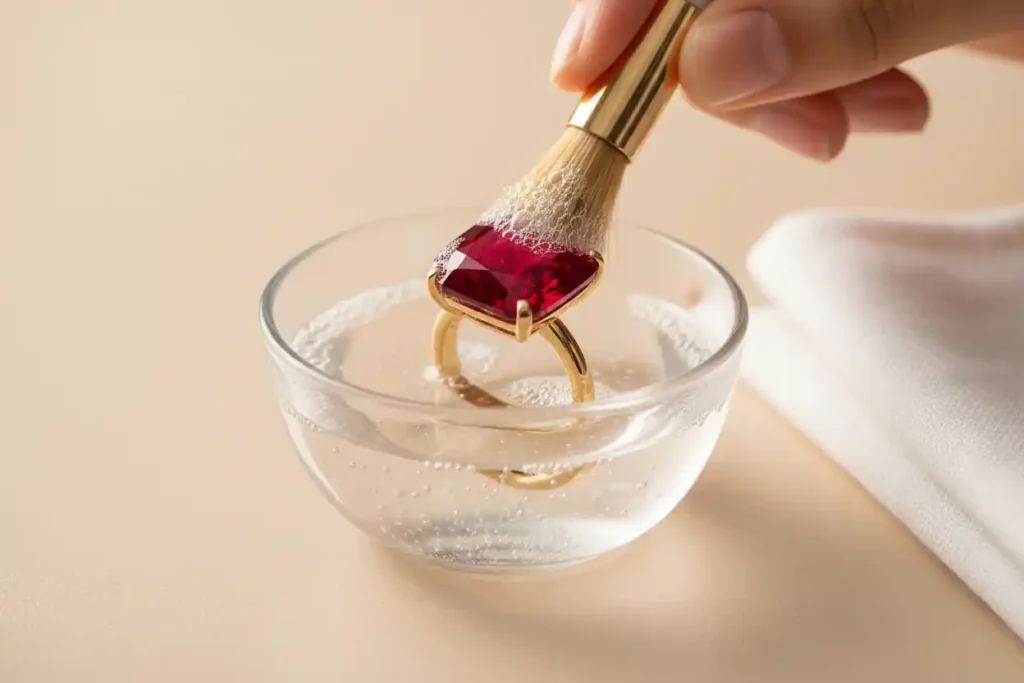
Use a soft brush to clean the ruby and its setting.
Work around the table, crown, girdle and accessible pavilion.
Most grime accumulates underneath the gemstone where skin oil and cosmetic residue are difficult to see.
Use light strokes.
Ruby is hard, but aggressive brushing can still damage a delicate setting.
4. Clean Behind the Ruby
If the mounting has gallery openings, brush gently through them.
Cleaning the pavilion can dramatically improve the apparent brightness of a transparent ruby.
Do not insert needles, pins or metal tools underneath the gemstone.
A metal object can bend a prong, scratch the mounting or place concentrated force against the ruby.
How to clean ruby jewelry effectively does not require digging into the setting.
5. Rinse Carefully
Move the jewelry into a second bowl containing clean lukewarm water.
Rinse away soap residue.
Avoid rinsing directly over an open sink.
Keep the rinse water close to the same temperature as the cleaning solution.
Extreme temperature changes are unnecessary, especially when a stone contains inclusions or fractures.
6. Dry Gently
Blot the jewelry with a lint-free cloth.
Allow moisture trapped beneath the ruby or between setting components to evaporate naturally.
Do not accelerate drying with:
a hair dryer,
radiator,
heat gun,
direct flame,
or intense lamp.
Once dry, inspect the ruby and setting again.
That completes the safest general method for how to clean ruby jewelry.
How to Clean Lab-Grown Ruby Jewelry
The core method for how to clean ruby jewelry applies equally well to most sound lab-grown rubies.
A lab-grown ruby is synthetic corundum.
It has essentially the same aluminum-oxide crystal structure and Mohs hardness as natural ruby. Laboratory-grown ruby is therefore not red glass or plastic.
Its manufactured origin does not require a special soap, stronger cleaner or fundamentally different maintenance routine.
Use:
lukewarm water,
mild liquid soap,
a soft brush,
gentle rinsing,
and room-temperature drying.
The broader comparison of lab-grown versus natural gemstones explains why manufactured origin and imitation are different concepts.
Why Lab-Grown Ruby Still Needs Inspection
A common mistake is assuming that synthetic ruby can be cleaned aggressively because it was manufactured.
That is not always safe.
Lab-grown ruby can contain internal growth features, fractures or cavities.
More importantly, additional treatment may occur after growth.
A laboratory-grown ruby can be:
fracture filled,
coated,
dyed,
assembled,
or set with sensitive materials.
That means how to clean ruby jewelry should never be decided from the word “lab-grown” alone.
Ask two separate questions:
Is the ruby natural or laboratory grown?
Has the finished stone received any additional treatment?
The answers describe different characteristics.
Flame-Fusion Ruby Care
Flame-fusion, or Verneuil, ruby is one of the oldest and most widely produced forms of lab-grown corundum.
Sound flame-fusion ruby is highly durable and generally responds well to normal mild soap-and-water cleaning.
Its low production cost also makes it common in vintage jewelry, class rings, inexpensive birthstone jewelry and decorative pieces.
The ruby itself may be durable while the mounting is not.
Older jewelry can contain worn prongs, glue, solder repairs or mixed gemstones.
When deciding how to clean ruby jewelry containing flame-fusion material, inspect the entire piece rather than focusing only on the synthetic ruby.
Flux-Grown Ruby Care
Flux growth can produce synthetic ruby with internal features that sometimes resemble aspects of natural inclusions.
Flux-grown ruby is still corundum and can be very durable.
However, growth features, fractures and later treatments vary between individual stones.
Warm soapy water and a soft brush remain the sensible default.
Avoid assuming a high-priced flux-grown ruby should automatically go into an ultrasonic cleaner.
How to clean ruby jewelry depends on condition and treatment, not how sophisticated the growth method sounds.
Hydrothermal Ruby Care
Hydrothermal methods can also grow synthetic corundum under controlled conditions involving hot pressurized solutions.
The finished material can have excellent color and transparency.
Again, normal hand cleaning is appropriate for a sound untreated stone.
If a laboratory-grown ruby contains significant fractures or later filler, use the more conservative method appropriate to that treatment.
Synthetic origin does not cancel physical vulnerabilities.
Can Lab-Grown Ruby Be Glass Filled?
Yes.
Laboratory growth and fracture filling are separate processes.
A synthetic ruby can contain a surface-reaching fracture that is later filled with another substance.
Likewise, manufactured ruby can be assembled with glass or other materials.
This is why how to clean ruby jewelry should be based on the finished product rather than the growth origin alone.
When filler is present, avoid heat, strong chemicals, acids and aggressive machine cleaning.
How to Clean Heat-Treated Ruby
Conventional heating is common and generally stable.
For a sound heated ruby without vulnerable filling, how to clean ruby jewelry is essentially the same as for untreated material.
Use lukewarm water.
Add mild soap.
Brush gently.
Rinse.
Dry naturally.
Conventional heating does not normally create a fragile surface layer that washes away.
However, “heated” can sometimes conceal more complicated treatment histories in casual sales descriptions.
Flux residues, healed fractures and filling deserve separate consideration.
If an expensive ruby has a laboratory report, read the treatment comments rather than relying on the single word “heated.”
How to Clean Lead-Glass-Filled Ruby
Lead-glass-filled ruby requires much stricter care.
Highly fractured low-quality corundum can be infiltrated with lead-rich or other glass to improve apparent transparency.
The visible appearance may depend extensively on filler.
This material should not be treated like sound untreated ruby simply because the host material contains corundum.
For how to clean ruby jewelry containing substantial glass filling, use minimal hand cleaning.
A soft damp cloth may be enough.
If more cleaning is required, use brief exposure to mild lukewarm soapy water followed by careful rinsing and drying.
Avoid:
ultrasonic cleaners,
steam,
acidic products,
vinegar,
lemon juice,
strong jewelry dips,
solvents,
high heat,
and jeweler’s torch exposure.
Tell any jeweler that the ruby is glass filled before repair or resizing.
Why Glass-Filled Ruby Is Different
Glass has different physical and chemical properties from corundum.
A heavily filled ruby may contain networks of fractures and cavities in which glass contributes substantially to the apparent transparency and integrity of the finished material.
If the filler is etched, dissolved, cracked or altered, the ruby may suddenly appear much more fractured or cloudy.
This is why aggressive methods are especially dangerous.
The real vs fake ruby guide explains how natural ruby, synthetic ruby, filled material and simulants differ.
Correct identification directly affects how to clean ruby jewelry.
How to Clean Flux-Healed Ruby
Flux-assisted healing differs from extensive low-temperature lead-glass filling.
During high-temperature treatment, flux may enter fractures and help facilitate partial healing while leaving residues.
Such ruby can remain reasonably durable, but the amount and nature of foreign material matter.
For home care, mild hand cleaning is a prudent method.
When significant treatment is documented or suspected, avoid unnecessary chemical or thermal extremes.
If jewelry requires soldering, retipping or resizing, provide the laboratory report to the jeweler.
The repair procedure can expose a ruby to much higher temperatures than routine cleaning.
How to Clean Diffusion-Treated Ruby
Diffusion treatment modifies ruby color by introducing color-producing elements at high temperatures.
Routine lukewarm soap-and-water cleaning does not normally remove stable lattice-diffused color.
However, some diffusion effects are concentrated closer to the surface.
Repolishing, recutting or significant abrasion can physically remove part of a shallow color layer.
That means how to clean ruby jewelry containing diffusion-treated material is usually straightforward, but repair and repolishing decisions still require treatment awareness.
Gentle cleaning remains preferable to unnecessary abrasion.
How to Clean Coated or Dyed Ruby
Surface coatings and dyes require more caution than conventional heat treatment.
A coating exists on or near the surface and can potentially scratch, peel, dissolve or wear.
Dye may fade or bleed depending on the material and treatment.
For coated or dyed ruby, avoid aggressive scrubbing.
Use a soft damp cloth or very mild brief manual cleaning.
Avoid solvents, acids and abrasive cleaners.
How to clean ruby jewelry with uncertain surface treatment should always err toward the gentler method.
How to Clean Star Ruby Jewelry
Star ruby is ruby containing oriented inclusions that create asterism when the stone is cut as a cabochon.
The complete star ruby guide explains how rutile silk and other internal structures produce the star.
Many star rubies are translucent or opaque and naturally contain substantial inclusions.
Some commercial material is also diffusion treated, fracture filled or laboratory grown.
For that reason, hand cleaning is the safest general approach.
Use lukewarm water, mild soap and a soft cloth or brush.
Avoid ultrasound when treatment status is uncertain or when the stone contains obvious fractures.
How to clean ruby jewelry with a star stone should prioritize preserving both the cabochon surface and the treatment.
How to Clean a Ruby Ring
Rings encounter more dirt and impact than most other forms of jewelry.
Hand cream, soap, sanitizer, cooking oils and cosmetics collect around the lower setting.
When learning how to clean ruby jewelry in ring form, pay particular attention beneath the center stone.
Inspect the prongs first.
Then brush carefully through the gallery openings.
Do not force the brush into a fracture.
For a frequently worn ruby engagement ring, periodic professional setting inspection is especially useful.
Ruby is durable enough for regular ring wear, but its setting can loosen gradually through daily impacts.
Remove the ring before:
weightlifting,
gardening,
home repair,
heavy cleaning,
contact sports,
and other high-impact activities.
Preventing damage is more important than cleaning it afterward.
How to Clean Ruby Earrings
Ruby earrings accumulate skin oil, makeup, hair products and residue around the posts and backs.
How to clean ruby jewelry in earring form is straightforward when the stones are sound.
Remove the backs.
Use mild soapy water.
Clean gently behind the stones and around the settings.
Clean the posts separately.
Rinse and dry thoroughly before reassembling the earrings.
If you use a separate product to disinfect metal posts, keep strong solvents away from filled, coated or glued gemstones.
Do not assume that a disinfectant suitable for metal is suitable for the ruby treatment.
How to Clean a Ruby Necklace
Ruby pendants and necklaces are exposed to perfume, cosmetics, skin oil and sunscreen.
Apply those products before putting on jewelry whenever practical.
The ruby necklace guide covers solitaire pendants, halos, bead strands, station necklaces and other designs.
When deciding how to clean ruby jewelry worn around the neck, inspect the chain and clasp as carefully as the gemstone.
Support the pendant during washing.
Do not allow a hard chain or diamond accent to scrape repeatedly across an exposed ruby surface.
After cleaning, dry around the bail and chain connections carefully.
How to Clean a Ruby Bracelet
Bracelets experience repeated contact with desks, tables, doorframes and other surfaces.
They also contain numerous links, prongs and moving components.
The ruby bracelet guide explains why construction deserves as much attention as gemstone quality.
To clean a bracelet, support the entire piece rather than letting sections hang under their own weight.
Work along the bracelet one section at a time.
Inspect every ruby and accent stone before and after cleaning.
How to clean ruby jewelry in bracelet form should account for the possibility that one vulnerable setting determines the cleaning limit of the whole piece.
How to Clean Ruby-and-Diamond Jewelry
Diamond ranks 10 on the Mohs scale, while ruby ranks 9.
Both are highly scratch resistant.
However, a diamond can scratch ruby.
In a ring, bracelet or necklace where the stones are positioned close together, check that exposed facets or girdles are not rubbing during movement.
A sound untreated ruby and diamond can normally share the same mild soap-and-water cleaning process.
If the ruby is filled or coated, follow the ruby’s more restrictive care requirements.
How to clean ruby jewelry containing several gem species should always be based on the most vulnerable component.
How to Clean Ruby With Other Gemstones
A ruby may appear alongside pearl, emerald, opal, turquoise or other more sensitive materials.
In that situation, ruby’s durability does not determine the cleaning method.
A ruby-and-pearl piece must be cleaned according to pearl’s sensitivity.
Ruby and emerald jewelry should follow the more conservative emerald approach.
An opal-and-ruby design should avoid methods unsuitable for opal.
This principle is essential to how to clean ruby jewelry:
The strongest stone does not make the entire piece equally strong.
Can You Use an Ultrasonic Cleaner on Ruby?
Sometimes.
A sound untreated or conventionally heated ruby in a secure modern setting can often tolerate ultrasonic cleaning.
Corundum itself is generally well suited to this type of cleaning when it lacks significant fractures or vulnerable treatments.
However, ultrasonic cleaning should be avoided for:
lead-glass-filled ruby,
fracture-filled ruby,
heavily fractured stones,
coated material,
assembled jewelry,
loose settings,
and pieces containing ultrasonic-sensitive companion gemstones.
The broader gemstones in ultrasonic cleaners guide explains why treatment and structural condition matter as much as hardness.
If the ruby’s history is uncertain, manual cleaning is the safer answer to how to clean ruby jewelry.
Can You Steam Clean Ruby?
Sound untreated and conventionally heated ruby can often tolerate professional steam cleaning.
But steam is not universally appropriate.
Avoid steam for glass-filled, fracture-filled, coated or heavily fractured material.
Also consider the setting and companion stones.
Steam combines heat with pressure, so there is little reason to use it at home when mild soap already removes most jewelry residue.
For routine maintenance, how to clean ruby jewelry does not need to involve steam.
Can You Clean Ruby Jewelry With Toothpaste?
No.
Toothpaste is not a jewelry cleaner.
Many formulas contain abrasive particles.
Ruby itself may resist the abrasion, but gold, platinum, silver, plating, fillers and surface coatings may not.
Use mild liquid soap instead.
How to clean ruby jewelry safely should protect the entire object, not merely the corundum.
Can You Use Baking Soda on Ruby?
Baking soda is unnecessary for routine ruby cleaning.
Its abrasive texture can scratch polished metal and become trapped around settings.
Ordinary oils and lotions do not require abrasive powder.
Mild soap breaks down greasy residue more safely.
Can You Clean Ruby With Vinegar?
Avoid vinegar.
Acidic cleaners are especially inappropriate when glass filler, coatings, glue or another sensitive material may be present.
There is no routine ruby-cleaning problem that requires household vinegar.
The same applies to lemon juice.
How to clean ruby jewelry should not become a kitchen-chemistry experiment.
Can You Use Bleach or Chlorine?
Avoid bleach and chlorine-based household cleaning products.
The ruby crystal itself may be chemically resistant, but jewelry alloys, solder, plating and treatments can respond differently.
Swimming pools and hot tubs also expose jewelry to chemicals while increasing the chance of loss.
Remove ruby jewelry before swimming.
Can You Clean Ruby Jewelry With Alcohol?
Alcohol is unnecessary for ordinary cleaning.
A sound untreated ruby itself may tolerate contact, but filler, coating, glue, antique construction or another gemstone may not.
If the treatment is unknown, use mild soap and water rather than experimenting with solvents.
How to clean ruby jewelry safely depends on the weakest component.
Can Ruby Jewelry Go in Water?
Many sound rubies can tolerate brief exposure to water very well.
That includes most untreated natural ruby, conventionally heated ruby and untreated lab-grown ruby.
However, “ruby can go in water” is too broad to serve as a complete cleaning rule.
Heavily filled, dyed, coated or assembled material may require more conservative care.
Likewise, jewelry strings, glue and other components may respond poorly to soaking.
Brief controlled washing is normally enough.
Should You Soak Ruby Jewelry Overnight?
No.
Extended soaking provides little benefit for normal jewelry residue.
A short cleaning session with gentle brushing is more effective.
Overnight immersion also creates unnecessary uncertainty if treatment, adhesive or construction details are not fully known.
Knowing how to clean ruby jewelry means using only as much exposure as the dirt requires.
Why Does a Ruby Look Cloudy After Cleaning?
A ruby that remains dull after cleaning may have more than surface dirt.
Possible reasons include:
internal inclusions,
surface abrasion,
glass filler,
damaged filling,
soap residue,
fractures,
poor polish,
or an imitation material with different durability.
Rinse once more if soap residue seems likely.
Do not respond by using progressively stronger chemicals.
If the appearance changed noticeably after cleaning, stop and have the piece examined.
For identity questions, real vs fake ruby separates natural, synthetic, treated and imitation materials.
How Often Should You Clean Ruby Jewelry?
There is no fixed schedule.
Clean ruby jewelry when oil and residue begin affecting its appearance.
A ring worn every day may require gentle cleaning more frequently than earrings worn once a month.
Preventive habits reduce cleaning frequency.
Apply lotion and perfume before putting jewelry on.
Remove rings during messy work.
Avoid repeatedly touching polished gemstone surfaces.
Wipe jewelry after wear.
How to clean ruby jewelry correctly matters more than cleaning on a rigid calendar.
How to Store Ruby Jewelry
Store ruby separately.
Ruby is hard enough to scratch many other gemstones.
Diamond can scratch ruby.
Another ruby or sapphire can also abrade it under repeated hard contact.
Use a soft pouch, lined box or individual compartment.
Do not allow a diamond pendant to rub continuously against ruby.
For star ruby, protect the polished cabochon dome.
Store treatment documentation with valuable pieces.
The report may be useful later if the jewelry requires professional cleaning, repair or resale.
Heat During Jewelry Repair
Repair creates risks far beyond normal home cleaning.
Resizing, soldering, retipping prongs and resetting stones can expose ruby to concentrated heat.
A sound untreated ruby can tolerate high temperatures better than many gemstones, but treatment changes the situation.
Lead-glass filler can be badly damaged.
Coatings can deteriorate.
Existing fractures can worsen.
Always tell the jeweler what is known about the ruby before repair.
Provide the laboratory report when available.
This is especially important for expensive natural ruby and treated material whose value depends on accurate disclosure.
Buying Ruby With Future Care in Mind
Care starts at purchase.
Ask whether the stone is:
natural,
lab-grown,
heated,
diffusion treated,
glass filled,
fracture filled,
coated,
or assembled.
The ruby price guide explains why these distinctions can dramatically affect value as well as maintenance.
For expensive natural ruby, treatment disclosure should be supported appropriately when it materially affects price.
For lab-grown ruby, clear disclosure of synthetic origin is essential, and any additional filling or coating should also be disclosed.
A properly described stone makes how to clean ruby jewelry much easier throughout its lifetime.
When Professional Cleaning Is Better
Take the jewelry to an appropriate professional when:
a ruby moves,
a prong is bent,
the piece suffered a substantial impact,
treatment is uncertain,
the ruby is heavily glass filled,
the jewelry is antique,
the piece contains multiple sensitive gemstones,
a coating may be present,
or gentle cleaning does not remove the residue.
Professional cleaning is not simply about stronger equipment.
The main advantage is inspection.
A jeweler can identify loose settings and choose a method suited to the complete piece.
Frequently Asked Questions
What is the safest way to clean ruby jewelry?
The safest general method for how to clean ruby jewelry is lukewarm water, mild liquid dish soap and a soft brush, followed by gentle rinsing and room-temperature drying. Use stricter care for filled, coated or heavily fractured ruby.
How do you clean ruby jewelry at home?
Inspect the setting first. Place a sound ruby briefly in mild lukewarm soapy water, brush gently around and beneath the stone, rinse in a separate bowl and blot dry.
How do you clean lab-grown ruby jewelry?
How to clean ruby jewelry made with lab-grown corundum is generally the same as cleaning natural ruby. Use lukewarm water, mild soap and a soft brush unless the stone has additional filling, coating or structural concerns.
Is lab-grown ruby safe in water?
Sound untreated laboratory-grown ruby generally tolerates brief water exposure well. The setting and any post-growth treatment still need to be considered.
Can lab-grown ruby go in an ultrasonic cleaner?
A sound untreated lab-grown ruby in a secure setting may tolerate ultrasound, but laboratory origin alone does not prove suitability. Filled, fractured, coated or assembled stones should be cleaned manually.
Can lab-grown ruby be steam cleaned?
Sound untreated synthetic corundum may tolerate professional steam cleaning, but filled, coated, fractured or mixed-material jewelry may not. Mild hand cleaning is sufficient for routine maintenance.
Is natural ruby safe in an ultrasonic cleaner?
Many sound untreated or conventionally heated natural rubies can tolerate ultrasonic cleaning. Avoid it when significant fractures, glass filling, coatings, loose settings or sensitive companion gemstones are present.
Can heat-treated ruby be cleaned normally?
Yes. Conventional heat treatment is generally stable. Mild soap, lukewarm water and a soft brush are appropriate for most sound heated ruby.
How do you clean glass-filled ruby?
Use minimal gentle hand cleaning. Avoid ultrasound, steam, acids, strong chemicals, solvents and high heat. Tell a jeweler about the filling before any repair.
Can you soak a ruby ring overnight?
There is no need. How to clean ruby jewelry effectively requires only brief washing and gentle brushing. Extended soaking adds unnecessary exposure.
Can ruby jewelry be cleaned with toothpaste?
No. Toothpaste can abrade jewelry metals, coatings and fillers even though ruby itself is highly scratch resistant.
Can I clean ruby with baking soda?
Baking soda is unnecessary and can abrade metal surfaces. Mild soap is a safer choice.
Can vinegar clean ruby?
Avoid vinegar. Acids can be particularly damaging to glass-filled or otherwise treated material.
Can I use alcohol to clean ruby jewelry?
Avoid using alcohol as a default method. Treatments, adhesives and other components may be sensitive even when sound corundum is not.
Can ruby jewelry go in a swimming pool?
It is better to remove it. Chlorine can affect some jewelry metals and treatments, while swimming also creates a substantial loss risk.
Can a ruby scratch?
Ruby is extremely scratch resistant at Mohs 9, but diamond can scratch it. Another ruby or sapphire may also abrade it during repeated contact.
Can a ruby chip?
Yes. Corundum is tough for a gemstone but still brittle. Thin girdles, corners and fractures can chip under a sufficiently strong impact.
How should star ruby jewelry be cleaned?
Use gentle lukewarm soapy water and a soft brush or cloth. Hand cleaning is particularly sensible when treatment status, fractures or inclusion condition are uncertain.
Why does my ruby look dull?
Oil, lotion and cosmetics may coat the surface. If how to clean ruby jewelry with mild soap does not restore the appearance, inclusions, poor polish, filling, damage or another material may be responsible.
How often should ruby rings be cleaned?
Clean when visible residue begins reducing brightness. Daily-wear rings may need gentle cleaning relatively often, while occasional jewelry needs much less.
Should I clean antique ruby jewelry at home?
Only conservatively. Old pieces may contain fragile repairs, glue, enamel, foil backing or unidentified stones. Valuable antique jewelry is often safer with professional assessment.
Is a synthetic ruby the same as fake ruby?
No. Lab-grown ruby is synthetic corundum with essentially the same basic composition and crystal structure as natural ruby. Glass, red cubic zirconia and other lookalikes are simulants rather than ruby.
Does ruby treatment affect cleaning?
Yes. Treatment is one of the most important factors in how to clean ruby jewelry. Conventional heat is generally stable, while glass filling, fracture filling, coatings and some assembled products need much stricter care.
What should I tell a jeweler before ruby repair?
Tell the jeweler whether the ruby is natural or laboratory grown and disclose any known heating, diffusion, fracture filling, lead-glass filling, coating or other treatment. Bring the laboratory report when one exists.
Keeping Natural and Lab-Grown Ruby Jewelry Beautiful
The safest approach to how to clean ruby jewelry is straightforward once treatment and condition are understood.
For a sound untreated natural ruby, conventionally heated ruby or untreated lab-grown ruby, lukewarm water, mild liquid soap and a soft brush are usually all that routine care requires.
Clean behind the stone where oils collect.
Rinse carefully.
Dry naturally.
Inspect the setting before and after cleaning.
Be far more conservative with lead-glass-filled, fracture-filled, coated, heavily fractured or assembled material. These stones should not be treated as though corundum hardness protects every component inside them.
Lab-grown ruby belongs within the same care framework rather than on a separate path. It is genuine corundum, so ordinary cleaning is fundamentally similar to natural ruby. The practical differences arise from fractures, post-growth treatments, settings and jewelry construction—not simply from whether the crystal formed underground or in a manufacturing environment.
Understanding those distinctions is the real key to how to clean ruby jewelry safely. Gentle cleaning preserves brilliance, while correct treatment awareness prevents a durable gemstone from being damaged by a method that was stronger than necessary.