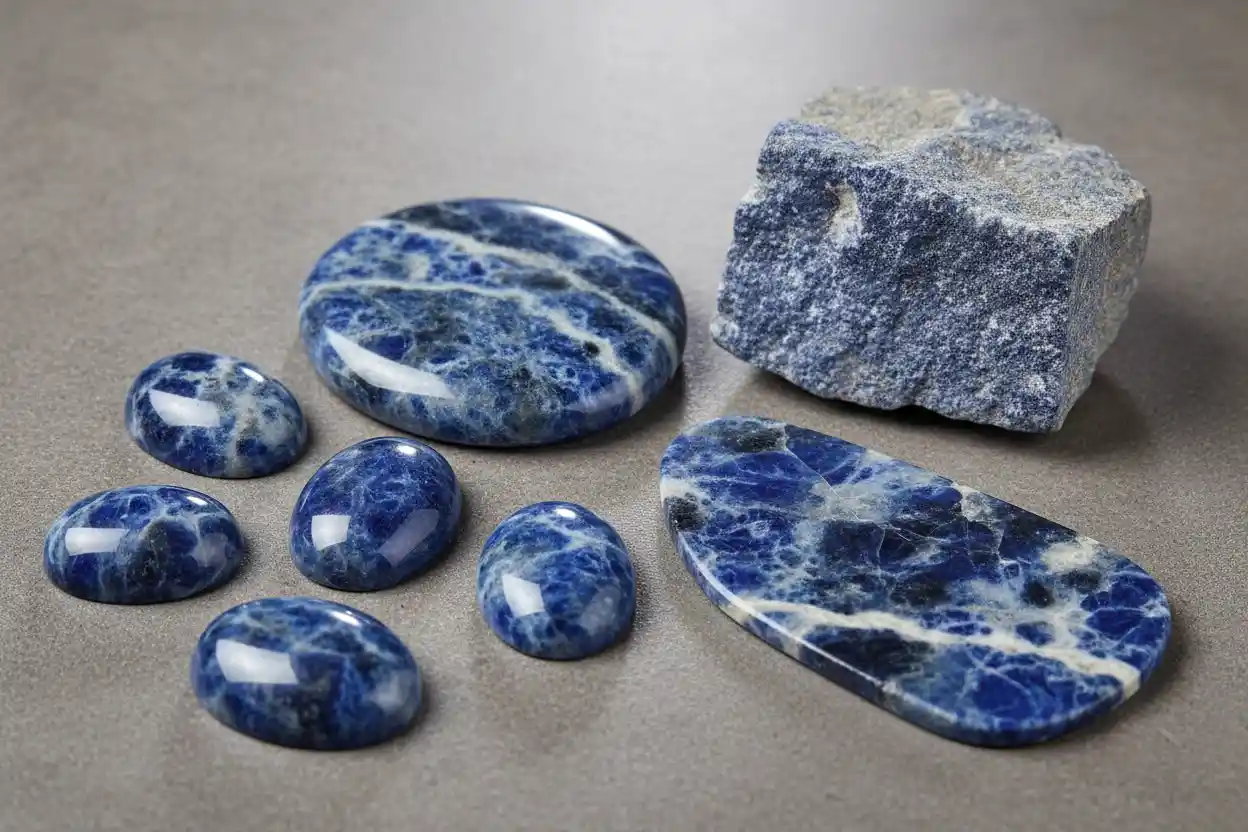
Sodalite Healing Properties: 10 Wellness Associations, Blue Color Science & Safe Use
Sodalite healing properties are commonly associated with concentration, emotional steadiness, communication, self-reflection, confidence, decision-making, patience, resilience, meditation, and spiritual insight. The stone’s deep blue to violet-blue color, frequently crossed by white calcite veins, makes themes involving thought, truth, communication, and introspection easy to understand symbolically. Those associations do not establish a therapeutic mechanism. Sodalite healing properties have not been scientifically demonstrated to treat anxiety, depression, thyroid disease, insomnia, headaches, neurological disorders, blood pressure problems, inflammation, or another medical condition. Scientifically, sodalite is a sodium-rich feldspathoid mineral with an idealized composition commonly written as Na₄(Si₃Al₃)O₁₂Cl. It belongs to the cubic crystal system, measures about Mohs 5.5 to 6, and commonly occurs in blue massive form rather than as transparent facetable crystals.
10 Sodalite Healing Properties Associations
- Concentration and sustained attention
- Emotional steadiness during stressful situations
- Clearer and more deliberate communication
- Self-reflection and pattern awareness
- Confidence grounded in preparation
- Decision-making based on evidence
- Patience with gradual progress
- Resilience after setbacks
- Meditation and present awareness
- Spiritual reflection on truth and personal values
These ten sodalite healing properties become more useful when they are translated into deliberate behavior rather than treated as ten automatic effects of a blue mineral. Concentration can mean reducing distractions, communication can mean stating a request clearly, and confidence can mean preparing before an unfamiliar task. The separate Sodalite benefits topic can address practical uses, while this article keeps sodalite healing properties focused on wellness beliefs, mineral science, evidence limits, and safe handling.
Sodalite Is a Sodium-Rich Feldspathoid Mineral
Understanding sodalite healing properties begins with sodalite’s actual mineral identity. Sodalite belongs to the sodalite group and is also classed among feldspathoid minerals. Its ideal composition contains sodium, aluminum, silicon, oxygen, and chlorine, although natural chemistry can vary slightly through substitution.
Sodalite crystallizes in the cubic system but is much more commonly encountered as massive blue stone, granular aggregates, or irregular crystalline masses than as sharply formed transparent crystals. Its luster ranges from vitreous to greasy, while typical specimens are translucent around thin edges and opaque through thicker sections.
Mohs hardness around 5.5 to 6 makes sodalite softer than quartz. It can therefore be scratched by quartz-rich dust, rock crystal, topaz, sapphire, ruby, and many other common gemstones. Sodalite healing properties do not alter that physical limitation.
White veins frequently seen in commercial sodalite are commonly calcite. These contrasting veins are one reason polished sodalite resembles some grades of lapis lazuli, although the two stones have different compositions and mineral assemblages.
What Makes Sodalite Blue?
The color behind sodalite healing properties is linked to sulfur-related species and structural defects inside the mineral’s cage-like crystal framework. The intense royal blue is not produced by a blue liquid, pigment coating, or invisible healing frequency.
Sodalite’s structure contains microscopic cages capable of hosting ions and sulfur species. Interactions involving sulfur radical ions contribute strongly to the blue coloration found in sodalite-group minerals. Variations in sulfur chemistry, structural defects, and other substitutions can produce violet, gray, white, colorless, yellowish, greenish, or orange-toned examples as well.
This chemistry helps explain why sodalite healing properties should not be divided into different medical effects according to the saturation of blue color. A darker stone may be visually desirable, but deeper blue does not mean stronger neurological, emotional, or endocrine effects.
Sodalite can also fluoresce under ultraviolet light, although fluorescence varies between specimens and localities. Fluorescence is an optical response to excitation, not evidence that sodalite healing properties operate through stored energy.
Hackmanite Shows How Sodalite Can Change Color
One especially interesting member of the sodalite family is hackmanite, a sulfur-bearing variety capable of tenebrescence. Tenebrescence is reversible photochromism, meaning the gemstone can change color after exposure to ultraviolet light and then gradually return toward its earlier appearance under different lighting conditions or darkness.
Some hackmanite becomes a much stronger violet or purple after ultraviolet exposure. The process results from reversible changes in electronic color centers within the crystal structure.
This phenomenon is scientifically real, but it should not be confused with sodalite healing properties. A visible color change does not demonstrate that the gemstone senses emotions, absorbs negativity, or changes according to a person’s health.
Ordinary blue sodalite may show little or no tenebrescence. Hackmanite is a special variety rather than the standard appearance of every sodalite specimen.
Sodalite and Lapis Lazuli Are Different
The appearance of sodalite often causes confusion with lapis lazuli, and distinguishing them helps keep sodalite healing properties tied to the correct stone.
Sodalite is a specific mineral species. Lapis lazuli is a rock containing several minerals, usually dominated by lazurite with calcite and often pyrite. Lazurite itself belongs to the sodalite mineral group, which explains some of the visual and chemical relationship between the two.
Typical sodalite often shows blue areas with irregular white calcite veining but little or no metallic pyrite. Lapis lazuli may show intense ultramarine blue together with white calcite and golden pyrite grains.
The separate Lapis Lazuli healing properties therefore belong to a different gemstone identity even though some modern communication and intuition themes overlap.
Sodalite Formation and Important Sources
Sodalite usually forms in sodium-rich, silica-poor igneous environments, especially alkaline rocks such as nepheline syenites and related intrusive complexes. It can occur with nepheline, cancrinite, aegirine, feldspar, calcite, and other minerals characteristic of alkaline geological systems.
The type locality is the Ilímaussaq alkaline complex in Greenland. The mineral’s name refers to its high sodium content rather than to any spiritual association.
Canada is particularly famous for attractive blue sodalite used as decorative stone, including material from Ontario. Brazil, Namibia, Greenland, Afghanistan, Myanmar, Russia, and several other regions also produce notable sodalite.
Sodalite healing properties do not vary medically by locality. Differences in color, veining, transparency, associated minerals, and condition affect appearance and collectibility rather than therapeutic potency.
Focus, Emotional Steadiness, and Communication
Concentration Through a Defined Work Cue
Concentration is one of the most repeated sodalite healing properties. The mineral has not been demonstrated to improve memory, learning, attention span, or neurological performance through skin contact.
A practical use is to place the stone beside one defined task. Silence unrelated notifications, choose a clear endpoint, and avoid switching activities until the planned interval is complete. Sodalite healing properties become useful here as a behavioral reminder rather than as a neurological treatment.
Emotional Steadiness Before Responding
Emotional calm also appears frequently among sodalite healing properties. Sodium aluminosilicate does not regulate cortisol, serotonin, adrenaline, or another stress pathway through ordinary handling.
When emotional intensity rises, separate what definitely happened from what you assume happened. If a response is not urgent, delay it until the situation can be evaluated with less emotional pressure.
Communication With Clearer Intent
Blue stones are commonly associated with communication, so this is one of the most familiar sodalite healing properties. A mineral cannot make another person understand, agree, or become honest.
Before a difficult conversation, identify the central point, separate a specific request from accusations, and decide what boundary or question actually needs to be expressed.
Self-Reflection, Confidence, and Decision-Making
Self-Reflection Through Written Evidence
Self-awareness is another common part of sodalite healing properties. The stone cannot reveal hidden memories or provide automatic psychological insight.
Keeping Sodalite near a journal can create a repeatable cue to record situations, reactions, assumptions, and consequences. Over time, patterns become easier to recognize because they have been documented consistently.
Confidence Through Preparation
Confidence appears within sodalite healing properties as calm certainty rather than impulsive boldness.
The stone cannot biologically increase self-esteem. Before a presentation, negotiation, interview, or difficult conversation, review what has already been prepared, identify what remains uncertain, and define which first action remains under personal control.
Decision-Making With Evidence
Clear thinking is central to many descriptions of sodalite healing properties. Sodalite cannot predict outcomes or reveal which option is objectively correct.
Compare alternatives, likely consequences, reversibility, missing information, and risk. If intuition still matters, record it separately and test it against the evidence rather than treating it as proof.
Patience and Resilience
Patience With Realistic Timelines
Patience is one of the quieter sodalite healing properties. A blue mineral cannot change how quickly another person, project, or situation develops.
Use the stone as a reminder to judge long-term goals over an appropriate period. Learning, writing, saving, rehabilitation, and relationship changes are rarely understood accurately from a single day.
Resilience After Setbacks
Resilience also fits naturally among sodalite healing properties because the stone is commonly used during periods of uncertainty or mental pressure.
After a setback, identify what failed, what remains usable, what information was missing, and which change should be made before another attempt. The gemstone can mark that review, but the adaptation itself creates resilience.
Meditation and Present Awareness
Meditation is one of the easiest sodalite healing properties to convert into a real attentional practice. Polished stones often contain deep blue areas, irregular white veins, darker spots, and fine fractures that provide stable visual details.
Choose one color boundary or vein and observe it for several minutes. When attention wanders, return to that feature or to the breath.
The exercise genuinely trains sustained attention. It does not demonstrate that sodalite healing properties alter brain waves, open psychic channels, or change consciousness through a gemstone frequency.
The useful part is the repeated return of attention.
Spiritual Reflection on Truth and Values
The tenth of the sodalite healing properties concerns truth, intuition, self-honesty, and alignment with personal values.
These themes are particularly common because Sodalite’s blue color is linked with communication and third-eye symbolism in modern crystal systems. Someone may use the stone during prayer, journaling, or reflection on whether current behavior matches stated beliefs.
A practical exercise asks which commitments are genuinely important, which decisions are being delayed, and where words and actions are inconsistent.
Sodalite healing properties can support this kind of reflection without claiming that the stone transmits objective spiritual information.
Sodalite Chakra Associations
Sodalite healing properties are most commonly connected with the throat and third-eye chakras in contemporary crystal practice. Blue coloration encourages themes involving communication, truth, insight, reflection, concentration, and intuition.
Some systems extend darker blue stones toward crown-centered meditation.
Chakras are spiritual frameworks rather than anatomical structures. Sodalite healing properties have not been demonstrated to affect the thyroid, throat, brain, pineal gland, pituitary gland, nervous system, or endocrine system through chakra placement.
Sodalite Care and Cleaning
Sodalite healing properties do not change the stone’s moderate hardness. At about Mohs 5.5 to 6, it is easier to scratch than quartz and should be stored away from harder gems.
White calcite veins can create additional care differences because calcite is only Mohs 3 and reacts with acids. A polished Sodalite piece containing significant calcite therefore deserves gentler handling than its blue areas alone might suggest.
Use lukewarm water, mild soap, and a soft cloth for routine cleaning. Avoid prolonged soaking when a specimen contains open fractures, porous areas, glue, coatings, or attached matrix.
Steam and ultrasonic cleaners are unnecessary and are better avoided for fractured, calcite-rich, repaired, or uncertain pieces.
Vinegar, lemon juice, descalers, and acidic household cleaners can attack calcite and should not be used.
Cutting and Dust Safety
Finished Sodalite is generally suitable for normal handling, but cutting, drilling, and polishing produce mineral dust that should not be inhaled.
Lapidary work should use wet methods where appropriate, good extraction, eye protection, appropriate respiratory controls, and careful cleanup.
Sodalite healing properties do not justify grinding the stone into powder, putting crushed rock into drinks, or intentionally inhaling dust.
Normal handling of a polished stone is very different from exposure to airborne cutting particles.
Safe Ritual Cleansing
Sodalite healing properties do not require saltwater, acids, flame, steam, or harsh chemical sprays. There is no scientifically demonstrated unwanted energy that must be chemically removed from the mineral.
Sound, intentional breathing, quiet reflection, dry placement, or gentle hand cleaning are lower-risk choices.
A communication-focused ritual can be made practical by identifying one conversation that requires greater clarity and writing down the exact point that needs to be expressed.
Avoid abrasive salt and acid-based cleansing, especially when white calcite veins are visible.
Conclusion
Sodalite healing properties are contemporary wellness and spiritual beliefs attached to a distinctive sodium-rich feldspathoid whose blue color is closely connected with sulfur-related structural chemistry. Concentration, communication, self-reflection, confidence, decision-making, patience, resilience, meditation, and values-based reflection can all become useful practices when the gemstone remains a symbolic cue rather than a medical treatment.
FAQs
What are sodalite healing properties?
Sodalite healing properties commonly refer to beliefs involving concentration, emotional steadiness, communication, self-reflection, confidence, decision-making, patience, resilience, meditation, and spiritual insight.
What is Sodalite made of?
Sodalite is a sodium-rich aluminosilicate feldspathoid containing chlorine, with an idealized composition commonly written as Na₄(Si₃Al₃)O₁₂Cl.
What makes Sodalite blue?
Sulfur-related ions and electronic color centers within Sodalite’s crystal structure contribute strongly to its blue coloration.
How hard is Sodalite?
Sodalite measures about Mohs 5.5 to 6, making it softer than quartz and vulnerable to scratching by many common gemstones.
Is Sodalite the same as Lapis Lazuli?
No. Sodalite is a mineral species, while Lapis Lazuli is a rock usually containing lazurite, calcite, and often pyrite.
Are sodalite healing properties ancient?
Sodalite has a documented mineralogical history, but the standardized system of sodalite healing properties used in modern crystal practice is largely contemporary.
Which chakras are associated with Sodalite?
Modern crystal practice most commonly links Sodalite with the throat and third-eye chakras. These are spiritual rather than anatomical associations.
Can Sodalite go in water?
Brief gentle washing is generally reasonable for sound polished Sodalite, but prolonged soaking is unnecessary, particularly when calcite veins, fractures, repairs, or porous areas are present.
Can Sodalite be cleaned with vinegar?
No. Acidic cleaners are poor choices because many Sodalite specimens contain calcite, which reacts readily with acids.
Are sodalite healing properties medically proven?
No. Sodalite healing properties are spiritual or personal wellness beliefs rather than scientifically established therapeutic effects.
Sodalite healing properties are contemporary spiritual or personal beliefs and should not replace qualified medical or mental health care.