9 Popular Sodalite Benefits: Deep Traditions, Evidence, Safe Use & Clear Limits
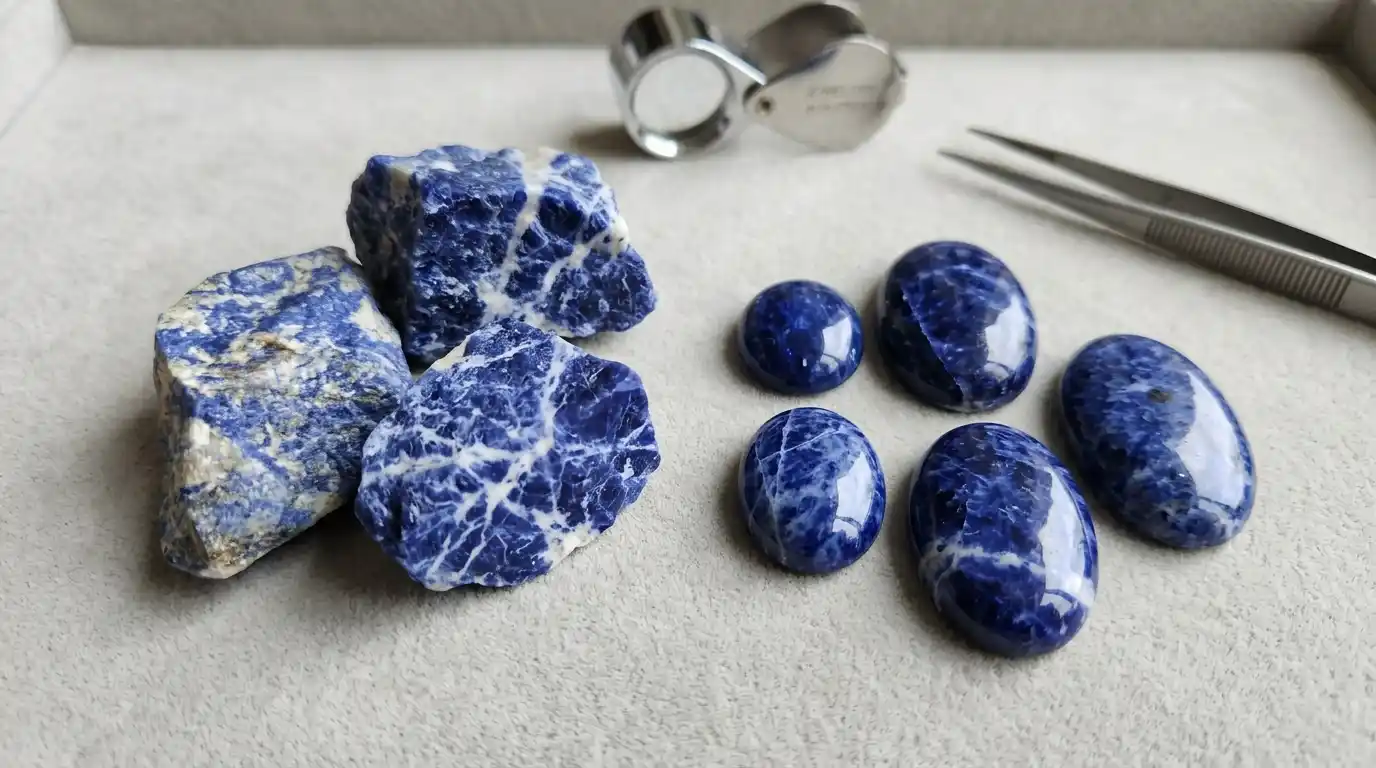
Sodalite benefits begin with an attractive sodium-rich feldspathoid mineral valued for deep blue color, white calcite veining, interesting fluorescence, unusual sulfur-related optical behavior in some varieties, and a strong history in ornamental carving. Sodalite has the ideal formula Na4(Al3Si3O12)Cl, crystallizes in the isometric system, and normally falls around 5.5 to 6 on the Mohs scale. Its blue appearance can resemble other famous blue stones, yet its mineral identity, chemistry, and optical properties are distinct.
Unlike quartz, sodalite forms in silica-undersaturated geological environments, particularly alkaline igneous rocks such as nepheline syenites. Its relatively modest hardness and brittle character make it better suited to pendants, earrings, beads, cabochons, carvings, and decorative objects than to exposed rings worn during demanding physical activity. The stone is often encountered as massive blue material crossed by pale calcite veins, although transparent or unusually colored crystals also occur.
Modern crystal traditions add communication, mental clarity, emotional balance, intuition, self-expression, and calming symbolism to sodalite benefits. These interpretations can give a stone personal meaning during meditation, study, journaling, or important conversations, but they should remain separate from claims that sodalite medically treats anxiety, changes brain chemistry, improves thyroid function, or directly increases intelligence.
9 Sodalite Benefits at a Glance
The nine points below separate the stone’s useful physical and gemological qualities from the symbolic traditions that have grown around its blue color. This keeps the article practical while still acknowledging why many people choose sodalite for personal or spiritual routines.
- Sodalite’s rich blue color gives it strong ornamental, carving, jewelry, and collector appeal.
- Its sodium-rich aluminosilicate chemistry provides an excellent example of feldspathoid mineralogy.
- Mohs hardness around 5.5 to 6 allows useful jewelry wear when impact and abrasion are limited.
- White calcite veining creates natural contrast and helps give many polished pieces their distinctive appearance.
- Some sodalite can show strong orange or orange-red fluorescence under ultraviolet light, while hackmanite can also display reversible color change.
- Sodalite helps students distinguish a single mineral species from lapis lazuli, which is a rock made from several minerals.
- Modern communication and clarity traditions can serve as personal reminders to prepare, listen, and express ideas carefully.
- Emotional-balance symbolism can support reflective routines without being confused with psychological treatment.
- Appropriate cleaning, careful storage, and accurate identification allow sodalite to be enjoyed without exaggerated medical or spiritual claims.
Sodalite Benefits Begin With Feldspathoid Mineralogy
One of the strongest sodalite benefits is its mineralogical character. Sodalite belongs to the sodalite group within the feldspathoid family, a group of minerals that forms in environments where there is not enough silica available for feldspar and quartz to dominate. Its ideal chemistry contains sodium, aluminum, silicon, oxygen, and chlorine arranged within an isometric framework containing cage-like structural spaces.
Sodalite normally has a vitreous to greasy luster and specific gravity around 2.27 to 2.33, while its hardness of approximately 5.5 to 6 places it below quartz but above many softer ornamental minerals. It is brittle, and cleavage can range from poor to more noticeable depending on the specimen, so a polished piece can chip when struck even though it withstands light daily handling reasonably well. These properties explain why large carvings, cabochons, beads, and decorative objects are more common than heavily exposed faceted rings.
The mineral name reflects its sodium-rich chemistry rather than a spiritual idea. Sodalite’s type locality lies within Greenland’s Ilímaussaq alkaline complex, one of the world’s classic areas for unusual feldspathoid and rare-element minerals. That geological background gives sodalite scientific value long before color symbolism or crystal traditions are considered.
Sodalite Technical Properties
The table below summarizes the most useful physical characteristics when evaluating sodalite for collecting, jewelry, or identification.
| Property | Sodalite |
|---|---|
| Mineral group | Sodalite group, feldspathoid family |
| Ideal formula | Na4(Al3Si3O12)Cl |
| Crystal system | Isometric |
| Mohs hardness | About 5.5–6 |
| Specific gravity | About 2.27–2.33 |
| Typical luster | Vitreous to greasy |
| Common appearance | Blue to violet-blue, frequently with white calcite |
| Tenacity | Brittle |
| Typical uses | Cabochons, beads, pendants, carvings, decorative objects |
| Notable variety | Hackmanite, which can show tenebrescence |
This combination of moderate hardness and brittleness means sodalite needs more protection than quartz, garnet, sapphire, or ruby. Earrings and pendants generally experience fewer impacts, while rings and bracelets should be worn more selectively if the polished surface and edges are expected to remain attractive.
Blue Color Gives Sodalite Its Strongest Visual Appeal
Color is one of the most obvious sodalite benefits. Most ornamental sodalite ranges from medium blue and royal blue to violet-blue, often crossed by white or pale gray calcite. Individual specimens may also contain gray, colorless, greenish, yellowish, or other zones depending on chemistry and associated minerals.
The blue color is related to sulfur-bearing color centers within the sodalite structure rather than to a simple blue pigment. This same broad chemical family produces especially interesting behavior in hackmanite, a sodalite variety capable of tenebrescence, meaning its color can reversibly change after ultraviolet exposure and then fade again under different lighting conditions. GIA has examined hackmanite from Myanmar and Afghanistan showing strong color changes, fluorescence, and phosphorescence tied to its sulfur-related chemistry.
These properties make sodalite more interesting than a uniformly blue carving stone. Color, fluorescence, tenebrescence, inclusions, and crystal transparency can all reveal something about composition and geological growth, especially in unusual transparent specimens that look very different from familiar opaque blue ornamental sodalite.
Sodalite and Lapis Lazuli Are Not the Same Stone
Sodalite is frequently confused with lapis lazuli because both can show rich blue color and pale calcite-rich areas, but their identities are fundamentally different. Sodalite is a mineral species, while lapis lazuli is a rock composed mainly of lazurite together with varying amounts of calcite, pyrite, and other minerals.
Fine lapis commonly receives much of its blue color from lazurite and may contain metallic gold-colored pyrite flecks. Typical sodalite more often appears blue with white calcite veining and usually lacks the characteristic scattered metallic appearance associated with many lapis specimens, although pyrite alone should never be treated as an absolute identification test because mineral assemblages can vary. GIA specifically notes that sodalite is often semitransparent to opaque violetish blue with white calcite veining and can resemble lapis lazuli.
The distinction matters for both value and identification. A seller should not use the prestige of lapis lazuli to describe sodalite incorrectly, and an attractive sodalite cabochon does not become inferior simply because it belongs to a different mineral species. Accurate naming gives each stone its own geological identity.
Fluorescence and Hackmanite Add Scientific Interest
Ultraviolet behavior is another unusual sodalite benefit. Some sodalite displays intense orange to orange-red fluorescence, and hackmanite can add reversible photochromism to that response. When suitable hackmanite is exposed to ultraviolet radiation, its color may deepen toward pink, purple, or violet and then gradually return toward its earlier appearance under visible light or in darkness.
Not every sodalite specimen behaves this way, and not every sulfur-bearing sodalite should automatically be marketed as strong hackmanite. GIA researchers have suggested reserving the hackmanite name for sodalite showing noticeable tenebrescence because specimens with similar chemistry can respond very differently to light.
For collectors, this variation creates a useful reason to examine stones under controlled illumination. A specimen that changes color under ultraviolet light demonstrates a real optical response, while the same behavior should not be interpreted as proof that the stone absorbs negative emotions or emits a healing frequency.
Sodalite Benefits for Jewelry and Decorative Use
Sodalite’s color and availability make it especially useful for ornamental work. Large blue pieces can be cut into beads, cabochons, boxes, spheres, animal carvings, inlay, decorative slabs, and polished freeforms without requiring the expense associated with rare transparent blue gemstones. White calcite veins can create dramatic natural designs when cutters orient the rough thoughtfully.
Moderate hardness means the surface is reasonably serviceable but not exceptionally resistant to scratching. Quartz-rich dust, topaz, garnet, corundum, and diamond can all abrade sodalite, while a hard impact can chip edges because the mineral is brittle. Pendants, earrings, brooches, and necklaces are therefore easier to protect than exposed everyday rings.
The stone’s relatively low specific gravity can also distinguish it from some visually similar blue gems during professional testing. For valuable or unusual transparent stones, refractive index, specific gravity, fluorescence, microscopy, spectroscopy, and other measurements provide far stronger evidence than appearance alone.
Sodalite Benefits for Learning Gem Identification
Sodalite is particularly useful for teaching why color is never enough to identify a gemstone. Lapis lazuli, dyed howlite, dyed magnesite, blue glass, synthetic products, and several natural minerals can all be sold or mistaken for sodalite when evaluation stops at visual appearance.
When identity matters, real and fake sodalite are better separated by examining hardness, density, structure, magnification features, fluorescence, color distribution, and whether the stone behaves like a natural mineral rather than relying on one home test. Perfectly uniform artificial color, obvious glass bubbles, suspicious surface concentrations of dye, or a hardness inconsistent with sodalite can justify closer examination.
A large blue stone covered with golden metallic flecks may also deserve comparison with lapis lazuli rather than immediate identification as sodalite. Gemology works by combining observations, not by forcing one visual clue to carry the entire conclusion.
Geological Formation Gives Sodalite Value Beyond Color
Sodalite commonly forms in alkaline igneous rocks such as nepheline syenites and related silica-poor systems. These unusual magmas allow sodium-rich feldspathoid minerals to develop where quartz would be unstable, creating mineral assemblages that can include nepheline, aegirine, feldspar, cancrinite, calcite, and other alkaline-rock minerals.
Greenland’s Ilímaussaq complex is the type region, while sodalite is also known from important occurrences in Canada, Brazil, Namibia, Afghanistan, Myanmar, and several other countries. Different deposits can produce massive ornamental stone, well-formed crystals, transparent gems, strongly fluorescent specimens, or hackmanite with noticeable reversible color change.
This geological diversity makes locality information valuable to collectors. A blue carving may be appreciated primarily for appearance, while a natural crystal with a reliable locality can preserve much more information about an unusual alkaline geological environment.
Communication as a Helpful Modern Tradition
Communication is one of the most popular symbolic sodalite benefits, probably because deep blue is widely connected in modern spiritual systems with speech, thought, honesty, and the throat chakra. Used carefully, the stone can become a practical reminder to prepare ideas before speaking, listen long enough to understand another person’s point, and separate emotional reaction from the message that actually needs to be communicated.
A person preparing for an important meeting might keep sodalite near written notes and associate the stone with speaking more clearly. Another might use it during journaling before a difficult conversation, identifying what is known, what is assumed, and what outcome is realistically being requested. In these situations, the useful mechanism is preparation and attention rather than a physiological effect of sodium aluminosilicate.
Sodalite does not alter vocal cords, thyroid function, language centers in the brain, or another person’s willingness to listen. Communication improves through preparation, practice, empathy, boundaries, and mutual behavior, while the gemstone can serve only as a personal symbol for those goals.
Mental Clarity and Logic Need Evidence-Safe Limits
Mental clarity and logical thinking also appear frequently among sodalite benefits. The deep blue color and association with communication make these themes easy to understand symbolically, especially for students, writers, analysts, or people who enjoy keeping a meaningful object near a workspace.
There is no reliable evidence that wearing sodalite increases IQ, memory, attention span, executive function, or neurological processing speed. A student may still associate the stone with study because it becomes a visual cue to put away distractions and begin a planned session, but the learning itself depends on practice, sleep, repetition, instruction, and appropriate study methods.
This distinction is important because symbolic routines can be helpful without turning the gemstone into a cognitive treatment. The stone can represent careful thinking while real reasoning still depends on the person doing the work.
Emotional Balance Without Psychological Treatment Claims
Sodalite healing properties extend from emotional balance into anxiety relief, panic control, blood-pressure regulation, thyroid support, immune improvement, or treatment of psychological conditions. These claims should be separated from the stone’s genuine mineral properties because clinical evidence does not establish sodalite as a treatment for those conditions.
A polished stone may still become part of a quiet routine. Someone might use it while breathing slowly, writing down concerns, or deciding whether a stressful issue needs immediate action, later attention, or professional help. The calming value comes from the routine and the person’s responses rather than from a medically active field emitted by the mineral.
Persistent anxiety, depression, panic attacks, thyroid symptoms, cardiovascular concerns, or other health problems deserve appropriate professional evaluation. Spiritual or reflective practices can accompany care, but they should not delay it.
Water, Cleaning, and Safe Sodalite Care
Sodalite is not extremely difficult to care for, but its moderate hardness, brittleness, calcite veining, and possible treatments make conservative cleaning sensible. Warm water, mild soap, and a soft cloth are generally more appropriate than abrasive powders, aggressive scrubbing, acids, or harsh household chemicals.
Acidic cleaners are especially unnecessary because many sodalite pieces contain white calcite, a carbonate mineral that can react with acids. Prolonged soaking also offers no advantage, particularly when the stone contains open fractures, porous areas, adhesives, dyes, or attached matrix.
Ultrasonic and steam cleaning are poor default choices for fractured or composite pieces. After cleaning, drying the stone and storing it away from harder gems helps preserve its polish and prevents unnecessary abrasion.
Conclusion
Sodalite benefits include distinctive blue color, unusual feldspathoid chemistry, moderate jewelry usefulness, interesting ultraviolet behavior, hackmanite-related tenebrescence, geological value, and strong educational use in gemstone identification. Communication, mental clarity, emotional balance, and calming symbolism can remain meaningful personal traditions when they are kept separate from claims about neurological treatment, thyroid health, anxiety therapy, or other medical effects.
FAQs
What are the main sodalite benefits?
Sodalite benefits include attractive blue color, carving and jewelry potential, unusual feldspathoid mineralogy, fluorescence in some specimens, and educational value for identification. Modern traditions also connect sodalite with communication, reflection, logical thinking, and emotional balance, but those ideas are symbolic rather than established medical effects.
What is sodalite made of?
Sodalite is a sodium aluminum silicate chloride with the ideal formula Na4(Al3Si3O12)Cl. It belongs to the sodalite group of feldspathoid minerals and crystallizes in the isometric system.
Is sodalite the same as lapis lazuli?
No. Sodalite is an individual mineral species, while lapis lazuli is a rock made mainly from lazurite together with calcite, pyrite, and other minerals. Both can be blue and contain pale calcite-rich areas, which explains the frequent visual confusion.
What is hackmanite?
Hackmanite is a variety of sodalite known for tenebrescence, a reversible color change triggered by ultraviolet exposure and later fading under different lighting conditions. The strength of this effect varies greatly between specimens.
Is sodalite durable enough for jewelry?
Sodalite is around Mohs 5.5 to 6 and is brittle, so it is suitable for pendants, earrings, beads, and protected jewelry but needs more care than quartz, garnet, or sapphire. Exposed rings are more vulnerable to scratches and impact damage.
Does sodalite improve communication?
There is no scientific evidence that sodalite changes speech, brain function, or another person’s response. It can serve as a personal reminder to prepare, listen carefully, and communicate with greater intention.
Does sodalite improve mental clarity?
Sodalite has not been shown to increase intelligence, memory, or concentration through physical contact. It may be used symbolically during study or planning as a cue to reduce distractions and approach a task deliberately.
Can sodalite help with anxiety?
Sodalite is not an anxiety treatment and has not been shown to regulate psychological or neurological conditions. A meaningful stone can still accompany meditation, breathing, journaling, or another reflective routine.
Can sodalite have personal meaning without spiritual beliefs?
Yes. Sodalite can represent a journey, geological interest, family gift, academic achievement, favorite color, collection milestone, or important conversation. Personal symbolism does not require a universal metaphysical explanation.
Disclaimer: Communication, mental-clarity, emotional-balance, chakra, calming, healing, and energetic descriptions of sodalite reflect spiritual beliefs and personal practices. Sodalite is not a medical or psychological treatment and should not replace professional healthcare.