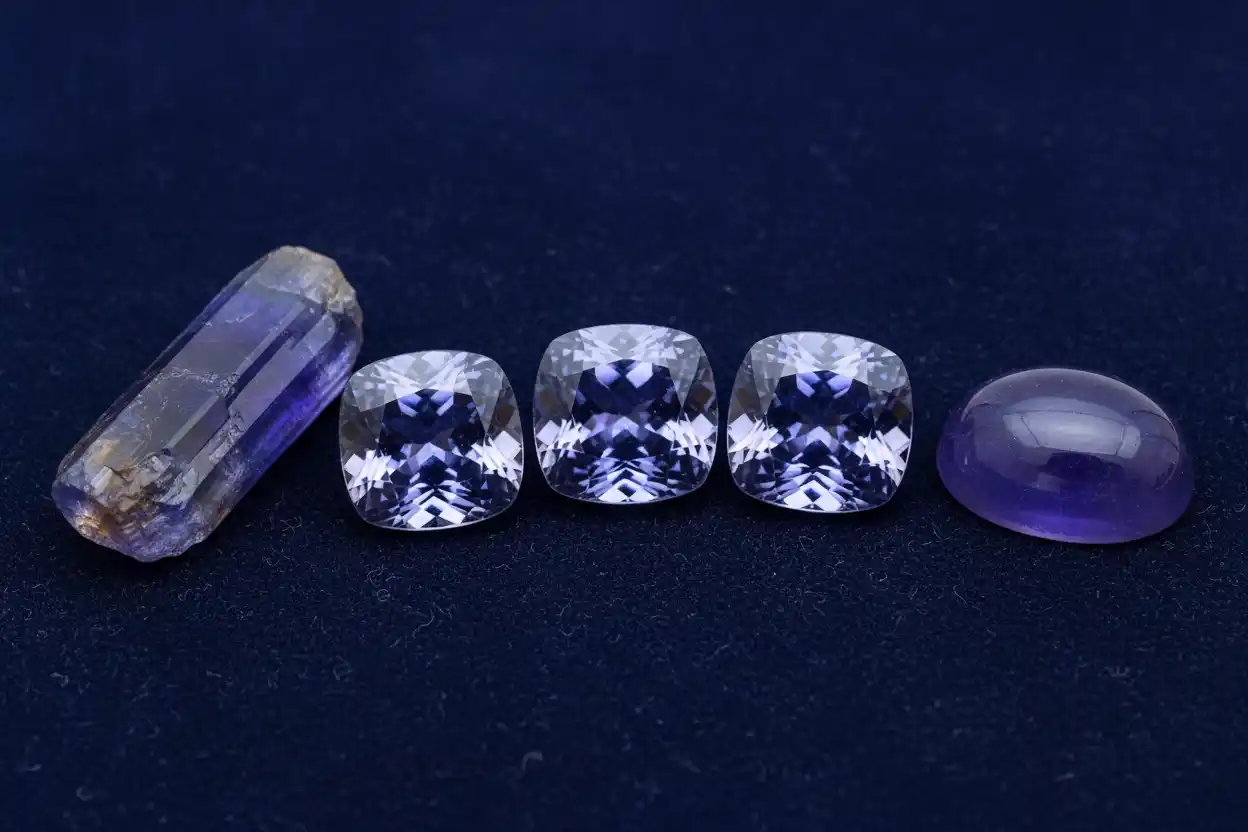
Tanzanite: Meaning, Properties & Symbolism
Tanzanite is the transparent blue-violet to violet-blue variety of zoisite mined commercially from one small region in northern Tanzania. Its most distinctive characteristic is strong pleochroism: the same crystal can display blue, violet, red-violet, brown, yellow-green, or burgundy tones from different directions.
Most Tanzanite in jewelry has received low-temperature heat treatment to reduce brownish or yellow-green components and emphasize blue and violet. The treatment is stable and widely accepted, although it should still be disclosed.
Tanzanite at a Glance
| Property | Tanzanite |
|---|---|
| Composition | Calcium aluminum silicate hydroxide, Ca₂Al₃(SiO₄)(Si₂O₇)O(OH) |
| Group or type | Blue-to-violet variety of zoisite |
| Color | Violet-blue, blue-violet, violet, purple-blue; untreated rough may be brown, burgundy, greenish, yellowish, or trichroic |
| Crystal system or texture | Orthorhombic |
| Habit | Striated prismatic crystals, columnar rough, granular or massive zoisite |
| Luster | Vitreous |
| Transparency | Transparent to translucent |
| Mohs hardness | Approximately 6–7 |
| Cleavage | Perfect in one direction |
| Tenacity | Brittle |
| Common uses | Faceted jewelry, cabochons, collector crystals, December birthstone pieces |
| Primary care concern | Cleavage, impact, thermal shock, scratches, fracture filling, and aggressive cleaning |
What Is Tanzanite?
Tanzanite is a color variety of zoisite, an orthorhombic calcium aluminum silicate mineral.
The name applies specifically to blue-to-violet transparent gem material. Green, pink, yellow, brown, and other zoisite colors may be attractive, but gemological laboratories generally call them zoisite rather than Tanzanite.
Tanzanite was introduced to the international jewelry market after discoveries in northern Tanzania during the 1960s. Tiffany & Co. promoted the new name because “blue zoisite” was considered commercially awkward.
The gem’s identity now combines mineralogy and origin. Commercial Tanzanite production remains tied to the Merelani Hills near Mount Kilimanjaro.
Its saturated colors place it naturally beside blue gemstones and purple gemstones, but its pleochroism and single-source geology make it distinct from sapphire, spinel, and iolite.
Tanzanite Composition and Crystal Structure
Zoisite has the formula Ca₂Al₃(SiO₄)(Si₂O₇)O(OH). Its structure contains calcium, aluminum, silicon, oxygen, and hydroxyl groups.
Vanadium is the principal color-causing trace element in Tanzanite. Chromium may contribute in some samples, while iron and titanium can modify the final appearance.
Tanzanite crystallizes in the orthorhombic system and is biaxial. Light traveling through different crystallographic directions encounters different absorption, producing strong pleochroism.
Perfect cleavage follows one structural direction. This weakness is more important to jewelry durability than its hardness alone suggests.
Tanzanite also has a relatively large thermal-expansion response in different directions. Sudden heating or cooling can stress inclusions and cleavage planes.
Why Tanzanite Changes Color with Direction
Untreated Tanzanite can be trichroic, displaying three distinct colors along its principal optical directions.
Documented colors include deep blue, red-violet, yellow-green, brown, burgundy, and violet. The exact combination depends on trace chemistry and whether the crystal has been heated.
Heat treatment removes or reduces the yellow-green and brown components. The resulting gem normally shows blue and violet rather than three strongly contrasting colors.
Pleochroism remains visible after heating. When a finished stone is tilted, one side can appear predominantly blue while another looks more violet.
Lighting changes the balance further. Cool daylight or fluorescent-equivalent illumination emphasizes blue, while warmer incandescent light often brings out violet and purple.
This behavior is not the same as true color change. The difference arises mostly from direction and lighting spectrum rather than a complete switch between two separate body colors.
How Tanzanite Forms
Tanzanite forms in a highly unusual metamorphic and metasomatic environment involving graphite-rich rocks, gneiss, marble, pegmatitic fluids, and chemically complex alteration.
The host sequence underwent intense tectonic deformation during East African mountain-building events. Heat, pressure, folding, faulting, and fluid movement created localized conditions suitable for vanadium-bearing zoisite.
Vanadium likely came from the surrounding graphitic and metamorphic rocks. Calcium, aluminum, silica, and hydroxyl-bearing fluids then participated in zoisite growth.
Tanzanite commonly occurs in narrow veins, fractures, and altered zones rather than broad uniform ore bodies.
The combination of vanadium availability, host-rock chemistry, metamorphic history, and structural pathways is exceptionally restricted. This explains why commercial blue-violet material has not been reproduced by another major natural deposit.
The general geological processes are covered in how gemstones are formed, while Tanzanite’s Merelani setting remains a particularly localized example.
The Merelani Hills Source
Commercial Tanzanite is mined in the Merelani Hills of northern Tanzania, southeast of Arusha and close to Mount Kilimanjaro.
The mining area has historically been divided into blocks. Operations range from small-scale underground workings to larger mechanized mines.
Miners follow narrow mineralized zones through complex folded and fractured metamorphic rock. Production can vary substantially because valuable crystal pockets are discontinuous.
Rough crystals may be coated with graphite, clay, or host-rock residue. Some show natural blue areas, but much of the production appears brown, greenish, burgundy, or mixed before heating.
The geographically restricted source is an important part of Tanzanite’s appeal. Nevertheless, single-source origin does not mean every stone is investment grade, nor does it guarantee continually rising prices.
Tanzanite Color
The most valued Tanzanite generally shows vivid violetish blue or bluish violet without excessive darkness, grey, or brown.
Predominantly blue stones are often scarcer because cutters may need to orient the rough toward a direction that sacrifices more weight.
Predominantly violet stones can still be fine quality. Personal preference and lighting environment influence which balance looks most attractive.
Small gems commonly appear lighter because their shorter light path produces less saturation. Stones above several carats can show deeper color without becoming as dark.
Overly dark Tanzanite may appear black in ordinary indoor lighting. Conversely, very pale material may look grey or washed out.
There is no universal AAA, AA, or A grading standard. Those labels belong to individual sellers and cannot be compared reliably across companies.
Clarity and Inclusions
Most fine faceted Tanzanite is expected to appear eye-clean. Visible inclusions can reduce brilliance and color uniformity.
Common internal features include needles, mineral crystals, growth tubes, graphite, healed fractures, fingerprints, cleavage-related planes, fluid inclusions, and color zoning.
Surface-reaching fractures matter because they reduce durability and may contain oil or resin.
Some inclusions provide origin or natural-growth information, but they must be interpreted carefully. No single feature proves Tanzanian origin or treatment status.
Fracture-filled Tanzanite exists but remains uncommon compared with ordinary heat treatment. Filled stones need gentler cleaning because heat, solvents, or ultrasonic vibration can affect the filler.
Heat Treatment
Heating is the standard treatment for Tanzanite. Most blue-violet gems in the market have been heated.
Typical treatment uses comparatively low temperatures, often around 400–600°C, to reduce brown, green, and yellow components.
The process changes vanadium-related absorption and makes blue and violet pleochroic colors more dominant.
Heat treatment is generally stable under normal jewelry conditions. Sunlight and ordinary indoor lighting do not reverse it.
Unheated naturally blue Tanzanite exists, but it is uncommon. Natural heating within the Earth may have modified some crystals before discovery.
An unheated claim should come from a capable independent laboratory. Even then, buyers should judge the gem’s color, clarity, cut, and durability rather than paying for treatment status alone.
Other Treatments
Fracture filling with oil or polymer is possible but rare. The filler may reduce the visibility of surface-reaching cracks.
Coatings can create or intensify blue and violet color on zoisite, glass, topaz, or other substitutes. Wear along facet edges can expose the underlying material.
Diffusion treatment is not a standard commercial method for Tanzanite.
Irradiation can produce or alter colors in some minerals, but it is not the accepted routine treatment responsible for normal Tanzanite.
A seller should disclose heat, filling, coating, dye, backing, and composite construction. The terminology in gemstone treatments explained provides the wider framework.
Tanzanite Versus Sapphire
Blue sapphire is substantially harder and tougher than Tanzanite. Sapphire ranks 9 on the Mohs scale and lacks Tanzanite’s perfect cleavage.
Tanzanite generally shows more obvious blue-violet pleochroism, while sapphire may display blue-to-greenish or violetish pleochroic directions depending on its chemistry.
Sapphire has higher refractive indices and specific gravity. The two also show different absorption spectra and inclusion scenes.
Tanzanite is usually less expensive than fine blue sapphire of comparable apparent size and color, although exceptional Tanzanite can still be costly.
The dedicated Tanzanite vs Sapphire comparison owns the detailed identification and purchasing intent.
Tanzanite Versus Iolite
Iolite can resemble violet-blue Tanzanite and also shows strong pleochroism.
Iolite commonly displays violet-blue, pale blue, and yellow-grey or nearly colorless directions. Tanzanite generally shows stronger brilliance and a different blue-violet balance.
Iolite is slightly lighter in density and has lower refractive indices. Its inclusions and cleavage behavior also differ.
Fine Iolite is usually much less expensive. Consequently, loose violet-blue stones without reports should not be priced as Tanzanite from appearance alone.
Other Tanzanite Imitations
Synthetic spinel can imitate pale blue or violet Tanzanite. It is cubic and singly refractive.
Glass is common in low-cost jewelry. Rounded bubbles, flow lines, low hardness, and lower density can expose it.
Synthetic sapphire and laboratory-grown corundum can be produced in Tanzanite-like colors. Their hardness and optical properties differ significantly.
Coated topaz, cubic zirconia, YAG, and other manufactured materials may also resemble Tanzanite.
Synthetic zoisite has been produced experimentally, but laboratory-grown Tanzanite is not a major commercial jewelry category.
The lab-grown vs natural gemstones guide explains why simulants, synthetic gems, coatings, and misidentified natural stones are separate categories.
How to Identify Tanzanite
A standard gemological examination begins with refractive index, birefringence, pleochroism, specific gravity, optic character, magnification, and spectroscopy.
Tanzanite commonly has refractive indices near 1.69–1.70 and specific gravity around 3.35.
A dichroscope may reveal blue and violet directions, with additional brown-green or burgundy color in unheated material.
Its hardness of approximately 6–7 is lower than sapphire, spinel, topaz, and quartz. Scratch testing should not be used on a finished stone.
Magnification may reveal natural inclusions, cleavage, filling, coating wear, or imitation features.
Raman and infrared spectroscopy can confirm zoisite and detect some treatments. Laboratory testing is recommended whenever origin, heat status, or high value materially affects the purchase.
The how to identify crystals guide provides the general testing framework.
Cutting Tanzanite
Cutting orientation strongly influences face-up color.
A cutter can orient the table to emphasize blue or violet. The blue direction may require greater weight loss, which contributes to the scarcity of predominantly blue gems.
Deep cuts can improve saturation but may retain excessive hidden weight. Shallow cutting can create a pale window through the center.
Mixed, cushion, oval, pear, emerald, trillion, and round cuts are common. Fancy shapes help cutters follow the original crystal while preserving color and weight.
Cleavage creates risk during sawing, preforming, faceting, and setting. A small catch on a lap can split valuable rough.
Polishing is generally good, but damaged facet edges and thin girdles remain vulnerable during jewelry manufacture.
Durability and Jewelry Suitability
Tanzanite requires more care than sapphire, ruby, spinel, chrysoberyl, or diamond.
Its hardness of approximately 6–7 provides moderate scratch resistance, but ordinary quartz dust and harder gems can abrade it.
Perfect cleavage creates a serious impact weakness. A sharp blow can split the stone even when the surface looks intact.
Pendants and earrings are safer than bracelets and daily-wear rings. A Tanzanite ring should use a protective bezel, halo, or substantial shoulders.
The gemstone toughness vs hardness guide explains why Tanzanite’s scratch resistance does not predict its resistance to splitting.
The dedicated Tanzanite ring page owns setting and style intent. Buyers seeking lower-impact jewelry may prefer the Tanzanite necklace guide.
Tanzanite Value and July 2026 Asking Prices
Detailed valuation belongs on the dedicated Tanzanite price page because size, color, clarity, cutting, and retailer markup create a wide range.
As of July 2026, pale or commercial-quality faceted Tanzanite commonly carries asking prices around $100–$250 per carat.
Better eye-clean stones with medium-to-strong blue-violet color often appear around $250–$600 per carat.
Fine deeply saturated stones, particularly above two carats, may ask approximately $600–$1,000 per carat.
Exceptional predominantly blue, well-cut, clean, or unusually large stones can reach $1,000–$1,500 per carat or more.
These are asking-price ranges rather than a universal grading chart. Seller-specific terms such as AAA and investment grade have no independent standard.
Buying Tanzanite
The dedicated Tanzanite buying guide owns detailed transactional intent.
View the exact gem under both cool and warm light. It should remain attractive when its balance shifts between blue and violet.
Ask for weight, measurements, depth, face-up color, clarity, heat disclosure, filling disclosure, and a rotating video.
Compare dimensions with carat weight. An excessively deep stone may carry hidden weight without looking larger face-up.
Inspect the girdle and corners for chips. Tanzanite’s cleavage makes pointed pear, marquise, and trillion corners particularly vulnerable.
An independent laboratory report is appropriate for expensive stones, unusual unheated claims, and high-value origin documentation.
General seller, return, and payment checks appear in how to buy gemstones online.
Cleaning and Storage
Detailed instructions belong on the dedicated how to clean Tanzanite jewelry page.
Use lukewarm water, mild soap, and a very soft brush. Rinse briefly and dry the jewelry carefully.
Do not use steam. Sudden heat can stress the gem and threaten cleavage or fractures.
Ultrasonic cleaning is not recommended, especially when the stone contains fractures or filler. The general risks are explained in gemstones in ultrasonic cleaners.
Avoid acids, bleach, harsh dips, and sudden temperature changes.
Store Tanzanite separately from quartz, topaz, sapphire, ruby, and diamond. A padded individual compartment protects both the facets and vulnerable edges.
Tanzanite Meaning and Symbolism
Tanzanite has no ancient tradition under its modern name because it entered the international gem market in the late 1960s.
Its blue-violet pleochroism commonly inspires themes of perspective, communication, imagination, intuition, and recognizing that one situation can appear different from another direction.
The transformation from brownish rough to blue-violet gem through accepted heat treatment may symbolize refinement, intentional change, or revealing a quality that was already structurally possible.
As a modern December birthstone, Tanzanite can carry personal meaning connected with birthdays, anniversaries, family gifts, and milestones.
Contemporary crystal practices may associate it with calm expression, spiritual exploration, or integrating thought with feeling.
These interpretations belong to personal and spiritual belief systems. Scientific evidence does not show that Tanzanite treats disease, changes brain activity, improves communication automatically, or produces guaranteed emotional outcomes.
Frequently Asked Questions
1. Is Tanzanite a separate mineral?
No. Tanzanite is the blue-to-violet transparent gem variety of zoisite.
2. Where is Tanzanite found?
Commercial Tanzanite is mined in the Merelani Hills of northern Tanzania.
3. Why does Tanzanite look blue in one light and violet in another?
Pleochroism and the spectral balance of the light source change the relative strength of its blue and violet colors.
4. Is most Tanzanite heat treated?
Yes. Heating commonly reduces brownish and yellow-green components and emphasizes blue and violet.
5. Is Tanzanite treatment permanent?
Conventional heat treatment is stable under normal jewelry conditions.
6. Is naturally blue unheated Tanzanite real?
Yes, but it is uncommon, and a valuable unheated claim should receive independent laboratory support.
7. Is green Tanzanite a recognized variety?
Gemological laboratories generally call green, pink, or yellow material zoisite rather than Tanzanite.
8. Is Tanzanite softer than sapphire?
Yes. Tanzanite has hardness around 6–7 and perfect cleavage, while sapphire has hardness 9 and better jewelry durability.
9. Can synthetic Tanzanite be made?
Synthetic zoisite has been produced experimentally, but commercial laboratory-grown Tanzanite is uncommon; simulants are a greater concern.
10. Is Tanzanite suitable for an engagement ring?
It can be worn carefully in a protective setting, but it is less suitable for unrestricted daily wear than sapphire or diamond.
11. Can Tanzanite go in an ultrasonic cleaner?
No. Hand cleaning is safer because vibration can affect fractures and cleavage.
12. What most affects Tanzanite value?
Color saturation, blue-versus-violet orientation, clarity, carat weight, cutting, treatment, condition, and market confidence determine value.
Tanzanite’s appeal comes from more than a single-source story. Its strongest examples reveal how pleochroism, skilled orientation, accepted heat treatment, and careful cutting combine to create a color that changes naturally with movement and light.