12 Tourmalinated Quartz Healing Properties: Modern Beliefs, Mineral Science & Safe Use
Tourmalinated quartz healing properties are commonly associated with grounding, emotional steadiness, personal boundaries, clear thinking, resilience, focused intention, and reflective awareness. The stone’s striking combination of transparent or milky quartz crossed by dark tourmaline crystals makes it visually suited to symbolism involving contrast, balance, and staying centered during complicated situations. These interpretations can support personal rituals, but tourmalinated quartz is not scientifically proven to treat anxiety disorders, depression, trauma, sleep disorders, chronic pain, inflammation, immune disease, circulatory conditions, or any other physical or psychiatric illness.
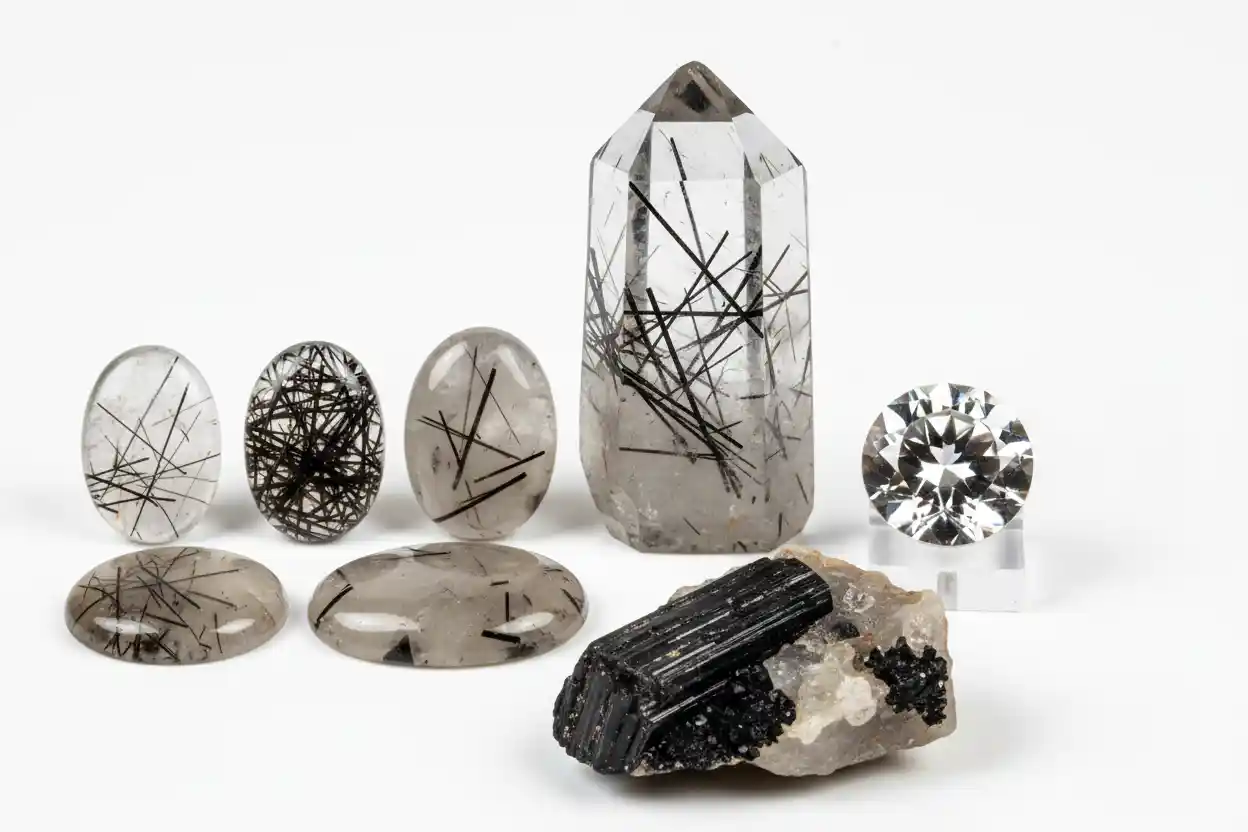
Tourmalinated quartz is also not a single mineral species. It is quartz, silicon dioxide, containing visible tourmaline crystals, most commonly dark schorl. Quartz has a trigonal crystal structure and a Mohs hardness of about 7. Schorl is an iron-rich member of the tourmaline group and is commonly black to bluish-black. The inclusions may appear as fine needles, thick rods, intersecting prisms, or irregular dark networks trapped inside clear, smoky, or milky quartz.
The most useful way to approach tourmalinated quartz healing properties is therefore symbolic and behavioral. A person can use the stone as a physical reminder to pause, establish a boundary, organize thoughts, journal, or return attention to a chosen task. Those behaviors can be meaningful without attributing medically measurable energy to the quartz or tourmaline.
12 Tourmalinated Quartz Healing Properties Used as Modern Wellness Associations
- Grounding when attention feels scattered or overstimulated.
- Emotional steadiness during stressful situations.
- Clearer reflection before responding to conflict.
- Stronger awareness of personal boundaries.
- Focus on practical actions within personal control.
- Resilience when plans change unexpectedly.
- Intentional release of repetitive or unhelpful habits.
- Balanced thinking when emotions and logic seem opposed.
- Mindful attention during meditation or journaling.
- Confidence when saying no or protecting personal time.
- Spiritual reflection around contrast, change, and integration.
- A symbolic sense of protection paired with real-world awareness.
What Tourmalinated Quartz Really Is: Quartz Hosting Tourmaline Crystals
Understanding the stone’s actual structure adds useful context to tourmalinated quartz healing properties. Quartz has the formula SiO₂ and belongs to the trigonal crystal system. It typically has a vitreous luster, no true cleavage, and conchoidal fracture. In tourmalinated quartz, dark tourmaline crystals became enclosed by the growing quartz rather than being painted onto its surface.
The black inclusions are commonly schorl, an iron-rich sodium aluminum borosilicate in the tourmaline group. Schorl is also trigonal and usually appears black, bluish-black, or brownish-black. Its prismatic crystal habit makes the internal inclusions look like straight rods or needles, although some specimens contain dense intersecting networks. Quartz and tourmaline frequently occur together in granitic pegmatites and related hydrothermal environments, where fluids rich in silica, boron, and other elements can support the growth of both minerals.
Specimens occur in several gem-producing regions, including Brazil, Madagascar, Pakistan, and other pegmatite districts. Some Pakistani quartz crystals are particularly known for clearly visible schorl inclusions. These geological relationships are evidence of mineral growth conditions, not evidence that tourmalinated quartz healing properties combine two measurable forms of spiritual energy.
Tourmalinated Quartz Healing Properties for Grounding, Focus, and Boundaries
Grounding as deliberate attention to the present
Grounding is one of the most frequently described tourmalinated quartz healing properties. Crystal traditions often interpret the dark tourmaline as stabilizing while clear quartz represents clarity or amplification. This contrast can make a memorable symbol, but no experiment has established that the stone anchors an invisible human energy field.
A practical grounding ritual is simpler. Hold the stone, identify where you are, notice several physical details in the immediate environment, and decide what action actually needs attention next. During an overwhelming day, it may also help to write down tasks and separate urgent responsibilities from concerns that can wait. The gemstone becomes a cue for the process rather than the mechanism producing calm.
Emotional steadiness and responding instead of reacting
Tourmalinated quartz healing properties also include emotional balance and resilience. These ideas are sometimes framed as the dark inclusions absorbing negativity while the quartz restores clarity. There is no evidence that negative emotions exist as transferable substances that can be drawn into a mineral. A more useful interpretation is to connect the stone with a pause between emotion and action.
During disagreement, for example, someone might touch or look at the stone before responding and ask what outcome matters most. That small routine can create time to reconsider an impulsive reply. It does not treat trauma, depression, panic disorder, or other clinical conditions, but it can serve as a chosen behavioral cue within ordinary self-reflection.
Boundaries and symbolic protection
Protection is another familiar theme within tourmalinated quartz healing properties. In spiritual culture, black tourmaline is often associated with shielding or deflecting unwanted energy, while quartz is interpreted as bringing clarity. Such language can be meaningful symbolically, but a gemstone does not provide objectively demonstrated protection against violence, accidents, illness, financial harm, manipulation, electromagnetic exposure, or other hazards.
Protection beliefs become safer when translated into real actions. The stone might remind someone to verify information before sharing personal details, leave an unsafe environment, communicate a boundary, use appropriate protective equipment, or decline a commitment that exceeds available time. Symbolic protection should strengthen practical awareness rather than replace it.
Focus, release, and realistic personal change
Modern tourmalinated quartz healing properties frequently include mental clarity and release of unwanted patterns. A person could pair the stone with a brief journal routine: identify one recurring behavior, describe the trigger, choose an alternative response, and review what happened later. That creates an observable process instead of expecting the specimen to remove a habit automatically.
The same principle applies to concentration. Keeping tourmalinated quartz near a desk can signal the beginning of an uninterrupted work period or a reminder to put away distractions. The everyday decorative and tactile uses of the stone fit naturally within tourmalinated quartz benefits, while healing-focused discussion remains centered on wellness beliefs and their limitations.
Tourmalinated Quartz Healing Properties and the Symbolism of Contrast
The most distinctive visual feature of tourmalinated quartz is the contrast between light-transmitting quartz and dark tourmaline. Modern crystal interpretations often turn that appearance into themes of integration, accepting complexity, balancing opposing priorities, or finding clarity without pretending difficult experiences have disappeared.
This aspect of tourmalinated quartz healing properties can support reflective questions rather than supernatural conclusions. Someone might ask which two needs seem to be in conflict, what can realistically coexist, and where a compromise would create a better outcome. A person can value both independence and connection, ambition and rest, or caution and curiosity without treating either side as inherently negative.
The symbolism overlaps naturally with tourmalinated quartz meaning, where contrast and integration can be explored as cultural and personal interpretations. In a healing-properties context, the important distinction is that the stone does not medically integrate brain function, regulate emotional chemistry, or remove psychological conflict.
Tourmalinated Quartz Chakra and Spiritual Associations
Tourmalinated quartz healing properties are often linked with more than one chakra because practitioners interpret the black inclusions and lighter quartz separately. Black tourmaline is commonly associated with the root chakra and grounding, while clear quartz is often linked with the crown chakra, clarity, or spiritual awareness. Some practices therefore present tourmalinated quartz as a symbolic bridge between grounded attention and higher reflection.
Chakras are spiritual frameworks, not anatomical structures. There is no established medical evidence that tourmalinated quartz opens, closes, balances, cleanses, or repairs a physical energy center. It cannot be shown to alter the nervous system, endocrine system, brain function, or circulation through chakra placement.
A chakra ritual can still be reader-controlled. Root-oriented meditation might focus on practical stability such as sleep routines, finances, housing, responsibilities, or boundaries. Crown-oriented reflection could focus on values, purpose, gratitude, or perspective. Tourmalinated quartz healing properties remain symbolic associations within these practices rather than physiological processes.
How Tourmaline Becomes Enclosed Inside Quartz
Tourmalinated quartz develops when tourmaline and quartz grow within the same mineral-forming environment. Tourmaline is especially common in boron-rich granitic pegmatites and associated veins. As fluids circulate and conditions change, dark tourmaline crystals can form before or during later quartz growth. Quartz may then surround the tourmaline while preserving the prismatic crystals inside.
The resulting patterns differ dramatically from one specimen to another. Some pieces contain only a few clean black rods; others show dense networks of intersecting tourmaline. The quartz host can range from highly transparent to cloudy or fractured. Internal stress around inclusions can also produce reflective fractures and veils.
Tourmalinated quartz should not automatically be confused with rutilated quartz. Rutile is titanium dioxide and often forms golden, reddish, brown, or dark needles, while tourmaline has a different chemistry and crystal habit. Visual appearance can sometimes be ambiguous, so reliable identification may require gemological examination rather than assumptions based on color alone.
Treatments, Imitations, and Altered Appearance
Tourmalinated quartz is generally valued for its natural inclusions, so strong treatment is not necessary to create its characteristic appearance. Even so, quartz in commerce can sometimes be dyed, coated, irradiated, or fracture-filled, and altered stones can be marketed under many descriptive names. Surface-reaching fractures may also collect oils, polishing compounds, or dyes that change how the specimen looks.
Glass or resin can imitate included quartz, while other dark needle-bearing minerals may be mistaken for tourmaline without testing. Natural inclusions themselves are not evidence for tourmalinated quartz healing properties. Their importance is gemological: they record part of the stone’s growth environment and create the distinctive visual character sought by collectors and jewelry designers.
Because treatments and fracture conditions are not always obvious, gentle care is preferable whenever the history of a specimen is unknown.
Tourmalinated Quartz Care: Hardness, Fractures, Water, Heat, and Dust
Quartz has a Mohs hardness of 7 and lacks true cleavage, giving intact quartz reasonably good durability. Schorl tourmaline is also relatively hard, but tourmalinated quartz can be less mechanically predictable than clean quartz because numerous inclusions, internal fractures, and surface-reaching crystals may create weak areas. Avoid hard impacts and store finished pieces separately from diamonds, corundum, topaz, and other harder gems that can scratch quartz.
Warm water, mild soap, and a soft cloth or brush provide the safest routine cleaning method. Brief contact with clean water is generally reasonable for untreated specimens, but extended soaking is unnecessary, especially when fractures reach the surface. Avoid abrupt temperature changes because internal stresses can encourage cracking. Steam cleaning is not recommended, and ultrasonic cleaning is best avoided for heavily included, fractured, filled, dyed, or otherwise altered specimens.
Quartz is generally stable in normal light, but harsh chemical cleaning offers no benefit. Hydrofluoric acid and fluoride-bearing chemical mixtures can attack silica, while some strong alkaline solutions can also damage quartz under suitable conditions. Treatments, fillers, coatings, or dyes may introduce additional sensitivities.
Cutting and grinding require greater caution than ordinary handling. Quartz produces respirable crystalline silica dust when worked dry, and inhaling fine silica can cause serious occupational lung disease. Lapidary work should use wet methods, effective local extraction, eye protection, and suitable respiratory protection. Avoid dry sanding or drilling in enclosed spaces. Do not intentionally ingest quartz or tourmaline powder, and do not place chipped stones into drinking water to create elixirs. Tourmalinated quartz healing properties do not justify exposure to mineral dust or ingestion hazards.
Safer Symbolic Cleansing for Tourmalinated Quartz
Symbolic cleansing can remain simple. People who work with tourmalinated quartz healing properties may wipe the stone gently, rest it on a clean dry cloth, use sound, meditate with it, or restate an intention while holding it. Brief placement in indirect natural light is another low-risk symbolic option.
Avoid boiling, flame, prolonged saltwater soaking, salt burial, harsh acids, strong cleaners, and repeated temperature changes. Dense inclusions and fractures make unnecessary physical stress particularly undesirable. Ritual cleansing represents personal symbolism; physical cleaning is simply the removal of dirt and oils.
Conclusion
Tourmalinated quartz healing properties are modern spiritual and wellness associations centered on grounding, emotional steadiness, boundaries, focus, resilience, reflection, and the symbolism of integrating contrasts. The stone itself is quartz containing visible tourmaline, commonly black schorl, formed through genuine geological processes in pegmatitic and related environments. Its appearance can make it a memorable focus object, but the reflective behavior belongs to the person using it.
Tourmalinated quartz healing properties therefore make the most sense when the gemstone acts as a reminder rather than a treatment. It can prompt attention, journaling, boundary setting, meditation, or deliberate action without being credited with curing disease, changing brain chemistry, detoxifying the body, or producing objectively measurable protection.
FAQs
What are the main tourmalinated quartz healing properties?
Tourmalinated quartz healing properties commonly include grounding, emotional steadiness, clear reflection, boundaries, focus, resilience, intentional release, balanced thinking, mindfulness, confidence, spiritual reflection, and symbolic protection.
What is tourmalinated quartz made of?
It is quartz, SiO₂, containing tourmaline crystals. The black inclusions are commonly schorl, an iron-rich member of the tourmaline group.
Is tourmalinated quartz a separate mineral?
No. Tourmalinated quartz is a descriptive name for quartz containing visible tourmaline inclusions rather than a separate mineral species.
Are tourmalinated quartz healing properties scientifically proven?
No. Scientific evidence does not establish that the stone treats disease, changes emotional chemistry, removes harmful energy, or produces measurable therapeutic effects.
Can tourmalinated quartz help with anxiety?
It is not a treatment for anxiety disorders. Some people use the stone as a cue for grounding, journaling, or deliberate breathing, but persistent or severe anxiety should receive appropriate professional attention.
Which chakras are associated with tourmalinated quartz?
Modern crystal practice commonly links the dark tourmaline component with the root chakra and clear quartz with the crown chakra. Chakras are spiritual frameworks rather than anatomical structures.
Can tourmalinated quartz go in water?
Brief washing with lukewarm water and mild soap is generally suitable for an intact untreated specimen. Long soaking is unnecessary, particularly when the quartz has fractures or surface-reaching inclusions.
Is tourmalinated quartz the same as rutilated quartz?
No. Tourmalinated quartz contains tourmaline inclusions, commonly schorl, while rutilated quartz contains rutile, a titanium dioxide mineral. Both can show needle-like inclusions but have different mineral chemistry.
Is tourmalinated quartz safe to handle?
Finished specimens and jewelry are generally safe for normal handling. Cutting, drilling, or grinding requires effective dust control because quartz can release hazardous respirable crystalline silica.
Should tourmalinated quartz be cleaned ultrasonically?
Gentle hand cleaning is preferable. Ultrasonic cleaning can pose unnecessary risk when a specimen has abundant inclusions, internal fractures, fillers, dyes, or an uncertain treatment history.
Tourmalinated quartz healing properties belong to personal and spiritual wellness practice, not clinical treatment, and should never take the place of qualified medical or mental health care.