Tourmalinated Quartz Meaning, Properties, Value and Identification
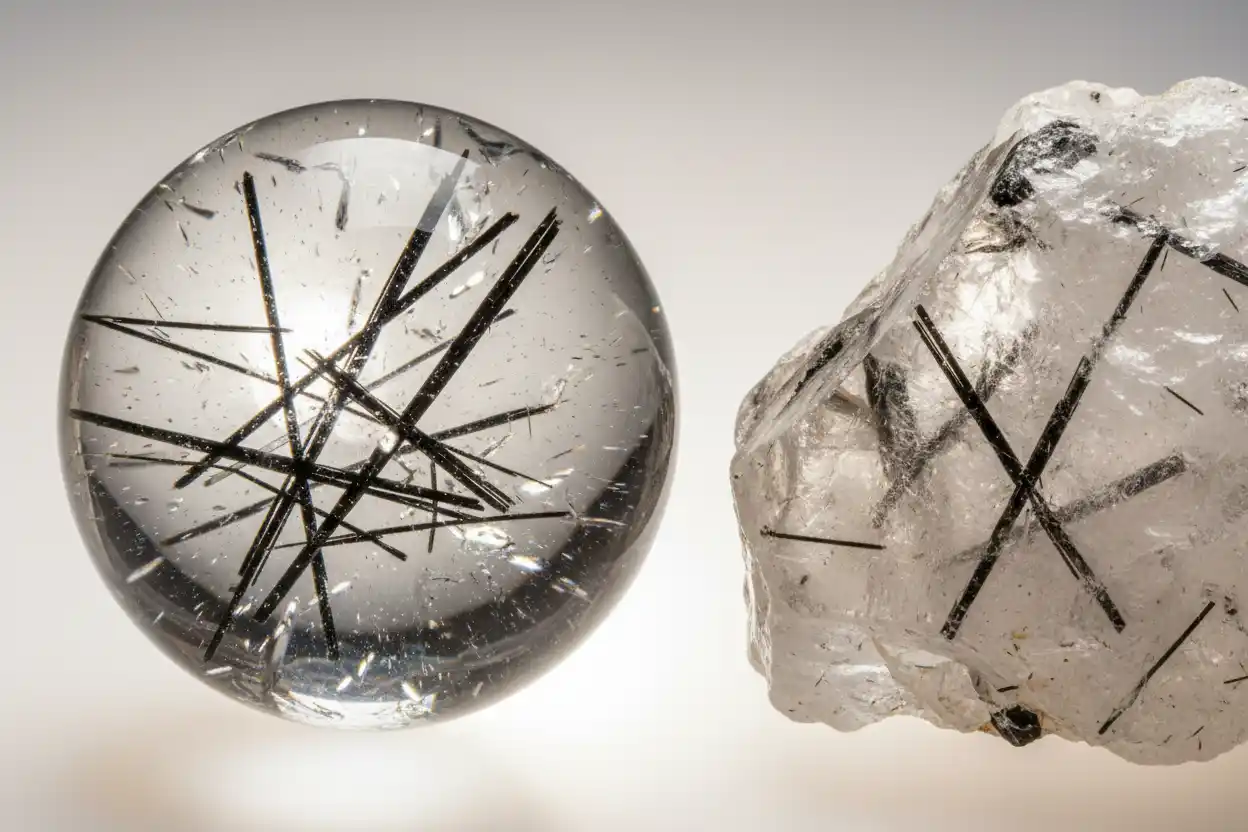
Tourmalinated quartz is transparent to milky quartz containing visible tourmaline crystals, most commonly black schorl. The dark needles, rods and irregular prisms may cross the quartz in sparse geometric lines or form dense networks that make every polished stone visually unique.
It is an included-quartz material rather than a separate mineral species. The quartz supplies most of the polished gem’s physical properties, while the tourmaline inclusions create its defining pattern and influence how the rough behaves during cutting.
Tourmalinated Quartz at a Glance
| Property | Tourmalinated Quartz |
|---|---|
| Material type | Included quartz containing tourmaline |
| Main host mineral | Quartz |
| Host composition | SiO₂ |
| Typical inclusion | Black schorl tourmaline |
| Other possible inclusions | Dravite, elbaite or other tourmaline-group members |
| Common colors | Clear, white, gray or smoky quartz with black, dark green, brown or rare colored inclusions |
| Crystal systems | Quartz: trigonal; tourmaline: trigonal |
| Luster | Vitreous |
| Transparency | Transparent to opaque, depending on inclusion density and fractures |
| Refractive index | Usually dominated by quartz, approximately 1.544–1.553 |
| Specific gravity | Usually near 2.65, increasing slightly with dense inclusions |
| Mohs hardness | Quartz surface approximately 7 |
| Cleavage | Quartz has no true cleavage; internal fractures may follow tourmaline contacts |
| Tenacity | Brittle |
| Common cuts | Cabochons, free forms, beads, carvings, faceted stones and polished points |
| Main care concern | Tourmaline-quartz boundaries and associated fractures can weaken an otherwise hard stone |
What Is Tourmalinated Quartz?
Tourmalinated quartz is quartz that enclosed tourmaline during crystal growth. Mineral databases classify it as a natural mixture or included material rather than a formally independent mineral species.
The dark inclusions are usually black tourmaline, whose mineralogical name is schorl. Schorl is the most abundant member of the tourmaline group and commonly forms in granite, granitic pegmatites, hydrothermal veins and metamorphic rocks.
Although “black tourmaline quartz” and “tourmaline quartz” are common trade names, “tourmalinated quartz” gives the clearest description: quartz containing tourmaline.
The parent quartz guide owns quartz-family mineralogy, while the parent tourmaline guide covers the chemically complex tourmaline supergroup. This page focuses on what happens when the two occur together as one lapidary material.
Is Tourmalinated Quartz a Variety of Quartz?
In practical gem and mineral trade usage, it is treated as a variety of included quartz. Strictly speaking, however, the tourmaline crystals remain a separate mineral enclosed inside the quartz.
The stone does not have one unified chemical formula. Quartz contributes SiO₂, while the included tourmaline has a much more complex borosilicate composition.
That distinction matters during identification. A test performed on a clear surface usually records quartz properties, while a test placed directly over a projecting black inclusion may respond differently.
The material belongs alongside the included and structural varieties described in types of clear quartz, but its inclusion species gives it a more specific identity.
What Kind of Tourmaline Is Inside the Quartz?
Most black needles are schorl, an iron-rich tourmaline. Its color ranges from opaque black to very dark blue, green or brown.
Brown inclusions may be dravite or another magnesium-rich tourmaline. Green, pink or blue inclusions are possible when elbaite or another colored tourmaline grows with quartz, although these combinations are much less common.
Color is not enough to determine the precise tourmaline species. Schorl, dark dravite and heavily saturated elbaite can all appear nearly black when viewed through quartz.
A laboratory can identify the inclusion through Raman spectroscopy or chemical analysis. For ordinary commercial stones, sellers usually use the broader description black tourmaline unless species-level testing has been performed.
The range of recognized members is explained in the types of tourmaline guide.
How Tourmalinated Quartz Forms
Tourmalinated quartz commonly forms in granitic pegmatites and hydrothermal veins. These environments contain silica-rich fluids capable of growing quartz as well as boron, iron and other elements needed for tourmaline.
Tourmaline may begin crystallizing before the surrounding quartz. Later silica-rich fluid encloses the existing needles and prisms, preserving them inside the transparent host.
In other specimens, both minerals grow during overlapping stages. A tourmaline crystal can continue lengthening while quartz closes around it.
Changes in pressure, temperature and fluid composition create fractures and healed growth planes. These features explain why many polished stones show both black inclusions and reflective internal cracks.
The inclusions do not pierce a finished quartz crystal after it forms. They developed within the same mineral-forming environment and were enclosed as the quartz grew.
Important Sources
Brazil, particularly Minas Gerais, supplies a large proportion of commercial tourmalinated quartz used for cabochons, beads, carvings and decorative objects.
Pakistan and Afghanistan produce quartz-tourmaline associations from complex pegmatites. Some material contains thick, sharply defined black prisms, while other stones show fine hairlike networks.
Namibia’s Erongo region is known for quartz associated with lustrous schorl crystals. Madagascar, India, Russia, China and the United States also produce included quartz.
California and Maine contain historic American pegmatite localities where quartz and black tourmaline occur together.
A country name alone does not establish value. Inclusion arrangement, quartz clarity, cutting quality and treatment disclosure normally matter more than broad origin.
Inclusion Patterns
Sparse Needles
A few isolated black needles can create a clean, modern appearance. Transparent quartz surrounding each inclusion allows the tourmaline shape to remain clearly visible.
Sparse patterns can command strong prices when the quartz is unusually clean and the needles are well positioned.
Dense Networks
Some stones contain dozens or hundreds of intersecting inclusions. The resulting pattern may resemble brushstrokes, woven fibers or abstract linework.
Dense material can become opaque when inclusions and fractures block too much light.
Thick Prisms
Rather than thin needles, some quartz encloses broad black tourmaline rods. These can show striated surfaces and polygonal cross-sections.
Large prisms often create internal stress because quartz and tourmaline expand differently during geological cooling.
Radiating Sprays
Tourmaline crystals may grow outward from one point, creating a starburst or fan. A cutter must orient the rough carefully to preserve the complete pattern.
Broken or Offset Inclusions
A dark rod may appear broken and shifted across a healed fracture. This can be a natural geological feature rather than evidence that the stone was assembled.
Tourmalinated Quartz Versus Rutilated Quartz
Rutilated quartz contains rutile, a titanium oxide, rather than tourmaline.
Rutile needles are commonly golden, coppery, red-brown or black. They tend to be finer and more reflective than schorl.
Tourmaline inclusions are often thicker, darker and less metallic. They may show longitudinal striations and irregular widths.
Black rutile can resemble fine tourmaline needles closely. Raman spectroscopy provides the strongest identification when trade value depends on the inclusion species.
Neither material should be identified from inclusion color alone.
Tourmalinated Quartz Versus Garden Quartz
Garden quartz contains scenic inclusions such as chlorite, iron oxides, clay minerals and fluid-filled cavities.
Its patterns generally appear mossy, cloudlike or landscape-like rather than forming distinct black rods.
A stone can contain tourmaline alongside chlorite or other minerals. In that case, the seller should describe the complete inclusion assemblage rather than forcing the piece into only one trade category.
Tourmalinated Quartz Versus Phantom Quartz
Phantom quartz preserves the outline of an earlier crystal-growth stage. The phantom may be marked by chlorite, hematite, clay or other deposited material.
Tourmalinated quartz is defined by identifiable tourmaline crystals rather than a ghostlike internal crystal outline.
Both features can occur together. A quartz crystal may contain a visible phantom and later-grown tourmaline inclusions.
Internal Fractures and Durability
Quartz itself has a Mohs hardness of 7, placing it high enough for many forms of jewelry. Its position appears in the gemstone hardness chart.
Hardness measures scratch resistance, not resistance to breaking. The difference is explained in gemstone toughness versus hardness.
Tourmalinated quartz is often less durable than equally clean clear quartz because fractures develop around the inclusions.
Quartz and tourmaline respond differently to temperature and stress. Their contact boundaries may become natural weak points.
The quartz has no true cleavage, but cracks can still propagate through it. The role of cleavage and fracture is discussed in gemstone cleavage explained.
A heavily fractured cabochon may survive as a pendant yet fail quickly in a ring exposed to repeated impact.
Identifying Real Tourmalinated Quartz
Begin by confirming that the host material behaves like quartz. A polished surface should have quartz-level hardness, vitreous luster and gemological properties close to rock crystal.
Under magnification, natural black inclusions commonly vary in width, orientation and termination. They may intersect fractures or disappear beneath the surface.
Some inclusions show tourmaline’s characteristic striations. Others appear rough, broken or chemically etched where they contacted the quartz.
The black material should exist inside the quartz rather than appearing painted onto the surface.
Raman spectroscopy can identify both the host and inclusion. The general testing sequence appears in how to identify crystals.
The authentication checks in real versus fake clear quartz also help detect glass and resin hosts.
Common Imitations and Misidentifications
Glass with embedded black fibers can imitate the appearance. Rounded bubbles, flow lines and a lower hardness often reveal glass.
Resin imitations may contain graphite, plastic threads or deliberately placed mineral fragments. They scratch more easily and may show mold seams or flattened bubbles.
Black rutile, aegirine, hornblende and other dark minerals can be mistaken for tourmaline.
Some stones contain real quartz and natural dark inclusions but are mislabeled at species level. Such material is not necessarily fake; the seller may simply have identified the needles incorrectly.
Artificially assembled pieces can contain black rods inserted into drilled or fractured quartz and sealed with resin. Glue concentrations and unnaturally straight entry points are warning signs.
Treatments and Enhancement
Most tourmalinated quartz is sold without deliberate color treatment because the natural contrast provides its appeal.
Fracture filling with resin can improve transparency and stabilize weak stones. Filled fractures may show flattened bubbles, colored flash effects or different surface luster.
Clear coatings can conceal scratches or improve polish temporarily. They may wear away around facet edges or drill holes.
Dye can darken fractures or the quartz body, although it is less common than in ordinary chalcedony.
The inclusion pattern itself cannot be created through heat treatment. Heating can, however, worsen existing fractures.
Treatment terminology is explained in gemstone treatments explained, while treated clear quartz owns detailed quartz-treatment detection.
Commercial synthetic quartz exists, and tourmaline crystals can theoretically be combined with manufactured hosts or resin. The distinction between natural, synthetic and imitation material appears in lab-grown versus natural gemstones.
Cutting and Polishing
Tourmalinated quartz is commonly fashioned as cabochons because a curved surface displays inclusions from several angles.
Free-form cuts allow the lapidary to preserve unusual sprays and avoid unstable fractures. Standard ovals can waste attractive pattern areas.
Transparent, lightly included material may be faceted. Step cuts and modified brilliant cuts can create reflections around the dark needles, although too many inclusions reduce brilliance.
A cutter examines each black crystal before sawing. A tourmaline rod intersecting the surface may pull out, leave a pit or cause the quartz to split.
Drilling beads presents another risk because the drill may encounter a hard inclusion or existing fracture.
Polishing should remain cool and controlled. Localized heat can expand fractures around the included tourmaline.
Jewelry Suitability
Pendants and earrings are the safest choices because they receive fewer hard impacts.
Cabochon rings can work when the quartz is structurally sound and protected by a bezel. Highly fractured stones should be reserved for occasional wear.
Bracelets expose beads to repeated contact with desks, doors and neighboring beads. Drill holes should be checked for chips and resin.
Faceted stones with surface-reaching inclusions require protective prongs that do not press directly against a fracture.
The inclusion network is the main attraction, but it should not be mistaken for exceptional toughness.
Tourmalinated Quartz Prices in 2026
Small tumbled stones commonly retail for approximately $3–$15.
Commercial beads and simple cabochons generally cost $5–$40 per piece, depending on size and quartz clarity.
Better cabochons with transparent quartz, well-defined needles and strong polish commonly range from $40–$150.
Large designer cuts, carvings and unusually clean inclusion patterns may sell for $150–$400 or more.
Mineral specimens with complete quartz crystals and well-formed tourmaline can range from $50 to several hundred dollars. Exceptional pegmatite specimens may exceed $1,000.
Carat weight is not a reliable comparison because commercial included-quartz lots can sell for only a few dollars per carat, while artistic one-of-a-kind cuts receive much higher piece prices.
What Determines Value?
Quartz clarity is important. A stone that allows the viewer to see each tourmaline crystal generally receives more attention than cloudy material.
Pattern quality matters more than the number of needles. A balanced sparse arrangement can be more valuable than a dense chaotic mass.
Inclusion identification also affects price. Verified tourmaline supports the trade name, while unidentified black fibers should receive a more cautious description.
Cutting should frame the pattern rather than cropping it awkwardly. Pits, scratches, severe windows and resin-filled fractures reduce value.
Natural crystal specimens are evaluated for termination, association, damage, locality and overall composition.
Buying Guidance
Use the dedicated tourmalinated quartz buying guide for seller and authenticity checks.
Request close photographs from the front, back and sides. One angle may hide large fractures or exposed inclusions.
Confirm whether the stone is solid quartz, glass, resin or a composite. Ask specifically about fracture filling and surface coating.
Do not pay a high premium solely because a seller calls the material black rutile, black tourmaline or “super seven.” Inclusion names should match actual mineral evidence.
Look for chips around drill holes and points where dark rods reach the surface.
A stone intended for a ring should be inspected more strictly than one intended for display.
Cleaning and Storage
Clean structurally sound material with lukewarm water, mild soap and a soft brush.
Avoid ultrasonic and steam cleaners. Internal fractures and differences between quartz and tourmaline make vibration and thermal shock unnecessary risks.
Do not move the stone directly between hot and cold water.
Dry it thoroughly around drill holes and surface-reaching inclusions.
Store each piece separately from harder gemstones. Although quartz resists many scratches, sapphire and diamond can abrade it.
Ordinary indoor light does not normally alter the black inclusions. However, resin-filled stones and dyed hosts should be kept away from prolonged heat and intense sunlight.
Meaning and Symbolism
Modern crystal traditions associate tourmalinated quartz with balance, grounding, clear boundaries and the integration of contrasting qualities.
The clear host and dark inclusions encourage symbolism involving clarity that does not require ignoring difficult experiences.
Some people interpret the stone as combining the amplifying symbolism of quartz with the protective or grounding associations of black tourmaline.
These meanings are spiritual, cultural or personal rather than scientifically demonstrated effects.
The color symbolism overlaps the broader guides to black crystals and clear crystals, but the mineral’s geological identity remains an included-quartz assemblage.
Frequently Asked Questions
1. Is tourmalinated quartz a real natural stone?
Yes. It forms when quartz grows around pre-existing or simultaneously growing tourmaline crystals.
2. Is the black material always black tourmaline?
Usually it is schorl, but dark dravite, rutile and other minerals can look similar. Laboratory testing may be needed.
3. Is tourmalinated quartz the same as rutilated quartz?
No. Rutilated quartz contains titanium-oxide rutile, while tourmalinated quartz contains tourmaline.
4. Can tourmalinated quartz be completely transparent?
Yes. Fine material can have transparent quartz surrounding only a few distinct black needles.
5. Why does tourmalinated quartz contain so many cracks?
Stress commonly develops where quartz surrounds tourmaline crystals. Pegmatite growth and later geological movement can add further fractures.
6. Is tourmalinated quartz treated?
Much material is untreated, but resin fracture filling, coating and assembled imitations can occur.
7. Can it be faceted?
Yes. Lightly included transparent rough can be faceted, although cabochons and free forms are more common.
8. Is it durable enough for a ring?
A sound stone can be worn in a protected ring. Heavily fractured examples are better suited to pendants or display.
9. Can tourmalinated quartz go in water?
Brief gentle washing is generally safe for untreated solid material. Avoid prolonged soaking when resin, glue or extensive fractures are present.
10. Where is tourmalinated quartz found?
Important commercial sources include Brazil, Pakistan, Afghanistan, Namibia, Madagascar, India and the United States.
11. How much is tourmalinated quartz worth?
Small commercial pieces may cost under $20, while fine designer cabochons and specimens commonly range from $50 to several hundred dollars.
12. Does tourmalinated quartz have scientifically proven healing properties?
No. Symbolic meanings may hold personal value, but scientific evidence does not establish healing effects.
Tourmalinated quartz is most convincing when the inclusion pattern remains visibly geological: needles change thickness, disappear into the quartz, cross natural fractures and respond differently from every viewing angle. That irregularity is not a flaw to standardize away; it is the record of two minerals sharing the same pegmatite environment.
Tourmalinated quartz appears in Crystals That Start With T and Gemstones That Start With T.