10 Unakite Healing Properties: Modern Beliefs, Geology & Safe Use
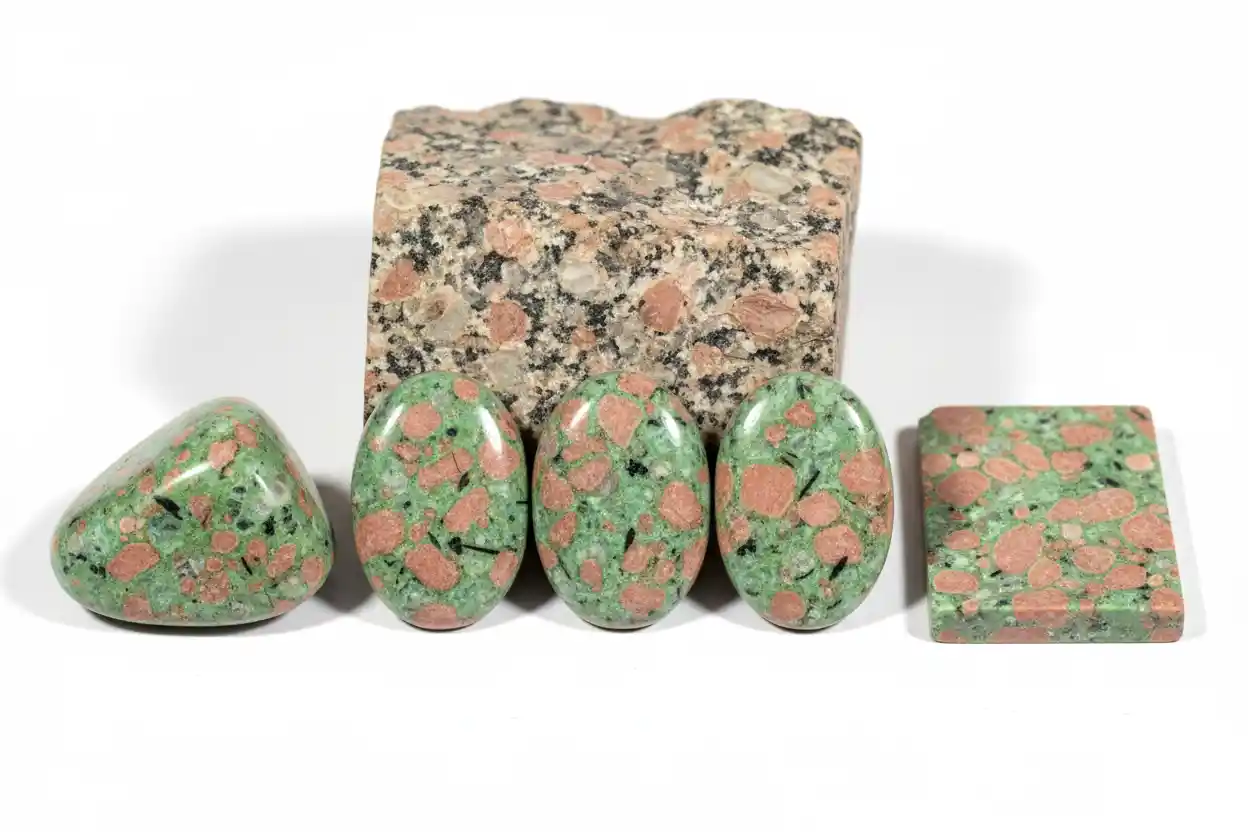
Unakite healing properties are commonly associated with emotional balance, patience, self-reflection, steady progress, grounding, compassion, and releasing habits that no longer feel useful. Its mottled combination of green epidote, pink orthoclase feldspar, and pale quartz gives the rock a distinctive appearance that modern crystal practice often interprets as a visual balance between growth and emotional warmth. These associations can support personal rituals, but unakite is not scientifically proven to treat anxiety, depression, trauma, fertility problems, pregnancy complications, pain, sleep disorders, hormonal conditions, or any other medical condition.
Unlike many stones used in crystal practice, unakite is not a single mineral species. It is an altered granitic rock composed mainly of green epidote, pink orthoclase feldspar, and quartz. Hydrothermal alteration changes part of the original granite, especially by replacing plagioclase with epidote while orthoclase and quartz remain. This geological process explains its characteristic pink-and-green pattern without requiring claims about therapeutic energy.
A responsible approach to unakite healing properties treats the stone as a tactile or visual reminder for reflective behavior. Someone might use it to pause before reacting, write about a recurring pattern, review a realistic goal, or practice patience during a period of change. Any useful result comes from the person’s choices and habits rather than a medically demonstrated effect produced by the rock.
10 Unakite Healing Properties Commonly Used in Modern Crystal Practice
- Emotional balance during periods of change.
- Patience with gradual personal progress.
- Grounding when thoughts feel scattered.
- Self-reflection around recurring habits and reactions.
- Compassion toward oneself without avoiding responsibility.
- Releasing expectations that no longer fit current circumstances.
- Steady motivation for realistic long-term goals.
- Mindful communication during emotionally charged situations.
- Acceptance of mixed feelings rather than forcing positivity.
- Spiritual reflection centered on growth, renewal, and integration.
What Unakite Really Is: Epidote, Feldspar, Quartz, and Altered Granite
Understanding the rock itself helps separate unakite healing properties from verified geology. Unakite forms when granite undergoes hydrothermal alteration or related metasomatic change. Fluids moving through the rock transform much of its original plagioclase feldspar into epidote, while pink orthoclase feldspar and quartz remain. The result is the familiar mixture of pistachio-green epidote, salmon-to-pink feldspar, and clear, gray, or milky quartz.
Because unakite contains several minerals, it does not have one perfectly uniform hardness or cleavage behavior. Epidote generally falls around 6 to 7 on the Mohs scale, orthoclase around 6, and quartz around 7. Their similar hardness allows good-quality unakite to take an attractive polish, which is why it appears in cabochons, beads, carvings, tumbled stones, and ornamental objects. Coarse specimens can wear less evenly, while cleavage in feldspar and epidote may contribute to breakage under a sharp impact.
Unakite takes its name from the Unaka Mountains of the southeastern United States. Its modern geological identity dates from the nineteenth century, so descriptions of named ancient unakite healing properties should be treated cautiously.
Unakite Healing Properties for Emotional Balance and Patient Change
Emotional Balance Without Erasing Difficult Feelings
Emotional balance is among the most familiar unakite healing properties. Modern crystal interpretations often connect the green and pink colors with harmony between growth, feeling, and self-acceptance. A realistic approach does not require the stone to erase sadness, anger, fear, or grief. Instead, unakite can become a cue to notice an emotion before deciding what action should follow.
Someone might hold the stone while writing down what happened, what emotion arose, which assumptions intensified the reaction, and what response would be proportionate. That process creates time and structure around an emotional experience. The rock itself is not treating a mental health condition or altering brain chemistry.
This distinction matters because unakite healing properties sometimes receive language that sounds therapeutic. Personal ritual can support reflection, but persistent depression, severe anxiety, trauma symptoms, or other mental health concerns need appropriate evidence-based care rather than crystal substitution.
Patience and Progress Through Repeatable Habits
Patience and gradual progress also appear repeatedly among unakite healing properties. The rock’s altered geological character makes it an appealing modern symbol for change that happens over time rather than instantly. That symbolism can be useful when a goal requires repetition, such as learning a skill, improving a routine, organizing finances, or maintaining a creative practice.
A person might place unakite beside a planner and use it as a reminder to choose one manageable action instead of judging an entire goal at once. Completing a small task consistently can be more useful than waiting for a sudden burst of motivation. The stone does not create discipline, but it can become part of a routine that reinforces deliberate action.
Many unakite benefits are practical as well. The rock polishes attractively, works well for beads and cabochons, and offers distinctive color without relying on wellness claims.
Letting Go Without Avoidance
Another common theme within unakite healing properties is release. Crystal practitioners may describe the stone as helping someone let go of old emotions, attachments, expectations, or habits. Used carefully, that idea can mean examining whether a belief or behavioral pattern still serves a constructive purpose.
A reflective routine could identify one recurring habit, notice the circumstances that trigger it, choose an alternative response, and review the result later. This keeps responsibility with the person rather than transferring it to the stone. Letting go should not mean suppressing distress or pretending that a serious problem has disappeared.
Unakite’s altered-rock origin naturally invites metaphors about transformation, but geological change does not prove psychological change. The connection is symbolic rather than medical.
Grounding, Communication, and Realistic Boundaries
Grounding also appears frequently in descriptions of unakite healing properties. A practical grounding routine can involve noticing immediate surroundings, slowing down, checking current responsibilities, and choosing what deserves attention first. The stone can function as the object that starts that process.
Communication can work in much the same way. Before a difficult conversation, someone may use unakite as a reminder to distinguish facts from assumptions, decide what boundary needs to be stated, and consider how to communicate it without unnecessary escalation. This does not guarantee a particular response from another person, but it turns symbolism into preparation.
Modern ideas surrounding unakite meaning often emphasize growth, integration, renewal, and the meeting of contrasting colors. Those themes can shape personal interpretation without suggesting that unakite controls emotions, relationships, or another person’s behavior.
Unakite Healing Properties in Heart Chakra and Spiritual Practice
Modern crystal systems commonly associate unakite with the heart chakra because of its green and pink appearance. Some practitioners also include it in root-focused practices or meditation centered on emotional integration, compassion, patience, and gradual growth. These correspondences vary between practitioners and do not represent measurable mineral properties.
Chakras are spiritual frameworks rather than anatomical structures. Unakite healing properties do not demonstrate that the rock opens the heart, changes cardiac function, regulates circulation, alters hormones, improves fertility, or supports pregnancy. Reproductive claims deserve particular caution because unakite is sometimes promoted with unsupported ideas involving conception or healthy pregnancy.
A heart-centered practice can remain behavioral. Someone might reflect on where greater kindness is appropriate, where a boundary remains necessary, or whether self-criticism is contributing anything useful. A grounding practice may focus on practical stability such as sleep routines, household responsibilities, budgeting, or planning.
Why Named Unakite Healing Traditions Are Relatively Modern
Unakite’s pink-and-green appearance comes from a distinctive altered-rock composition, but the name itself is modern. It was named after the Unaka Mountains following its geological recognition in the nineteenth century. Claims that unakite healing properties formed part of an ancient tradition using that specific stone name therefore lack strong historical support.
Current metaphysical interpretations appear to draw heavily from color symbolism and the contrast between its mineral components. Green commonly represents growth or renewal in modern crystal culture, while pink may represent compassion or emotional warmth. The geological transformation of granite also encourages symbolic themes of change and integration.
These modern interpretations can still carry personal value. Historical accuracy simply means describing them as contemporary spiritual ideas rather than assigning unakite an invented ancient medical pedigree.
Unakite Care: Hardness, Cleavage, Water, Heat, and Lapidary Dust
Unakite is reasonably durable for pendants, beads, cabochons, carvings, and decorative pieces, but its mixed composition means it should not be treated as a perfectly uniform crystal. Its main minerals generally fall around Mohs 6 to 7, and cleavage in feldspar and epidote can make some pieces vulnerable to sharp impacts. Rings and bracelets may develop wear more quickly than pendants or earrings, especially when they frequently contact harder objects.
Warm water, mild soap, and a soft cloth or brush are suitable for routine cleaning of intact polished unakite. Long soaking offers little advantage. Avoid strong chemicals, sudden temperature changes, steam, and aggressive ultrasonic cleaning, particularly with fractured or coarse-grained pieces. Store polished stones away from harder gems such as sapphire, ruby, topaz, and diamond.
Lapidary work needs additional precautions because unakite contains quartz. Cutting, drilling, sanding, or grinding can produce respirable crystalline silica dust along with particles from its other minerals. Wet working methods, effective ventilation, eye protection, and appropriate respiratory protection reduce this hazard. Finished stones are very different from airborne cutting dust, and unakite healing properties provide no reason to ingest powder or prepare drinks from crushed rock.
Safer Symbolic Cleansing for Unakite
Symbolic cleansing can remain gentle. A clean cloth, sound, quiet meditation, a designated resting place, or simply holding the stone while restating an intention can serve the ritual purpose. Brief indirect natural light is another low-risk choice.
Avoid boiling, flame, harsh acids, abrasive powders, and deliberate thermal shock. Long saltwater soaking is unnecessary and may leave residue within surface irregularities. Physical cleaning removes dirt, while symbolic cleansing expresses personal intention.
Conclusion
Unakite healing properties are modern wellness and spiritual associations centered on emotional balance, patience, grounding, reflection, release, communication, and gradual personal growth. The stone itself is an altered granitic rock made mainly of epidote, orthoclase feldspar, and quartz, with genuine geology that explains its distinctive color and texture.
Used responsibly, unakite can become a meaningful cue for journaling, meditation, preparation, or habit change. Its usefulness as a reflective object does not require claims that it treats illness, alters hormones, affects fertility, or creates a medically measurable healing force.
FAQs
What Are the Main Unakite Healing Properties?
Unakite healing properties commonly include emotional balance, patience, grounding, self-reflection, compassion, release, steady motivation, mindful communication, acceptance, and spiritual growth.
Is Unakite a Mineral?
No. Unakite is an altered granitic rock composed mainly of green epidote, pink orthoclase feldspar, and quartz.
Are Unakite Healing Properties Scientifically Proven?
No. There is no reliable evidence that unakite treats disease, mental health disorders, hormonal conditions, fertility problems, pain, or another medical condition.
Which Chakra Is Associated With Unakite?
Modern crystal practice most often links unakite with the heart chakra, although some practitioners also use it in grounding practices. Chakras are spiritual frameworks rather than anatomical structures.
Can Unakite Help With Fertility or Pregnancy?
There is no evidence that unakite improves fertility, regulates reproductive hormones, supports pregnancy, or prevents pregnancy complications.
Can Unakite Go in Water?
Brief washing with warm water and mild soap is generally suitable for an intact polished piece. Long soaking is unnecessary, and harsh chemicals or sudden temperature changes should be avoided.
How Hard Is Unakite?
Its main minerals generally fall around Mohs 6 to 7. Because unakite contains several minerals, durability can vary with grain size, cleavage, fractures, and texture.
Is Unakite an Ancient Healing Stone?
The rock received its modern name in the nineteenth century, so claims of ancient healing traditions specifically involving named unakite are not well supported.
Is Unakite Safe to Handle?
Finished polished stones are generally suitable for normal handling. Cutting and grinding can produce silica-containing dust, so lapidary work requires appropriate dust controls.
How Should Unakite Be Cleansed Spiritually?
Gentle methods such as sound, meditation, a clean cloth, or restating an intention avoid unnecessary physical stress while preserving the symbolic purpose.
Unakite healing properties are modern spiritual and personal wellness beliefs and should not replace qualified medical or mental health care.