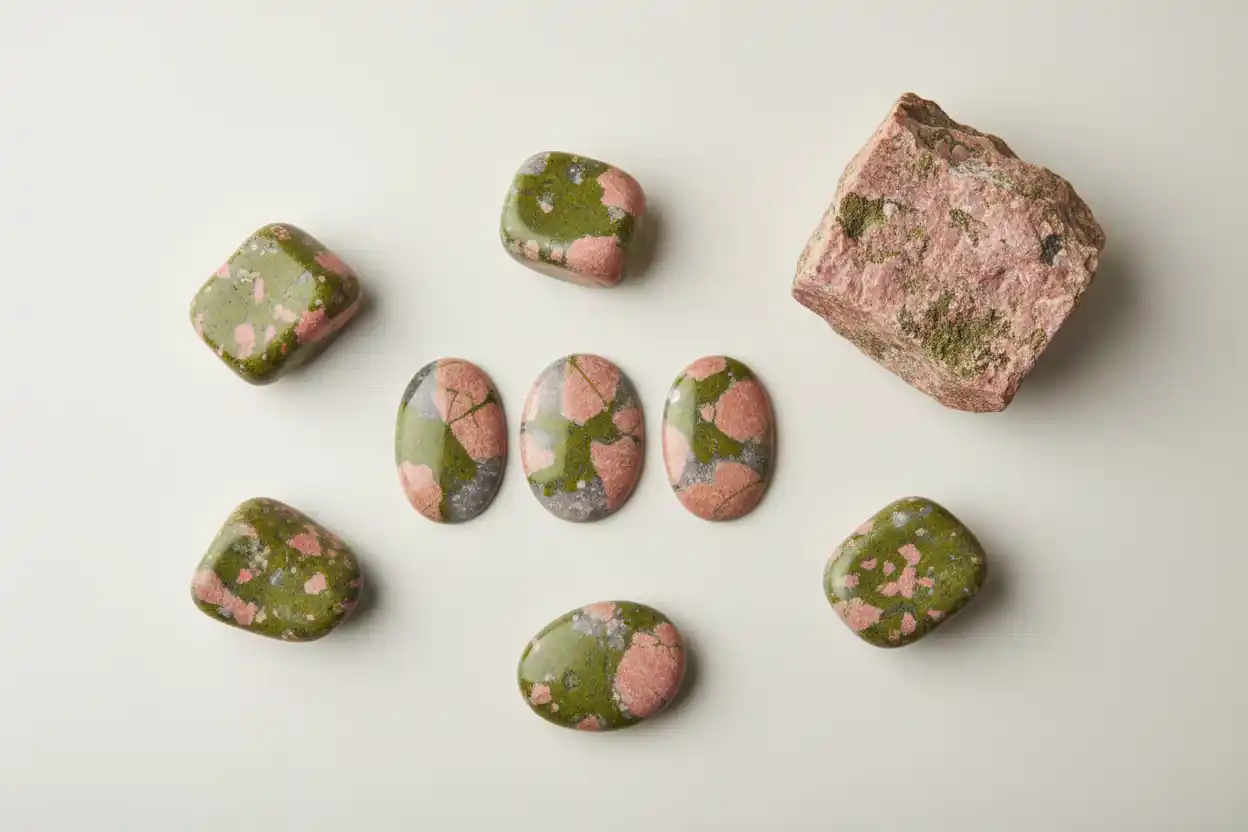
Unakite Meaning, Properties, Uses and Identification
Unakite is a mottled pink-and-green rock formed when granitic material undergoes hydrothermal or metasomatic alteration. Its familiar appearance comes primarily from pink potassium feldspar, pistachio-green epidote and colorless to milky quartz.
Despite the common retail name “unakite jasper,” genuine unakite is not a jasper variety and is not one mineral species. It is a multi-mineral lapidary rock whose composition, grain size and pattern can vary from one piece to another.
Unakite at a Glance
| Property | Unakite |
|---|---|
| Material type | Metasomatically altered granitic rock |
| Main components | Pink potassium feldspar, green epidote and quartz |
| Possible additional minerals | Plagioclase, biotite, hornblende, magnetite and iron oxides |
| Typical colors | Salmon pink, peach, rose, pistachio green, olive green, white, gray and black |
| Texture | Coarse-grained and mottled |
| Crystal system | Not applicable to the rock as a whole; each component has its own crystal structure |
| Luster | Vitreous to dull, depending on mineral and polish |
| Transparency | Opaque overall; individual quartz grains may be translucent |
| Specific gravity | Commonly about 2.6–2.9 |
| Approximate hardness | Usually about 6–7, varying among component grains |
| Cleavage | Variable according to mineral components |
| Tenacity | Generally fair; may fracture along grain boundaries |
| Common cuts | Cabochons, beads, tumbled stones, carvings, spheres and slabs |
| Main care concern | Uneven mineral hardness can cause scratches, undercutting and fractures along grain boundaries |
What Is Unakite?
Unakite is an altered granitoid composed mainly of epidote, potassium feldspar and quartz. The green areas are predominantly epidote, while the pink areas are usually orthoclase or microcline feldspar.
Clear, white or gray patches generally represent quartz. Additional dark grains may include biotite, hornblende, magnetite or other minerals inherited from the original rock.
Because it contains several minerals, unakite does not have one chemical formula, refractive index or crystal system. Each constituent retains its own mineral properties.
This distinction places unakite among rocks and lapidary materials rather than single-mineral crystals. The broader types of gemstones guide explains how ornamental rocks can still be used as gem materials.
Is Unakite a Mineral, Granite or Jasper?
Unakite is a rock, not a mineral. More specifically, it is an altered granitic rock formed through metasomatism or hydrothermal alteration.
Calling it “unakite granite” or “epidote granite” can be descriptively useful, although the alteration may have changed the original granitoid substantially.
The label “unakite jasper” is commercially common but mineralogically inaccurate. Jasper consists mainly of microcrystalline quartz, whereas unakite contains visibly distinct grains of feldspar, epidote and quartz.
The jasper meaning guide and types of jasper guide therefore cover a different material family.
How Unakite Got Its Name
Unakite was named after the Unaka Mountains, part of the Appalachian region along the border of western North Carolina and eastern Tennessee.
The rock was scientifically described during the nineteenth century after specimens were examined from the Unaka range. Its locality name eventually became the standard term for similarly altered pink-and-green granitic rock.
The name should describe both composition and texture, not merely a pink-and-green color combination. Some trade materials resemble unakite but contain different mineral assemblages.
How Unakite Forms
Unakite begins with a granitic or related intrusive rock containing feldspar, quartz and dark ferromagnesian minerals. Hot chemically active fluids then move through fractures and grain boundaries.
These fluids alter calcium-rich plagioclase and some dark minerals into epidote. Meanwhile, pink potassium feldspar remains, recrystallizes or becomes more visually prominent.
Quartz may remain from the original granite or be redistributed by the fluids. The resulting rock develops a coarse mosaic of pink feldspar, green epidote and pale quartz.
This is a metasomatic process because the fluids add, remove or redistribute chemical elements while changing the mineral assemblage. The transformation occurs at low to moderate metamorphic temperatures compared with deeper high-grade metamorphism.
Alteration rarely affects every grain equally. Consequently, one slab may contain broad pink areas, while another is dominated by green epidote or milky quartz.
Unakite’s Mineral Components
Epidote
Epidote produces most of unakite’s yellow-green, pistachio and olive color. Iron within epidote contributes to its characteristic green appearance.
The mineral commonly replaces plagioclase or dark silicates during hydrothermal alteration. Grain size can range from tiny disseminated crystals to broad green patches.
Potassium Feldspar
Pink potassium feldspar supplies unakite’s salmon, peach and rose colors. The component may be orthoclase, microcline or an intergrowth within the feldspar group.
The broader feldspar guide owns family-level mineralogy, while orthoclase covers one of the principal pink feldspar components separately.
Quartz
Quartz appears as colorless, smoky, white or gray grains. It may form small translucent pockets between the more opaque feldspar and epidote.
With a Mohs hardness of 7, quartz can polish differently from the slightly softer feldspar areas. That hardness contrast influences tumbling and cabochon finishing.
Minor Minerals
Dark specks may include biotite, hornblende, magnetite or iron oxides. White plagioclase can remain where alteration was incomplete.
A small amount of an additional mineral does not automatically make the material fake. Unakite is naturally heterogeneous.
Unakite Colors and Patterns
Classic unakite balances pink feldspar and green epidote with smaller amounts of pale quartz. The most recognizable pieces show both colors across the face rather than one dominant mineral.
Pink-Dominant Unakite
Pink-dominant material contains broad potassium-feldspar areas with scattered green epidote. It can appear softer and warmer than balanced material.
Green-Dominant Unakite
Green-dominant unakite contains abundant epidote with smaller pink patches. Some pieces approach the appearance of massive epidote but retain visible feldspar and quartz grains.
Fine-Grained Unakite
Fine-grained material creates a dense speckled or mossy appearance. It often tumbles smoothly because the individual mineral boundaries are small.
Coarse-Grained Unakite
Coarse material shows obvious crystals and bold patches. Cabochon cutters can use these larger grains to create landscape-like or abstract patterns.
Orbicular or Spotted Material
Some pieces contain rounded green or pink concentrations. “Orbicular unakite” is descriptive rather than a recognized mineral variety.
Important Sources and Localities
The Appalachian region of the United States is unakite’s classic source. Material occurs in North Carolina, Tennessee and Virginia, where altered granitic bodies form part of the Blue Ridge geological province.
Virginia adopted unakite as its state rock, and the material occurs in several parts of the state as float, boulders and bedrock.
Similar epidotized granitic rocks occur in South Africa, Brazil, China, Sierra Leone, Zimbabwe and other regions. Commercial rough may be sold under a country name, but appearance alone cannot establish origin.
Not every pink-and-green altered rock from another locality should automatically receive the unakite name. The mineral assemblage should still be dominated by potassium feldspar, epidote and quartz.
Internal Features and Texture
Unakite’s internal “inclusions” are better described as mineral grains, boundaries, fractures and replacement textures because the material is a rock.
Under magnification, pink feldspar may show cleavage traces, weathered surfaces or cloudy alteration. Epidote can form granular clusters or irregular replacement zones.
Quartz grains commonly fill spaces between feldspar and epidote. Their greater transparency may create small glassy windows in an otherwise opaque cabochon.
Grain boundaries can collect iron staining, clay or polishing residue. Natural fractures may follow those boundaries, particularly in coarse material.
Dark biotite or hornblende grains add contrast but can undercut during polishing if they are softer, flaky or altered.
How to Identify Real Unakite
Genuine unakite normally displays visibly separate pink, green and pale mineral grains. The pattern should look geological and irregular rather than printed or painted.
A fresh broken surface commonly reveals the same colors beneath the exterior. Dyed or coated material may show concentrated color only near the surface or within cracks.
The rock should feel relatively dense and take a smooth polish. However, different grains may reflect light differently because quartz, feldspar and epidote do not share identical hardness or luster.
Magnification can reveal feldspar cleavage, granular epidote and glassy quartz. A uniform waxy texture would be less typical of coarse unakite.
The crystal identification guide explains why photographs and color alone cannot establish identity. Buyers seeking material online can use the dedicated where to buy real unakite guide for seller-specific checks.
Unakite Lookalikes
Dragon Blood Jasper
Dragon blood jasper often shows green material with red patches. Its colors tend to be darker and more sharply contrasting than unakite’s salmon-pink feldspar and pistachio epidote.
The commercial dragon blood name can also cover different rock types, making mineral confirmation important.
Ruby in Zoisite
Ruby in zoisite combines red corundum with green zoisite and often black hornblende. The red areas may show a corundum luster and much greater hardness than unakite’s pink feldspar.
Epidote
Massive epidote may look similar to green-dominant unakite. Genuine unakite should still contain visible pink potassium feldspar and usually quartz.
The separate epidote buying guide addresses specimens where epidote itself is the primary material.
Pink-and-Green Jasper
Some jaspers and brecciated rocks combine similar colors, but they usually have a finer microcrystalline texture. Unakite commonly reveals distinct coarse mineral grains.
Dyed Granite or Resin Composite
Low-cost decorations can imitate unakite with dyed crushed stone in resin. Repeated patterns, air bubbles, molded surfaces and unnaturally uniform color can reveal manufactured material.
Trade Names and Misleading Labels
“Unakite jasper” is the most common inaccurate label. It is widely understood in retail settings, but it should be accompanied by the explanation that unakite is altered granite rather than jasper.
“Epidote granite” is generally a reasonable descriptive synonym, provided the rock contains the expected pink feldspar, quartz and epidote.
“Green unakite” and “pink unakite” describe color balance rather than formal varieties.
“African unakite” may identify genuine epidotized granite from Africa, but it can also function as a vague marketing term. Buyers should request the actual country and mineral composition.
Treatments, Composites and Imitations
Most unakite is untreated because natural rough is abundant, inexpensive and attractive after ordinary polishing.
Wax or oil may be applied to rough slabs and carvings to deepen color. The enhancement is generally temporary and should be disclosed when it significantly changes appearance.
Resin stabilization can strengthen fractured or weathered material. Stabilized unakite remains natural rock, but the added polymer affects value and cleaning.
Dyeing is possible, particularly when pale feldspar or porous fractures absorb color. Bright neon green, intense red or concentrated surface color should prompt closer examination.
Reconstructed products may combine unakite chips or powder with resin. They should be sold as composite or reconstituted material rather than solid natural unakite.
There is no meaningful commercial category of lab-grown unakite. Because it is a multi-mineral altered rock, manufacturers imitate its appearance rather than growing a standard synthetic counterpart.
Cutting and Polishing Behavior
Unakite is well suited to cabochons, beads, carvings, spheres and tumbled stones. Its strong color contrast remains visible without transparency or faceting.
Lapidaries must account for uneven hardness. Quartz grains resist abrasion more strongly than feldspar, while altered dark minerals may wear away faster.
If grinding pressure is excessive, softer grains undercut and leave a slightly uneven surface. Gradual abrasive steps and a firm polishing support help maintain a level finish.
Natural fractures can open during sawing. A cutter should inspect slabs under strong light before shaping thin cabochons or narrow bracelet pieces.
Unakite generally takes a good polish, though the finish may be satin rather than mirror-bright when the mineral grains differ greatly in texture.
Its performance makes it suitable for the projects discussed in rock tumbling for beginners and the broader tumbled stones guide.
Larger patterned pieces also work well for the lapidary forms described in best gemstones for carving and cabochons.
Hardness, Toughness and Durability
Unakite is often assigned an approximate Mohs hardness of 6–7, but the rock does not have one perfectly uniform value.
Potassium feldspar measures about 6, epidote approximately 6–7 and quartz 7. A steel tool may therefore affect one area differently from another.
The gemstone hardness chart provides comparative context. Still, the rock’s grain boundaries and fractures influence breakage more than a single hardness number.
Unakite has fair practical toughness for beads and cabochons. Nevertheless, coarse material can split along feldspar cleavage or between contrasting mineral grains.
The difference between scratching and breaking is explained further in gemstone toughness versus hardness.
Jewelry Suitability
Unakite works particularly well in pendants, earrings, beads and brooches. These uses display its pattern while limiting impact.
Bracelets are common, especially in rounded beads. Surface wear may gradually soften the polish, but the low material cost makes restringing or replacing a bead straightforward.
Rings require a protective bezel or substantial setting. A high, exposed cabochon can chip if struck against a hard surface.
Because unakite is opaque and widely available, jewelry value usually depends more on design, craftsmanship and metal than on the stone’s carat weight.
Unakite Prices in 2026
Unakite remains an affordable lapidary material. Rough tumbling material commonly retails for about $5–$15 per pound, depending on pattern, grade and source.
A current specialist rock-shop listing priced one-pound tumbling rough at $8, while a one-pound lot of approximately 30 polished pieces was listed at $28.
Individual tumbled stones commonly sell for $2–$6. Standard cabochons often range from $5–$25, while larger matched pairs or unusually attractive designer cuts may reach $25–$60.
Small carvings, palm stones and spheres generally sell for $10–$75. Large polished spheres, elaborate carvings or documented American locality specimens may exceed $100.
Finished silver jewelry commonly falls between $20 and $100, depending mainly on workmanship, setting and metal weight.
Unakite should rarely command fine-gem per-carat pricing. A seller asking a high premium should provide exceptional pattern, craftsmanship, size or documented provenance.
Value Factors
Balanced pink and green color usually attracts the broadest demand. Pieces dominated by muddy brown, gray alteration or broad fractures receive less interest.
Pattern matters more than uniformity. Distinct mineral patches, flowing transitions and landscape-like designs can make one cabochon more appealing than another from the same slab.
Polish should be smooth and consistent across all component grains. Pits, undercutting and open fractures reduce quality.
Large unbroken slabs and carving rough can be more valuable than small fragments because coarse-grained unakite may crack during cutting.
Documented material from the Appalachian type region can interest collectors, although ordinary decorative pieces remain inexpensive.
Buying Guidance
Look for a natural mixture of salmon-pink feldspar, yellow-green to olive epidote and pale quartz. One color may dominate, but all three components should usually be evident.
Check polished surfaces for pits and open grain boundaries. These weaknesses can collect dirt or enlarge during wear.
Ask whether the piece is waxed, stabilized, dyed or reconstructed. Treatment is not common, but disclosure remains important.
For carvings and spheres, examine several sides. A photograph of only the most colorful face can conceal fractures or dull areas elsewhere.
Do not assume “unakite jasper” means the seller is intentionally deceptive; the term is widespread. However, a knowledgeable seller should understand that the material is an altered granitic rock.
The dedicated where to buy unakite guide retains the full purchasing and fake-avoidance intent.
Cleaning, Water, Heat and Sunlight
Clean sound unakite with lukewarm water, mild soap and a soft brush. Rinse briefly and dry the stone thoroughly.
Solid untreated material can tolerate short water contact, but prolonged soaking is unnecessary. Resin-stabilized stones, glued jewelry and pieces with open fractures require more conservative treatment.
The general crystal water guide explains why the setting and treatment can matter as much as the underlying minerals.
Avoid ultrasonic and steam cleaners. Vibration can extend grain-boundary fractures, while heat can affect resin, adhesive or wax.
Unakite’s natural colors are generally stable in ordinary light. Even so, prolonged exposure to direct sunlight and heat can dry surface treatments and fade some adhesives, so the sunlight safety guide remains relevant.
Do not use acids or harsh household chemicals. Acidic cleaners can attack altered mineral surfaces and dull the polish.
For spiritual cleansing practices, dry methods from how to cleanse crystals avoid unnecessary soaking or chemical exposure.
Storage
Store unakite separately from diamond, sapphire and other harder stones that can scratch its polished feldspar areas.
A soft pouch or lined jewelry compartment is adequate for cabochons and beads. Large carvings should rest on a stable surface where they cannot fall.
Avoid stacking slabs directly against one another. Grit trapped between them can produce scratches even when the rock itself feels durable.
Meaning and Symbolism
Modern crystal traditions often associate unakite’s pink and green combination with balance, patience, compassion and gradual personal growth. The visual mixture of different minerals encourages symbolism based on integration rather than uniformity.
Some people use unakite as a reminder to approach change steadily or to hold two perspectives at once. Others connect the green epidote with renewal and the pink feldspar with affection or emotional openness.
These meanings are cultural, spiritual or personal interpretations rather than scientifically established effects. Unakite should not replace professional medical or mental-health care.
The stone also appears in modern color-based collections of green crystals and pink crystals, although its identity depends on mineral composition rather than symbolism.
Frequently Asked Questions
1. Is unakite a mineral?
No. Unakite is a multi-mineral altered granitic rock composed mainly of pink potassium feldspar, green epidote and quartz.
2. Is unakite a type of jasper?
No. “Unakite jasper” is a common trade name, but true unakite is not primarily microcrystalline quartz and therefore is not mineralogically jasper.
3. What makes unakite green and pink?
Epidote produces the green areas, while potassium feldspar creates the pink or salmon-colored portions. Quartz forms pale, white or translucent grains.
4. How does unakite form?
Hot chemically active fluids alter granite or a related rock. Plagioclase and dark minerals change partly into epidote while potassium feldspar and quartz remain or recrystallize.
5. Where was unakite first found?
The material was named after the Unaka Mountains along the western North Carolina and eastern Tennessee region of the United States.
6. Can unakite go in water?
Sound untreated unakite tolerates brief washing, but soaking is unnecessary. Fractured, stabilized or glued pieces should remain out of prolonged water.
7. Is unakite suitable for rock tumbling?
Yes. It is a popular beginner tumbling material, although large hardness differences and fractures can cause undercutting or bruising.
8. Can unakite be worn every day?
Beads and pendants can handle regular wear. Rings need a protective setting because feldspar areas and grain boundaries can chip or scratch.
9. How can I tell unakite from dragon blood jasper?
Unakite usually shows salmon-pink feldspar, pistachio epidote and pale quartz in a coarse granitic texture. Dragon blood material tends to show darker green with red spots or patches.
10. Is unakite normally treated?
Most unakite is untreated. Some pieces may be waxed, resin-stabilized, dyed or reconstructed, particularly when the surface looks unusually bright or uniform.
11. How much is unakite worth?
Most tumbled stones cost a few dollars, while cabochons commonly sell for $5–$25. Large carvings, designer cuts and documented locality specimens can cost more.
12. Does unakite have scientifically proven healing properties?
No. Its spiritual and emotional associations are matters of belief and personal practice rather than effects demonstrated by scientific research.
Unakite’s character comes from geological transformation rather than a single crystal species. Its green epidote, pink feldspar and pale quartz preserve visible evidence of how fluids can reorganize a granitic rock and create a durable, affordable material for tumbling, carving and jewelry.
Unakite appears in Crystals That Start With U and Gemstones That Start With U.
Safety disclaimer: Cutting, grinding or polishing unakite can release silica-bearing mineral dust. Use wet lapidary methods, effective ventilation and appropriate respiratory and eye protection.