Boulder Opal Benefits: 11 Popular Uses, Helpful Symbolism & Verified Facts, Important Cautions
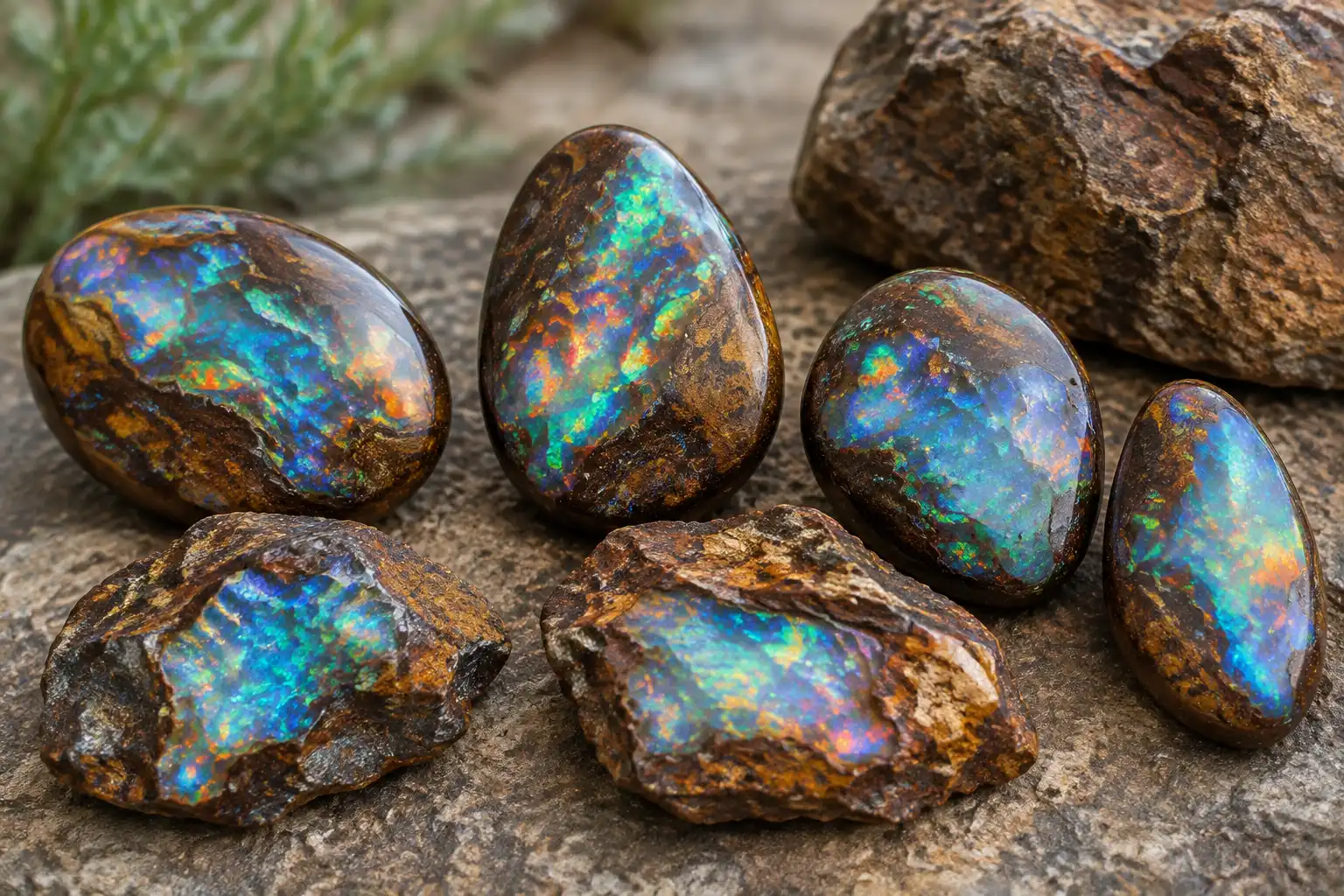
Boulder opal benefits begin with a feature that distinguishes it immediately from many other precious opals: the colorful opal commonly remains naturally attached to the brown ironstone in which it formed. Instead of cutting away every trace of host rock, lapidaries often preserve this backing because the precious opal occurs as thin seams, veins, patches, or networks running through the ironstone. The result can combine vivid play-of-color with an earthy natural base in a single polished gemstone.
This structure gives boulder opal benefits in jewelry, collecting, lapidary work, geology, identification, and visual individuality. A well-cut stone may display flashes of blue, green, orange, red, violet, or yellow across an irregular seam that could never have been separated into a conventional solid opal cabochon without losing much of the color. Preserving the host rock allows cutters to retain more of the natural formation while creating a durable backing for thin precious-opal layers.
Modern spiritual traditions sometimes add boulder opal benefits involving creativity, confidence, emotional balance, grounding, hope, or personal transformation. These interpretations can serve as symbolism, but they should remain separate from medicine. Boulder opal does not treat depression, anxiety disorders, hormone problems, circulation issues, neurological conditions, or other illnesses because it contains precious opal or ironstone.
11 Boulder Opal Benefits at a Glance
- Natural ironstone backing allows thin precious-opal seams to become wearable gemstones.
- Strong contrast between dark host rock and spectral color can intensify visual impact.
- Each stone preserves an individual relationship between opal and its geological host.
- Lapidary cutting rewards careful orientation and creative use of irregular color seams.
- Jewelry designers gain naturally shaped gems that often work well in one-of-a-kind settings.
- Collectors can study opal formation directly within ironstone rather than seeing only separated opal.
- Play-of-color provides an accessible lesson in structural color and light diffraction.
- Natural backing helps distinguish genuine boulder opal construction from assembled doublets and triplets.
- Pattern, brightness, color range, host-rock balance, and cutting provide useful quality-comparison skills.
- Modern symbolism can represent creativity, resilience, or individuality without requiring health claims.
- Proper care preserves both the precious opal and ironstone portions for long-term ownership.
Natural Ironstone Backing Is One of the Most Important Boulder Opal Benefits
The natural connection between precious opal and ironstone is central to boulder opal benefits. In many pieces, the opal occurs as a seam too thin or irregular to be cut away cleanly as a conventional solid opal. Keeping the ironstone attached allows the cutter to preserve the colorful layer while maintaining enough physical support for a finished gemstone.
This differs fundamentally from an assembled opal doublet. A doublet is made by attaching a thin opal layer to a backing after cutting, whereas genuine boulder opal retains the naturally associated host rock in which the opal formed. The distinction matters for identification, description, and value.
The brown or dark ironstone can also enhance contrast. Bright green, blue, orange, and red flashes may appear more dramatic beside the subdued host rock, creating a visual effect that is difficult to reproduce in pale opal. Some stones show only narrow veins of color, while others contain large opal faces with a thin ironstone edge or backing.
These structural differences mean that boulder opal benefits cannot be judged by one formula. The beauty of a particular stone depends on how the opal and host rock interact across the finished face.
Play-of-Color Gives Boulder Opal Exceptional Visual Movement
Precious opal displays play-of-color because light interacts with an orderly arrangement of microscopic silica spheres inside the opal. Different sphere spacing and viewing angles allow different wavelengths of visible light to appear, creating spectral flashes that move or change as the stone turns.
This phenomenon gives boulder opal benefits that are immediately visible. A gemstone may look predominantly blue-green from one direction and reveal orange or red flashes from another. Some stones display broad sweeping color, while others show pinfire, rolling flashes, small mosaics, or narrow streaks following the natural opal seam.
The ironstone background can make these colors stand out more strongly, especially when the opal layer has good brightness. This is one reason a relatively thin boulder opal seam can create a striking finished gem.
Color should still be evaluated across multiple angles. A photograph taken under intense directional lighting may make an opal look more colorful than it does during normal wear. Video, daylight viewing, and several angles often provide a more realistic understanding of performance.
Anyone evaluating boulder opal quality grading should therefore consider brightness, pattern, color range, viewing direction, opal coverage, condition, cutting, and the visual relationship between the opal and ironstone.
Every Boulder Opal Preserves a Distinct Geological Pattern
Individuality is one of the strongest boulder opal benefits. The opal does not simply sit on a uniform manufactured backing. Its seams follow natural fractures, cavities, and boundaries inside ironstone, which gives each specimen an irregular geological architecture.
One stone may contain a narrow ribbon of electric blue across brown rock. Another may display several branching seams with green and red color. A third may have a large precious-opal face interrupted by visible ironstone patches that become part of the design.
Collectors often value this irregularity because it makes duplication difficult. Even two stones cut from the same piece of rough can show very different patterns once the cutter follows separate color seams.
The geological connection also makes boulder opal useful as a teaching specimen. Instead of seeing precious opal isolated from its formation setting, an owner can observe how silica filled spaces within the host rock and remained there through later cutting and polishing.
These boulder opal benefits make the gem especially appealing to people who enjoy stones whose natural formation remains visible rather than hidden by a standardized cut.
Lapidary Skill Can Preserve Color That Would Otherwise Be Lost
Cutting boulder opal requires careful judgment because the precious-opal layer may be extremely thin, uneven, curved, or partly hidden beneath ironstone. Removing too much host rock can grind away valuable color permanently.
This challenge creates another important group of boulder opal benefits. A skilled cutter studies the rough to determine where color runs, how deep the seam extends, which side should become the face, and how much ironstone should remain for support.
Standardized shapes are not always the best choice. Freeforms, elongated cabochons, asymmetrical outlines, and irregular shapes may preserve substantially more color than forcing the rough into a perfect oval or calibrated rectangle.
A successful finished stone therefore reflects both geology and craftsmanship. The opal supplies the color, but cutting determines whether the brightest area survives and whether the finished face shows the pattern effectively.
For anyone studying lapidary work, boulder opal demonstrates why maximum beauty and maximum weight are not always the same goal. Sometimes a smaller, carefully oriented stone displays far stronger color than a larger piece cut without regard to the natural seam.
Jewelry Designers Gain Unusually Individual Shapes and Color Combinations
Boulder opal works particularly well in one-of-a-kind jewelry because irregular outlines can be an advantage rather than a flaw. A natural freeform shape may preserve an exceptional color seam while giving a designer an opportunity to create a setting around the stone rather than forcing the stone into a predetermined setting.
The combination of warm brown ironstone and bright spectral color offers considerable design flexibility. Yellow gold can echo the earthier host-rock tones, while white metals can emphasize blue or green play-of-color. Rose gold may complement orange or red flashes particularly well.
Pendants and earrings are practical choices because they experience fewer direct impacts than rings. Boulder opal can also work in rings when the setting protects exposed opal edges and the owner avoids heavy manual wear.
These jewelry-focused boulder opal benefits depend on craftsmanship. Secure setting, smooth edges, appropriate metal support, and thoughtful orientation are more important than simply choosing the largest possible gem.
A person preparing to buy boulder opal should therefore consider both the gemstone and the quality of the finished setting rather than evaluating color alone.
Collectors Can Study Precious Opal Without Losing Its Host-Rock Context
Collectors often value specimens that preserve geological relationships, and boulder opal does this naturally. The ironstone and precious opal remain physically connected, allowing the finished stone to show part of the environment in which the opal developed.
This creates boulder opal benefits that ordinary polished opal cannot always provide. A collector can examine vein thickness, host-rock texture, color distribution, and areas where precious opal transitions into common opal or ironstone.
Rough specimens can be even more informative because they reveal how little color may be visible before cutting. What appears to be an ordinary brown rock can contain a thin seam capable of producing a remarkable gemstone when oriented correctly.
Australian provenance is especially important because boulder opal is strongly associated with Queensland fields. Reliable locality documentation can add collecting interest, although exact mine claims should be supported rather than inferred merely from appearance.
Collectors should also distinguish naturally attached host rock from repair, filling, or assembled construction. Honest disclosure preserves the geological value that makes boulder opal unique.
Boulder Opal Helps Explain Structural Color Rather Than Pigment Alone
One of the educational boulder opal benefits comes from the way color is produced. Precious opal does not rely only on chemical pigments to create the rainbow flashes seen on its surface. Much of the visual effect comes from microscopic structure interacting with light.
That makes the stone useful for understanding structural color. As light enters the opal, the orderly arrangement of silica spheres can diffract visible wavelengths, producing color that changes with viewing angle.
The effect differs from the stable body color of many ordinary gems. A ruby remains red because of its chemistry, while the dominant flash in a precious opal may change dramatically as the stone moves.
Boulder opal adds another layer because this spectral color sits directly beside brown ironstone. The contrast makes the optical effect easier to appreciate and helps explain why polished orientation matters so much.
A small specimen can therefore introduce concepts involving silica structure, diffraction, host rock, color contrast, and lapidary orientation in a form that is visually memorable.
Natural Boulder Opal Is Different from Doublets and Triplets
Identification is another practical source of boulder opal benefits because the stone teaches buyers to distinguish natural geological construction from assembled products.
A solid boulder opal retains its natural ironstone backing. A doublet normally consists of a thin precious-opal slice attached artificially to another backing, while a triplet adds a transparent cap over a thin opal layer.
Doublets and triplets can be attractive and legitimate jewelry products when accurately disclosed, but they should not be represented as natural boulder opal.
Side views are especially useful when evaluating construction. Natural boulder opal often shows an irregular boundary between precious opal and ironstone, while assembled stones may show a more obvious joining plane. Professional gemological inspection can resolve difficult cases.
These distinctions matter financially as well as scientifically. The factors influencing boulder opal price include brightness, pattern, spectral range, size, condition, cutting, natural structure, and overall appearance. Construction and treatment disclosure can significantly affect what a buyer should expect to pay.
Modern Symbolism Can Represent Creativity and Resilience
Modern crystal culture sometimes associates boulder opal benefits with creativity, grounding, confidence, emotional balance, resilience, and transformation. The combination of luminous opal and earthy ironstone makes these associations visually understandable.
Creativity can be interpreted through the stone’s irregular pattern. No fixed layout determines where each color must appear, and cutters often work with natural shapes rather than imposing complete symmetry. The result can symbolize finding value in variation.
Resilience can be represented by the contrast between fragile-looking precious opal and substantial ironstone. The idea remains symbolic. The gemstone does not create psychological resilience or automatically improve someone’s ability to cope with difficulty.
Someone may still wear boulder opal during a creative project because the stone represents experimentation, or keep a specimen nearby as a reminder that an unconventional shape can still become something valuable.
Personal symbolism becomes most useful when it encourages a deliberate attitude or action without being mistaken for a medical treatment.
Boulder Opal Requires Care Despite Its Natural Rock Backing
Ironstone backing does not make precious opal indestructible. The opal portion remains softer than quartz and can scratch, chip, or fracture if treated carelessly. It may also be vulnerable to extreme heat, sudden temperature changes, and prolonged exposure to harsh conditions.
Routine cleaning should remain gentle. Lukewarm water, mild soap, and a soft cloth are appropriate for many stable solid boulder opals. Steam and ultrasonic cleaning are unnecessary risks, particularly when natural fractures or repaired areas may be present.
Rings deserve additional caution because hands strike hard surfaces frequently. Pendants and earrings generally offer safer everyday wear, while protective bezel-style settings can reduce exposure around vulnerable edges.
Owners should also avoid interpreting ironstone backing as evidence that any cleaning method is safe. The precious-opal seam remains the part that requires the greatest care.
These limits are part of responsible boulder opal benefits because understanding durability helps preserve the stone rather than shortening its useful life.
Important Cautions Keep Boulder Opal Benefits Evidence-Based
Boulder opal is sometimes described as healing emotional trauma, improving confidence, balancing energy, supporting hormones, stimulating creativity, or strengthening the body. These claims are not established medical effects of precious opal or ironstone.
The geological components also do not function as supplements. Wearing ironstone does not supply therapeutically useful iron, and silica within opal does not become a medicinal source through skin contact.
A gemstone can still have emotional significance as jewelry, a gift, a family object, or a reminder attached to a personal goal. That type of significance does not require a biological mechanism.
Boulder opal benefits are already substantial through natural beauty, geological context, structural color, lapidary challenge, collecting value, jewelry individuality, and scientific interest. Evidence-aware appreciation allows those qualities to stand on their own.
Conclusion
Boulder opal benefits include natural ironstone backing, vivid play-of-color, unique geological patterning, skilled lapidary possibilities, jewelry individuality, collecting value, structural-color education, and useful identification lessons. The connection between precious opal and host rock gives each stone a natural architecture that conventional opal rarely duplicates.
Modern themes of creativity, resilience, grounding, or confidence can add personal meaning when they remain symbolic. The strongest boulder opal benefits come from appreciating genuine geology, careful cutting, honest identification, thoughtful design, and proper care rather than relying on unsupported health claims.
FAQs
What are the main boulder opal benefits?
The most verifiable boulder opal benefits include vivid play-of-color, natural ironstone support, jewelry use, collecting, lapidary education, geological interest, identification practice, and personal symbolism.
What makes boulder opal different from other opal?
Boulder opal usually retains natural ironstone attached to the precious-opal seam because the color often occurs too thinly or irregularly to separate without significant loss.
Is boulder opal a doublet?
No. Genuine boulder opal has naturally attached host rock. A doublet is assembled by attaching a thin opal layer to a backing after cutting.
Is boulder opal good for jewelry?
Yes. It can make striking pendants, earrings, rings, and other jewelry, although the opal portion still needs protection from hard impacts, scratches, and extreme heat.
Why does boulder opal show rainbow colors?
Precious opal contains microscopic silica structures capable of diffracting visible light, producing play-of-color that changes with viewing angle.
Is every piece of boulder opal unique?
Natural color seams and host-rock patterns vary considerably, so individual pieces can have highly distinctive combinations of opal, ironstone, color, and shape.
Does ironstone make boulder opal stronger?
Natural backing can provide useful physical support to thin opal seams, but the exposed opal remains vulnerable to scratching, chipping, and thermal stress.
What does boulder opal symbolize?
Modern symbolism often connects it with creativity, individuality, resilience, grounding, hope, and transformation. These are personal or spiritual interpretations.
Does boulder opal have healing benefits?
There is no established clinical evidence that boulder opal treats disease, mental-health conditions, hormonal problems, pain, circulation issues, or other medical concerns.
How should boulder opal be cleaned?
Use lukewarm water, mild soap, and a soft cloth for stable solid pieces. Avoid steam, ultrasonic cleaning, strong chemicals, high heat, and hard impacts.
What should I look for when buying boulder opal?
Look at brightness, color range, pattern, opal coverage, host-rock balance, condition, cutting, construction, treatment disclosure, and whether photographs represent the actual stone.
Boulder opal benefits described as healing, emotional, energetic, or grounding effects belong to spiritual and personal belief and should not replace qualified medical or mental-health care.