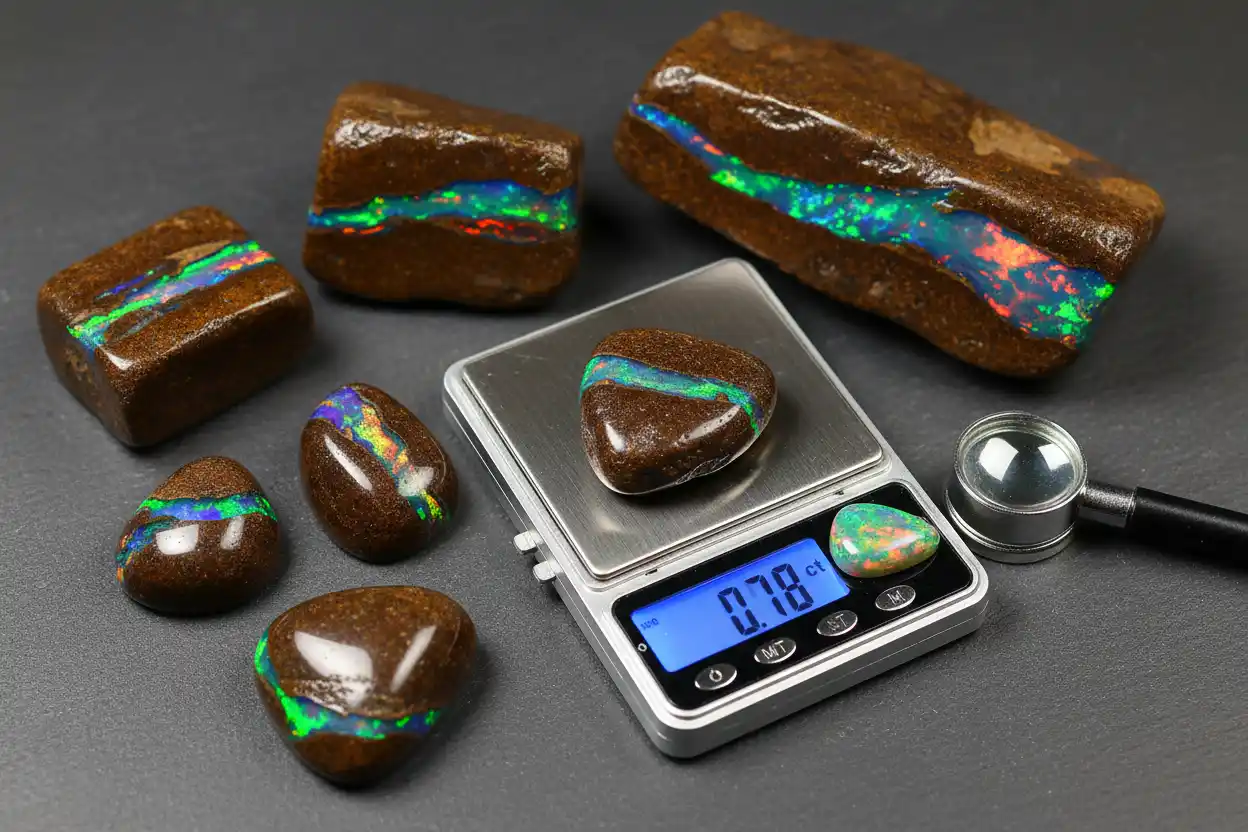
Boulder Opal Price: Quality & Value, Grade, Supply & Demand
Boulder opal price cannot be judged responsibly from carat weight alone because a finished boulder opal contains both precious opal and the natural host rock in which that opal formed. Queensland boulder opal commonly occurs as thin veins, seams, patches, or kernels of precious opal within ironstone, and cutters deliberately retain the host rock because separating the opal may destroy the color-bearing layer or remove much of the visual character. GIA’s field research describes Queensland as the classic home of boulder opal and documents the natural structural relationship between opal and ironstone that distinguishes this material from assembled opal products.
That structure makes boulder opal valuation fundamentally different from valuing a homogeneous faceted gemstone. Two pieces weighing twenty carats can contain very different proportions of precious opal, display dramatically different brightness and color coverage, and face up at different dimensions. The Gems Lore guide on how to buy boulder opal explains the identity and inspection side of that problem, while this guide focuses on how those physical characteristics translate into value. Buyers comparing boulder opal price should concentrate on visible quality, construction, stability, workmanship, provenance, and market context before using any price-per-carat figure.
Boulder Opal Price At a Glance
| Value Factor | What to Examine | Typical Influence on Boulder Opal Price |
|---|---|---|
| Play-of-Color | Brightness, range, coverage and viewing angles | Strong vivid color usually supports the greatest premium |
| Pattern | Broad flashes, veins, pictures, balanced natural designs | Distinctive attractive patterns can increase collector demand |
| Matrix | Amount, placement and appearance of natural ironstone | Attractive matrix can enhance value; excessive or weak matrix can reduce visual appeal |
| Opal Seam | Thickness, continuity and stability | Bright stable precious-opal seams are more desirable than weak or fractured layers |
| Size | Face-up dimensions together with total carat weight | Larger attractive pieces can command more, but total weight includes ironstone |
| Cut | Orientation, polish, contour and use of natural structure | Skilled cutting can maximize color and improve presentation |
| Stability | Cracks, crazing, loose seams or structural weakness | Instability can substantially lower desirability and value |
| Construction | Natural boulder opal versus doublet or triplet | Assembled opals generally occupy a different and lower market category |
| Treatment | Dye, smoke, impregnation, coating or other enhancement | Treatment changes the appropriate comparison group and must be disclosed |
| Origin | Credible Queensland or field provenance | Provenance can add collector interest but does not replace quality |
| Documentation | Identification report, invoice and provenance records | Strong documentation can reduce uncertainty on important pieces |
| Market Context | Retail, private sale, auction, dealer purchase | The same stone can carry different values in different transaction settings |
Play-of-Color Is the Foundation of Boulder Opal Value
GIA identifies play-of-color as the most important quality factor in precious opal and evaluates its strength together with pattern and clarity. Bright play-of-color receives more favorable evaluation than weak color, and stones displaying color across a broader range of viewing angles can be especially attractive. For boulder opal, the contrast between colorful opal and naturally dark or brown ironstone can make even a relatively thin seam look visually dramatic.
Brightness should be evaluated under realistic illumination rather than a single intense spotlight. A piece that produces brilliant color only under highly directional jewelry-store lighting may behave differently in ordinary indoor light or daylight. Rotate the opal slowly and determine whether the display remains lively across useful angles, whether major areas become inactive, and whether the strongest flashes occupy the center or only a narrow edge. Boulder opal price becomes easier to justify when the color remains visually compelling through normal movement rather than depending on one carefully chosen photographic position.
Coverage matters alongside brightness. A broad surface containing vivid precious opal can command stronger demand than a large ironstone piece with only a narrow weak vein, but there is no universal percentage that automatically establishes quality. A tiny ribbon of spectacular red, green, and blue may create greater visual interest than a much larger area of dull play-of-color, particularly when the matrix forms an attractive natural composition around it.
Pattern Can Add Collector Value Beyond Basic Color
Boulder opal often develops patterns unlike those seen in more uniform solid opals because precious opal follows fractures, cavities, concentric structures, and irregular spaces inside ironstone. GIA’s Queensland research highlights the appeal of these exotic patterns and abstract natural imagery as an important part of boulder opal’s attraction to collectors and jewelry buyers.
Some stones resemble landscapes, rivers, coastlines, lightning, branching veins, or abstract paintings. Such descriptions are subjective rather than formal gemological grades, but visual distinctiveness can still affect demand. A memorable natural pattern can make one stone more desirable than another with comparable brightness and size because buyers are purchasing a unique object rather than a standardized product.
Pattern premiums should remain evidence-based, however. A seller can invent an elaborate name for almost any matrix arrangement, and the story itself does not create objective value. The useful question is whether the pattern remains attractive without the marketing description. Strong composition, balanced use of matrix, bright opal placement, good polishing, and an appealing overall silhouette are more defensible reasons for a premium.
Natural Ironstone Is Part of the Gem, Not Automatically a Value Defect
Matrix usually reduces value in many gemstone materials, but boulder opal is an important exception. GIA specifically explains that thin layers of opal exist within the host rock and that boulder opal is cut with this matrix attached as part of the finished gemstone. The ironstone provides both structural support and visual contrast, allowing cutters to preserve thin seams that might otherwise be impossible to fashion.
The presence of matrix therefore should not be judged by a simple “less rock equals more value” rule. Some collectors prefer pieces dominated by precious opal, while others actively seek stones in which ironstone creates striking natural patterns. Value depends on how the matrix contributes to the finished object, whether it supports or overwhelms the color, and whether the stone remains structurally sound.
Excessive inactive ironstone can still lower the efficiency of a piece when it adds significant weight without contributing to appearance. This is one reason face-up dimensions and visual composition should carry more weight than the raw carat figure. A carefully shaped ten-carat piece can offer more visual value than a forty-carat stone whose additional weight exists mainly in a thick ironstone back.
Carat Weight Is Especially Misleading in Boulder Opal
Unlike a loose aquamarine or citrine, where essentially the entire measured weight belongs to the gemstone material being valued, boulder opal includes natural host rock. A thirty-carat piece may contain only a thin surface seam of precious opal supported by a substantial ironstone body. Another stone of the same total weight may contain several thick, colorful veins and present much more precious opal face-up.
This does not make carat weight irrelevant. Large, visually impressive boulder opals can command substantial prices because they offer greater display area and can preserve natural patterns that smaller pieces cannot. The important distinction is that weight must be interpreted with dimensions, matrix proportion, play-of-color coverage, and workmanship.
Generic boulder opal price-per-carat charts therefore have limited usefulness unless the stones being compared are highly similar. The same caution appears in the Gems Lore black opal price guide, although the problem is even more pronounced with boulder opal because host rock is included directly in the finished weight.
Cut Quality Can Transform the Same Rough Into Very Different Value
Boulder opal frequently appears in freeform shapes because cutters follow the natural opal-bearing seams rather than forcing the rough into calibrated ovals or rounds. GIA notes that boulder opal is commonly cut freeform and with undulating surfaces to follow the contours of opal within ironstone. This means asymmetry is not automatically a cutting defect and can represent an intelligent response to rare natural color.
Fine cutting should orient the strongest play-of-color toward the viewer, maintain enough structural support, produce a clean polish, and create an intentional overall outline. Abrupt thin points, poorly polished depressions, unnecessary heavy backing, or badly exposed fragile seams can reduce both beauty and durability.
Custom cutting can also create additional artistic value. A well-designed pendant stone may be worth more than its raw gemological characteristics alone would imply because the cutter successfully integrated color, matrix, shape, and surface contour. That craftsmanship should still be separated conceptually from intrinsic opal quality so buyers understand which part of the premium comes from material and which comes from artistry.
Opal Seam Thickness Matters, but Thicker Is Not Always Better
Queensland boulder opal frequently occurs in thin seams inside ironstone, and the host rock allows those thin color layers to survive as finished stones. A thin opal seam can therefore display exceptional brightness and command strong value when it is stable, beautifully oriented, and well supported.
A thicker precious-opal layer can be desirable because it provides more material, potentially improves durability, and may give the cutter greater freedom. Yet thickness should not be rewarded if the additional opal is dull, heavily included, fractured, or hidden where it contributes little to the face-up appearance.
Side-view photographs become particularly valuable for higher-priced boulder opals because they reveal how the color-bearing seam interacts with the ironstone. They can also expose structural weaknesses, repairs, assembly, or unusual backing that a face-up image might conceal.
Cracks and Crazing Can Reduce Boulder Opal Price Sharply
Opal requires more durability awareness than many common faceted gemstones. GIA gives opal a Mohs hardness of approximately 5 to 6.5 and notes that its toughness can range from very poor to fair. Crazing, which produces networks of cracks, materially reduces durability and commercial value.
Boulder opal can add another structural consideration because precious opal and ironstone meet along natural boundaries. A harmless matrix line should not be mistaken automatically for a crack, but fractures that cross the precious-opal layer, loosen portions of the stone, or reach vulnerable edges deserve serious attention.
Condition should therefore be priced explicitly. A historically interesting or exceptionally beautiful piece can remain desirable despite a minor old chip, but the buyer should know about it before purchase. Repaired fractures, filled areas, re-polishing, and edge damage should also be disclosed because they change the comparison with undamaged material.
Natural Boulder Opal and Doublets Belong in Different Price Categories
A boulder opal’s ironstone backing formed naturally with the opal. A doublet or triplet is an assembled product made by bonding separate components together. GIA explains that doublets contain a thin layer of opal cemented to backing material, while triplets add a transparent protective top. GIA further notes that assembled opals generally sell for only a fraction of the price of boulder opal while still offering an attractive way to use thin opal layers.
This distinction is crucial in valuation because an assembled stone can look spectacular face-up. A dark backing may strengthen contrast, and a clear cap can magnify color, making a low-cost triplet visually dramatic. That does not make the product illegitimate when disclosed correctly; it simply places it in a different commercial category.
A price comparison should therefore begin by confirming construction. Using a doublet’s asking price as evidence that an equivalent-looking natural boulder opal is overpriced would compare fundamentally different products.
Treatment Status Can Change the Appropriate Value Comparison
Opal may be treated through impregnation with oil, wax, or plastic and through surface modification, while other documented techniques can alter color or apparent clarity. GIA’s current opal guidance specifically notes treatment by impregnation and surface modification.
Boulder opal does not need artificial dark backing to create contrast because its natural ironstone can perform that role, but treatment is still possible. The opal surface may be impregnated, dyed, coated, or repaired, and the matrix itself can potentially be altered to improve appearance. A seller should disclose known treatment rather than relying on the broad word “natural.”
Treatment does not automatically eliminate value. The market effect depends on the specific enhancement, its stability, its disclosure, and how comparable untreated material is priced. Undisclosed treatment is a much larger problem because it prevents the buyer from making a fair comparison.
Queensland Provenance Can Add Context Without Creating Automatic Quality
Queensland is recognized by GIA as the home of boulder opal, with important fields including Koroit, Yowah, Quilpie, and other areas across the state’s opal-bearing regions. GIA field research documented more than a dozen boulder-opal mining areas and noted that activity and salable production vary considerably from field to field.
A well-documented locality can increase collector interest, particularly when a piece has a distinctive style associated with a recognized field. Yowah “nuts,” Koroit matrix patterns, and other regional forms can attract buyers who value both geological context and visual character.
Origin should never replace quality, however. GIA’s opal buyer guidance states plainly that opal value rests on quality rather than locality alone. A poorly colored, cracked Queensland opal does not become top quality merely because its mine is famous.
Supply Is Naturally Uneven and Difficult to Standardize
Boulder opal supply differs from a factory-produced material because miners must locate ironstone concretions or seams that contain opal, open or cut the host material, and then discover whether the interior has salable color. GIA’s Queensland field reporting documents mechanized mining alongside highly variable production, with some fields active and others no longer commercially productive at the time studied.
This uncertainty helps explain why consistent suites of matching boulder opals can be difficult to assemble. One stone’s pattern may never be reproduced because its exact opal seam and matrix structure were unique to that piece of rough. Supply therefore operates not only at the level of total carats but also at the level of specific appearance.
Scarcity should still be distinguished from value. A pattern can be unique without attracting strong demand, while another unusual configuration may appeal immediately to collectors and designers. Supply establishes what is available; demand determines how strongly buyers compete for it.
Demand Is Driven by Both Gem Quality and Artistic Individuality
Boulder opal appeals to conventional gemstone buyers, mineral enthusiasts, collectors of Australian opal, custom jewelers, and buyers who prefer one-of-a-kind natural patterns. GIA specifically notes that consumers and collectors appreciate boulder opal’s exotic patterns, abstract imagery, and unique relationship with its host rock in addition to its play-of-color.
This broadens the value equation beyond traditional ideas of perfect symmetry or uniform transparency. A designer may willingly pay more for an irregular stone whose matrix creates a striking composition because that shape supports a unique piece of jewelry. A collector may prioritize a documented Yowah or Koroit origin, while another buyer may care almost entirely about brightness.
Demand can therefore produce premiums that are difficult to capture in generic grading charts. The market is partly gemological and partly aesthetic, which makes direct comparable sales more useful than broad price averages.
AAA and Similar Boulder Opal Grades Are Not Universal Standards
GIA evaluates opal but does not assign an overall quality grade. Its buyer guidance states that a Colored Stone Identification Report can document characteristics, identify natural or laboratory-grown material, and disclose detectable treatments, but GIA does not grade opal.
Retail labels such as AAA, AAAA, museum grade, top gem, picture grade, or investment grade should therefore be interpreted as seller terminology unless a clearly defined independent system accompanies them. One company’s AAA boulder opal may not correspond at all to another company’s AAA material.
A better valuation substitutes observable factors for labels: brightness, color coverage, pattern, matrix appearance, opal seam thickness, dimensions, condition, treatment, provenance, and workmanship. A seller who can explain those features in detail provides a stronger basis for price than one who relies primarily on an impressive grade name.
Laboratory Identification Is Not the Same as an Appraisal
GIA’s Colored Stone Identification Report describes gemstone type, whether material is natural or laboratory-grown, detectable treatments, and physical characteristics such as weight, measurements, shape, cutting style, and color. That information can be valuable when an expensive piece has uncertain construction or treatment.
The report does not set a boulder opal price. Market valuation remains dependent on brightness, pattern, dimensions, provenance, condition, craftsmanship, and buyer demand. An appraisal serves a separate financial purpose and should state whether it estimates replacement value, fair market value, liquidation value, or another defined measure.
Retail asking price, laboratory identification, appraisal value, auction result, and dealer resale offer should therefore remain separate concepts.
The Retail Price and Resale Value Can Differ Substantially
Retail boulder opal price may include specialist sourcing, cutting, photography, laboratory testing, insured shipping, return rights, jewelry design, marketing, and dealer overhead. A private owner reselling the same stone may not recover those costs because a professional buyer must allow for inspection, holding time, marketing, potential re-cutting, and profit margin.
The effect can be especially noticeable with highly individual stones. A dealer may need time to find the buyer who appreciates a specific freeform shape or matrix pattern. Liquidity therefore differs from beauty: an exceptional boulder opal can be highly desirable yet still require patience to sell at a premium.
This is one reason claims of guaranteed appreciation or guaranteed buy-back prices should be treated cautiously. The Gems Lore discussion of the rarest gemstones in the world explains the broader distinction between scarcity and monetary value, while the ammolite price guide provides another example of a color-driven material whose market price depends heavily on quality, structure, and condition.
How to Compare Boulder Opal Prices Properly
A meaningful comparison requires stones with broadly similar brightness, color coverage, matrix character, dimensions, opal thickness, stability, treatment status, and workmanship. Carat weight can then provide additional information, but it should not lead the analysis because the ironstone content can vary enormously.
Look at the finished piece as an integrated object. Ask how much active color is visible, whether the pattern remains attractive through movement, how thick the opal seam appears, whether cracks or repairs are present, whether the matrix contributes positively to the design, and whether the seller has documented treatment and provenance honestly.
Comparing only photographs can still be difficult because lighting dramatically affects opal. Video, side views, rear views, dimensions, and a meaningful inspection or return period become particularly important when substantial money is involved.
What Usually Raises Boulder Opal Price?
Boulder opal tends to command stronger prices when vivid play-of-color covers a meaningful portion of the face, the pattern is visually compelling, matrix enhances rather than overwhelms the design, the opal seam is stable, and the cutter has oriented and polished the piece effectively. Larger face-up dimensions can increase desirability when the quality remains strong, while credible provenance and professional documentation can add confidence for collectors.
The strongest premiums often result from combinations rather than isolated features. A large stone with average color may remain less desirable than a smaller piece displaying extraordinary brightness and an unforgettable natural pattern. Likewise, a spectacular color bar loses some appeal if the stone contains serious cracking or uncertain assembly.
What Usually Lowers Boulder Opal Price?
Weak play-of-color, extensive inactive matrix, structural cracks, crazing, poor polishing, unstable seams, awkward excess weight, visible repairs, undisclosed treatment, uncertain construction, or misleading provenance can all reduce value. An irregular shape alone should not be considered a negative because freeform cutting is normal and often necessary for boulder opal.
A lower-priced stone can still offer excellent value when its compromises are transparent. Buyers who prioritize design may happily accept more matrix in exchange for a striking pattern, while someone focused on precious-opal coverage may prefer a smaller piece with more concentrated color.
Conclusion
Boulder opal price is best evaluated through visible quality and natural structure rather than a universal price-per-carat formula. The precious opal and ironstone form together, so total weight does not represent pure opal weight, and the matrix itself may add beauty, contrast, geological interest, and structural support. GIA’s research confirms both the distinctive ironstone-hosted formation of Queensland boulder opal and the importance of play-of-color, pattern, clarity, and cutting in evaluating precious opal.
A reliable valuation therefore compares brightness, color coverage, pattern, matrix, dimensions, seam thickness, condition, treatment, construction, provenance, and workmanship before considering weight. Retailer grades should not substitute for those observations, and laboratory identification should not be confused with an appraisal. Buyers who maintain those distinctions can judge boulder opal price far more accurately than anyone relying on a generic per-carat chart.
Frequently Asked Questions
How much is boulder opal worth per carat?
There is no universal boulder opal price per carat because total weight includes both precious opal and natural ironstone matrix. Two stones of identical weight can have completely different color coverage, seam thickness, dimensions, pattern, and matrix proportions. Price-per-carat becomes meaningful only after the stones being compared are genuinely similar in structure and quality.
Why can two boulder opals of the same weight have very different prices?
Boulder opal is highly individual. One stone may show vivid play-of-color across a broad face with an attractive matrix pattern, while another carries most of its weight in inactive ironstone. Brightness, color range, pattern, structural stability, cutting, provenance, and treatment can therefore outweigh simple carat weight.
Does ironstone lower boulder opal value?
Not automatically. Natural ironstone is integral to boulder opal and can provide contrast, structural support, and distinctive patterns. GIA specifically recognizes matrix as part of finished boulder opal. Ironstone becomes less desirable when it contributes unnecessary bulk, weakens the piece, or overwhelms the play-of-color.
Is boulder opal more valuable than an opal doublet?
Comparable natural boulder opal generally occupies a higher market category because a doublet is an assembled product containing a thin opal layer bonded to another material. GIA states that assembled opals sell for only a fraction of the price of boulder opals in general market terms. Individual quality still affects every transaction.
Does Queensland origin automatically make boulder opal expensive?
No. Queensland is the classic source and documented provenance can add collector interest, but GIA emphasizes that opal value is based on quality rather than locality alone. Poor brightness, cracking, or weak workmanship can reduce the value of a Queensland stone substantially.
Does GIA grade boulder opal?
No. GIA evaluates opal and can issue identification reports, but it does not assign an overall opal quality grade. Retail terms such as AAA or museum grade should therefore be treated as seller-specific descriptions rather than universal laboratory grades.
Does a laboratory report tell me the market value of boulder opal?
No. A laboratory report can establish identity, physical characteristics, and detectable treatments within the report’s scope, but market value requires a separate appraisal or market comparison. The report can reduce uncertainty without determining what a particular buyer should pay.
What is the most important boulder opal value factor?
Play-of-color is the central opal quality factor, particularly its brightness, coverage, color range, and behavior through movement. Boulder opal adds matrix pattern, seam structure, freeform cutting, and stability to that basic evaluation.
Is boulder opal a guaranteed investment?
No. Fine boulder opal can be scarce, collectible, and valuable, but future demand, condition, liquidity, transaction costs, and buyer preferences can change. A seller’s rarity or investment claim cannot guarantee appreciation or resale value.