Ethiopian Opal Benefits: 9 Popular Uses, Helpful Symbolism & Hidden Facts, Responsible Use
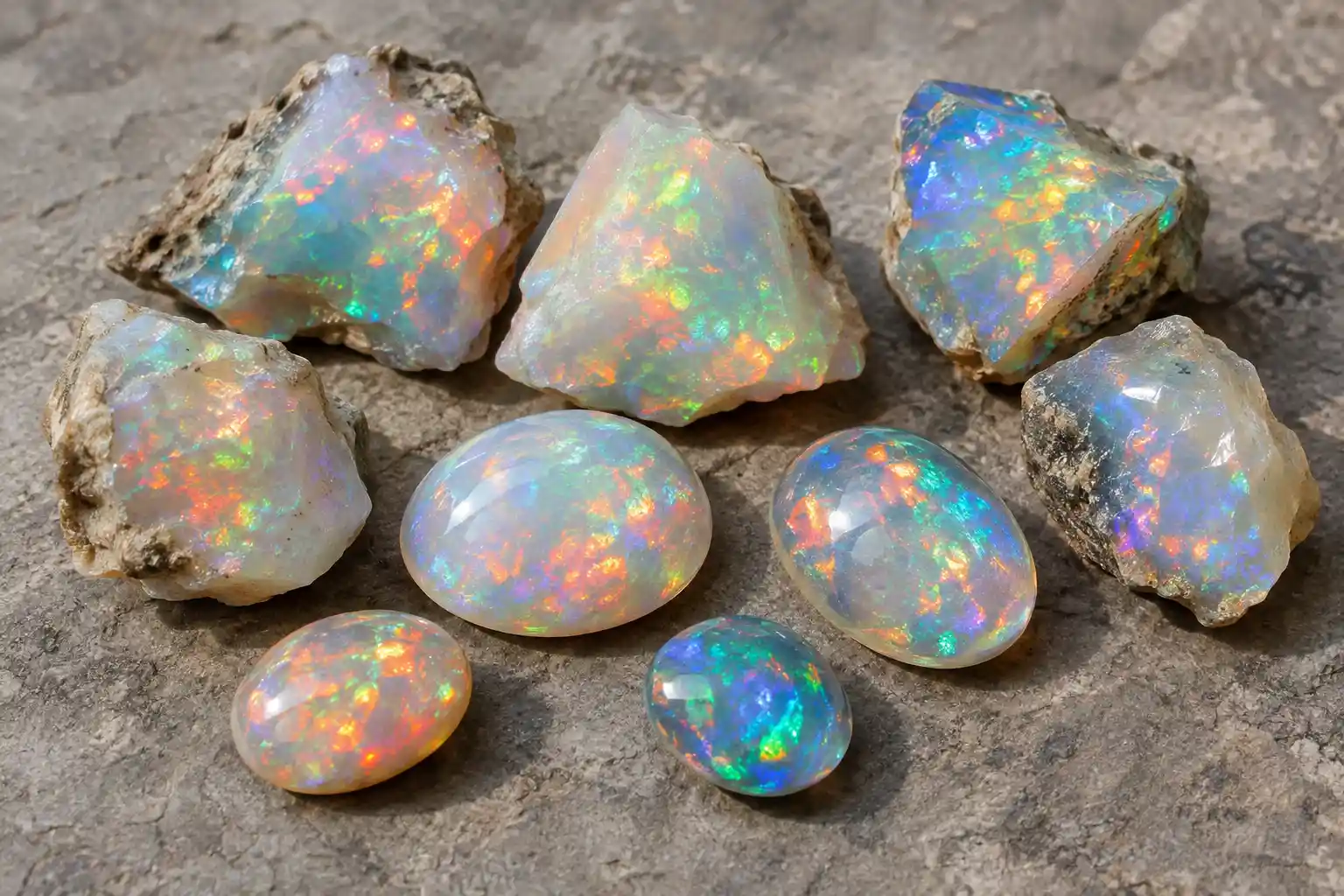
Ethiopian Opal benefits begin with extraordinary play-of-color, wide pattern variety, attractive white-to-transparent body tones, unusual hydrophane behavior, lapidary versatility, and geological interest. Precious opal is a hydrated form of silica rather than a conventional crystalline gemstone, and its famous flashes of spectral color arise when light interacts with an orderly internal arrangement of microscopic silica spheres. Ethiopian deposits have produced opals capable of showing red, orange, yellow, green, blue, violet, and combinations that can move dramatically across the surface as the stone or light source changes position.
Many Ethiopian opals, particularly stones associated with Wollo, are hydrophane. This means the opal is porous enough to absorb water relatively readily. Water uptake can temporarily change transparency, body appearance, or the visibility of play-of-color, and the stone may require time to return to its normal appearance after drying. Hydrophane behavior is one of the most important Ethiopian Opal benefits for gemological study because it distinguishes much of this opal from less porous varieties, but the same property also creates care considerations involving prolonged soaking, dyes, oils, cosmetics, and unpredictable stability.
These verified features already give Ethiopian Opal benefits considerable depth. Modern crystal traditions may additionally connect Ethiopian Opal with creativity, hope, emotional expression, transformation, or inspiration. Such meanings can serve as personal symbolism, but opal does not medically improve eyesight, fertility, hormonal function, mood disorders, immunity, or neurological health through ordinary wearing or handling.
9 Ethiopian Opal Benefits at a Glance
- Vivid play-of-color can display multiple spectral colors across a single polished gemstone.
- Hydrophane behavior provides an unusual opportunity to study porosity and water interaction in opal.
- White, transparent, translucent, brown, and other body appearances create substantial visual variety.
- Diverse patterns give collectors and jewelry buyers highly individual stones rather than uniform-looking gems.
- Cabochon cutting can preserve large areas of play-of-color and make efficient use of irregular rough.
- Volcanic geological origin adds important mineralogical and gemological interest.
- Identification teaches buyers about natural opal, hydrophane behavior, dyeing, impregnation, and treatment disclosure.
- Jewelry designers gain access to bright color effects without requiring a highly saturated body color.
- Modern symbolism can represent creativity, adaptability, or hope when kept separate from medical claims.
Vivid Play-of-Color Is the Most Important Ethiopian Opal Benefit
Play-of-color is responsible for much of Ethiopian Opal’s appeal. Unlike an ordinary body color that remains relatively constant across a gemstone, precious opal can produce shifting patches, flashes, pinpoints, bands, or larger areas of spectral color as illumination and viewing angle change. Red and orange flashes can appear beside green, blue, and violet within the same cabochon, while some stones show one dominant color and others display a complete rainbow effect.
The phenomenon is structural rather than pigment-based. When silica spheres are arranged with sufficient regularity, their spacing interacts with visible light and separates certain wavelengths according to viewing geometry. This is why a stone’s brightest colors can appear, disappear, or change position as it moves. Fine play-of-color depends not only on which colors are present but also on brightness, coverage, pattern, contrast, and how easily the effect becomes visible under ordinary lighting.
These Ethiopian Opal benefits make the gemstone unusually interactive. A static photograph can never capture every face-up appearance because movement is part of the visual experience. Someone evaluating Ethiopian Opal quality should therefore consider the stone in motion under several realistic light sources rather than judging it from one highly controlled image.
Hydrophane Behavior Makes Ethiopian Opal Gemologically Fascinating
Hydrophane character is one of the most distinctive Ethiopian Opal benefits. Many Wollo opals contain enough connected porosity to absorb water. When immersed, an opaque or translucent stone may temporarily become more transparent, and the appearance of play-of-color can weaken, shift, or become difficult to see until the opal dries again.
This property is scientifically interesting because it demonstrates how pore spaces within opal influence optical behavior. It also explains why hydrophane opal requires care that differs from many conventional gemstones. Prolonged soaking is unnecessary, and liquids other than clean water deserve even greater caution because porous opal may absorb substances that stain or otherwise alter appearance.
Hydrophane does not mean every Ethiopian opal reacts identically. Porosity varies, and some stones absorb water faster or show more dramatic changes than others. Not every Ethiopian opal is hydrophane, either, so geographic origin alone should not be treated as proof of one exact response.
These differences make testing and seller disclosure useful. A buyer who understands hydrophane behavior is less likely to mistake a temporary post-water appearance change for permanent damage, while also recognizing that repeated soaking is not a sensible care method.
Pattern Diversity Gives Collectors an Enormous Range of Visual Choices
Another major source of Ethiopian Opal benefits is pattern diversity. Fine stones can show pinfire, broad flashes, rolling areas of color, mosaic-like arrangements, honeycomb-like effects, digit patterns, and other visually complex structures. Some patterns are sharply defined, while others appear to move more freely across translucent or transparent body opal.
Digit patterns are particularly associated with Ethiopian opal and can appear as finger-like or columnar areas of precious opal extending through common opal. Cutting direction strongly influences whether these internal structures become obvious in the finished stone.
Collectors therefore have far more to evaluate than simple body color. Two white Ethiopian opals of similar dimensions can look completely unrelated once the distribution, brightness, color range, pattern, transparency, and directionality of play-of-color are compared.
This individuality is one of the most practical Ethiopian Opal benefits because buyers can choose stones according to personal visual preference rather than one universal ideal. A tightly organized pattern may appeal to one collector, while another may prefer large unpredictable flashes that change dramatically with movement.
White, Crystal, and Brown Body Opals Offer Different Visual Experiences
Ethiopian deposits have produced opal with several body appearances, including white, nearly colorless transparent or translucent crystal opal, brown to reddish-brown stones, and less common darker examples. Play-of-color interacts differently with each body type.
White opal can provide a soft luminous background that supports bright flashes without creating extreme contrast. Transparent or highly translucent crystal opal may make the color appear suspended within the stone, allowing patterns to reveal themselves at different depths. Brown or darker opal can create stronger contrast with bright spectral flashes, producing a very different visual character.
This range increases Ethiopian Opal benefits for both collecting and jewelry design because buyers are not restricted to one familiar look. A delicate pendant may benefit from luminous white opal, while a dramatic ring may use a darker body tone to emphasize orange, red, and green flashes.
Body color should still be evaluated carefully because hydrophane opal can accept dyes. Unusual or unusually saturated colors deserve proper treatment disclosure rather than automatic assumptions about natural origin.
Cabochon Cutting Makes Excellent Use of Ethiopian Opal’s Optical Structure
Most precious opal is cut as a cabochon because a smooth domed surface can display play-of-color effectively while preserving more weight than many faceted designs. Ethiopian Opal benefits particularly from this approach because rough pieces often contain irregular color zones, internal structures, or directional patterning that a skilled cutter can orient toward the face of the finished stone.
The cutter may remove potch, cracks, unstable edges, or weakly colored areas while preserving the section with the best combination of pattern and brightness. Dome height also matters. A high dome can produce attractive depth but may retain excess weight, while a very shallow cabochon can increase vulnerability or reduce visual impact depending on the rough.
Some transparent Ethiopian opals are faceted, but faceting changes the visual experience. Reflections from facet surfaces compete with internal play-of-color, creating a different effect from the soft continuous face of a cabochon. Neither style is universally superior.
These lapidary Ethiopian Opal benefits demonstrate why cutting is interpretive. The opal already contains the optical structure, but orientation determines how much of that hidden display reaches the viewer.
Volcanic Formation Adds Geological Depth to Ethiopian Opal
Ethiopian Opal benefits also extend into geology because important deposits occur in volcanic settings. Silica-rich fluids move through porous volcanic rocks, cavities, fractures, and altered zones, eventually depositing opal under suitable conditions. This differs from the geological setting of many famous Australian opals, which developed primarily in sedimentary environments.
Understanding these contrasting origins helps explain why the word opal describes gemstones that can share similar optical phenomena while forming in substantially different settings. Ethiopian opal frequently shows characteristics associated with opal-CT and volcanic formation, while individual deposits can differ in body color, inclusions, porosity, and stability.
Early Ethiopian production from the Shewa region became known for certain brown or chocolate-colored opals, while later discoveries in Wollo brought large quantities of attractive white, crystal, and other precious opal into international gem markets. These distinct occurrences should not be treated as though every Ethiopian opal has identical geology or physical behavior.
For collectors, locality adds context to appearance. The gemstone becomes more interesting when color and pattern can be connected with a real volcanic environment rather than viewed only as decoration.
Identification and Treatment Awareness Protect Ethiopian Opal Buyers
Hydrophane porosity creates both beauty and vulnerability to treatment, making identification one of the most practical Ethiopian Opal benefits. Porous stones can absorb dyes, allowing sellers to create colors that may not be natural. Impregnation or other enhancements may also change stability, transparency, or surface appearance.
A vivid purple, blue, pink, or otherwise unusual Ethiopian opal should therefore be evaluated carefully. Color concentrations around pits, scratches, fractures, or porous areas may raise questions, although professional gemological testing provides a stronger basis for identification than simple visual assumptions.
Natural opal can also be confused with synthetic opal or assembled products. Doublets and triplets combine thin opal layers with backing or protective caps, while synthetic products can reproduce convincing play-of-color patterns. None of these categories is inherently unusable when disclosed accurately, but identity matters because durability, care, rarity, and value can differ considerably.
Someone preparing to buy Ethiopian Opal should prioritize actual photographs, play-of-color videos, hydrophane disclosure when known, treatment information, dimensions, body appearance, crack condition, and realistic seller descriptions.
Ethiopian Opal Jewelry Can Be Spectacular When the Setting Respects the Gem
Opal has a Mohs hardness around 5 to 6.5 and can scratch more easily than quartz, sapphire, or diamond. Ethiopian opal additionally requires consideration of hydrophane behavior, internal fractures, and potential crazing. These facts do not prevent jewelry use, but they make thoughtful design one of the essential Ethiopian Opal benefits.
Earrings and pendants provide relatively protected environments because they encounter fewer direct impacts. Rings can be worn successfully when settings shield the edges and when the wearer accepts that opal requires more care than harder gems. Bezel settings can offer useful protection, although every design should also allow future inspection and cleaning.
Jewelry should generally be removed before swimming, bathing, dishwashing, applying oils or cosmetics, or working with household chemicals. Prolonged water exposure is especially unnecessary for hydrophane opal because absorption can change appearance and may create unpredictable stress in some stones.
Storage away from harder gemstones helps prevent scratching. Responsible use preserves the visual Ethiopian Opal benefits of play-of-color, polish, pattern, and translucency without pretending the gem is built for unrestricted abuse.
Modern Symbolism Can Represent Creativity, Adaptability, and Hope
Modern spiritual culture commonly associates Ethiopian Opal benefits with creativity, inspiration, emotional expression, transformation, hope, and personal change. Several of these themes are visually understandable because the stone’s play-of-color changes continuously with movement while hydrophane specimens can alter appearance even more dramatically after absorbing water.
Adaptability becomes a particularly natural metaphor. The gem can look different under changing circumstances without becoming a different substance. A person may therefore use Ethiopian Opal as a symbol of adjusting to new conditions while keeping important values intact.
Creativity is another reasonable personal association because one opal can present an extraordinary combination of colors and patterns that appears different from every angle. Artists, writers, or designers may simply enjoy the stone as a visual reminder to consider more than one possibility.
Beliefs involving Ethiopian Opal healing properties may extend into emotional healing, fertility, eyesight, hormonal balance, or energetic transformation. These interpretations belong to spiritual practice rather than established clinical medicine.
Responsible Care Is Essential for Hydrophane Ethiopian Opal
Care is one of the most important limits to understand. Hydrophane Ethiopian opal should not be routinely soaked in water to make it appear transparent or to test its behavior for entertainment. Water absorption can temporarily change appearance, and drying may take considerable time depending on porosity and stone size. Some opals may also be vulnerable to cracking or crazing, and predicting individual stability is difficult.
Oils, perfume, lotion, dyes, dirty water, household chemicals, and cleaning solutions deserve particular caution because a porous opal may absorb substances that are harder to remove than clean water. Steam cleaners and ultrasonic machines are poor default choices for opal jewelry, especially when internal condition or treatment history is uncertain.
If an Ethiopian opal becomes wet, allowing it to dry naturally at normal room conditions is generally more sensible than applying direct heat. Hair dryers, radiators, ovens, hot sunlight, and other attempts to accelerate drying can introduce unnecessary thermal stress.
These limits do not reduce Ethiopian Opal benefits. They simply reflect the unusual porous structure that makes many Ethiopian stones gemologically fascinating in the first place.
Conclusion
Ethiopian Opal benefits include extraordinary play-of-color, hydrophane behavior, varied body appearances, diverse patterns, skilled lapidary possibilities, volcanic geological interest, identification value, jewelry versatility, and meaningful modern symbolism. The gem’s porosity makes it particularly distinctive because water can temporarily alter transparency and play-of-color in ways not normally encountered with conventional crystalline gemstones.
The strongest Ethiopian Opal benefits come from appreciating that complexity rather than treating every stone as identical. Careful buying, treatment disclosure, realistic assessment of stability, protective settings, and avoidance of unnecessary soaking help preserve the gem. Modern symbolism involving creativity, hope, adaptability, or transformation can add personal meaning when it remains separate from medical claims.
FAQs
What are the main Ethiopian Opal benefits?
The most verifiable Ethiopian Opal benefits include vivid play-of-color, pattern variety, collecting, jewelry use, volcanic geological study, hydrophane behavior, gem identification, and lapidary interest.
What makes Ethiopian Opal special?
Many Ethiopian opals combine strong play-of-color with hydrophane porosity, meaning they can absorb water and temporarily change transparency or optical appearance.
Is all Ethiopian Opal hydrophane?
No. Hydrophane behavior is very common in important Ethiopian opal production, particularly from Wollo, but not every Ethiopian opal has identical porosity.
Why does Ethiopian Opal change when wet?
Hydrophane opal contains interconnected pore spaces that can absorb water. The water changes how light moves through those pores, temporarily altering transparency and sometimes the appearance of play-of-color.
Is Ethiopian Opal suitable for jewelry?
Yes, but it requires more care than harder and less porous gemstones. Protected settings, avoidance of prolonged soaking, and gentle handling are important.
Can Ethiopian Opal be dyed?
Yes. Hydrophane porosity can allow dye to enter the stone, which is why unusually colored opals require appropriate treatment disclosure.
What creates play-of-color in Ethiopian Opal?
Play-of-color develops when visible light interacts with sufficiently ordered microscopic silica spheres inside precious opal, producing shifting spectral colors.
Should Ethiopian Opal be soaked in water?
Routine soaking is unnecessary and is not recommended as a normal care practice. Hydrophane opal can change appearance when wet, and stability varies between stones.
Does Ethiopian Opal have healing benefits?
There is no established clinical evidence that Ethiopian Opal treats eyesight, fertility, hormonal conditions, anxiety, depression, or other medical concerns.
Ethiopian Opal benefits described as healing, emotional, fertility-related, creative, transformative, chakra, or energetic effects remain spiritual and personal beliefs and should not replace qualified medical or mental-health care.