7 Popular Lab Diamond Benefits: Helpful Traditions, Verified Facts & Important Cautions
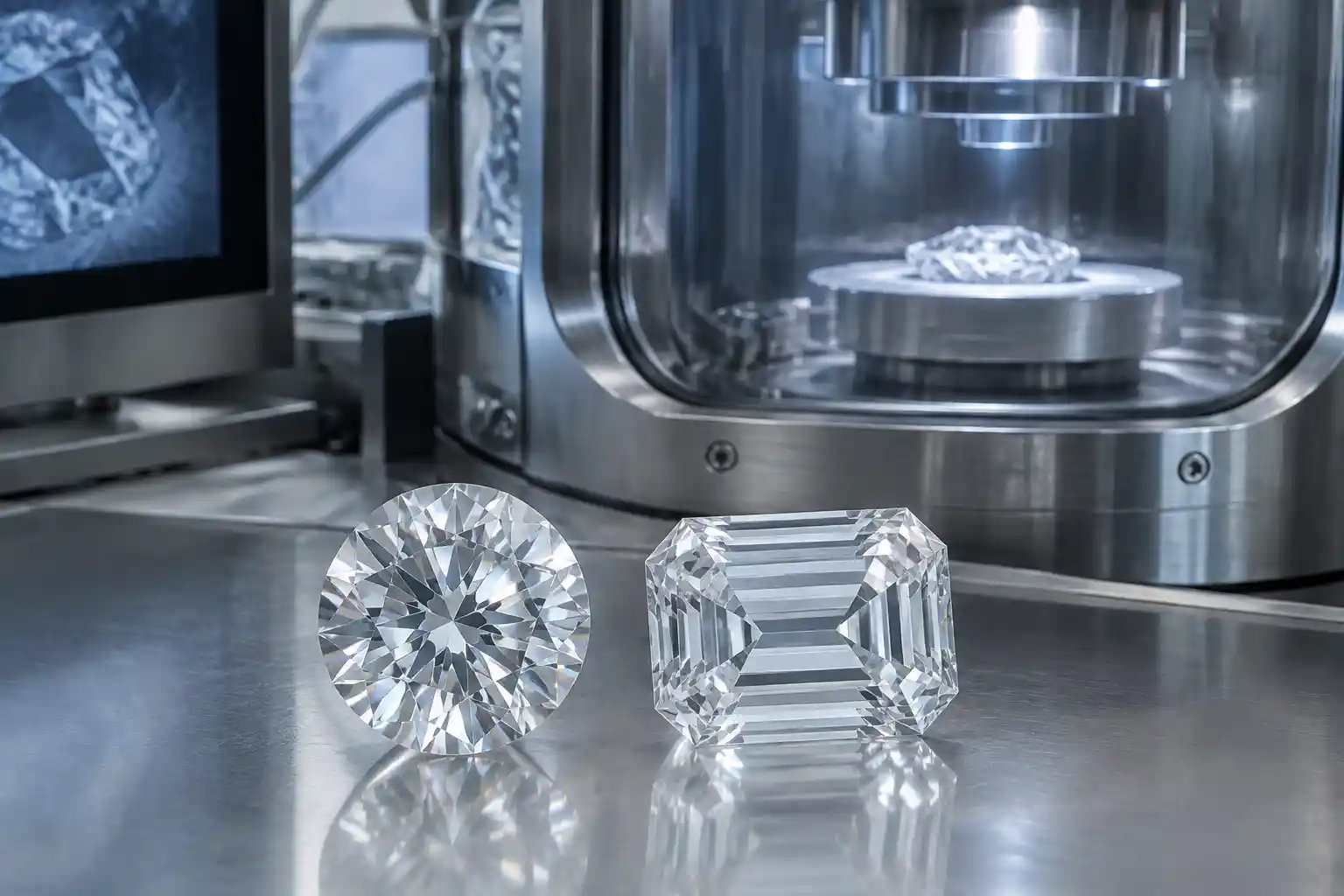
Lab Diamond benefits begin with the most important scientific point: a laboratory-grown diamond is diamond. It consists predominantly of carbon arranged in the diamond crystal structure and has essentially the same fundamental chemical, physical, and optical properties as natural diamond. Laboratory-grown diamonds are therefore fundamentally different from cubic zirconia, moissanite, glass, or other diamond simulants, which may resemble diamond visually but are different substances.
Two principal production methods dominate modern laboratory-grown diamond manufacturing. High Pressure High Temperature, usually abbreviated HPHT, recreates conditions that allow diamond to crystallize from carbon under extreme pressure and heat, while Chemical Vapor Deposition, or CVD, grows diamond layer by layer from carbon-containing gas under carefully controlled conditions. Both methods can produce gem-quality diamonds suitable for fine jewelry, and post-growth treatment may sometimes be used to modify color or other characteristics.
The strongest Lab Diamond benefits include genuine diamond hardness, familiar brilliance and dispersion, the availability of larger high-quality stones at prices generally lower than comparable natural diamonds, clear disclosure of manufactured origin, and access to sophisticated laboratory identification. Important cautions remain. Laboratory-grown diamonds usually have very different resale economics from natural diamonds, environmental claims depend heavily on energy source and production conditions, and the word diamond should be accompanied clearly by laboratory-grown or equivalent wording so buyers understand the origin.
7 Lab Diamond Benefits at a Glance
- Laboratory-grown diamonds have essentially the same diamond crystal structure and core physical properties as natural diamonds.
- Mohs hardness 10 gives them the exceptional scratch resistance expected from diamond jewelry.
- High refractive index and strong dispersion provide the familiar brilliance and colored fire associated with diamond.
- Manufacturing can make larger or higher apparent quality combinations more financially accessible than comparable natural diamonds.
- HPHT and CVD growth methods provide known technological origins that can be identified by specialist laboratories.
- Modern gemological testing can distinguish laboratory-grown diamonds from natural diamonds and evaluate quality characteristics.
- Buyers can choose laboratory-grown origin deliberately while considering price behavior, sustainability evidence, disclosure, treatments, and long-term expectations.
Lab-Grown Diamonds Have the Fundamental Properties of Diamond
The most important Lab Diamond benefits come from composition and structure. Laboratory-grown diamonds are not coatings applied to another stone and are not substitutes whose only similarity is appearance. Carbon atoms are arranged within the diamond lattice, producing the extreme hardness, high refractive index, thermal conductivity, and other physical characteristics associated with diamond.
This is why ordinary visual inspection may not distinguish a well-grown laboratory diamond from a natural diamond. Traditional diamond testers based only on thermal conductivity can also identify both as diamond because both possess the relevant physical property. More sophisticated laboratory instrumentation is required to determine growth origin reliably.
The distinction therefore concerns origin rather than whether the stone is chemically diamond. A natural diamond formed through geological processes deep within Earth, while a laboratory-grown diamond developed in a manufactured growth environment.
Someone preparing to buy a Lab Diamond should understand this distinction clearly because it prevents two opposite mistakes: describing laboratory-grown diamonds as fake, or failing to disclose that they were manufactured rather than mined.
Mohs Hardness 10 Gives Lab Diamonds Exceptional Scratch Resistance
Diamond defines the top of the traditional Mohs hardness scale, and laboratory-grown diamond shares that characteristic because hardness arises from the carbon crystal structure rather than the geological location in which the crystal formed. This gives Lab Diamond benefits substantial practical value for engagement rings, wedding jewelry, earrings, pendants, bracelets, and other pieces expected to retain polish during regular wear.
Hardness does not mean indestructibility. Diamond has cleavage and can chip after a sufficiently strong impact, particularly at exposed corners, pointed shapes, thin girdles, or existing fractures. A hard blow against metal, stone, tile, or another diamond can therefore cause damage even when ordinary scratching would not.
This distinction matters because diamond is exceptionally scratch resistant but not infinitely tough. Protective settings, sensible wear, and periodic inspection of prongs remain valuable for both laboratory-grown and natural diamonds.
The manufactured origin does not reduce the need for ordinary diamond care because the relevant physical structure remains diamond.
Optical Performance Can Match the Familiar Appearance of Natural Diamond
Laboratory-grown diamond possesses the high refractive index and dispersion responsible for the brightness, contrast, scintillation, and colored fire people associate with polished diamond. Once the rough is cut, optical performance depends heavily on proportions, symmetry, polish, facet arrangement, shape, and the interaction of the finished stone with light.
This means Lab Diamond benefits cannot be judged from carat weight or growth method alone. A well-cut one-carat stone can look more lively than a poorly proportioned larger diamond, while two CVD stones of similar weight can perform very differently if one has stronger cutting quality.
Round brilliants are designed to emphasize light return and scintillation, while emerald, oval, pear, radiant, cushion, marquise, and other shapes create distinct visual personalities. Laboratory growth does not eliminate the importance of cut.
When evaluating Lab Diamond quality, face-up performance, transparency, finish, color, clarity, proportions, and personal preference should be considered together rather than assuming all laboratory-grown diamonds look identical.
Larger Diamond Sizes Can Become More Financially Accessible
One of the most commercially important Lab Diamond benefits is the ability to obtain a larger or higher-specification diamond for a given jewelry budget compared with many equivalent natural-diamond options. Manufacturing has expanded supply substantially, particularly in commonly desired colorless and near-colorless ranges.
This can give a buyer more freedom to prioritize size, shape, cut, or setting design without allocating the same amount required for a comparably described natural diamond. Someone who values visible face-up size may therefore choose a larger laboratory-grown center stone, while another buyer may use the price difference to select a more elaborate setting or simply spend less.
The financial advantage should be considered together with resale expectations. Laboratory-grown diamond prices have experienced substantial downward pressure as manufacturing capacity and efficiency increased, and replacement-market pricing may change more quickly than buyers expect.
Understanding Lab Diamond price is therefore important before interpreting a lower purchase price as guaranteed retained value. Affordability at purchase and resale performance are separate questions.
HPHT and CVD Provide Distinct, Knowable Growth Origins
Laboratory-grown diamonds are produced mainly by HPHT or CVD processes. HPHT uses extreme pressure and temperature with a growth environment that allows carbon to crystallize as diamond, while CVD generally grows diamond from a carbon-containing gas onto a diamond seed under low-pressure conditions.
These technologies create Lab Diamond benefits for anyone interested in modern gem science because the growth origin can leave characteristic internal, spectroscopic, fluorescence, strain, or growth-pattern features detectable with specialized equipment. Post-growth treatment can also sometimes alter color, creating additional information for laboratories to identify.
Neither method automatically guarantees superior beauty. Excellent and mediocre diamonds can be produced through both processes, and the finished gem should be evaluated on its actual characteristics.
Growth method matters scientifically and may matter to an individual buyer, but it should not become a shortcut replacing examination of cut, color, clarity, transparency, treatment, and overall appearance.
Specialist Laboratories Can Reliably Identify Laboratory-Grown Origin
Advanced gem laboratories can distinguish laboratory-grown diamonds from natural diamonds even when the stones appear identical to ordinary observation. Differences in growth structures, defects, fluorescence behavior, spectroscopy, and other features provide evidence of origin that specialized instruments can detect.
This identification ability is an important Lab Diamond benefit because transparent disclosure allows natural and laboratory-grown markets to coexist without requiring one product to masquerade as the other. Reputable laboratory documentation can confirm that a stone is laboratory-grown and may also identify whether it was produced by HPHT or CVD methods and whether evidence of post-growth treatment is present.
Current GIA service for qualifying colorless to near-colorless laboratory-grown diamonds uses an overall descriptive quality assessment rather than simply reproducing its natural-diamond grading system. Other laboratories may use different reporting formats, so buyers should understand which organization issued a document and what its terminology actually means.
A report is also different from an appraisal. Identification and quality assessment describe the gem, while monetary value changes with the market.
Clear Origin Disclosure Helps Buyers Make an Informed Choice
Responsible disclosure is central to Lab Diamond benefits. A laboratory-grown diamond should be described clearly with wording such as laboratory-grown or laboratory-created so the buyer understands that it was manufactured rather than mined. Calling the stone simply a diamond without making origin clear can create confusion even though the substance itself is diamond.
The same clarity matters when distinguishing laboratory-grown diamonds from simulants. Cubic zirconia and moissanite are not laboratory-grown diamonds because they have different chemical compositions and crystal structures. A laboratory-created simulant and a laboratory-grown diamond are therefore completely different product categories.
Transparency also extends to treatments. Post-growth processes may be used to improve or modify color in some laboratory-grown diamonds, and reputable documentation should disclose relevant findings where laboratory examination detects them.
Clear terminology allows buyers to choose according to their own priorities rather than having the origin hidden or exaggerated.
Sustainability Claims Need Evidence Rather Than Assumptions
Environmental messaging often appears among claimed Lab Diamond benefits, but laboratory origin does not automatically prove that one stone has a lower environmental impact than every natural diamond. Energy use can be substantial during diamond growth, particularly when electricity sources depend heavily on fossil fuels, while factories using lower-carbon electricity can present a different emissions profile.
Natural-diamond mining has its own land, energy, water, waste, and social considerations, and impacts vary across mines and regions. A meaningful comparison therefore requires specific information rather than a universal statement that one origin is always environmentally superior.
Buyers interested in sustainability can look for credible energy disclosures, independently supported environmental reporting, manufacturing location, power source, recycling practices, and supply-chain information. Marketing phrases such as eco-friendly or sustainable are more useful when backed by measurable evidence.
This is an area where origin alone provides less information than many advertisements imply.
Lab Diamonds Can Carry Modern Relationship Symbolism Without Ancient Traditions
Diamond symbolism involving commitment, durability, love, and celebration developed around natural diamond jewelry long before laboratory-grown stones became commercially significant. Laboratory-grown diamonds can now carry the same personal symbolism because the meaning of an engagement ring or anniversary gift often comes from the relationship, promise, and memory attached to the object.
Lab Diamond benefits therefore include the freedom to participate in familiar diamond jewelry traditions without claiming that laboratory-grown diamonds have an ancient cultural history of their own. A CVD or HPHT diamond is a modern technological product, so narratives describing ancient societies using laboratory-grown diamonds are obviously impossible.
A couple may choose one because they prioritize size, price, manufactured origin, or technology, while another couple may prefer natural geological origin. Neither preference determines the emotional seriousness of the relationship.
Symbolism belongs to people and context, not to a growth chamber or mine alone.
Resale Economics Are an Important Caution
Laboratory-grown diamond pricing has changed rapidly as production technology improved and supply increased. This creates attractive purchase opportunities but also means buyers should be careful about expectations of resale value.
A retailer’s original selling price includes manufacturing, grading, cutting, distribution, marketing, setting, and profit margins, while secondhand buyers evaluate what comparable stones cost in the current market. If new laboratory-grown diamond prices decline, used stones face corresponding pressure.
This does not eliminate Lab Diamond benefits for someone buying primarily to wear and enjoy the jewelry. Many consumer products and luxury goods are purchased for use rather than investment.
The important point is expectation. A lower initial price can be a real advantage, while long-term retained value should not be assumed to behave like a savings account or guaranteed investment.
Responsible Care Is Similar to Natural Diamond Care
Because laboratory-grown diamonds share diamond’s fundamental physical properties, ordinary care resembles that recommended for natural diamond. Warm water, mild soap, and gentle brushing are suitable for many untreated stones and ordinary settings, while periodic jewelry inspection helps identify loose prongs or worn metal before a stone is lost.
Diamonds can scratch other gemstones and other diamonds, so loose pieces should be separated during storage. Strong impact can chip a diamond despite its hardness, particularly around pointed corners or vulnerable girdles.
Heat and chemicals may also affect certain treatments or the surrounding jewelry even when the diamond itself is stable. Cleaning recommendations should therefore consider the entire piece, including metal, solder, coatings, accent stones, and any identified treatment.
Conclusion
Lab Diamond benefits include genuine diamond chemistry and structure, Mohs hardness 10, familiar brilliance and dispersion, access to larger stones within many budgets, sophisticated HPHT and CVD growth technology, reliable laboratory identification, and transparent choice of manufactured origin.
The strongest Lab Diamond benefits become clear when advantages and cautions are considered together. Laboratory-grown diamonds are real diamonds, but they are not mined diamonds and should be disclosed accordingly. Price accessibility can be significant, while resale expectations, environmental claims, treatment history, documentation, and actual cutting quality still deserve careful evaluation.
FAQs
What are the main Lab Diamond benefits?
The main Lab Diamond benefits include genuine diamond physical properties, exceptional scratch resistance, strong optical performance, availability across a wide range of sizes and shapes, and lower purchase prices than many comparable natural diamonds. Buyers also benefit from laboratory identification of growth origin, while resale expectations, sustainability claims, and disclosure should be evaluated separately rather than assumed from the word laboratory-grown alone.
Are lab-grown diamonds real diamonds?
Yes. A laboratory-grown diamond has essentially the same diamond crystal structure and fundamental chemical, physical, and optical properties as a natural diamond. The difference is origin: natural diamonds formed through geological processes, while laboratory-grown diamonds are created using manufacturing techniques such as HPHT or CVD.
Are lab diamonds the same as cubic zirconia or moissanite?
No. Cubic zirconia and moissanite are diamond simulants with different chemical compositions, crystal structures, hardness values, refractive properties, and other physical characteristics. A laboratory-grown diamond is crystallized diamond, while a simulant merely resembles diamond visually.
Are lab diamonds as hard as natural diamonds?
Yes. Laboratory-grown diamonds have Mohs hardness 10 because hardness comes from the diamond crystal lattice rather than whether the crystal formed underground or in a manufacturing facility. They can still chip along vulnerable areas after severe impact, so hardness should not be confused with complete resistance to breakage.
Which is better, HPHT or CVD?
Neither growth method is automatically better for every buyer. Both HPHT and CVD can produce attractive high-quality diamonds, while individual stones differ in color, clarity, transparency, growth features, treatment history, and cut. Evaluating the finished diamond is more useful than assuming one manufacturing method guarantees superior beauty.
Can a jeweler tell a lab diamond from a natural diamond by looking at it?
Usually not through ordinary visual inspection alone. Laboratory-grown and natural diamonds can be extremely similar in appearance and basic gemological behavior, so advanced screening and spectroscopic equipment are used by professional laboratories to determine growth origin reliably.
Do lab diamonds come with grading or quality reports?
Yes, laboratory-grown diamonds can be submitted to major gemological laboratories for identification and quality assessment. Reporting systems vary among laboratories, and the terminology used for laboratory-grown diamonds may differ from the language applied to natural diamonds, so buyers should read the actual document rather than assuming every report follows the same format.
Are lab diamonds more environmentally friendly?
Not automatically. Environmental impact depends on electricity source, manufacturing efficiency, production location, equipment, and other factors, while natural-diamond mining has its own variable environmental footprint. Claims that a particular laboratory-grown diamond is environmentally preferable are more meaningful when supported by specific energy and emissions information.
Do lab diamonds hold their value?
Laboratory-grown diamonds can have limited and uncertain resale value, and their prices have faced strong downward pressure as production has become more efficient and supply has expanded. A buyer can still receive excellent wearing value from the jewelry, but purchase affordability should not be confused with guaranteed financial appreciation or predictable resale performance.
Can lab diamonds be used for engagement rings?
Yes. Laboratory-grown diamonds have the hardness, brilliance, durability, and range of shapes needed for engagement rings and other frequently worn jewelry. A couple may choose one for size, price, technology, or manufactured origin, while the emotional meaning of the ring comes from the relationship and commitment rather than the geological or laboratory origin of the center stone.
Are lab diamonds treated?
Some laboratory-grown diamonds receive post-growth treatment to modify color or improve appearance, while others do not. Advanced gemological examination can often identify evidence of growth method and treatment, which is why laboratory documentation and clear seller disclosure are useful when purchasing a significant stone.
Do lab diamonds have healing powers?
There is no established clinical evidence that laboratory-grown diamonds treat illness, emotional disorders, pain, anxiety, or other physical or mental-health concerns. Lab Diamond benefits are practical, gemological, technological, financial, and personal rather than medical, while any symbolic meaning attached to diamond jewelry reflects human tradition and individual experience.