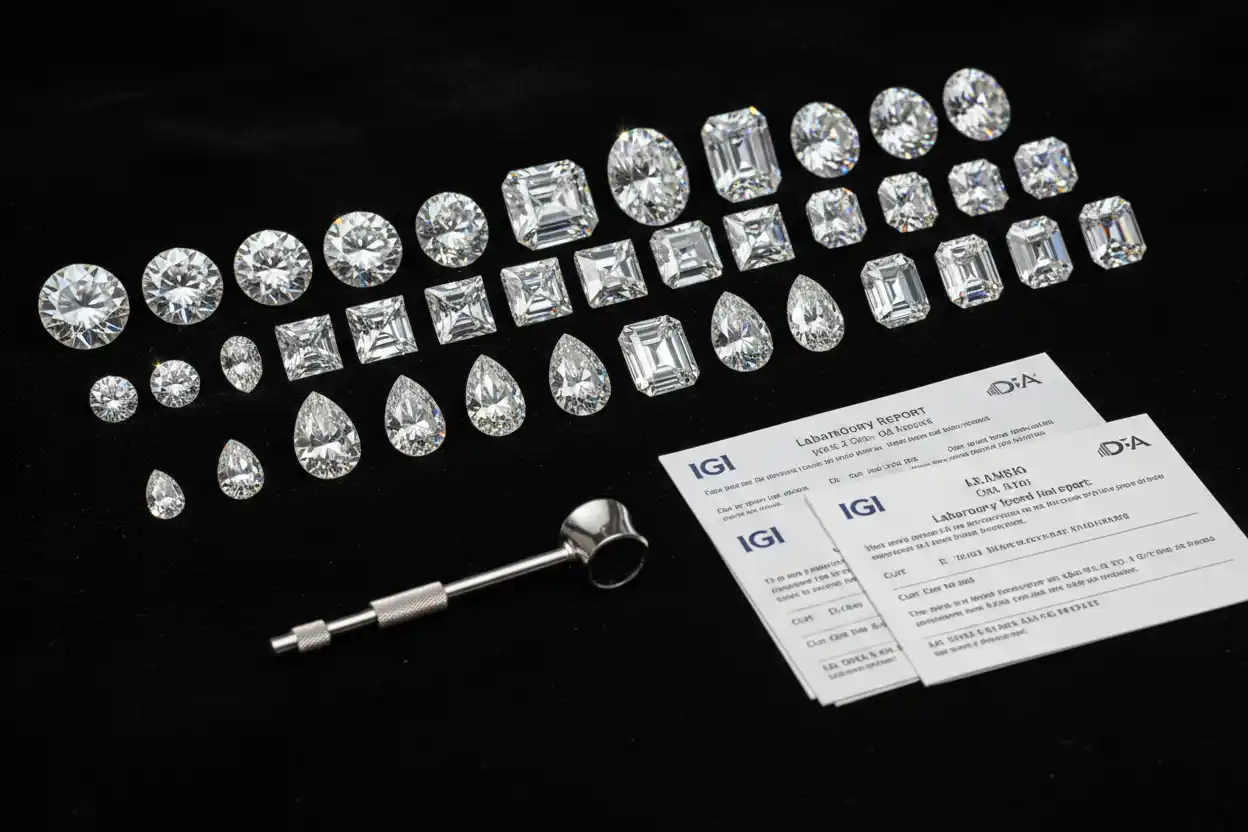
Lab Diamond Price: Value Benchmarks, Rarity, Demand & Treatments
Lab diamond price is shaped by a manufactured supply chain in which size, cutting, color, clarity, shape, growth method, post-growth treatment, documentation, brand, retail competition, setting quality, and seller services all influence what a consumer pays. Laboratory-grown diamonds share diamond’s fundamental material properties, but their crystals are produced through HPHT or CVD growth rather than extracted from geological deposits. This changes the economics of scarcity because manufacturers can expand capacity, improve growth recipes, use larger substrates, reduce production defects, and apply post-growth processing as technology advances. GIA research documents dramatic increases in the size and quality of laboratory-grown diamonds over time, including a shift from early small CVD stones toward much larger modern production.
The reporting system has changed as well. Since October 1, 2025, GIA has classified qualifying colorless-to-near-colorless laboratory-grown diamonds as Premium or Standard under its Laboratory-Grown Diamond Quality Assessment rather than applying the previous GIA lab-grown grading framework. This means current lab diamond price comparisons must account for report date and laboratory system instead of treating every D, E, VVS, VS, Premium, or Standard label as though it came from one unchanged framework. Anyone actively shopping should first review the Gems Lore buy lab diamond guide and then compare genuinely similar stones.
Lab Diamond Price At a Glance
| Price Factor | Stronger Value Signals | Factors That Can Lower Price |
|---|---|---|
| Identity | Verified laboratory-grown diamond | Unverified stone or simulant confusion |
| GIA Assessment | Premium or strong Standard stone | Stone outside qualifying criteria or unclear documentation |
| Cut | Excellent light performance and proportion | Windowing, extinction, bow tie, excess depth |
| Shape | Well-executed desirable shape | Poor outline or less desirable facet pattern |
| Carat Weight | Larger size with quality maintained | Extra weight hidden below girdle |
| Face-Up Spread | Efficient visible dimensions | Small appearance for weight |
| Color | Colorless or attractive near-colorless face-up appearance | Unwanted yellow, gray, brown, or other tint |
| Clarity | Eye-clean appearance | Visible inclusions or growth features |
| Post-Growth Processing | Transparent disclosure | Ambiguous or concealed processing |
| Report | Reputable and independently verifiable | Unrecognized, copied, or mismatched document |
| Brand | Genuine craftsmanship and service | Prestige markup without added product value |
| Setting | Durable metalwork and finishing | Weak mounting or inflated setting price |
| Retail Competition | Competitive comparable inventory | Excess markup for readily available specifications |
| Resale Liquidity | Clear realistic secondary-market expectations | Assumption that retail equals future cash value |
Manufacturing Supply Changes the Meaning of Rarity
Natural diamond scarcity begins with geology. Laboratory-grown diamond scarcity begins with production capability. Manufacturers can add reactors, improve seed preparation, refine gas chemistry, increase growth rates, use larger substrates, and apply post-growth annealing to raise output or improve appearance.
GIA’s laboratory data show how rapidly that capability has changed. CVD submissions that were once typically below half a carat have expanded dramatically in size, and the majority of modern CVD submissions now exceed sizes that were exceptional in earlier production eras. GIA also reports that colorless HPHT-grown material became much more common as producers improved their ability to control nitrogen and other impurities.
This means a large, high-clarity laboratory-grown diamond can remain beautiful and technologically impressive without carrying the same geological rarity as an equivalent natural diamond.
There Is No Universal Lab Diamond Price Per Carat
A one-carat round, one-carat emerald cut, one-carat oval, and one-carat cushion can all have different manufacturing yield, demand, visible size, cut performance, and retail price. Two diamonds of the same shape and weight can still differ because one has superior proportions, brighter light return, better color, cleaner appearance, stronger documentation, or a more generous return policy.
A universal lab diamond price per carat therefore compresses too many variables into one number.
Use price-per-carat only after aligning shape, weight, dimensions, quality, cut, documentation, treatment disclosure, loose-versus-mounted status, and seller service.
Current GIA Premium and Standard Categories Affect Comparisons
GIA Premium requires all of its Premium criteria to be met, including D color, Very Very Slightly Included or better clarity, Excellent polish and symmetry, and Excellent cut when the stone is a round brilliant. Standard covers qualifying stones meeting the published minimum criteria, including E-to-J color, Very Slightly Included clarity, Very Good polish, appropriate symmetry, and Very Good round-brilliant cut where applicable.
Premium can support a higher asking price because it represents a tighter combination of technical characteristics. The premium is not automatically justified at any level, however.
A Standard stone that appears fully colorless, eye-clean, and beautifully cut to the buyer can represent stronger value than paying considerably more for specifications that create little visible improvement.
Older Reports Complicate Historical Price Comparison
Before the current GIA assessment system, laboratory-grown diamonds could receive older GIA reports using individual color and clarity specifications. Existing retail and secondhand inventory therefore includes legitimate stones documented under different GIA eras.
A historical lab diamond price based on an older D/VVS report should not be compared mechanically with a current Premium assessment without understanding what each document means.
The market price at the time of purchase is also affected by the manufacturing environment of that period. As production expands, an older rarity premium can disappear even when the physical diamond itself has not changed.
Cut Quality Is One of the Best Places to Spend the Budget
The visual difference between excellent and mediocre cutting can be obvious across a room, while the difference between two already eye-clean clarity levels may require magnification.
Round brilliants with strong proportion relationships typically deliver efficient brightness and scintillation. Fancy shapes require more subjective evaluation because bow ties, windows, contrast patterns, and shape outlines are not summarized by one universal grade.
A buyer comparing lab diamond price should therefore resist choosing the highest color and clarity combination while accepting poor cutting merely to stay within budget.
Shape Can Change Both Price and Visible Size
Round diamonds generally demand different pricing from ovals, cushions, pears, emerald cuts, radiants, and marquises because rough yield and consumer demand vary. Fancy shapes may provide more face-up area per carat, but their optical performance can be less consistent.
An elongated oval can create excellent finger coverage, while a poorly cut oval may show a large dark bow tie. An emerald cut can look elegant and sophisticated but reveal bodycolor and inclusions more readily.
Price should therefore be interpreted inside the chosen shape category.
Face-Up Spread Is Often More Important Than the Last Fraction of a Carat
A laboratory-grown diamond weighing 2.00 carats can look smaller than a 1.85-carat alternative if the heavier stone carries substantial depth.
The psychological appeal of round-number carat milestones can encourage buyers to pay for hidden weight rather than visible size.
Compare millimeter dimensions and face-up appearance before deciding that the higher carat figure delivers more value.
Bigger Laboratory-Grown Diamonds Are Increasingly Achievable
GIA’s research demonstrates the extraordinary increase in laboratory-grown diamond size, with documented modern CVD stones reaching tens of carats and substantially exceeding earlier production benchmarks.
This does not make every large stone easy or inexpensive to manufacture. Larger clean growth can require longer runs, higher production risk, suitable seed size, successful treatment, and greater cutting loss.
The key economic point is that manufacturing technology can expand supply in ways that geological rarity cannot, so size premiums in the laboratory-grown market should be interpreted within current production capability.
Color Price Differences Can Be Smaller Than Consumers Expect
Modern laboratory-grown production concentrates heavily in high color and clarity ranges, one reason GIA concluded that descriptive Premium and Standard terminology better reflects the manufactured product category.
A subtle color difference may be difficult to see once the diamond is mounted, particularly in brilliant cuts.
The buyer should ask whether paying materially more for the technically higher color creates a visible advantage in the actual shape, size, and metal selected.
Clarity Premiums Can Become Economically Inefficient
High-clarity laboratory-grown diamonds are widely available relative to the natural-diamond market, so technical improvements above eye-clean clarity can become inexpensive in some inventories but unnecessarily expensive in others.
The key is to examine the inclusion rather than the grade alone. A small inclusion hidden near the edge can have little practical effect, while a centrally located black feature can remain visible despite the same nominal clarity category.
Paying for an invisible microscopic upgrade creates less visible value than improving cut or obtaining more useful face-up size.
Post-Growth Processing Is Part of Modern Supply Economics
GIA reports that approximately 80% of CVD-grown diamonds submitted since 2020 showed post-growth processing, commonly HPHT annealing used to improve color.
This means the cost structure of a CVD diamond can include both growth and subsequent processing.
Treatment should not automatically be interpreted as a quality failure. It is often an intentional part of producing a marketable colorless laboratory-grown diamond efficiently.
CVD Does Not Have a Permanent Price Advantage Over HPHT
Production economics change. One manufacturer may achieve better CVD yields while another produces efficient HPHT material. Energy prices, growth rates, seed availability, reactor capacity, post-growth processing, defect rates, and cutting yield all influence costs.
A seller advertising one growth method as inherently more valuable should explain what measurable consumer benefit supports the premium.
For most buyers, the finished stone’s beauty and price matter more than allegiance to one manufacturing method.
Reports Add Confidence but Do Not Create Scarcity
A recognized laboratory assessment lowers uncertainty about identity and quality. GIA’s current service also laser inscribes assessed lab-grown diamonds with “Laboratory-Grown” and the assessment number.
The report itself does not make an ordinary laboratory-grown diamond rare.
Certification cost should therefore be understood as a documentation and trust expense rather than intrinsic gem value.
Natural Diamond Price Is a Different Market Benchmark
A consumer can reasonably compare what the same budget buys in laboratory-grown and natural diamond, but the difference should be treated as a purchasing tradeoff rather than an intrinsic valuation formula.
The Gems Lore diamond price guide explains why mined-diamond pricing incorporates geological rarity, quality, size, and established natural-diamond market structures.
Laboratory-grown diamond should be compared with other laboratory-grown inventory when deciding whether its price is competitive.
Retail Competition Can Move Prices Quickly
Laboratory-grown diamonds are highly searchable products. Consumers can often compare dozens of similar stones online using report numbers, dimensions, videos, and specifications.
This transparency puts pressure on retail margins and can produce rapid price changes as manufacturing costs and inventory levels move.
A historical receipt is therefore weak evidence of current market value. The same physical specifications may be available at a significantly different price later.
Brand and Jewelry Design Can Still Command Premiums
A branded laboratory-grown diamond ring can cost substantially more than an unbranded loose stone because the consumer is purchasing design, craftsmanship, retail experience, warranty, service, packaging, and prestige.
Those benefits can be legitimate.
They should be evaluated separately from the laboratory-grown diamond’s standalone market price.
Retail Price and Resale Value Are Different
A retail price incorporates marketing, grading, inventory, returns, setting costs, staff, payment processing, shipping, warranty, and seller margin. A secondhand dealer needs enough room to reverify the diamond, remarket it, compete with newly manufactured inventory, and earn a margin.
This structural difference can produce weak resale retention even when the original stone remains physically pristine.
Consumers should therefore buy primarily for jewelry use rather than assuming retail expenditure will function like a financial deposit.
Upgrade Programs Do Not Equal Cash Liquidity
A lifetime upgrade program can make a laboratory-grown diamond more useful to a buyer who expects to purchase a larger stone later. Its value depends entirely on contract terms.
A retailer may require the customer to spend more than the original price, preserve documentation, return the stone undamaged, or take store credit rather than cash.
Those conditions make upgrade value different from open-market resale value.
Appraisal Value Does Not Establish Market Price
GIA’s role is gemological analysis rather than determining what the consumer should pay. A grading or assessment document therefore should not be confused with an appraisal.
An insurance appraisal can intentionally estimate replacement cost in a retail environment and may be much higher than a dealer’s immediate cash offer.
A salesperson presenting a high appraisal as proof that the consumer is buying below “true value” should be treated cautiously.
Lab Diamond Price Versus Cubic Zirconia Price
Cubic zirconia is a simulant and should not be compared with laboratory-grown diamond on the assumption that they are two manufacturing grades of the same material.
Gems Lore’s cubic zirconia price guide covers the economics of a different gemstone substitute, while buy cubic zirconia explains its durability and identification.
Laboratory-grown diamond commands a different market because it is diamond material rather than a visual imitation.
Lab Diamond Price Versus Natural Diamond Price
The Gems Lore diamond price guide and buy diamond guide cover natural diamond considerations such as geological origin, established 4Cs grading, natural rarity, and mining-market supply.
Laboratory-grown diamond can match natural diamond closely in appearance and physical behavior while having very different scarcity economics.
Neither market should be used mechanically to calculate the other.
What Usually Raises Lab Diamond Price?
Lab diamond price usually rises with larger size, attractive cut, strong face-up dimensions, desirable color and clarity, popular shape, high finish quality, current reputable documentation, careful setting craftsmanship, and strong retailer service. Premium GIA assessment can add a technical quality distinction, while branded design and custom workmanship can add separate jewelry value.
What Usually Lowers Lab Diamond Price?
Weak cut, bow ties, excessive depth, poor spread, visible inclusions, undesirable tint, outdated or unverifiable documentation, unattractive fancy-shape proportions, weak seller service, intense competition, abundant comparable inventory, and falling manufacturing costs can all lower price.
A physical diamond does not need to deteriorate for its market value to change because supply and production economics can move around it.
How to Compare Lab Diamond Prices Fairly
Compare the same shape, similar weight, similar dimensions, equivalent visual cut quality, comparable color and clarity, the same laboratory or report framework where possible, similar treatment disclosure, and equivalent loose-versus-mounted status. Add retailer return policy, warranty, setting quality, and upgrade terms only after the center stones are genuinely comparable.
Conclusion
Lab diamond price is driven by both gemstone quality and manufacturing economics. GIA research documents rapid expansion in laboratory-grown diamond size, quality, and production, demonstrating why manufactured supply can change scarcity premiums more quickly than geological supply.
Current buyers must also understand GIA’s Premium and Standard assessment system, introduced on October 1, 2025, while recognizing that legitimate older reports remain in circulation. Cut, face-up spread, color, clarity, shape, documentation, post-growth processing, retailer competition, setting quality, and resale expectations all belong in the valuation.
A competitive lab diamond price is therefore not the one showing the largest percentage discount from a mined diamond. It is the price that makes sense relative to comparable laboratory-grown diamonds available in the current market.
Frequently Asked Questions
How much does a lab diamond cost per carat?
There is no universal lab diamond price per carat. Shape, size, cut, face-up spread, color, clarity, growth and processing history, report, brand, and retailer can all change the price substantially.
Why have lab diamond prices changed over time?
Manufacturing technology has improved rapidly, allowing larger and higher-quality laboratory-grown diamonds to be produced in greater quantities. GIA has documented dramatic increases in both CVD size and overall laboratory-grown quality.
Does GIA Premium make a lab diamond more valuable?
Premium represents GIA’s stricter current quality criteria and can support a price premium among otherwise similar stones. It does not establish a universal dollar value or guarantee that every buyer will see a meaningful difference from a strong Standard diamond.
Why do some GIA lab diamond reports still show D or VVS grades?
Older GIA laboratory-grown reports used a different reporting framework. The Premium and Standard Quality Assessment began October 1, 2025.
Do bigger lab diamonds become much more expensive per carat?
Sometimes, but manufacturing can expand supply of larger sizes. The premium depends on current production capability, quality, shape, cut, and demand rather than geological scarcity alone.
Does CVD cost more than HPHT?
Not universally. Manufacturing efficiency, producer, quality, treatment, size, yield, and current inventory can matter more than the growth method itself.
Are most CVD lab diamonds post-growth treated?
A large proportion are. GIA reports that approximately 80% of CVD diamonds submitted since 2020 had undergone post-growth processing.
Do grading reports determine market price?
No. Laboratory reports document gemological characteristics. Retail market value depends on current competing inventory, brand, setting, seller terms, and demand.
Why might a two-carat lab diamond look smaller than another two-carat stone?
Carat measures mass rather than visible diameter. Deep pavilions, thick girdles, and inefficient proportions can hide weight below the face-up surface.
Are fancy-shape lab diamonds cheaper than rounds?
They can be, but the relationship varies with shape demand, cutting yield, available inventory, proportions, and individual light performance.
Will I recover the retail price if I resell a lab diamond?
There is no guarantee. Resale value depends on current new-stone pricing, production supply, demand, documentation, condition, and dealer margin.
Is lab diamond price likely to behave like an investment asset?
It should not be assumed to. Laboratory-grown diamond is a manufactured jewelry product whose supply can expand with technological improvement, so price appreciation is not guaranteed.