10 Hidden Moldavite Benefits: Helpful Uses, Evidence, Safe Use & Clear Limits
Moldavite benefits begin with one of the most unusual geological origin stories in the gem world. Moldavite is a natural green tektite formed during the Ries impact event in what is now southern Germany roughly 15 million years ago. The enormous energy of the impact melted and ejected terrestrial surface rocks, and droplets of silica-rich melt cooled into natural glass while traveling through the atmosphere before falling mainly across areas of the present-day Czech Republic and nearby Central Europe.
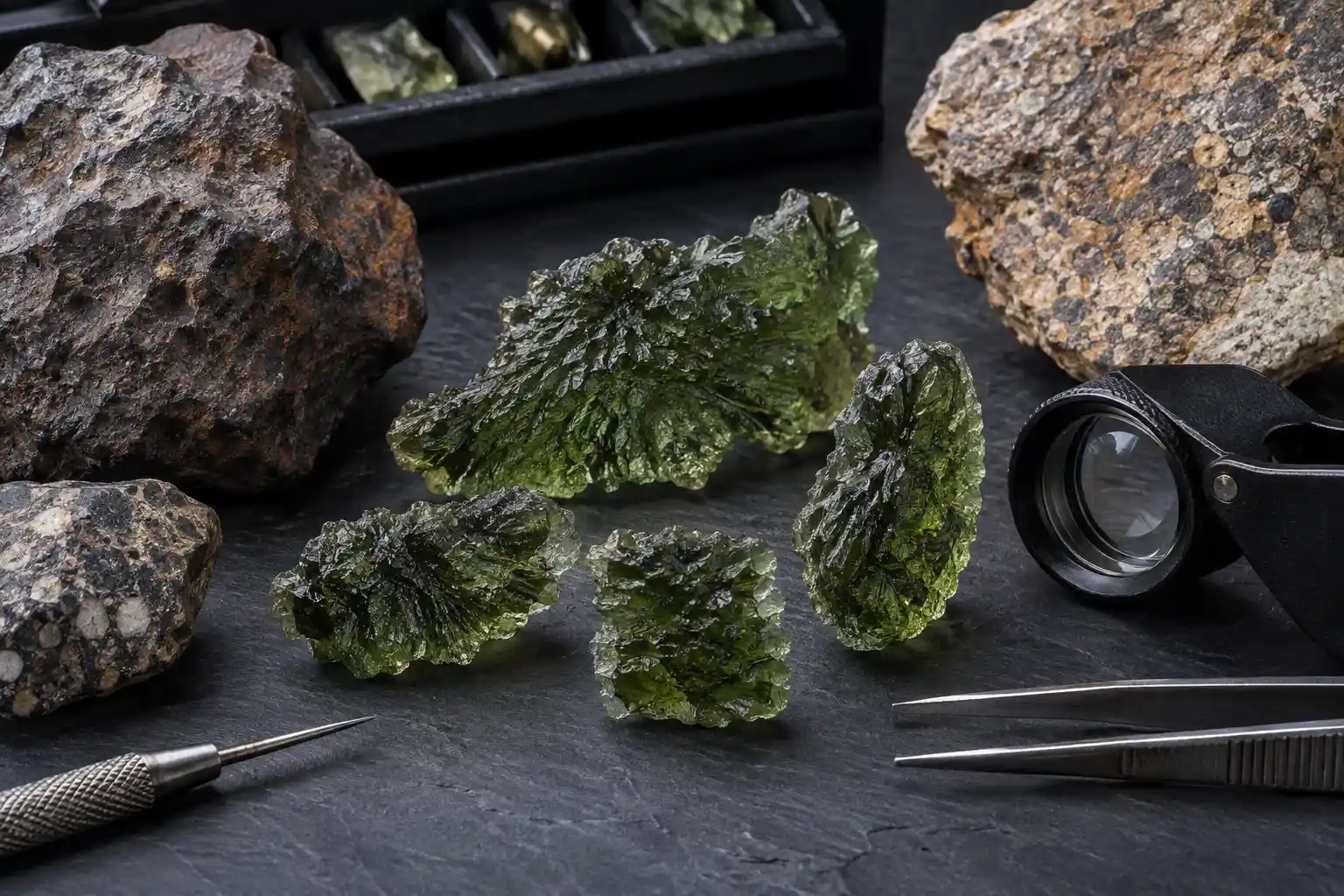
This origin makes Moldavite fundamentally different from ordinary volcanic glass such as obsidian. Obsidian forms directly from rapidly cooled lava, whereas Moldavite belongs to the tektite family, natural glasses produced during meteorite or asteroid impact events. Genuine specimens commonly appear bottle green, olive, brownish green, or yellow-green and may display etched pits, grooves, wrinkles, sculpted surfaces, bubbles, flow structures, and elongated internal features.
Modern discussions of Moldavite benefits often emphasize rapid spiritual transformation, energetic intensity, unusual sensations, or dramatic life changes. These are contemporary metaphysical interpretations rather than established physical effects of the tektite. The strongest Moldavite benefits are its exceptional impact geology, limited geographic distribution, collector significance, identifiable natural textures, lapidary potential, educational value, and ability to serve as a meaningful symbol of change without being presented as medicine.
10 Moldavite Benefits at a Glance
- Impact origin gives Moldavite exceptional geological and scientific interest.
- Limited Central European occurrence creates strong geographic and collector identity.
- Natural sculpturing and surface texture make rough specimens visually distinctive.
- Green transparent to translucent glass can produce attractive faceted gems and jewelry.
- Tektite structure provides educational value for understanding impact processes and natural glass.
- Internal bubbles and flow structures can help trained observers evaluate genuine specimens.
- Collecting encourages attention to locality, surface preservation, form, authenticity, and provenance.
- Modern symbolism can connect Moldavite with transformation, change, perspective, and important milestones.
- Meditation or reflection can use Moldavite as a symbolic focus without requiring therapeutic claims.
- Careful buying and handling protect collectors from imitations, chips, exaggerated claims, and avoidable damage.
Impact Geology Is the Most Important Moldavite Benefit
The real origin behind Moldavite benefits is more compelling than many legends attached to the stone. The Ries impact created an enormous energy release capable of melting terrestrial rock and ejecting molten droplets over substantial distances. Those droplets cooled rapidly into glass and became part of a recognizable tektite strewn field.
Chemical studies show that Moldavite derives primarily from terrestrial target rocks rather than being fragments of the meteorite itself. This distinction matters because Moldavite is sometimes marketed as if it were an extraterrestrial stone that arrived directly from space. Its connection with space comes from the cosmic impact event that formed it, while the glass itself was produced from Earth-derived substances affected by that impact.
That history makes every genuine specimen a physical record of a rare geological event. A small green tektite can therefore connect planetary geology, impact physics, atmospheric transport, erosion, sedimentation, and later human collecting within one object.
For students and collectors, this scientific story is one of the most defensible Moldavite benefits. The tektite does not need supernatural properties to be extraordinary.
Limited Geographic Distribution Gives Moldavite Collector Importance
Moldavite is strongly associated with the Czech Republic, especially regions of Bohemia and Moravia within the Central European strewn field linked to the Ries event. Geological transport and later sedimentary processes affected where specimens accumulated and how their surfaces evolved.
Collectors often care about locality because different fields can produce recognizable tendencies in color, shape, sculpturing, and surface character. Locality information also helps establish provenance and can make a specimen more scientifically useful.
Not every visually attractive green tektite should be assumed to come from a famous collecting area. Reliable records, experienced dealers, and established provenance become increasingly important when high-value specimens are involved.
The limited source area contributes to market demand but should not be interpreted as proof that every specimen is financially rare. Size, condition, surface preservation, color, transparency, shape, locality, authenticity, and current market demand all influence desirability.
Natural Surface Sculpturing Creates Distinctive Visual Appeal
Rough Moldavite can display remarkable surface features. Grooves, pits, ridges, wrinkles, channels, sharp projections, and deeply etched textures may develop as specimens interact with soil, groundwater, weathering, and chemical alteration after deposition.
These surfaces can look almost deliberately carved, yet genuine sculpturing is geological. Different specimens range from relatively smooth forms to highly textured examples with dramatic projections.
Surface preservation is especially important to collectors. A naturally sculpted specimen that has not been heavily chipped or polished may preserve information about its history after formation. Removing the original surface can make a stone attractive for jewelry but may reduce its interest as a natural collector specimen.
This creates a useful choice. Someone interested in geology may prefer untouched rough Moldavite, while another buyer may value a polished cabochon or faceted gem for wearable beauty. Neither use is inherently superior because they emphasize different Moldavite benefits.
Jewelry Use Can Highlight Moldavite’s Green Transparency
Transparent and translucent Moldavite can be cut into faceted gems, cabochons, beads, pendants, earrings, and rings. Faceting reveals the glassy transparency and internal features, while cabochons and freeform cuts can preserve more of the natural shape.
Moldavite’s hardness is commonly around 5 to 5.5 on the Mohs scale, so it is substantially softer than quartz, sapphire, or diamond. Natural glass also lacks the toughness expected from several durable crystalline gemstones. Thin edges and exposed points can chip when struck.
Pendants and earrings are therefore particularly practical. Rings can be worn, but protective settings and careful habits are sensible when the stone will be exposed to desks, doors, tools, and other hard surfaces.
Jewelry buyers should also decide whether they want a natural sculpted surface or a completely cut stone before they buy Moldavite. A rough pendant preserves more external geology, whereas a faceted gem emphasizes color, transparency, and internal optical character.
Genuine Moldavite Offers Educational Identification Features
Another important Moldavite benefit is the opportunity to learn how gemological identification works. The market contains glass imitations because Moldavite’s green color and high demand make counterfeiting commercially attractive.
Genuine specimens may contain bubbles, flow structures, elongated inclusions, irregular internal textures, and naturally etched surfaces. However, no single visible feature should be treated as a perfect authenticity test. Artificial glass can contain bubbles, and convincing imitations can reproduce superficial textures.
Experienced gemological assessment considers the combination of surface morphology, internal features, optical behavior, chemistry when necessary, provenance, and the overall consistency of the specimen.
Collectors should be particularly cautious with pieces that look unnaturally uniform, extremely glossy while supposedly being untouched rough specimens, or covered in repetitive artificial-looking grooves. Authentication becomes more important as price increases.
Collecting Moldavite Encourages Attention to Provenance
Collecting is one of the strongest practical Moldavite benefits because specimens vary greatly in shape, color, transparency, surface texture, and size. Some are flattened or drop-like, others irregular, and some preserve complex sculpturing that makes them highly distinctive.
Provenance strengthens a collection because Moldavite’s value is tied partly to its geological origin. Knowing where and when a specimen was collected, who handled it, and whether locality information has been preserved can add context that a generic retail label cannot provide.
Market value varies widely, and rarity claims should be evaluated critically. Large, intact, unusually sculpted, highly transparent, or well-documented specimens may command strong premiums, while smaller or damaged pieces can be much less expensive.
The factors behind Moldavite price are therefore more complex than weight alone. Authenticity, locality, shape, texture, color, transparency, condition, provenance, and collector demand can all contribute.
Transformation Is an Understandable Modern Moldavite Symbol
Transformation is perhaps the most familiar modern symbolic interpretation among Moldavite benefits. This theme has an intuitive geological basis because the tektite exists as a result of extreme physical transformation during an impact event.
Terrestrial rocks experienced intense energy, melting, ejection, atmospheric flight, rapid cooling, deposition, burial, weathering, and eventual recovery. A modern owner may use that sequence as a metaphor for major personal change.
Someone starting a new career may associate Moldavite with leaving an old stage behind. Another person may choose it during relocation, education, marriage, or another transition. The stone does not cause these events or guarantee positive change, but it can represent them.
This symbolic interpretation becomes stronger when it acknowledges the real impact story. Transformation is a metaphor inspired by geology rather than evidence of a force that automatically restructures someone’s life.
Meditation Can Use Moldavite Without Dramatic Energy Claims
Modern crystal communities sometimes describe Moldavite as exceptionally intense, and reports may include warmth, tingling, emotional sensations, dizziness, excitement, or what is sometimes called the “Moldavite flush.” These experiences are personal reports rather than evidence of a scientifically established energy field.
Expectation can strongly shape subjective sensations, especially when a person has been told in advance that a particular object should feel unusually powerful. Environmental temperature, anxiety, excitement, attention, posture, breathing, and normal physiological variation can also affect what someone notices.
A person can still use Moldavite during meditation or journaling. Its extraordinary impact history can make it a strong visual reminder of change, time, perspective, or adaptation.
Beliefs discussed under Moldavite healing properties should therefore remain separate from medical claims. A meditation object does not become a treatment for anxiety, depression, trauma, neurological illness, pain, sleep problems, or other health conditions.
Moldavite Has a Cosmic Connection Without Being a Meteorite Fragment
One of the most attractive Moldavite benefits is its genuine connection with an extraterrestrial impact. That connection should be described accurately because misleading marketing sometimes goes much further.
Moldavite is not ordinarily described as a fragment of the projectile that struck Earth. It is impact glass formed mainly from terrestrial substances melted and ejected during the event.
This makes the story no less remarkable. The tektite exists because an object from space collided with Earth with sufficient energy to transform surface rocks into flying melt.
Someone interested in astronomy, planetary geology, meteorites, or impact structures may therefore find Moldavite especially meaningful. Cosmic symbolism can represent perspective, discovery, or humanity’s place within planetary processes without claiming that the jewelry itself traveled through interplanetary space before impact.
Safe Handling Protects Moldavite and the Owner’s Investment
Moldavite’s natural glass structure means sensible care is important. Rough pieces with pointed sculpturing can chip, while cut gems can scratch more readily than harder stones.
Cleaning is generally straightforward for uncomplicated pieces. Mild soap, lukewarm water, and a soft cloth are preferable to harsh abrasives. Jewelry with adhesives, coatings, delicate settings, or additional stones may require different care.
Storage should prevent Moldavite from rubbing against harder gemstones. Quartz, sapphire, ruby, and diamond can scratch the glass, so individual pouches or lined compartments are useful.
Heat and strong thermal shock are also unnecessary risks. Treating the stone as a collectible natural glass rather than an indestructible object helps preserve surface details and polish.
What Moldavite Benefits Do Not Include
Moldavite benefits do not include scientifically established treatment for physical or mental-health conditions. There is no credible evidence that wearing or holding the tektite cures disease, regulates hormones, treats anxiety or depression, removes toxins, improves fertility, alters DNA, strengthens immunity, or changes neurological function.
Claims that Moldavite automatically causes dramatic life events are also not supported scientifically. People can make substantial decisions while using a meaningful object, but the object should not be treated as controlling external events.
The tektite’s genuine value is already considerable. It preserves evidence of an ancient impact event, displays unusual natural glass textures, supports geological education, provides collector interest, and can carry powerful personal symbolism.
Conclusion
Moldavite benefits come first from genuine impact geology. Its formation during the Ries event, Central European distribution, unusual green glass, natural sculpturing, internal structures, collector appeal, and jewelry potential make it one of the most distinctive natural glasses used as a gem.
Modern symbolism involving transformation, perspective, change, and spiritual reflection can add personal significance, but extraordinary claims require evidence. Moldavite is best appreciated as both a remarkable tektite and a meaningful object without treating subjective experiences as medical effects.
FAQs
What are the main Moldavite benefits?
The strongest Moldavite benefits include exceptional impact geology, collector value, limited geographic origin, unusual surface sculpturing, attractive green color, jewelry use, and educational value as a natural tektite. Modern spiritual traditions also associate Moldavite with transformation and major personal change, but these themes are symbolic rather than scientifically demonstrated forces.
Is Moldavite a meteorite?
No. Moldavite is a tektite, a natural impact glass linked to the Ries impact event. The glass formed mainly from terrestrial surface substances that were melted and ejected during the impact rather than being ordinary fragments of the meteorite or asteroid itself. Its cosmic connection is therefore genuine but more scientifically precise than calling it a meteorite.
Why is Moldavite green?
Moldavite commonly appears bottle green, olive, brownish green, or yellow-green because of its glass chemistry, oxidation state of iron, trace components, thickness, and optical transmission. Color varies from specimen to specimen. Very bright or unusual shades should be evaluated together with other authenticity characteristics rather than used alone to judge whether a piece is genuine.
Is Moldavite rare?
Moldavite has a geographically limited distribution and genuine specimens are finite, giving it stronger scarcity than common forms of glass. Rarity still varies by specimen. Large, intact, unusually sculpted, highly transparent, locality-documented pieces can be much harder to obtain than small or damaged fragments.
Why does genuine Moldavite have rough surface textures?
Natural weathering and chemical etching after deposition can sculpt Moldavite into pits, grooves, ridges, wrinkles, and other complex surface forms. The exact appearance depends on geological history and preservation. Artificially textured glass can imitate some features, so surface roughness by itself is not proof of authenticity.
Is Moldavite safe for jewelry?
Yes, when handled sensibly. Moldavite has moderate hardness and can chip or scratch more readily than harder gemstones such as quartz or sapphire. Pendants and earrings are relatively protected, while frequently worn rings benefit from secure settings and greater care.
Does Moldavite really cause a physical “flush”?
Some people report warmth, tingling, excitement, dizziness, or other sensations while handling Moldavite, but these experiences are subjective and do not establish a unique physical energy emitted by the glass. Expectation, attention, emotion, temperature, breathing, and ordinary physiological responses can influence sensation. Persistent or concerning physical symptoms should not be attributed automatically to a gemstone.
Can Moldavite cause major life changes?
There is no scientific evidence that Moldavite controls external events or automatically causes relationships, jobs, circumstances, or identities to change. The stone can serve as a powerful symbol of transformation, and someone may make decisions while using it during reflection. Those decisions remain human actions rather than demonstrated effects of the tektite.
How should Moldavite be cleaned?
Mild soap, lukewarm water, and a soft cloth are generally appropriate for uncomplicated Moldavite pieces. Abrasive powders and rough handling should be avoided because the natural glass can scratch or chip. Special care is appropriate for jewelry containing delicate settings, adhesives, coatings, or additional gemstones.
Are Moldavite healing benefits scientifically proven?
No. Moldavite has not been shown to diagnose, treat, cure, or prevent disease or mental-health conditions. Modern claims concerning emotional healing, energy activation, detoxification, DNA changes, chakra effects, or physical treatment belong to metaphysical belief traditions rather than established medicine.
Moldavite benefits involving healing energy, dramatic transformation, chakras, or physical sensations reflect modern spiritual and personal interpretations and should not replace qualified physical or mental-health care.